
Quick wins for a faster PC:
Scan for outdated or missing drivers - takes under a minuteDriver Scan →Clear out junk files and repair common Windows errorsFree Scan →Fix the driver behind crashes, sound loss and screen glitchesFind Drivers →Some links on this page are affiliate links: if you buy through them we may earn a commission, at no extra cost to you.
The best first week for a newly adopted dog is calm, predictable and choice-based. Prepare one quiet, dog-proof retreat; keep meals, toilet breaks, rest and gentle enrichment on a steady rhythm; and let the dog decide when to approach. Skip parties, crowded outings, forced cuddling and rushed introductions. Use gates, doors and separate resources around children and resident pets, watch for stress signals, and arrange a veterinary appointment within the first week or two with the shelter or foster records.
Some dogs begin exploring after a few days; others need several weeks before they eat normally, seek contact or show their usual personality. Your job is not to make the dog sociable immediately. It is to make the new environment safe enough that confidence can develop at the dog’s pace.

As an Amazon Associate I earn from qualifying purchases.
What should I do before picking up my adopted dog?
Preparation prevents avoidable scares and gives the dog somewhere to recover when the household feels too busy. Complete the setup before pickup so you can concentrate on observation rather than searching for supplies.
Dog-proof the areas the dog can reach
Secure medicines, cleaning chemicals, batteries, electrical cords, toxic foods, poisonous plants, breakable objects and anything small enough to swallow. Check doors, fences and gates for escape routes. Close rooms that will be off limits initially, and remove items you would not want chewed or carried away.
Popular on Amazon
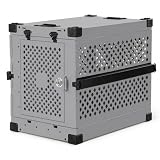
- Set Up In 60 Seconds - Set up is nearly instantaneous in less than one minute, no tools required, and when you're done, it collapses for easy stowage! It's truly never been easier.
- One-Handed Operation - Often dog crates can be difficult to open and close. With the Impact Collapsible Dog Crate you are able to use one hand to easily open and close your Impact Dog Crate.
- Stackable Like Sizes - Their design allows you to stack similar sizes on top of each other to make the most of whatever space you’re working with. Talk about an innovative way to help save room.
- Military Grade Handles - These military grade handles allow for not only easy portability but also for a strength that can take on the toughest of scenarios.
- Ventilated For Optimal Airflow - With its rounded diamond shaped air holes, it provides plenty of ventilation for your pup, making it comfortable and safe to use.
Create one quiet retreat
Choose a low-traffic room or corner away from the television, entrance door and children’s play area. Put down a washable bed or blanket, fresh water, safe toys or chews and any enrichment item you can supervise. A familiar blanket from the shelter, foster home or previous home may make the transition easier.
A crate can sit inside the retreat if the dog is already comfortable with crates. Otherwise, a gated, dog-proof room or exercise pen is just as legitimate. The space must remain available whenever the dog wants to withdraw; it is not a place to send the dog as punishment.
Agree on household rules
Decide before arrival who will handle meals, toilet trips, exercise, rest, training and play. Agree where the dog will sleep, which rooms are initially closed, whether furniture is allowed and how children will behave. Consistent responses reduce the confusion that comes from different people using different rules.
Gather transition supplies
- The food used by the shelter or foster home, if possible
- Food and water bowls
- A collar or harness, leash and current identification tag
- Bedding, age-appropriate toys and safe chews
- A pet gate or exercise pen
- A correctly sized crate only if you plan to use one positively
Ask the adoption organization what food, medicines, parasite treatments, vaccines and behavior observations are documented. Bring those records to your veterinarian.
What should I do when my dog arrives and on the first night?
Make the first day deliberately uneventful. A simple arrival sequence gives the dog a chance to toilet, sniff and retreat without being passed from person to person.
- Go straight to the toilet area. Take the dog there before entering the house. Give time to sniff and eliminate without scolding or excited play.
- Enter on leash. Walk calmly to the prepared area and allow the dog to investigate at their own pace. Keep resident animals behind a closed door or gate during this first tour.
- Offer the retreat. Show the bed, water and safe items, then give the dog control over whether to stay there or explore farther.
- Keep people quiet. Do not invite a welcoming crowd, insist on hugs or take an unnecessary trip to a busy pet store, dog park or other stimulating place.
- Feed privately. Offer the familiar diet, if available, away from children and other animals. Give the dog space around the bowl and remove pressure to eat on a schedule that feels frightening.
- Repeat calm toilet opportunities. Take the dog out after sleep, meals and periods of activity, while following the routine used by the shelter or foster home when you know it.
- Use the same sleep arrangement. Settle the dog in the chosen room, crate or gated area and keep the first night’s lighting, noise and access predictable.
Hiding, withdrawing, having an accident or eating very little can occur during the first days. Stay neutral, clean accidents without punishment and look for patterns rather than demanding interaction. If the dog retreats, let them; a voluntary approach is more useful than a forced greeting.
Also popular on Amazon

- Impact Dog Crate's Best Warranty - Backed by Impact Dog Crate's 10-Year manufacturer dog damage warranty.
- Zinc Steel Paddle Latch - Zinc-plated steel paddle latch which provides a robust mechanism for added security against the toughest escape attempts. This latch mechanism is designed to withstand high-stress forces.
- Four Additional Butterfly Latches - It features four additional butterfly latches, providing maximum strength and security. These latches are easy to operate and provide an added level of protection.
What does a practical first-week routine look like?
Predictability matters more than a perfect timetable. Adjust the rhythm for the dog’s age, health, energy and previous routine, and keep activities short enough that the dog can recover between them.
| Part of day | Low-pressure plan |
|---|---|
| Morning | Quiet toilet break, breakfast, uninterrupted rest, then a short sniff-focused walk or calm yard period if the dog is comfortable. |
| Daytime | Repeat toilet opportunities, provide naps and calm enrichment in the retreat, and offer very brief reward-based practice such as responding to the name or settling on a mat. |
| Evening | Serve the predictable meal, provide a toilet break, allow dog-chosen interaction and return to the same sleep setup. |
Days one and two: reduce demands
Keep the dog’s world small: the retreat, toilet area and one or two safe rooms. Let sniffing, resting and watching household activity count as enrichment. Avoid testing commands, inviting visitors or adding long walks simply because the dog seems quiet.
Days three and four: observe, do not accelerate
Some dogs begin to eat more reliably or approach family members. Respond with soft praise and a treat rather than reaching over the head or increasing handling. If the dog remains withdrawn, continue the same routine; a slower pace is not failure.
Days five through seven: add only one small change at a time
If the dog is relaxed in the current space, you can allow access to another dog-proof room, add a short sniffing route or practice one simple behavior for less than 10 minutes. AAHA guidance favors brief sessions and positive reinforcement. If stress appears after a change, return to the last comfortable arrangement.
What’s actually slowing this PC down?
Pick the symptom - the matching free tool is one click away.
Choose enrichment that supports calm behavior
Use items that are safe for the dog’s size and chewing style and supervise new toys or chews. Sniffing, licking and food-search activities can provide natural, quiet engagement. Remove anything that splinters, breaks into swallowable pieces or causes guarding around people or animals.
How long does it take an adopted dog to decompress?
There is no universal deadline. The ASPCA’s 3-3-3 framework is a loose planning aid: the first three days may be overwhelming, the following three weeks often bring more decompression and basic learning, and the first three months can include continuing adjustment and bonding. Wisconsin Humane Society notes that decompression may take several days to a few weeks and varies by individual dog.
Also popular on Amazon

- 【SAFE & SECURE CONSTRUCTION】This portable dog kennel is with protected seams and reinforced corners ensure your pet's safety. Made from durable quality & water-resistant materials makes it a great crate for small and medium dogs/cat/rabbit.
- 【THREE DOORS DESIGN】The dog cage features 3 high-density mesh windows for convenient access and be more ventilate.Double Zipper avoids pet’s escaping. Removable pad is comfortable and washable.
- 【DIMENSION】24.0"L×16.0"W×19.0"H: For extra small pets & small cats. 28"Lx18"Wx22"H,would fit 1-2 cats.ATTENTION:JUST fit small dog like Standard Poodle,Schnauzer OR SMALLER PET. 32"Lx21"Wx26"H,would fit Medium Pet like Boxer/Bulldog/Chihuahua/ French Bulldog. 36.0"L×23.0"W×28.0"H: For medium to large pets. Please compare it's size with the kennel and choose the right size.
- 【EASY TO FOLD AND UNFOLD】The sturdy and flexible steel wire makes sets up in seconds and requires no assembly, folds flat when not in use for easy carrying and storing. Warping occurs sometimes. Easy to get back to normal.
- 【OCCASIONS】This pop up dog kennel is ideal for indoor and outdoor use. Great as a car crate or travel kennel for camping and day trips.
Treat the framework as permission to go slowly, not as a promise that every dog will follow those intervals. A dog with a history of kennel stress, limited social experience, illness or repeated moves may need longer. Progress can look like sleeping more deeply, eating steadily, choosing to leave the retreat, recovering faster after a noise or accepting a treat in your presence.
Should I use a crate or a gated room?
Choose the option in which the dog can relax and retreat voluntarily. A crate can be useful for a dog who already finds it comfortable, while a gated dog-proof room is better for a dog who becomes distressed when confined in a crate.
The Tool Desk
Outbyte PC Repair FREERepair Windows errors before they cause bigger problemsFix Now →Outbyte Driver Updater FREEFix the driver behind crashes, sound loss and screen glitchesFind Drivers →| Option | Use it when | Essential safeguards |
|---|---|---|
| Crate | The dog is comfortable entering it and can rest there. | Use the correct size, introduce it with food and other positive associations, supervise initially and reserve it for short or necessary periods. Never use it as punishment. |
| Gated room or exercise pen | The dog needs more space or shows distress in a crate. | Dog-proof the area, provide water and bedding, keep an escape-free gate and preserve a quiet corner where the dog can be undisturbed. |
Do not force a frightened dog into a crate or shut the door to stop vocalizing without assessing the cause. If confinement distress continues, use the safer room arrangement and ask a qualified humane trainer for a gradual plan.
How should I handle children and visitors?
Keep visitors to a minimum during the first days. Ask anyone who enters to sit quietly, avoid reaching toward the dog and allow the dog to approach. End the interaction when the dog moves away, hides or returns to the retreat.
Children and dogs require active supervision, not just a child’s promise to be gentle. Teach children to let the dog sleep and eat undisturbed, avoid hugging or climbing, keep hands away from the bowl and stop when the dog turns away. The dog must always have a child-free retreat behind a gate or closed door.
Do not interpret a quiet dog as an invitation to handle them. Fear can temporarily suppress movement, and a dog may react defensively when pressure builds. Calm observation now protects the relationship later.
Recommended Free Tools
Also popular on Amazon

- 24" Stylish Snap-Connect White Wire Dog Crate: Modern look that blends with home décor—compact indoor small dog crate for apartments and bedrooms
- Two-Door Access (Slide + Top-Opening): Front sliding door for easy in/out; lift-up lid for feeding, cleaning, and quick checks. Remove the top to use as an open puppy crate playpen
- Inset Grid & Lift-to-Slide Tray: In this metal dog crate, the removable metal floor grid sits slightly below the threshold to help prevent prying or slip-outs, while the plastic tray rides on dual anti-slide rails—lift slightly, then slide out for fast cleaning.
- 4 Locking Swivel Casters: Roll the dog crate with wheels for cleaning or re-layout, then lock all four wheels to park securely
- Stackable, Space-Saving Setup: Same-size units (black ↔ black or black ↔ white) stack vertically to free floor space—this 2026 stackable dog crate ideal for multi-pet homes, breeders, groomers, and small clinics
How do I introduce my adopted dog to a resident dog?
Start with separation and scent familiarity instead of face-to-face contact in the home. Swap bedding or allow each dog to investigate the other’s scent through a barrier, then progress to a neutral outdoor area when both can remain loose and responsive.
- Keep both dogs on loose leashes with enough distance to stay below their stress threshold.
- Walk in the same direction, rewarding calm glances and relaxed movement.
- Allow a brief interaction only when body language stays loose, then separate for a break.
- Repeat short, positive sessions and increase shared time gradually.
- Feed, sleep and rest dogs separately until you are confident there is no conflict over resources.
Move back to an earlier stage if either dog stiffens, avoids, growls, lunges or cannot disengage. Never leave a newly introduced pair together unsupervised during the first week.
How do I introduce my adopted dog to a cat?
Use doors and gates to create separate zones, and give the cat elevated escape routes that the dog cannot reach. Begin with scent exchange and visual access through a barrier. Keep sessions short, end while both animals are calm and provide the cat with food, litter and resting places that the dog cannot block.
Do not carry the cat toward the dog or allow chasing as a way to “work it out.” The more cautious animal sets the pace. If either pet shows persistent fear, hiding, staring, stalking or frantic movement, increase distance and return to barrier-only contact.
What signs show that my dog is stressed?
RSPCA Western Australia identifies several common stress signals:
- Lip licking when no food is present
- Yawning when the dog is not tired
- Excessive panting
- Frequent blinking
- A tense body or rigid posture
- Ears pinned back
- A low or tucked tail
- Avoiding people or moving away
When you notice these signs, stop the interaction, increase distance, lower noise and offer the retreat. Look at the whole pattern rather than one isolated yawn; pain, heat and tiredness can have different explanations. A dog that repeatedly signals discomfort is asking for less pressure, not more encouragement.
Also popular on Amazon
When should I arrange veterinary and professional help?
AAHA advises a veterinary visit within one week, and ASPCA recommends establishing care shortly after adoption. Bring every shelter or foster record and ask the veterinarian to review the dog’s medical history, vaccinations and boosters, parasite prevention, microchip, sterilization status and life-stage plan. The appropriate schedule depends on age, health, location and documented treatments, so do not apply a generic calendar without veterinary advice.
Contact the adoption organization, veterinarian or a qualified humane trainer if fear, aggression, appetite concerns or interaction problems persist or worry you. Early guidance can prevent a manageable transition problem from becoming a rehearsed pattern. Trainer-certification routes named by AAHA include the Certification Council for Professional Dog Trainers, the Pet Professional Guild and the International Association of Animal Behavior Consultants; verify the individual’s methods and credentials before booking.
Do these 3 things before closing this tab:
1Fix the driver behind crashes, sound loss and screen glitches2Repair Windows errors before they cause bigger problems3Scan for outdated or missing drivers - takes under a minuteEmma Judson, a dog behavior consultant and co-author of Dog Training and Behaviour Solutions, told AAHA: “The dog already is dependent on them, entirely, wholly, completely.” That dependence is why calm routines, safe choices and patient supervision matter more than making the first week look impressive.
Frequently Asked Questions
Why is my newly adopted dog not eating on the first day?
A new home, unfamiliar sounds and pressure around the bowl can suppress appetite temporarily. Offer the familiar food in a quiet location, keep water available and avoid repeated coaxing; record what the dog eats and contact the veterinarian if reduced appetite continues or concerns you.
When can I start changing my dog’s food?
Keep the shelter or foster diet during the transition when it suits the dog. If a change is needed, ask the veterinarian about a gradual switch rather than replacing the food abruptly, which can contribute to digestive upset.
How soon can I invite people to meet my rescue dog?
Wait until the dog is resting, eating and exploring the current space without obvious stress. Start with one calm visitor who sits quietly and lets the dog choose whether to approach, rather than scheduling several introductions at once.
PC Slower Than It Used to Be?
A free scan shows the junk files, broken settings and background clutter dragging Windows down - then fixes them in one click.Free scan · Windows 10 & 11Outdated Drivers Are Slowing You Down
One free scan finds every outdated or missing driver and matches the right update for your exact hardware.Free scan · exact hardware matchWhat should I do if my dog growls at a family member?
Treat the growl as information that the dog needs more distance. Stop the interaction, move the person away, provide the retreat and avoid punishment; then contact the adoption organization, veterinarian or a qualified behavior professional for an individualized safety plan.
How do I find a humane trainer for a newly adopted dog?
Ask your veterinarian or adoption organization for referrals and check credentials through established professional groups such as CCPDT, the Pet Professional Guild or IAABC. Choose someone who explains reward-based methods, management and realistic timelines rather than promising a rapid personality change.





Leave a Reply