
PC Slower Than It Used to Be?
A free scan shows the junk files, broken settings and background clutter dragging Windows down - then fixes them in one click.Free scan · Windows 10 & 11Outdated Drivers Are Slowing You Down
One free scan finds every outdated or missing driver and matches the right update for your exact hardware.Free scan · exact hardware matchSome links on this page are affiliate links: if you buy through them we may earn a commission, at no extra cost to you.
Music can be a useful enrichment or calming aid for some cats, but it is not universally soothing. The safest approach is cat-led: begin only when your cat is already calm, play a steady recording at a very low volume, leave an escape route and hiding place, and stop at the first sign of distress. Cat-specific music is a sensible first trial because one veterinary-clinic study found better behavioral stress scores than silence or classical music. However, a separate 35-cat hospitalization study found no overall stress-score advantage, so silence may be the best choice for an individual cat.
Can music actually calm a cat?
Sometimes, but the effect depends on the cat, the recording, the volume and the situation. Music should be treated as an optional environmental change rather than a treatment for anxiety. A cat that is already frightened may find any new sound stressful.


As an Amazon Associate I earn from qualifying purchases.
Free tools Windows power users keep installed
One-click scans. No signup required.
What the veterinary-clinic study found
The strongest direct evidence comes from a veterinary-clinic experiment that compared silence, classical music and cat-specific music during auditory exposure and a physical examination. Cats hearing cat-specific music had significantly lower Cat Stress Scores after the exposure and during the examination than cats hearing either silence or classical music. Their handling scores were also lower.
That result is encouraging for short, stressful handling situations, but it has a precise limit. The study found no difference in neutrophil-to-lymphocyte ratios, a physiological stress marker. Lower behavioral scores therefore should not be described as proof that every aspect of the cats’ stress response was reduced.
Popular on Amazon
What the hospitalization study found
A randomized study by Juliane Eg Paz and colleagues in 2022 followed 35 hospitalized cats for 31 hours. Across five evaluations, there was no overall Cat Stress Score difference between cat-specific music, classical music and no music.
There were narrower findings: cat-specific music was associated with a higher percentage of positive social interactions at the first evaluation, while classical music was associated with a lower respiratory rate than the no-music control at the fourth evaluation. Those isolated results do not establish a universal winner.
What those findings mean at home
Cat-specific music is a reasonable first experiment, especially in a quiet room or during a brief, predictable activity. Your cat may instead prefer classical music, another gentle recording or complete silence. The only reliable decision rule is the cat’s observed response over repeated, low-pressure trials.
Guidance from the International Society of Feline Medicine and the American Association of Feline Practitioners emphasizes minimizing noise. It notes that classical or cat-specific music may help create a more relaxed environment, not that either genre works for every cat.
What kind of music is most appropriate for a cat?
Start with a recording designed around feline hearing and communication, then compare it with a quiet classical selection only if your cat remains comfortable. Genre matters less than stable sound, low intensity and the ability to leave.
Cat-specific music
Cat-specific compositions use frequencies, tempos and sound qualities intended to relate to cats’ vocal ranges and communication. Cats Protection describes David Teie’s Scooter Bere’s Aria as including purr- and suckling-like sounds and frequencies similar to those in cat vocalizations. VCA describes the category in similar terms while noting that evidence for human-oriented genres is mixed.
These recordings are not guaranteed to calm a cat. Some animals may find the unfamiliar vocal-like sounds interesting, while others may ignore them or move away. Treat the label as a reason to test a track, not as a promise.
Classical music
Classical music is familiar to people, but that does not make it reliably calming to cats. In the clinic study, it did not perform as well as cat-specific music on behavioral stress scores. In the hospitalization study, it produced a lower respiratory rate than control at one evaluation, yet it did not produce an overall Cat Stress Score advantage.
Also popular on Amazon

- Music for Calming combines sound and music therapy techniques to lessen feline anxiety and enhance environmental enrichment
- This box set includes 3-hours of specialized, simplified classical piano music
- Music for Calming makes use of sonic anchoring and frequency modulation for consistency and resonance with feline nervous systems
- Recommended during the following: car rides, visitors, loud noises, new baby or pet, stressed people, illness & recovery, poor elimination behaviors, and final stages of life
If you try classical music, choose a quiet recording without sudden crescendos, heavy bass or abrupt track changes. A cat’s response to the acoustic pattern is more important than the composer or playlist label.
Silence
Silence is an active choice, not a failure. The hospitalization study found no overall stress-score difference among the three sound conditions, and a cat that leaves when music starts is communicating a preference. Keep a quiet option available whenever you test audio.
| Option | What the evidence shows | How to use it |
|---|---|---|
| Cat-specific music | Lower behavioral stress and handling scores than silence or classical music in a veterinary-clinic study; no overall advantage in a 35-cat, 31-hour hospitalization study | Reasonable first trial at very low volume, with the cat free to leave |
| Classical music | No clinic advantage over silence; lower respiratory rate than control at one evaluation in the hospitalization study | Use only a quiet, steady selection and judge by the individual cat |
| No music | Served as a comparison condition; some cats may prefer it | Keep the room quiet if the cat shows stress or indifference to recordings |
How loud should music be for a cat?
Begin much quieter than ordinary listening volume. A 2025 review recommends a conservative ceiling below 85 dB and ideally no higher than 65 dB for veterinary interventions. Those figures are upper-limit guidance, not targets for a living room. Start at the lowest stable setting at which you can hear the recording and increase only if the cat remains relaxed over repeated trials.
Avoid sudden starts, strong bass, dramatic dynamic changes and automatic volume normalization that jumps between tracks. Put the speaker far enough away that the cat can move away from it. Never use headphones or place a speaker beside a bed, carrier or hiding box where the cat cannot create distance.
Volume is only one part of intensity. A quiet track with abrupt bangs can be more startling than a slightly louder, steady one. Keep the environment predictable: close doors gently, silence notification sounds and prevent another device from interrupting the trial.
How do I introduce music step by step?
Use short, supervised trials. The goal is not to make a cat approach a speaker; it is to discover whether the sound can coexist with relaxed behavior.
What’s actually slowing this PC down?
Pick the symptom - the matching free tool is one click away.
1. Choose a calm starting moment
Wait until your cat is settled and not already frightened, highly aroused or struggling with handling. Cats Protection warns that music can add stress when a cat is in that state. Do not make the first trial during a thunderstorm, a forced carrier session or an active conflict with another animal.
2. Prepare an exit and a refuge
Leave a door or room route accessible and provide a covered bed, cardboard box or other quiet hiding place. Your cat must be able to increase distance without squeezing past the speaker or a person. A box with a blanket is specifically recommended by Cats Protection’s clinical animal behaviourist Daniel Warren-Cummings.
Also popular on Amazon
3. Place the speaker at a distance
Set the speaker on a stable surface away from the hiding area, food and normal resting spot. Do not place it inside a carrier or beside the cat’s head. The cat should be able to investigate, ignore or leave the sound without being followed.
4. Start the recording very quietly
Use one steady track rather than a playlist with unpredictable transitions. Keep bass and treble restrained, and disable alerts on the playback device. Let the track begin before you invite the cat into the room; a sudden start beside the cat can create a startle response.
5. Observe without coaxing
Watch from a distance and do not call the cat toward the speaker, pick it up or block its route. Relaxed behavior, normal activity, voluntary proximity or simple indifference are acceptable responses. A cat does not need to look at the speaker for the trial to be successful.
6. Repeat short trials before changing anything
If the cat remains comfortable, repeat the same low-volume setup on another calm occasion. Changing the recording, room and volume simultaneously makes it impossible to tell what caused a reaction. Keep early sessions brief enough that you can stop while the cat is still settled.
7. Increase volume only in small steps
After repeated relaxed trials, raise the volume slightly, never to a level that competes with conversation or fills the entire home. Hold that setting for another trial. If the cat becomes tense, return to the previous level or stop rather than trying to acclimatize through distress.
8. Stop at the first clear stress signal
Startling, flattened or tense body language, hiding, agitation or leaving are reasons to stop the music and restore quiet. Do not restart immediately to see whether the reaction passes. Give the cat time and space to settle.
9. Re-test only if there is a useful reason
Later, you can try a different recording, a lower volume or a different room. There is no requirement to make your cat like music. If several careful trials produce avoidance, choose silence instead.
How can I tell whether my cat is relaxed or stressed?
Use behavior, not your own opinion of the music. The useful question is whether the cat’s behavior changes after the sound begins and returns to normal when it stops.
Also popular on Amazon
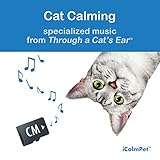
- Compatible with iCalmCat speakers 2.0 - 5.0 and most Micro SD-enabled devices
- Want a Calm cat? BioAcoustically re-arranged classical piano for the feline nervous system combines music and sound therapy techniques for feline anxiety issues and environmental enrichment
- 3-hours of frequency-modulated classical piano music helps reduce stress in chaotic or unsettling environments bringing the constancy needed for positive health and behavior
- A Fear Free Happy Homes Preferred Product, our specialized music and training protocols are recommended by veterinarian and dog trainers worldwide since 2008
- Includes training protocols and instructions for calming cats
- Signs that the trial may be acceptable: relaxed posture, normal activity, voluntary proximity or no noticeable change.
- Signs to stop: a startle, flattened or tense body language, hiding, agitation or leaving the area.
- Signs that the setup is too intense: the cat repeatedly increases distance, cannot settle while the track plays or reacts whenever the recording changes.
Do not interpret stillness by itself as calm. A cat that remains motionless but tense may be coping rather than enjoying the sound. Compare the cat’s posture and activity with the same room during silence.
What should I do if music stresses my cat?
Turn the recording off, reduce other noise and leave the cat’s hiding place and escape route unobstructed. Avoid reaching into the refuge, carrying the cat out or offering repeated tests while it is still unsettled.
Quick wins for a faster PC:
Fix the driver behind crashes, sound loss and screen glitchesFind Drivers →Repair Windows errors before they cause bigger problemsFix Now →Once normal behavior returns, decide which variable to change: use no music, lower the volume, move the speaker farther away or select a steadier recording. Change one variable at a time. If the cat reacts to every attempt, stop experimenting and maintain a quiet environment.
Music should never replace veterinary advice for persistent fear, aggression, appetite changes or other signs of illness. A clinic study cannot tell you whether audio is appropriate for a particular medical condition or medication plan.
Where can music fit into a cat’s routine?
Use it for a specific, supervised purpose rather than leaving it on continuously by default. A brief trial in a quiet room can show whether a cat tolerates the sound before you consider using it around a predictable event.
During a short home activity
Begin when the cat is already settled, keep the door and hiding place available, and end the track before the cat becomes restless. Repeating the same calm routine can make the sound more predictable, but only if the cat consistently remains comfortable.
The Tool Desk
Outbyte PC Repair FREERepair Windows errors before they cause bigger problemsFix Now →Outbyte Driver Updater FREEFix the driver behind crashes, sound loss and screen glitchesFind Drivers →Around transport or veterinary visits
The clinic evidence concerns auditory exposure and examination, not a guarantee for car travel or every appointment. If you plan to use music near a carrier, test it days beforehand in an open room. Never trap a cat with a new recording inside a closed carrier for the first trial.
For a hospitalized cat
The 31-hour hospitalization study found mixed results and no overall stress-score difference. A hospital should therefore follow its own noise and welfare protocols and allow the cat to experience quiet. Family members should not assume that sending a playlist will help without asking the veterinary team.
Also popular on Amazon
What should I look for when choosing a recording or speaker?
Choose the simplest setup that lets you control volume and stop instantly. A cat-specific music CD or digital recording can be a practical format, but the medium does not matter as much as predictable playback and the cat’s response.
- Stable playback: one track or a playlist without loud advertisements, spoken introductions or abrupt transitions.
- Fine volume control: a device that can start at a very low level and change in small increments.
- Reliable stop control: you should be able to silence it immediately without approaching the cat.
- Safe placement: a stable surface away from water, edges and the cat’s refuge.
- Quiet surroundings: do not layer the recording over television, vacuuming or other unpredictable noise during the test.
Do not buy a recording solely because it claims to calm every cat. The named composition Scooter Bere’s Aria is one example of cat-specific music, but availability and format vary by region. Treat any product as an audio option, then apply the same low-volume, cat-led protocol.
Do these 3 things before closing this tab:
1Repair Windows errors before they cause bigger problems2Scan for outdated or missing drivers - takes under a minute3Clear out junk files and repair common Windows errorsWhat common mistakes make music more stressful?
- Starting during fear: a frightened cat needs control and quiet before a new sound is introduced.
- Turning it up to test a reaction: loudness can create a stress response that tells you nothing about the recording at a safer level.
- Blocking the exit: removing the ability to leave prevents the cat from regulating distance.
- Forcing proximity: carrying a cat toward a speaker or keeping it beside one turns an optional sound into restraint.
- Changing several variables at once: a new room, track and volume make the result impossible to interpret.
- Assuming silence means failure: some cats show their best welfare response when the environment stays quiet.
- Equating one study with certainty: short examination findings and mixed hospitalization findings do not establish a universal effect.
How should I decide whether to keep using music?
Keep a recording only when your cat repeatedly tolerates it without stress signals and you have a clear reason to use it. A simple decision framework helps:
- Comfort: Did the cat remain relaxed or indifferent throughout several low-volume trials?
- Control: Could the cat leave and hide whenever it wanted?
- Consistency: Was the response similar across more than one calm occasion?
- Purpose: Does the sound improve a specific situation, or is it merely adding noise?
- Reversibility: Can you stop immediately and return the room to quiet?
If any answer is no, silence is the safer default. If all answers are yes, continue at the lowest comfortable volume and reassess whenever the cat’s circumstances change.
What is the practical conclusion?
Introduce music as a voluntary environmental choice, not a training exercise. Cat-specific music deserves the first trial because of its favorable short veterinary-clinic results, but the hospitalization evidence is mixed and does not justify a promise. Keep the volume low, avoid abrupt changes, provide a hiding place and escape route, observe quietly, and let the cat’s behavior determine whether music stays or goes.
Frequently Asked Questions
Can I leave music playing for my cat while I am away?
Only after supervised trials show that the cat consistently remains comfortable with that exact recording and volume. If you have not observed the response, leave the environment quiet rather than introducing an unattended sound source.
Recommended Free Tools
Is a cat-specific music track better than a purring recording?
The evidence described here concerns cat-specific compositions as a category, including tracks using purr- and suckling-like sounds; it does not establish that one sound component is superior. Compare any recording by the cat’s behavior, not by the presence of a particular sound.
Should kittens and older cats be introduced to music differently?
The available studies do not establish separate volume or genre rules by age. Use the same low-pressure method, provide an escape route, and be especially conservative if a cat has hearing, neurological or medical problems that could make new sounds harder to tolerate.
Can music replace pheromones or anxiety treatment?
No evidence here supports using music as a substitute for veterinary assessment or a treatment plan. Persistent fear, aggression or other concerning changes require advice from a veterinarian or qualified behavior professional.





Leave a Reply