
Some links on this page are affiliate links: if you buy through them we may earn a commission, at no extra cost to you.
The safest way to keep wasps away from a pet-friendly yard is to remove what attracts them before trying to kill them: bring pet food and water inside between meals, seal garbage and compost, clean spills, pick up fallen fruit, and repair leaking outdoor plumbing. Then identify the insect. Yellowjacket lure traps can reduce foraging near a patio when placed at the property edge, but traps are not a universal solution for paper wasps or hornets. Leave a low-risk nest alone if it is away from people and animals; use a licensed professional for nests in walls, underground, overhead, indoors, beside doors or play areas, or near anyone with a sting allergy.
Do not spray or block an active nest entrance while pets are nearby. Any pesticide must be registered and labeled for the target wasp and site, and pet food and water must be removed before application.
As an Amazon Associate I earn from qualifying purchases.
The Tool Desk
Outbyte Driver Updater FREEScan for outdated or missing drivers - takes under a minuteDriver Scan →Outbyte PC Repair FREEClear out junk files and repair common Windows errorsFree Scan →How do I keep wasps away from my dog’s food?
Keep food and water inaccessible whenever your dog is not actively using them. The simplest routine is to feed pets indoors, bring bowls inside promptly, or cover them so scavenging wasps cannot land in them. Pet bowls should also be removed from any area scheduled for pesticide treatment.
- Serve meals at set times rather than leaving food out all day.
- Bring bowls indoors as soon as the pet finishes, or use a cover that prevents insects from reaching the contents.
- Wipe up wet food, gravy, spilled kibble, and sugary drinks immediately.
- Wash bowls regularly; residue around a bowl can remain attractive even after the food is gone.
- Store dry food in an airtight container. This prevents access, although it does not repel wasps already flying through the yard.
Yellowjackets are especially likely to investigate meat, sweets, pet food, garbage and other human food. A bowl that is protected from insects is safer than trying to make the food itself unattractive with a spray or scent.
Popular on Amazon
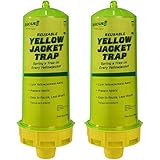
- THE ORIGINAL – There’s a reason you see this trap everywhere: it’s the original, and it works! There are roughly a dozen species of stinging yellow jackets throughout North America, and this trap is designed to lure them all.
- HIGHLY EFFECTIVE – Lured in by our specially formulated attractant, yellowjackets fly in through the holes in the bottom of the trap, continue upward through the interior cone, and become trapped. Once inside, they die from dehydration—no killing agent required.
- NON-TOXIC – Unlike potentially harmful sprays, this trap relies on a non-toxic mode of action to eliminate yellowjackets. Its durable plastic construction is built to withstand many seasons of use. Attractant refills are available.
- SMARTER PEST CONTROL – Our Reusable Yellowjacket Trap is specially designed to attract and kill yellowjackets, not beneficial honeybees. The included attractant lasts for weeks without daily maintenance.
- MADE IN THE USA – At RESCUE!, our goal is to design, manufacture, and market the safest and most effective pest control solutions available for homeowners. We are proud to manufacture our products in the USA!
What attracts wasps to a yard?
Wasps find more than pet food. Sanitation and water management often make a larger difference than a repellent product.
Secure waste and food scraps
- Use garbage cans with tight-fitting lids and empty them regularly.
- Cover compost and remove scraps, dog bones and animal feces from the yard.
- Clean drink and food spills as soon as they occur, including around outdoor tables and grills.
- Pick up fallen or overripe fruit before it ferments on the ground.
Remove unnecessary water sources
During hot, dry weather, wasps may seek water. Repair leaking faucets, hoses, sprinkler fittings and irrigation connections. Empty standing water where practical, while preserving water needed by pets in a bowl that is supervised and brought inside after use.
Do these 3 things before closing this tab:
1Fix the driver behind crashes, sound loss and screen glitches2Clear out junk files and repair common Windows errors3Scan for outdated or missing drivers - takes under a minuteReduce sheltered nesting sites without trapping insects inside
Clear unnecessary debris and seal cracks or openings in sheds and other structures only when you are sure no nest is active there. Never seal an active wall entrance while wasps are inside; trapped insects may find another route into the building or emerge indoors.
How can I tell which wasp is visiting?
Control depends on species and location. A trap designed for yellowjackets is not a general-purpose answer for every stinging insect, and indiscriminate lawn treatment can kill solitary wasps that are beneficial and rarely sting.
| Type | Typical behavior and nest | Pet-yard response |
|---|---|---|
| Yellowjackets | Scavengers attracted to food, pet food and garbage; nests are often underground or inside enclosed structures; adults can become defensive near the nest. | Remove attractants first. A species-labeled yellowjacket lure trap may reduce workers near a patio when positioned well away from activity. Treat a nest, rather than relying on traps, when it is hazardous or inaccessible. |
| Paper wasps | Often build exposed, umbrella-shaped combs beneath eaves or other sheltered overhangs; generally less aggressive unless the nest is disturbed. | Leave a nest alone when it is away from doors, pet routes and play areas. Do not poke, shake or spray it to identify the occupants. |
| Solitary ground-nesting wasps | Usually do not defend a large colony and are often beneficial; many rarely sting. | Avoid blanket lawn-pesticide applications. Observe from a distance and intervene only when a specific hazard has been established. |
On a warm day, watch flight paths from a safe distance. If several insects repeatedly disappear into the same eave, wall opening, tree cavity or ground hole, treat that location as a possible nest and keep pets away rather than investigating with a tool.
Also popular on Amazon

- FOR RESCUE! YELLOWJACKET TRAPS – This refill cartridge provides 10 weeks of yellowjacket attracting power when used in the RESCUE! Reusable Yellowjacket Trap.
- POWERFUL ATTRACTANT – Rather than relying on chemical killing agents, this cartridge uses a powerful attractant that lures queens and workers, spring through fall.
- NO MESS – This handy plastic cartridge comes pre-loaded with yellowjacket attractant. Simply place inside of your RESCUE! Reusable Yellowjacket Trap (not included) and watch yellowjackets pile up!
- NO KILLING AGENT – Our yellowjacket trap relies on a non-toxic mode of action. The attractant cartridge lures them in—once inside the trap, they dehydrate and die naturally.
- MADE IN THE USA – At RESCUE!, our goal is to design, manufacture, and market the safest and most effective pest control solutions available for homeowners. We are proud to manufacture our products in the USA!
What can I put in my yard to keep wasps away?
There is no single yard product that keeps every wasp away. The practical combination is attractant removal, physical separation from nesting sites and, for yellowjackets, carefully placed lure traps.
Free tools Windows power users keep installed
One-click scans. No signup required.
How to place a yellowjacket lure trap
Use a commercial trap whose label identifies yellowjackets and follow that label for bait, replacement and disposal. UC IPM gives these placement figures: in a large setting, approximately 200 feet from the area you want to protect, or about every 150 feet along a perimeter. Yellowjackets commonly forage about one-quarter mile, so a trap is a way to intercept some workers, not a barrier around the whole property.
- Choose the property edge or a point between the protected area and the likely nesting landscape.
- Keep the trap away from doors, patios, play spaces, pet runs, feeding stations and outdoor eating areas.
- Place it where pets and children cannot reach it. Use height or a barrier only when the product label permits that placement.
- For a water trap using protein bait, UC IPM specifies suspending the bait 1–2 inches above soapy water; follow the product’s own directions if they differ.
- Keep bait and trapped insects away from animals, and handle the trap only as directed on its label.
A tight-lid trash can and airtight pet-food container support sanitation, but neither one repels wasps. Do not put a lure next to the dog’s bowl or by the back door simply because that is where wasps are noticed; doing so can increase insect activity in the very place you are trying to protect.
Do wasp traps work?
Yellowjacket traps can reduce the number of foraging workers around a patio or play area, but they may not eliminate a colony. Penn State Extension describes the reduction as limited and says traps are unlikely to completely solve the problem. Their value is greatest when the target is yellowjackets, the trap is placed away from people and pets, and sanitation has already removed competing food sources.
Traps are not recommended as a universal treatment for paper wasps or hornets. They also cannot make an active nest beside a doorway safe. If wasps continue to emerge from one location, the nest location and the risk it creates matter more than the number caught in a trap.
Also popular on Amazon

- Lure & Eliminate Yellowjackets – This disposable yellowjacket trap targets and traps all major species of yellowjackets found in Mountain & Pacific States. Please consult the map to ensure you are purchasing the correct trap.
- Most Effective During Summer – This trap is most effective during summer months when the weather is warm and dry. (Please note: this trap only targets yellowjackets; it will not catch wasps or hornets).
- Easy to Use – Just add water to activate the powdered attractant and hang the trap outside! The attractant lasts for weeks, and no rebaiting is necessary. Once it’s full, dispose in the trash.
- Mountain & Pacific Formula – Make sure you choose the right trap! The attractant in this model is specially formulated to lure yellowjacket species found in states that fall in the Pacific and Mountain Time Zones.
- Made in the USA – At RESCUE!, our goal is to design and manufacture the safest and most effective pest control solutions available. We proudly manufacture our products in the USA!
How do I inspect a suspected nest without putting my dog at risk?
Observe, do not disturb. Keep the dog on a leash, wear shoes because some stinging insects nest on or in the ground, and stay far enough away that the insects do not change behavior.
- Inspect eaves, sheds, wall openings, trees and ground holes visually from a distance on a warm day.
- Note the entry point and the route insects use; do not shine a light into a cavity, probe soil, shake branches or strike a structure.
- Move the pet’s normal route, bowls and play area away from the suspected location.
- Do not block an opening, caulk a crack or fill a hole until an active nest has been ruled out.
- If the nest is hidden, high, indoors, underground or in a high-traffic place, arrange a licensed inspection instead of approaching it.
People with a known sting allergy should not attempt nest work. A licensed pest-control operator or local vector-control service is the safer option when the nest cannot be reached without a ladder, excavation, entry into a wall or close contact.
How do I get rid of a wasp nest without hurting my dog?
First decide whether removal is necessary. A paper-wasp nest in an unused, inaccessible part of a shed may pose less risk than a smaller nest beside the door your dog uses repeatedly. Do not try to make a nest safer by disturbing it.
| Situation | Safer choice | Reason |
|---|---|---|
| Exposed nest away from people and pets | Leave it undisturbed and keep normal activity away from it. | Disturbance is the event most likely to provoke defensive behavior. |
| Nest beside a doorway, pet run, play area or eating area | Keep the area closed off and call a licensed professional. | Routine traffic creates repeated opportunities for accidental contact. |
| Nest inside a wall, underground or high overhead | Use a licensed professional or local vector-control service. | Access and treatment can expose people and pets to insects or pesticide. |
| Nest near a person with a sting allergy | Do not attempt do-it-yourself removal; arrange professional help. | A sting can become a medical emergency. |
Do not knock down a nest, spray its opening, or block its entrance while insects are active. If a professional treatment is needed, keep pets and people out of the area as directed and follow any re-entry interval on the product label.
Recommended Free Tools
Are wasp sprays safe around pets?
“Pet-safe” is not a substitute for a legal pesticide label. A homeowner product must be registered and labeled for the target wasp and the site where it will be used. The label controls application, protective equipment, storage, disposal and when people and animals may return.
Also popular on Amazon

- Targets Yellowjackets – Lured in by our specially formulated attractant, yellowjackets fly in through the holes in the bottom of the trap and become trapped. Once inside, they die from dehydration.
- Attracts Multiple Species – This trap lures roughly a dozen species of stinging yellow jackets found in North America. (Please note: this trap only targets yellowjackets; it will not catch wasps or hornets).
- Reusable – Durable plastic construction is built to withstand many seasons of use. The included attractant lasts for weeks without daily maintenance. Additional attractant refills are available (sold separately).
- Won’t Attract Honeybees – Our Reusable Yellowjacket Trap is specially designed to attract and kill yellowjackets, not beneficial honeybees.
- Made in the USA – At RESCUE!, our goal is to design and manufacture the safest and most effective pest control solutions available. We proudly manufacture our products in the USA!
- Remove pet food and water bowls, toys and bedding before application.
- Keep the dog, other pets and children away from the treatment area during application and for the label’s stated re-entry period.
- Prevent pets from licking wet surfaces, contacting treated vegetation or investigating dead insects.
- Never spray a nest from a doorway or while standing where a retreat route is blocked.
- Do not improvise with household cleaners, essential oils or unregistered mixtures; their safety and effectiveness are not established by the label.
Professional treatment is safest for difficult nests. If a product label conflicts with general advice, follow the label and local regulations, or ask a licensed applicator.
What should I do if a wasp is near my pet?
Keep the pet calm and move slowly away. Do not swat at a lone wasp or encourage a dog to chase it. Guide the dog indoors or to a clear area, then look for the attractant or nest only after the insect has passed.
Keep traps outside normal pet routes. A barrier or elevated placement can reduce access only when the trap’s label allows it; placement that is stable for an adult may still be reachable by a curious dog or cat.
When is a sting an emergency?
Call emergency services after a sting if the person develops trouble breathing, facial or mouth swelling, throat tightness, difficulty swallowing, faintness, dizziness or blue coloring. Anyone with a diagnosed sting allergy should carry prescribed emergency medication and wear medical identification. Do not wait to see whether severe symptoms resolve.
For pets, contact a veterinarian promptly after a sting to the mouth or throat, multiple stings, marked swelling, vomiting, weakness or any breathing change. Keep the animal from returning to the nest while arranging care.
Also popular on Amazon

- For RESCUE! Yellowjacket Traps – This attractant refill works inside any reusable RESCUE! Yellowjacket Trap. Two vials of attractant are enclosed, each lasting 2 weeks.
- Attracts Yellowjackets – This refill lures queens and workers from all major yellow jacket species. (Please note: this trap only targets yellowjackets; it will not attract wasps or hornets).
- How it Works – When used in conjunction with a RESCUE! Yellowjacket Trap, this attractant lures yellowjackets to fly or crawl into the trap. Once they are trapped inside, they dehydrate and expire.
- Won’t Attract Honeybees – Our Yellowjacket Attractant is specially designed to attract yellowjackets, not beneficial honeybees.
- Made in the USA – At RESCUE!, our goal is to design and manufacture the safest and most effective pest control solutions available. We proudly manufacture our products in the USA!
What is a practical pet-yard prevention routine?
Use a short routine every day, then make a more careful inspection when wasps become noticeable.
- After meals: bring bowls inside and wipe the feeding area.
- During yard cleanup: remove fruit, bones, feces and food scraps; close garbage and compost.
- After watering: check faucets, hoses and sprinkler fittings for leaks.
- Before outdoor gatherings: inspect doors, eaves and play areas from a distance and keep sweet drinks covered.
- When activity increases: identify the wasp before choosing a trap, and move pet routes away from any suspected nest.
- Before pesticide use: remove all pet food and water, secure animals indoors and follow the complete product label.
The best way to prevent unpleasant encounters with social wasps is to avoid them. No authoritative universal percentage describes how many wasps a pet-friendly yard can exclude, because results vary with species, weather, nest location, colony stage and the product label. Treat sanitation and distance as the foundation, traps as a limited yellowjacket tool, and professional nest removal as the option for hazards that cannot be managed safely at home.
Frequently Asked Questions
Are all wasps in the lawn dangerous to dogs?
No. Many solitary ground-nesting wasps are beneficial and rarely sting because they do not defend a large social colony. Avoid blanket lawn pesticide use; identify a specific nest and its location before deciding that control is needed.
Can I seal a crack where wasps disappear into my wall?
Not while the entrance is active. Blocking it can force insects into the structure or into the home, so first keep pets away and have a professional assess the nest and the correct treatment.
Why should I avoid swatting a wasp near my dog?
Sudden movements can provoke a defensive response, and a dog trying to snap at the insect may be stung in the mouth. Move slowly to an indoor or clear area instead of striking at the wasp.
Does moving my dog’s bowl a few feet solve a wasp problem?
Usually not if the bowl remains outdoors near the same flight path. Bring it inside between meals, remove spills and investigate nearby garbage, fruit, leaks or nesting sites; relocation alone does not remove those attractants.





Leave a Reply