
Some links on this page are affiliate links: if you buy through them we may earn a commission, at no extra cost to you.
Photograph wild giraffes from a safari vehicle, viewing blind, or designated area with a telephoto lens, and let the animal set the distance. If a giraffe changes its posture, route, feeding, alertness, or interaction with another giraffe because of you, you are too close. Back away without calling, clapping, chasing, feeding, baiting, blocking, or otherwise trying to improve the picture. A conservative starting benchmark is 30 metres for wildlife in many North American guidelines, but it is not a universal giraffe law: the exact park rule, guide instruction, and the giraffe’s behavior take priority.
The safest approach also produces better photographs. Use binoculars to assess behavior before moving, wait for a natural head lift, use dawn or dusk light, and include the surrounding habitat instead of closing the gap.
As an Amazon Associate I earn from qualifying purchases.
Quick wins for a faster PC:
Repair Windows errors before they cause bigger problemsFix Now →Fix the driver behind crashes, sound loss and screen glitchesFind Drivers →Clear out junk files and repair common Windows errorsFree Scan →How close can I get to a giraffe for a photo?
Use enough distance that the giraffe behaves normally. Texas Parks & Wildlife Department states, “When an animal changes behavior as a result of our presence, we are too close.” That behavioral test is more useful than a fixed number because a giraffe’s tolerance varies with terrain, traffic, escape routes, calves, and the presence of other animals.
Several wildlife agencies use 30 metres as a conservative general benchmark. The BC SPCA recommends at least 30 metres for ungulates, and Alberta uses 30 metres for most wildlife. Those figures are general guidance, not a single giraffe-specific rule that applies worldwide. A park may require more space, restrict stopping on a road, or impose a minimum approach distance that changes by season or species. Check the current rules for the exact reserve before entering.
Popular on Amazon

- Multi-Scene Shooting: Bring the distant world to your fingertips. Perfect for concerts, bird watching, wildlife, and sports events like the soccer matchs or baseball games. Whether you‘re in the stands or out in nature, this 28X telephoto zoom lens with tripod captures every detail your phone’s camera would otherwise miss【PLEASE NOTE: This 28x telephoto lens is only capable of focusing on scenes beyond 3 metres; objects within 3 metres cannot be brought into focus.】
- For clear photos: Before installing, loosen the clip screw. Align the telescope with the main camera, cover other cameras. Shoot from at least 3m. If blurry, check alignment, clip tightness, camera coverage, distance, lens settings, and lens cleanliness; then slowly turn the focus ring until sharp, keep steady or use a tripod. If vignetting, zoom to 2.0x–2.4x. If still blurry, contact support.
- Complete Kit – Everything You Need in One Box: Comes with 28X telephoto lens, eyecup, tripod, storage case, cleaning cloth, and lens stickers. No extra purchases needed. Lightweight and portable, it slips easily into your bag. Important: This lens is designed for distant subjects (over 10ft/3 meters). Not for close-ups or selfies. Use the tripod for best results
- Universal Compatibility – Check Your Phone Thickness: Fits most smartphones up to 0.67in (17mm) thick including your phone case. Compatible with iPhone, Samsung Galaxy/Note, Google Pixel, Huawei, OnePlus, and more. Please measure your phone (with case) before purchase. Also compatible with most Android and iOS devices. Universal clip-on design makes installation simple
- High-Resolution Clarity: Capture distant subjects with high-resolution clarity, not blurry digital zoom. This lens lets you zoom in on faraway subjects while maintaining sharp detail – no more grainy, pixelated images. Perfect for shooting a player’s expression on the field, or a bird‘s feathers from a distance
- Start farther away than the minimum and close the distance only if a guide or posted rule permits it and the giraffe remains unaffected.
- Back away if the giraffe stops feeding, repeatedly watches you, changes direction, bunches with other giraffes, moves away, raises its head in alarm, or alters a calf’s position.
- Keep an unobstructed route between the giraffe and open habitat. Never position a vehicle, person, fence, or second vehicle so the animal is boxed in.
- Use a longer lens rather than walking closer.
The BC SPCA’s practical instruction is equally clear: if an animal appears threatened or stressed, back away and leave the area. A giraffe that remains still is not necessarily comfortable; judge the whole sequence of behavior rather than one calm-looking moment.
Is it safe to photograph giraffes on foot?
Sometimes, but only in a formally permitted experience with a trained guide, a defined route, and rules designed for that site. For most visitors, a vehicle, blind, or designated viewing area provides a safer protective enclosure and more reliable distance control. Alberta recommends photographing from vehicles or designated areas, and the U.S. National Park Service similarly advises using a vehicle as protection around wildlife.
Crashes, No Sound, or Screen Glitches?
Random freezes, missing sound and display glitches usually trace back to one bad driver. Find and replace yours safely.Free scan · under a minuteWindows Errors? Fix Them Before They Spread
Repair common Windows errors and clear accumulated junk for a smoother, more stable PC - no reinstall needed.Free scan · no reinstallVehicle photography
A vehicle keeps people out of the giraffe’s immediate space and lets the driver reposition without a person running toward the animal. Remain inside unless the guide identifies an approved place to exit. Keep hands, phones, and camera bodies inside when the giraffe is close, and follow instructions about engine noise and movement.
Viewing blinds and platforms
A blind or elevated platform can provide a stable shooting position without requiring an approach. Stay inside the structure, keep voices low, and do not leave to obtain a different angle. A blind is not permission to lure a giraffe toward it; baiting or feeding changes behavior and can be illegal.
Permitted walking encounters
On-foot access should be treated as a specialist activity, not a shortcut to closer portraits. Follow the guide’s spacing, walking order, and retreat signal. Do not step between a giraffe and its route, stand near the legs, or approach a mother and calf. If the guide says to stop shooting and withdraw, put the camera down and move as directed.
What behaviors signal that I should back away?
Photographers should watch the giraffe continuously, not only through a viewfinder. A behavior change is the decisive warning, even when the animal has not fled.
General warning signs
- Repeatedly turning the head to monitor you instead of feeding or traveling.
- Stopping an activity, stepping away, changing direction, or increasing pace.
- Gathering tightly with other giraffes or moving a calf behind an adult.
- Becoming agitated when vehicles or people close from another direction.
- Approaching a road, fence, building, or other obstacle with no clear escape route.
Do not wait for a dramatic charge. Quiet withdrawal at the first change protects the animal and leaves room for it to resume normal behavior.
Mothers and calves
Females and young may gather in small herds for calf protection, according to SANParks. Give these groups more space than the posted minimum, avoid separating an adult from a calf, and never place yourself between them. A calf can be difficult to see from a low vehicle or behind vegetation, so scan the entire group before repositioning.
Males that are necking
Male giraffes may engage in “necking,” a contest in which they swing and strike with their necks. Keep well clear of the legs and the arc of movement, do not drive between the animals, and do not attempt to draw a male’s attention for a dramatic frame. A telephoto lens is safer than a closer position.
Also popular on Amazon

- Compact, lightweight and high-image quality RF tele zoom lens, with a versatile zoom range of 100-400mm
- Optical Image Stabilizer with up to 5.5 Stops of shake correction
- Up to 6 stops of shake correction when paired with EOS R series cameras featuring In-Body Image Stabilizer (IBIS)
- Minimum focusing distance of 2.89 feet at 200mm and maximum magnification of 0.41x at 400mm
- High speed, smooth and quiet autofocus with Canon’s Nano USM
What is the safest way to approach a giraffe viewing site?
Plan the approach around distance, escape routes, and local rules rather than around a desired composition.
Recommended Free Tools
- Read the site rules before departure. Confirm minimum distances, where vehicles may stop, whether walking is allowed, guide requirements, road-crossing procedures, and restrictions on drones or lighting.
- Locate giraffes with binoculars. Observe feeding, travel direction, calves, other vehicles, and nearby roads before moving.
- Choose the least intrusive position. Stay on an established road, trail, blind, or viewing area. Leave a clear route for the giraffe.
- Stop early. A longer lens, a wider habitat composition, or a wait for the animal to move naturally is preferable to a closer approach.
- Monitor behavior while photographing. Lower the camera regularly to check the animal and surrounding traffic.
- Withdraw at the first behavior change. Reverse or walk away slowly, following the guide’s instructions, without calling or gesturing at the giraffe.
What lens do I need for giraffe photography?
A wildlife telephoto or long zoom is the primary tool. The Missouri Department of Conservation describes a good large telephoto lens as essential for wildlife work, while the National Park Service recommends zoom or telephoto lenses for safe close-ups. Longer, faster lenses generally cost more and may require tripod or other support.
| Photographic goal | Useful approach | Why it protects the giraffe |
|---|---|---|
| Head-and-shoulders portrait | Long telephoto or long zoom | Fills the frame without reducing the animal’s escape space. |
| Full-height portrait | Telephoto zoom with vertical orientation | Shows the entire giraffe while keeping the vehicle or blind stationary. |
| Giraffe in habitat | Moderate telephoto or wider lens from the same safe position | Adds trees, grassland, sky, or other animals without an approach. |
| Low-light dawn or dusk scene | Faster telephoto, stable support, and careful focus | Lets you remain distant when light levels are low. |
Carry binoculars as an observation aid, not merely as an accessory. They help you locate giraffes, identify calves and necking males, and decide whether a composition is possible before a vehicle moves. A wider lens is appropriate when the habitat is the story; moving closer to make a giraffe larger is not.
How can I keep a long lens steady without losing awareness?
Brace your elbows, use a stable vehicle surface or an approved support, and keep your attention wider than the camera screen. The National Park Service and Missouri Department of Conservation both emphasize stable support for wildlife photography. A monopod, beanbag, or tripod may be useful where the guide and park rules permit it, but never let equipment extend into an animal’s path.
- Set up before the giraffe reaches the frame so you are not scrambling as it approaches.
- Keep the camera strap and loose accessories secured inside the vehicle or blind.
- Check the surroundings between sequences: other vehicles, pedestrians, fences, and road traffic can create hazards that the viewfinder hides.
- If the giraffe comes closer than expected, stop photographing, lower the camera, and follow the guide’s instructions.
When is the best light for giraffe photographs?
Dawn and dusk often combine active wildlife with softer, more attractive light, according to the National Park Service. These periods can also produce lower light levels, so stability and patience matter more than pursuing a brighter angle.
Free tools Windows power users keep installed
One-click scans. No signup required.
Wait for a natural head lift, a pause in feeding, or a moment when the giraffe’s profile separates from vegetation. Do not call, clap, whistle, or make noises to force that pose. If the head remains down, a feeding or habitat image is an honest record of the animal’s behavior.
How should I compose a giraffe photograph without moving closer?
Change the frame, not the animal’s behavior. A vertical composition emphasizes the giraffe’s height and can include the full body, while a horizontal composition shows scale within the landscape.
Vertical portraits
Leave space in front of the muzzle and along the direction of travel. Include the legs when the full body is visible, but do not move toward the animal to avoid a crop. A clean background helps the patterned coat read clearly.
Horizontal habitat scenes
Use trees, grassland, hills, sky, or a herd to explain where the giraffe lives. Habitat context can be more informative than a tight face portrait and allows a wider lens from the same safe position.
Also popular on Amazon
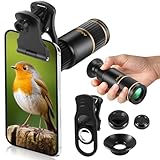
- Universal Phone Compatibility: Compatible with 98% of iPhone, Android and other mainstream smartphones. The adjustable clip supports a maximum thickness of 17mm including phone cases, holding various phone sizes firmly for easy HD shooting. NOTE: Please disable "Macro Control" prior to use on iPhone 13 Pro and newer, Samsung Galaxy S22/S23/S24/S25 Ultra and Galaxy foldable models. Reach out to our support team if you still have focusing troubles
- 22X High Power Magnification: Our 22X magnification paired with a 25mm objective lens pulls distant scenes up close-spotting bird feathers, concert stage details, or mountain ridges. The telephoto lens for iphone suitable for bird watching, hiking, and sports events, it delivers sharp, clear views without blurring.
- Premium BAK4 & FMC Optics: Equipped with BAK4 prism and FMC lenses, the zoom lens for iphone boosts light transmittance for vivid, high-contrast images. It also features 10mm eye relief (suitable for eyeglass wearers) and reliable low light vision for dawn/dusk observation.
- 2in1 Mode View & Capture Freely: Switch effortlessly between two modes: attach the universal phone clip to snap HD photos/videos, or swap in the soft silicone eyecup for glare-free handheld viewing. Never miss a shareable moment or comfortable observation.
- Ultra-Lightweight & Pocket-Sized: Weighing only 96g/0.2lbs and measuring 3.9 inches, this compact monocular fits in pockets, purses, or backpack side bags. Convenient for on-the-go adventures without extra bulk.
Behavioral frames
Feeding, walking, social grouping, and necking can tell a stronger story than a static pose. Keep extra space around moving giraffes and never reposition to block a route or split a mother from a calf.
Can I use flash, bait, or a drone on safari?
Do not use any light or device that disturbs behavior, and never use food, calls, clapping, or pursuit to create a photograph. Flash can startle an animal or alter a low-light encounter; even when a giraffe appears to tolerate one burst, repeated disturbance is not ethical.
Flash and artificial light
Turn flash off unless the destination and guide explicitly permit it for that species and situation. Natural dawn, dusk, and open shade are preferable. A flashlight or focus-assist beam can also be intrusive, especially after dark.
Baiting and feeding
Feeding, baiting, or placing food to hold a giraffe in a particular position changes natural behavior and can make wildlife dependent on people or aggressive around vehicles. Texas Parks & Wildlife and Alberta guidance prohibit or discourage deliberate manipulation, and disturbing wildlife may be illegal. Parks Canada notes that violations in Banff can carry fines up to C$25,000.
What’s actually slowing this PC down?
Pick the symptom - the matching free tool is one click away.
Drones
Check the exact destination before packing a drone. Alberta notes that drones may be prohibited in parks and can require permits. A drone can disturb a giraffe, interfere with other visitors, and create a safety risk even when the operator remains far away. If rules are unclear, leave it grounded and use a telephoto lens.
How do vehicle, blind, and on-foot photography compare?
Each method can be ethical when it follows local rules and produces no behavior change, but their risk profiles differ.
| Approach | Distance control | Animal and people safety | Image flexibility | Compliance priorities |
|---|---|---|---|---|
| Safari vehicle | Usually strong; the vehicle provides separation and can retreat. | Protective enclosure reduces exposure to legs and moving animals. | Telephoto portraits and wider habitat scenes are both practical. | Stay on permitted roads, obey stopping rules, and remain inside when instructed. |
| Viewing blind or designated area | Strong if visitors stay inside the structure or boundary. | Fixed position avoids wandering into a route or herd. | Stable support is often possible; angles are limited. | Do not leave the area or use it to lure animals. |
| Permitted on-foot experience | Depends on trained guides, terrain, and the site’s rules. | Highest personal exposure; legs, calves, and necking males require exceptional caution. | More flexible perspective, but only within the guide’s movement plan. | Confirm permits, guide requirements, walking routes, and retreat procedures. |
The right choice is the one that maintains a clear escape route and leaves the giraffe’s behavior unchanged. A supposedly calm animal is not evidence that an approach is acceptable if the group’s movement or feeding has altered.
Independent reader supportYour contribution helps us test, update, and keep practical guides available for everyone.What should I do around roads, fences, and other obstacles?
Slow down at road crossings and never force a giraffe toward traffic, a building, a fence, or another vehicle. Do not park so the animal is trapped between vehicles. If a giraffe approaches a road, stop where instructed, leave a wide corridor, and wait until it has passed before moving.
Stay on established roads and trails. Do not cut vegetation for a clearer foreground, climb barriers, or enter closed habitat. Pack out every item of waste, including food scraps and camera-accessory packaging. These actions protect habitat and reduce the chance that future visitors will be restricted because of photographer behavior.
Also popular on Amazon

- High Power Telephoto Lens - Achieve superior image quality with our 500mm/1000mm f/8 manual telephoto lens for Canon DSLR cameras. The high index, low dispersion multi-coated optical glass assures clear, sharp photos every time.
- EF-Mount Compatibility - Compatible with EF-Mount, this 500mm lens secures to your DSLR with ease, maximizing camera-lens integration for superior picture quality. This feature ensures sharp, detailed shots every time.
- Exceptional Magnification - The 2X Teleconverter doubles the lens power to a groundbreaking 1000mm. Whether you're capturing elusive wildlife, distant landscapes, or celestial wonders, this lens brings your subjects closer than you ever thought possible.
- Manual Precision - Fine-tune your shots with manual focus and aperture, giving you complete creative control over your images allowing unparalleled creative expression and versatility.
- Durability- Built to withstand the rigors of outdoor shooting, the lens features a robust black finish and durable construction, making it a reliable companion for your photographic adventures.
Should I geotag a giraffe sighting?
Use caution with exact coordinates. Sensitive locations can attract crowds, increase vehicle pressure, and expose animals to repeated approaches. Follow the reserve’s policy and consider a broad area or no location tag when a precise spot could encourage visitors to converge on a herd, a mother and calf, or a rare population.
Do not share a route around a temporary closure, an unmarked den area, or a guide-only site. Respect access controls even if another photographer has posted a close image from there.
Why does giraffe conservation status matter to photographers?
Ethical photography is part of reducing pressure on a species whose classification is being refined. The IUCN’s 2016 listing treated giraffe as one Vulnerable species. The Giraffe Conservation Foundation’s newer framework recognizes four species, and its State of Giraffe 2025 assessment identifies three of those four as highly threatened.
That does not mean every giraffe population faces the same risk. Status differs among species and populations and is being reassessed. The practical implication for a photographer is consistent: avoid disturbance, follow local limits, protect habitat, and do not publicize sensitive locations in a way that creates a rush of visitors.
What are the most common ethical mistakes?
- Chasing a better angle: the photographer follows when the giraffe walks away. Stop and let the animal choose the direction.
- Using the minimum distance as a target: a legal minimum is not a guarantee that the animal is comfortable. Start farther away and watch behavior.
- Focusing only through the viewfinder: the photographer misses a calf, another vehicle, or a changing escape route. Lower the camera often.
- Blocking movement: vehicles or people form a line that prevents the giraffe from reaching water, cover, or open ground. Keep corridors clear.
- Leaving the vehicle without approval: a familiar safari setting can still contain sudden movement, uneven ground, and animals that feel cornered.
- Calling for a head lift: the resulting pose is manufactured and may increase stress. Wait instead.
- Sharing an exact location: a popular post can bring more vehicles than the site can absorb. Use broad geotags or omit them when appropriate.
What is a practical checklist before pressing the shutter?
- Have I checked the current rules for this park or reserve?
- Am I in a vehicle, blind, or approved viewing area, or with a qualified guide on a permitted walk?
- Is the giraffe behaving normally, with a clear route away from me?
- Are there calves, necking males, roads, fences, or other hazards that require more distance?
- Can a telephoto or wider composition solve the framing problem without moving?
- Is flash, a drone, or any artificial aid prohibited or potentially disturbing?
- Am I watching the surroundings as well as the screen?
- Will I leave no waste, damage no vegetation, and avoid an unsafe location tag?
If any answer is uncertain, do not take the frame. A missed photograph is reversible; a stressed animal, blocked escape route, collision, or damaged habitat is not.
Frequently Asked Questions
What should I do if a giraffe walks toward my vehicle?
Stop photographing, keep body parts and equipment inside, and remain still while following the driver or guide’s instructions. Do not start the engine or move until the animal has a clear route and the guide says it is safe.
How can I photograph a giraffe at night without disturbing it?
Ask the destination whether night drives, artificial light, and photography are permitted at all. If lighting is allowed, use only the guide-approved method and duration; never shine a beam repeatedly at the animal or use a flash to obtain eye shine.
The Tool Desk
Outbyte Driver Updater FREEScan for outdated or missing drivers - takes under a minuteDriver Scan →Outbyte PC Repair FREEClear out junk files and repair common Windows errorsFree Scan →Is it ethical to photograph a giraffe at a feeding station?
Only if the facility is legally authorized, transparently managed, and its rules prohibit visitors from feeding or directing the animals. A picture made possible by visitor-supplied food does not document natural behavior and can reinforce harmful dependence.
What should I do if another photographer is crowding a giraffe?
Increase your own distance and alert the guide, ranger, or site staff rather than confronting the person near the animal. Record the location and time only if doing so is safe and useful to enforcement.
Can I publish a close giraffe portrait if I kept my distance?
Yes, but explain the context honestly and avoid captions that encourage viewers to approach wildlife. Remove precise location data when a public post could draw crowds to a sensitive herd or calf-rearing area.





Leave a Reply