
Recommended Free Tools
Some links on this page are affiliate links: if you buy through them we may earn a commission, at no extra cost to you.
The safest way to prepare a poodle for grooming is cooperative care: teach the dog that handling, tools, and brief procedures predict choice, pauses, and rewards. Start when your poodle is relaxed, work in tiny steps, and stop before stress appears. A short successful session is more valuable than finishing a haircut while the dog is frightened.
At home, build from calm touch to tool contact, then to movement and vibration. Use secure, non-slip footing and an opt-in behavior such as standing on a mat, resting the chin, or offering a paw. If your poodle freezes, tries to escape, growls, or snaps, pause and make the next session easier. For unsafe or unmanageable behavior, involve a veterinarian, veterinary behaviorist, qualified humane trainer, and a groomer who can work with low-stress handling.
As an Amazon Associate I earn from qualifying purchases.
The Tool Desk
Outbyte Driver Updater FREEFix the driver behind crashes, sound loss and screen glitchesFind Drivers →Outbyte PC Repair FREEClear out junk files and repair common Windows errorsFree Scan →What does cooperative care mean for a poodle?
Cooperative care means teaching a dog to participate in grooming rather than physically forcing the dog through it. The handler controls the difficulty, gives predictable rewards, watches body language, and allows pauses. Dr. Aly Cohen of Cornell’s Riney Canine Health Center recommends practicing when a dog is relaxed, pairing each exposure with small, frequent rewards, keeping sessions brief and predictable, and stopping while things are going well.
This approach matters because grooming combines several potentially worrying experiences: being touched in sensitive areas, standing on an unfamiliar surface, hearing a motor, feeling vibration, and having movement restricted. A poodle that accepts one of those experiences may still be frightened by another. Treat each component as a separate skill instead of assuming that tolerance of brushing means tolerance of clippers.
Popular on Amazon

- 【Premium Dog Grooming Kit】Owning a professional dog slicker brush and a comb, you can effectively remove tangles, knots, and mats, significantly reducing brushing and drying time. Let you, as the groomer, give your furry companion a shiny, healthy coat , Goldendoodle Must Haves - The Best Dog Gifts - Merry Christmas
- 【Professional Slicker Brush for Dogs】Designed for medium-length and curly-haired pets with thick, difficult-to-manage coats, our slicker brush features extra-long angled pins that penetrate deeply to remove dead hair and loose undercoat. It is the best choice for deep combing undercoat for Goldendoodles, Poodles, Labradoodles, etc.Ergonomic handle minimizes hand and arm fatigue during grooming sessions, making it an essential tool for shedding season
- 【High Quality Dog Comb】Made of high quality stainless steel, this comb is durable, corrosion resistant and will not fade, good for avoiding static electricity.Rounded pin ends are gentle to the skin.it’s perfect to promote blood circulation and massage skin
- 【Optimize Combing Function】Pin Length ≈ 1in,Tilt Angle ≈ 45° Extra-long pins effortlessly reach through dense coats, while the angled design protects sensitive skin. This innovative structure simplifies detangling by effectively accessing the undercoat.Ideal for Poodles, Bichons, Labradoodles, Goldendoodles, and Other Doodle Breeds
- 【2-Year Warranty & Support】As a professional pet care brand, we are committed to providing safe, practical, and affordable solutions. Enjoy peace of mind with our 7*24 customer support and 2-year quality guarantee covering any manufacturing defects
What success looks like
- Your poodle remains loose enough to eat, sniff, and offer the trained stationing behavior.
- The dog can move away or signal a pause without being chased or held tighter.
- Each session ends before the dog reaches panic, so the next session can begin at the same or an easier level.
Cooperative care does not promise that every dog will enjoy every procedure. It gives you a way to reduce fear, identify limits early, and make necessary grooming safer.
How should I set up a safe grooming practice area?
Set up the environment before bringing your poodle to the tools. A quiet room, secure equipment, and non-slip footing remove avoidable sources of fear and falls.
- Choose stable footing. Use a non-slip mat on the floor or a grooming surface that cannot wobble. American Kennel Club standards call for safe, sturdy grooming surfaces, and the American Animal Hospital Association recommends non-slip footing.
- Control the surroundings. Close doors, reduce sudden noise, and keep other pets from crowding the session. Have every tool and reward within reach so you do not leave the dog unattended.
- Prepare rewards. Use a treat pouch filled with food your veterinarian has approved. Tiny pieces delivered frequently let you reinforce calm behavior without making the session a meal.
- Keep tools simple at first. A rubber brush, metal brush, and a guarded vibrating tool are enough for early practice. You are teaching emotional comfort, not attempting a complete haircut.
- Plan an exit. Know where your dog can step away and how you will end the session calmly. Never block the only route out and then interpret escape attempts as disobedience.
Do not place a frightened dog on a high table to “get it over with.” Begin on safe, low, non-slip footing and transfer skills to professional equipment later.
How do I get my poodle used to being touched?
Begin with handling, not cutting. Touch only when your poodle is calm, pair the contact with a reward, and remove your hand before the dog needs to pull away. Cornell specifically recommends gentle practice with paws, nails, and ears while the dog is relaxed.
- Start on an easy body area. Touch a shoulder or back for about a second, feed a reward, and stop. Repeat only while the dog stays comfortable.
- Increase one variable at a time. Move gradually toward legs, paws, ears, face, and tail. If a new area causes tension, return to the last comfortable location and make the contact briefer.
- Add gentle holding. When a light touch is easy, briefly rest your hand around a paw or ear without squeezing. Reward the release as well as the contact.
- Introduce the positions grooming requires. Practice standing, turning, lifting one paw, and looking toward your hand. Do not pin the dog in place.
- Finish with an easy repetition. End on a body area the dog already accepts, then put the tools away.
Watch the dog’s whole body rather than focusing only on whether it stays still. Lip licking, yawning when not tired, a lowered posture, freezing, pulling away, or showing the whites of the eyes means the step is too difficult or too long.
How fast should handling progress?
There is no universal timetable. One poodle may accept a paw touch after several calm sessions; another may need many shorter repetitions. Progress only when the dog repeatedly remains relaxed at the current level. A single forced repetition can create a setback that takes longer to repair than the original task would have taken.
How do I introduce brushes and other grooming tools?
Make each tool predictable before using it on the coat. Let your poodle see and investigate the object, pair that investigation with food, then add one light touch. The Freedom Service Dogs protocol recommends choosing one item for a session and doing only one session per day, which prevents a long chain of difficult exposures.
| Stage | What you do | Move on when |
|---|---|---|
| Presence | Place the rubber or metal brush several feet away. Reward looking at it, then allow a brief sniff. | The dog can notice the brush and continue eating or relaxing. |
| Approach | Bring the brush closer, feed, and move it away. Repeat without touching the coat. | The dog stays loose as the distance changes. |
| Contact | Touch the shoulder or back with the brush for one second, reward, and remove it. | The dog accepts repeated touch-and-go trials. |
| Duration | Hold contact for roughly three to five seconds, then reward and pause. | The dog remains comfortable for several short holds. |
| Movement | Add one short brushing motion on an easy area. Stop, reward, and take a break. | The dog accepts a few strokes without tension. |
Use a break between trials. If the dog stops eating, stiffens, turns away, or leaves the station, the correct response is to stop and reduce the next exposure, not to add restraint.
Also popular on Amazon
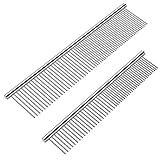
- ✅ FUNCTION -This dematting tool for dogs can removes tangles, mats, loose hair, besides, it’s perfect to promote blood circulation and massage skin.
- ✅ PREMIUM MATERIAL - Made of high quality stainless steel, this comb is durable, corrosion resistant and will not fade, good for avoiding static electricity.
- ✅ COMFORTABLE & SAFE - Rounded pin ends are gentle to the skin. This comb grooms and massages for a healthy coat, prevent snagging and pet injury.
- ✅ WHAT YOU GET- 2 Pack combs for removes both small & large areas tangles, knots. Large comb size: 7.4 x 1.65 IN, small comb size: 6.3 x 1.2 IN.
- ✅ RISK-FREE LIFETIME GUARANTEE - We firmly stand by the lasting quality of our pet grooming tool. If for any reason you're not 100% happy with it, reach out to us to receive a refund or replacement.
How can I stop my poodle from being scared of clippers?
Condition the sound and vibration separately from grooming. A guarded clipper or other vibrating tool should first be an inactive object, then a brief source of sound at a distance, and only later a source of vibration near the body. Tolerating a few seconds of vibration does not mean a dog is ready for a full shave.
- Show the switched-off tool. Let your poodle look at and sniff it while receiving food. Touch the tool to an easy body area only after the object itself is unremarkable.
- Add the sound at a distance. Turn the tool on briefly several feet away, feed continuously, and turn it off before the dog becomes tense. Increase proximity gradually over separate sessions.
- Pair brief vibration with contact. When the sound is easy, allow a one- or two-second touch of the guarded tool to the shoulder or back, then stop and reward.
- Build duration in tiny increments. The cited protocol recommends short touch-and-go trials, a break, and then gradual increases in duration and movement.
- Leave full clipping to a professional when needed. Do not attempt a complete shave at home simply because your poodle tolerates a brief vibration. The protocol directs full-groom shaving needs to trained staff.
Do not surprise the dog by starting the motor against its skin. If the motor sound itself causes panic, return to a silent tool and consult a low-stress groomer or behavior professional.
Windows Errors? Fix Them Before They Spread
Repair common Windows errors and clear accumulated junk for a smoother, more stable PC - no reinstall needed.Free scan · no reinstallOutdated Drivers Are Slowing You Down
One free scan finds every outdated or missing driver and matches the right update for your exact hardware.Free scan · exact hardware matchHow do I teach my poodle to opt in and ask for a break?
An opt-in behavior gives the dog a clear way to participate. Edmonton Humane Society cooperative-care guidance describes stationing, chin rests, and touch desensitization as useful skills.
Stationing on a mat
Reward your poodle for stepping onto a mat, then for remaining there briefly. Add handling only after the dog willingly returns to the mat. The mat is an invitation, not a trap; allow the dog to step off.
Chin rest
Offer your open hand or a low platform. Reward when the dog places its chin there, then remove your hand. Gradually add a light touch to another body area while the chin remains voluntarily supported. If the chin lifts, pause immediately.
Offered paw
Reward a paw placed in your hand, then add a brief touch to the toes or nails. Never pull the paw toward you. A withdrawn paw is information that the next repetition should be easier.
Use one signal consistently for “pause,” such as stepping off the mat or lifting the chin. When the signal appears, stop the tool and create space. Respecting the signal teaches the dog that communication works, which can reduce the need for defensive behavior.
What signs show that grooming has become too stressful?
Pause at early stress signals rather than waiting for a growl or snap. Cornell and the American Animal Hospital Association identify several signs that a dog is over its comfort threshold.
Also popular on Amazon
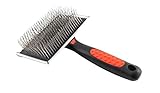
- EXTRA LONG PINS - Crafted from high-quality materials, this professional-grade "Tuffer Than Tangles" brush features extra-long stainless steel pins that easily penetrate deep into your pet's coat, removing dirt and debris from the undercoat.
- COMFORTABLE - The flat slicker design allows for gentle yet effective grooming, while the ergonomic handle ensures maximum comfort and control during use.
- ALL COAT TYPES - The Paw Brothers Extra Long Pin Flat Slicker Brush is suitable for all coat types and can be used on both dogs and cats. It's perfect for pet owners, as well as professional groomers.
- SIZE - Head 4.5in x 3in, Handle length 4.75in, Pins 1in length
- WHY RYAN'S PET SUPPLIES - Established in 1959, we have grown from humble beginnings as a family-operated four-page catalog to an international business featuring top quality products and services for pet professionals and pet lovers alike.
| Signal | What it can mean | Immediate response |
|---|---|---|
| Lip licking or repeated yawning when not tired | Unease is increasing even if the dog is still. | Stop the tool, offer distance, and return to an easier step later. |
| Freezing, lowered posture, or showing the whites of the eyes | The dog may be trying to avoid escalation. | Release contact and allow a break; do not praise stillness by continuing. |
| Pulling away, hiding, pacing, or escape attempts | The current setup or procedure is too difficult. | Open a safe exit, remove the trigger, and end the session if relaxation does not return. |
| Trembling or hypervigilance | Fear is high enough that learning is unlikely. | Stop immediately and seek a more appropriate plan. |
| Growling, snapping, or biting attempts | The dog is communicating that it cannot cope safely. | Do not punish. Create distance and arrange professional help. |
AAHA’s concise rule is to “Move at the animal’s pace.” A pause is not a failure; it protects the trust needed for the next session.
What should I do if my poodle freezes, tries to escape, or bites?
Stop the procedure and make the situation safe. Do not hold the dog tighter, scold a growl, or continue because an appointment or haircut is unfinished. The BC SPCA states that handling should be “the least physical and most effective method available” while minimizing fear, pain, stress, and suffering.
Quick wins for a faster PC:
Fix the driver behind crashes, sound loss and screen glitchesFind Drivers →Repair Windows errors before they cause bigger problemsFix Now →Scan for outdated or missing drivers - takes under a minuteDriver Scan →- Turn off tools and remove your hands from the dog’s sensitive area.
- Give the poodle space on secure footing. Keep your face and hands away from a dog that is snapping.
- Move other people and animals out of the area.
- Record what happened: the body area, tool, sound, duration, and early signals you noticed.
- End the session if the dog does not quickly return to relaxed behavior.
- Before trying again, ask a veterinarian about pain or medical issues and seek a veterinary behaviorist or qualified humane trainer if fear or aggression persists.
Urgent hygiene or health problems may require a professional plan rather than home practice. Tell the groomer exactly what happened; withholding a bite history puts the dog and staff at risk.
How long should home grooming practice last?
Keep practice short enough that your poodle remains below its stress threshold. The Freedom Service Dogs protocol calls for one session per day, while Cornell emphasizes small, frequent rewards and ending while the dog is doing well. In practical terms, a session may contain only a few repetitions and last seconds to a few minutes, depending on the dog.
Use this adaptable progression rather than a fixed calendar:
- Early sessions: one body touch or one tool investigation, followed by a reward and release.
- Building sessions: several three- to five-second contacts with a break between them.
- Movement sessions: one or two brush strokes or a brief vibration, then stop.
- Maintenance sessions: repeat the easiest successful level regularly before adding a new body area or longer duration.
If your poodle has a dense coat, mats, skin disease, pain, or a history of fear, the appropriate frequency and procedure should be set with a groomer or veterinarian. The available guidance does not establish one universal grooming interval for every poodle.
Do these 3 things before closing this tab:
1Repair Windows errors before they cause bigger problems2Fix the driver behind crashes, sound loss and screen glitches3Clear out junk files and repair common Windows errorsShould I groom my poodle at home or use a professional?
Choose the setting in which the dog can stay below its stress threshold while the handler can work safely. Home practice is best for teaching small skills; professional grooming is often safer for complex clipping, severe coat problems, or a dog that cannot remain calm around equipment.
| Factor | Home practice | Professional appointment |
|---|---|---|
| Primary purpose | Desensitization, handling skills, and cooperative-care signals. | Complete bathing, drying, clipping, nail, and coat-care procedures within the dog’s tolerance. |
| Best choice when | Your poodle can eat, move away, and relax during brief sessions. | The coat condition, equipment, or safety risk exceeds your skill or setup. |
| Main risk | Accidentally progressing too fast or attempting a full shave without training. | Stress from unfamiliar staff, noise, restraint, or a rushed appointment. |
| Support available | Veterinary advice and a qualified humane trainer when progress stalls. | A groomer who monitors stress and refers medical or medication questions to a veterinarian. |
Continue cooperative-care practice even when a professional does the haircut. Familiar stationing, touch, and tool exposure can make the appointment shorter and less frightening.
Also popular on Amazon

- 2 IN 1 DETANGING COMB Simplify the grooming process by using our two length combs for grooming, detangling and freshness. It offers both long and short metal teeth, so it reduces time by half.
- FOR LONG SHORT HAIR Unlike an average dog grooming comb, this can be used to care for long hair or short breeds. Use it to comb the hair of Pomeran, Poodle, Persian, Cats, etc.
- Stainless Steel Tines - The long and short teeth of this 2-in-1 PET comb with handle are made of solid stainless steel to ensure they are strong enough to effectively remove knots and mats.
- #1 DIY PET GROOM TOOL Our pet grooming supplies are recommended by long hair dog trainers and everyday pet owners. It is the perfect all-in-one detangling comb for you.
- International products have separate terms, are sold from abroad and may differ from local products, including fit, age ratings and language of the product, labelling or instructions.
How do I find a low-stress groomer?
Interview the groomer before booking and describe your poodle’s behavior honestly. Cornell suggests considering a Fear Free certified groomer, although availability varies by region.
Questions to ask
- Do you use reward-based, cooperative-care handling?
- What do you do if a dog freezes, pulls away, growls, or tries to escape?
- How often can you pause, and can you schedule a quiet appointment?
- How do you monitor stress during bathing, drying, brushing, and clipping?
- What equipment keeps dogs secure without unnecessary force?
- When would you stop and refer the dog to a veterinarian or behavior professional?
Information to provide at intake
Give the groomer the dog’s age, size, medical concerns, triggers, previous reactions, bite history, treat permissions, and vaccination information. AKC intake standards include these categories. Mention which body areas are difficult and which opt-in behavior your poodle knows.
What a safe facility should demonstrate
- Calm communication and a willingness to explain procedures.
- Non-slip table or tub surfaces and secure, appropriate equipment.
- Staff who recognize early stress signals and are prepared to pause.
- Accommodation for puppies, geriatric dogs, and toy-size dogs, including safe transfer procedures.
- A policy for refusing or stopping service when aggression or unmanageable behavior makes safe handling impossible.
Do not ask a groomer to administer prescription or “natural” sedation. AKC standards direct medication questions to a veterinarian. A veterinarian can decide whether pain evaluation, behavior treatment, or short-term medication is appropriate for the individual dog.
Independent reader supportYour contribution helps us test, update, and keep practical guides available for everyone.What is different about preparing poodle puppies, toy poodles, and older dogs?
All poodles benefit from early cooperative-care practice, but age and size change the safety plan. The Freedom Service Dogs protocol specifically highlights grooming practice when raising a Standard Poodle puppy.
Puppies
Use very short sessions and reward investigation of the mat, brush, and quiet handling. Arrange professional appointments that accommodate puppies rather than expecting a first visit to include every procedure.
Toy poodles
Handle transfers carefully and prevent jumps from tables or arms. AKC standards call for special transfer procedures for toy-size dogs; ask the groomer how the dog is moved between surfaces.
What’s actually slowing this PC down?
Pick the symptom - the matching free tool is one click away.
Geriatric poodles
Older dogs may need more breaks and adjustments for stiffness, vision, hearing, or pain. AKC standards require accommodations for geriatric dogs. Ask a veterinarian to evaluate any sudden change in grooming tolerance.
Standard poodles
Their size makes secure footing and calm transitions especially important. Teach stationing and cooperative handling before introducing full-size equipment or longer procedures.
Also popular on Amazon

- 【Medium Pin Dog Brush】20mm stainless steel round pins can comb through long and thick hair, reaching the undercoat. This wooden dog pin brush effectively cleans sticky dirt, stains, food residue, and tangled hair. The pins are firmly embedded and do not easily fall off. Round-ended bristles ensure a safe and comfortable grooming session for both you and your pet. Medium-length pins are suitable for any hair type on cats and dogs.
- 【Airbag Dog Grooming Comb】Featuring an all-metal pin design, this dog cat shedding comb is sturdy and resistant to breakage, detangling more effectively than plastic or bristle brushes. A firm cushion with an air vent provides flexibility without scratching the skin or breaking hair.
- 【Smooth Wooden Handle】Crafted from bamboo, the ergonomic handle offers a fantastic, comfortable grip, making this massage brush easy to use for extended periods without fatigue.
- 【Leave Fur Soft and Shiny】 Pet fur brushing spreads natural oils through the coat so your pet looks its best. It also increases blood circulation and makes the fur smooth and shiny. Removing your pet's dead hair for a healthy coat increases blood circulation, and leaves your pet's fur soft and shiny.
- 【Lightweight and Suitable Size】Measuring 8.6 inches in length and 2.36 inches in width, and weighing only 0.18 lbs, this brush is a thoughtful and practical gift for pet owners. It provides them with a regular grooming tool for their furry companions.
When should a veterinarian or behavior professional be involved?
Arrange professional help when your poodle cannot remain below threshold despite easier steps, when fear appears suddenly, or when handling could be painful. A veterinarian can check for skin, ear, orthopedic, neurologic, or other medical problems that make grooming uncomfortable. A veterinary behaviorist can address severe fear, aggression, and medication decisions; a qualified humane trainer can coach cooperative-care skills.
Referral is also appropriate when a groomer cannot maintain safety, when there is a bite history, or when the coat condition demands a procedure your home setup cannot perform safely. Sharing a written record of triggers and successful rewards helps the professionals create a consistent plan.
What common mistakes make grooming fear worse?
- Forcing completion. Finishing a haircut while the dog is panicking can teach the dog that escape signals do not work.
- Skipping intermediate steps. Going from a stationary brush to a running clipper removes the gradual exposure that builds confidence.
- Ignoring quiet signals. Freezing and lip licking are warnings, not cooperation.
- Changing several variables at once. A new room, new tool, longer duration, and sensitive body area should not all be introduced together.
- Using punishment. Scolding growls suppresses communication without changing the fear that caused it.
- Practicing until the dog is exhausted. The goal is a calm association, not physical fatigue.
- Using unsafe footing. Slips can create pain and make future handling harder.
- Hiding behavior history from the groomer. Staff need accurate information to protect everyone.
A poodle that leaves a session relaxed has made progress, even if no hair was cut. Cooperative care is measured by safer participation over time, not by how much grooming was completed in one appointment.
Frequently Asked Questions
What if my poodle refuses treats during grooming practice?
A dog that will not eat may be too worried to learn in that setting. Stop, increase distance from the tool or handling, and try again later in a quieter place; if appetite remains absent or fear is intense, ask a veterinarian to assess the situation.
Can I let another person hold my poodle still while I clip?
Extra restraint can increase fear and injury risk. Use the least physical handling needed, and stop if the dog cannot remain calm; a groomer trained in cooperative care can decide whether the procedure is safe.
What should I do about a poodle that already had a frightening grooming appointment?
Give the dog time to return to normal behavior, then restart with an easier exercise such as seeing a silent brush at a distance. Share the previous incident with the next groomer and consider veterinary behavior support before repeating the same procedure.
Free tools Windows power users keep installed
One-click scans. No signup required.
How should I handle a poodle that has painful mats or skin irritation?
Do not force brushing through suspected pain or attempt a risky home dematting session. Tell the groomer and veterinarian about the coat and skin condition so they can choose a humane, medically appropriate plan.





Leave a Reply