
Some links on this page are affiliate links: if you buy through them we may earn a commission, at no extra cost to you.
Flat-faced dogs should have shorter, slower walks in cool parts of the day, with shade, water and close monitoring—and sometimes no outdoor exercise at all. French Bulldogs, Pugs, Bulldogs and other brachycephalic dogs have narrowed upper airways, so panting removes heat less efficiently than it does in longer-muzzled dogs. Heat, humidity, direct sun, hard exercise, excess weight, age and heart or breathing disease can push them into life-threatening heatstroke quickly.
There is no single “safe” air-temperature cutoff for every dog. Use the heat index, humidity, sun, pavement temperature and your dog’s health together. If panting becomes unusually heavy or is accompanied by drooling, weakness, abnormal gums, vomiting, confusion, collapse or seizures, stop immediately, cool the dog with cool or tepid water and moving air, and contact an emergency veterinarian.
As an Amazon Associate I earn from qualifying purchases.
What’s actually slowing this PC down?
Pick the symptom - the matching free tool is one click away.
How do flat-faced dogs overheat so quickly?
Brachycephalic dogs have shortened skulls but the same amount of soft tissue that would normally fit along a longer muzzle. This can narrow the nostrils, throat and windpipe. Panting is therefore less efficient: air movement is restricted, and the effort of breathing can itself generate more heat. A dog may look comfortable at the start of a walk and then deteriorate rapidly once its body temperature rises.
Heat loss is harder when the air is humid because moisture evaporates less readily from the mouth and airways. Direct sunlight, little airflow, strenuous play, thick body fat and an underlying airway, heart or lung problem add further stress. A collar that presses on the neck can also compress already restricted airways. The UK Brachycephalic Working Group (BWG) advises reducing heat and exertion rather than relying on equipment to compensate for anatomy.
Popular on Amazon
](https://m.media-amazon.com/images/I/41ji4lsxEIL._SL160_.jpg)
- [UPDATED VESION, EASY TO PUT ON & TAKE OFF] This dog harness has 3 buckles( One is on the neck with Lockable, two are on the chest), NO NEED go through dog’s head. This will let your dog loves to wear harness!
- [NO PULL WITH 2 HOOK LOOPS] There are 2 sturdy metal hook loops for leash attachment. If you use the front hook on the chest, it will reduce the pulling a lot and make going for a walk more enjoyable. As usual, most people like to use the back hook.
- [REFLECTIVE MATERIAL] The reflective material will be really nice when it gets dark. Also, your dog will be saw easily. This reflective material can make drivers have long time to react, which ensure your dog’s safety!
- [USEFUL & SOFT HANDLES] You will like this handle on the back,it is helpful in controlling dogs a bit closer to you when they are trying to lunge at something. Also, it is convenient to assist dogs into the car.
- [100% BEST CUSTOMER SERVICE] If any products quality really exits, a refund or replacement will be available.
Heatstroke is a medical emergency, not ordinary post-exercise tiredness. High body temperature can injure the brain, kidneys, gut, muscles and clotting system. A dog that recovers visually after a few minutes may still have internal injury, so any suspected heatstroke needs veterinary assessment.
What temperature is too hot for a French Bulldog, Pug or Bulldog?
No universal temperature number safely covers every brachycephalic dog. Humidity, sun, wind, pavement, exercise intensity, body condition and airway health can make the same thermometer reading safe for one dog and dangerous for another. Treat a hot, humid or sunny forecast as a reason to shorten or skip a walk, and use the local heat index rather than air temperature alone.
Outdated Drivers Are Slowing You Down
One free scan finds every outdated or missing driver and matches the right update for your exact hardware.Free scan · exact hardware matchWindows Errors? Fix Them Before They Spread
Repair common Windows errors and clear accumulated junk for a smoother, more stable PC - no reinstall needed.Free scan · no reinstall| Condition to assess | Why it changes risk | Safer decision |
|---|---|---|
| High heat index or humidity | Evaporation from panting is less effective, so cooling slows. | Move toileting to the coolest available time; replace exercise with calm indoor enrichment when conditions are oppressive. |
| Direct sun | Radiant heat raises the dog’s body and surface temperature even when air feels tolerable. | Choose deep shade and avoid exposed routes; skip the outing during a heatwave. |
| Hard or prolonged exercise | Muscle activity creates heat faster than a restricted airway can shed it. | Use a brief, slow sniff walk only if the dog is comfortable; stop at the first change in breathing. |
| Hot pavement | Tarmac and paving can burn paw pads and reflect heat upward. | Press the back of your hand to the surface for several seconds. If it is too hot for your hand, it is too hot for paws. |
| Overweight, elderly or medically affected dog | Extra insulation, reduced fitness or heart and respiratory disease reduce heat tolerance. | Ask your veterinarian for an individualized activity plan and use a lower-risk schedule. |
The BWG consensus statement says to avoid or reduce exercise during the hottest part of the day, heat waves, direct sunlight and warm, humid weather. When conditions cannot be made comfortable, staying indoors is the safer choice; a missed walk is preferable to a medical emergency.
When should I walk a flat-faced dog in hot weather?
Schedule necessary walks for early morning or late evening, when the sun and pavement have cooled. Check the forecast shortly before leaving because humidity and heat index can change during the day. On exceptionally hot days, limit outside time to brief toileting and provide exercise through quiet indoor activities instead.
Use a short, low-intensity route
Choose a shaded route close to home so you can turn back immediately. Let the dog set the pace for relaxed sniffing rather than brisk walking, running, chasing games or prolonged training. Avoid hills, stairs and crowded places that increase exertion or stress. Keep the lead loose and stop for frequent rests in shade.
Carry water and plan ventilation
Bring fresh water and a portable bowl or bottle, offering small drinks at regular breaks. Do not wait until the dog is frantic or searching for water. Make sure the route has shade and airflow; a stagnant, enclosed area can remain dangerously hot even when it is out of direct sun.
Quick wins for a faster PC:
Scan for outdated or missing drivers - takes under a minuteDriver Scan →Clear out junk files and repair common Windows errorsFree Scan →Fix the driver behind crashes, sound loss and screen glitchesFind Drivers →Also popular on Amazon

- No Pull, 2 Clips - With 2 sturdy metal hook loops for leash attachment. Use the front clip to create gentle redirection force, to reduce tugging during walks and training. While back clip is great for casual walks, jogging for well-behaved dogs
- Comfort, No Choke - Made from durable fabric with breathable mesh, this vest keeps them comfortable and cool during extended walks or active play. The pulling pressure is distributed evenly with soft padded —no rubbing, no irritation, just happy tails
- Easy to Wear & Adjust - Simply slip the harness over dog's head, snap the two quick-release buckles, and ready to go. 4 fully adjustable straps to create a perfect fit for your dog with room of growth. No worries about slipping out
- Built for Safety - Bright reflective strips ensure a safe walk both early morning walks or late night runs. The top handle helps to hold dog pulling immediatly, also can be used for car riding with safety
- Large Dog Harness - Chest: 17-33.4in. Recommended to Large Dogs, such as Labrador, German Shepherd, Siberian Husky, Schnauzer Giant, etc. Please measure your dog's neck and check girth carefully before purchasing
Check the ground before every outing
Use the back-of-hand test on asphalt, concrete and other hard surfaces for several seconds. Test multiple sections because shaded and sunny patches can differ greatly. If the ground is hot, postpone the walk or use a cool, shaded surface. Paw burns can compound heat stress and make the dog reluctant to move.
Watch breathing continuously
Do not judge safety by distance completed or by a dog that appears eager to continue. Panting that becomes heavier, faster or more labored than expected is a signal to stop, move into shade and cool the dog. Brachycephalic dogs may deteriorate before they seem exhausted.
Should I skip a walk during a heatwave?
Yes. During a heatwave, especially when humidity is high or shade is unavailable, skip recreational walks and keep the dog in a cool, well-ventilated indoor space. A brief toilet break at the coolest practical time is enough until conditions improve.
Replace outdoor exertion with calm activities that do not raise body temperature: short scent games, food puzzles, gentle training and quiet interaction in an air-conditioned or well-ventilated room. Avoid vigorous indoor play in a warm room; exercise still produces heat indoors. Provide access to fresh water and check that the dog can settle comfortably rather than panting continuously.
Free tools Windows power users keep installed
One-click scans. No signup required.
Which harness and cooling equipment help?
A properly fitted walking harness is preferable to attaching the lead directly to a collar for many brachycephalic dogs. The BWG notes that neck pressure can compress the airway and impair panting. A harness can reduce that pressure, but it does not make a hot or humid walk safe and must never be used to justify longer exercise.
Fit and inspect the harness
- Choose a design that sits on the chest rather than across the throat.
- Check that it does not restrict shoulder movement or rub the armpits.
- Adjust it so the dog cannot back out, while still allowing normal chest movement.
- Recheck the fit after the dog has moved; straps can shift as the dog pants.
Use cooling products only as supplementary aids
A damp, cool (not icy) cloth, a pet-safe cooling mat or a cooling vest may provide comfort in a shaded, supervised setting. These products cannot remove the need for reduced activity, shade, ventilation and water. A wet garment that stays warm or traps heat can become counterproductive, and a dog should never be left unattended with equipment that could restrict movement or breathing.
Also popular on Amazon
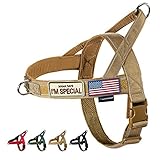
- [Premium No Pull Dog Harness] The wider soft padded inner is comfortable and friendly for dog's neck without dog's fur hurting. The back strap and chest strap inner is made of soft and breathable material that is comfortable for the dogs. And the front strap is better to prevent the dog from rushing forward. This design is maintain a long-time comfortable for walking,jogging,running,training,etc.
- [Reflective Strip] Reflective stitching along polyester webbing is not only add a sense of design to the safe for walking dog harness,but also increase a better visibility at dark under the light that it can keep the dog safe while walking.
- [Two Rings Design] The O-ring and D-ring is convenient and flexible to hang,they not only can connect well with dog leash,but also can hang ID tags,key,poop bag,etc.
- [Choose the Suitable Dog Harness] The no pull dog harness have FIVE sizes,XS is design 1 inch wide / S M L XL are design 1.5 inches wide for the small & medium and large dogs. PLEASE measure the size of the dog and refer the dimension chart to select the right one before buying.
- [Come with TWO Patches] There has a velcro area on the dog walking harness,and come with 2 patches, you can put the patches "MAMA SAY I'M SPECIAL" or the flag on the dog harness velcro area to make your dog unique.
What are the first signs of heatstroke in a brachycephalic dog?
Early recognition matters because deterioration can be rapid. Compare the dog’s breathing with its normal response to gentle activity and look for several signs together, not a single isolated behavior.
- Heavier, faster or excessive panting that does not settle with rest.
- Unusually thick drool or difficulty managing saliva.
- Restlessness, anxiety or inability to settle.
- Altered or labored breathing, noisy airway sounds or obvious effort to inhale.
- Lethargy, weakness, stumbling or incoordination.
- Bright-red, pale, gray or otherwise abnormal gums.
- Vomiting or diarrhea.
- Confusion, collapse or seizures.
Any combination of abnormal breathing, weakness, altered gums, vomiting, collapse or neurologic signs should be treated as heatstroke. Do not wait for a thermometer reading or for the dog to become unconscious.
What should I do if my dog is panting heavily after a walk?
Stop the activity at once. Move the dog to shade or air conditioning, begin active cooling, and call a veterinarian or emergency clinic immediately for instructions. If the dog is alert and can swallow normally, offer small amounts of water; never force water into a weak, confused or collapsed dog.
- Get out of the heat. Move away from sun and hot pavement. Use a cool indoor room, vehicle air conditioning or another well-ventilated shaded area.
- Cool with cool or tepid water. Wet the body, especially areas with less fur, while avoiding the nose and mouth. Use moving air from a fan or vehicle vents to improve evaporation.
- Keep cooling during transport. Call ahead, continue gentle cooling and follow the clinic’s directions. RECOVER guidance supports active on-scene cooling before transport when it is safe, because every minute at a high temperature can increase injury.
- Offer only safe drinking. If fully alert and able to swallow, provide small sips. Do not force fluids and do not give medication unless a veterinarian directs you.
- Avoid extreme cold. Do not use an ice bath, ice water immersion or aggressive rubbing. Extreme cold can constrict surface blood vessels and cause shivering, which interferes with heat loss.
- Go to the clinic even if signs improve. Internal organ damage and clotting problems may develop after the dog appears calmer.
Do not delay the call while searching for specialized equipment, taking photos or trying to obtain a rectal temperature. Cooling and professional care are more important than documenting the episode.
How do age, weight and illness change a dog’s walking plan?
Fitness and health determine how much heat a dog can produce and shed. Keep a lean body condition; excess fat increases insulation and the effort required to move and breathe. Puppies, seniors and dogs recovering from illness generally need shorter, closely supervised outings than healthy adults.
Dogs with airway, heart or respiratory disease
Ask your veterinarian for an individualized exercise and heat-management plan if the dog snores heavily while awake, has noisy breathing, tires quickly, has fainted, coughs, or has diagnosed airway, heart or lung disease. A harness and cooler schedule may reduce strain, but neither treats an obstructed airway or heart problem.
Also popular on Amazon

- Helps Stop Pulling: Patented Martingale loop design puts gradual pressure on your dog's shoulders to safely and effectively stop pulling; a front leash attachment helps you guide your dog
- Legacy Of Trust: Created by a veterinary behaviorist in 2004, the Easy Walk harness is loved and trusted by a million pet parents and trainers
- Comfortable Fit: Easy Walk harness has less coverage than other harnesses making it lightweight and very breathable
- No Gagging Or Choking: Rests across your dog's chest instead of his throat to stop gagging and choking if he pulls
- Easy to Fit: Quick-snap shoulder straps and a different color belly strap make it simple to put the harness on your dog
Dogs with previous heat illness
After any suspected heatstroke, obtain veterinary clearance before resuming normal walks. Keep future activity conservative, track the conditions that preceded the episode and stop earlier than you did previously. A history of heat illness is a reason for stricter management, not evidence that the dog has “acclimatized.”
Why are parked cars and pavement dangerous even when the air feels tolerable?
A parked car can become a heat trap within minutes. Opening windows does not make it safe, and shade moves as the sun changes. The BWG reports that, in the United Kingdom, peak internal car temperatures occur between 2 p.m. and 5 p.m., with interiors exceeding 35°C between April and September. Never leave a dog in a parked vehicle, even briefly.
Hot pavement is a separate hazard from air temperature. It can burn paw pads and radiate heat into the dog’s body. A route that feels acceptable in a shaded park may be unsafe on exposed tarmac. Test the actual surface, choose grass or shade when possible and turn back if the dog’s paws become tender or the ground heats up.
Independent reader supportYour contribution helps us test, update, and keep practical guides available for everyone.How common is heat-related illness in flat-faced dogs?
Available figures show why conservative planning is justified, although they are not a personal risk calculator. The British Veterinary Association reported in 2018 that almost two-thirds of veterinarians had treated animals affected by hot weather and half had treated animals for heatstroke.
Do these 3 things before closing this tab:
1Clear out junk files and repair common Windows errors2Scan for outdated or missing drivers - takes under a minute3Repair Windows errors before they cause bigger problemsPDSA reported in 2023 that British Bulldogs were 14 times more likely than Labradors to develop heatstroke, while Pugs were six times more likely. Those comparisons describe population-level risk and do not establish a safe temperature for an individual dog.
The RSPCA states that dogs are 10 times more likely to suffer heat-related illness from exercising in hot weather than from overheating in cars. The page does not give a publication year, so treat that figure as undated rather than as a current annual estimate. It reinforces the practical priority: reduce exertion in heat, not only time spent in vehicles.
Also popular on Amazon

- 【No Pull & No Choke Design】: This harness simply goes through the dog's head, snaps on the belly and that's the end of it. Besides, the D-ring on the chest strap is used for no pull dog training and guiding direction, and the O-ring on the back is used for daily dog walking. The triangular design on both sides of this no pull harness helps to distribute the pulling force, so you don't have to worry about the dog choking when suddenly pulling.
- 【Soft Velvet Padded & Durable】: With soft thicken and wider fleece pads used beneath the strap of neck, back and handle atop, this dog harness could reduce friction from movement and protect the health of the dog's skin. It also uses superior nylon material to ensure long-lasting use.
- 【Leash Double Handle & Elastic Band】: You can use the top handle for casual dog walking, and the center handle for controlling the direction of the dog, easily guiding it through crowded areas and preventing storming in case of accidents. And the springy design of the leash really absorbs the pull from large strong dogs without tugging on your wrist and shoulder.
- 【Neck & Chest Adjustable】: SlowTon dog harness is equipped with adjustable loop for both neck and chest girth, and the quick-release buckle allows for quick donning. No matter what kind of breed and shape, it provides proper length after adjusting to fit your dog's neck and chest, which is perfectly designed for walking, jogging, running, hiking and training.
- 【Tangle-free Leash & Reflective】: The heavy-duty 360°swivel metal hook ensures no tangle. Plus, it has an elastic bungee and 2 padded handles, which is great for walking training of city dogs, or wandering off in country. Furthermore, its super bright reflective strips ensure a safe walk both day and night. And it comes with 2 hook and loop straps, a regular one Support Dog and the reflective one DO NOT PET.
Dr Dan O’Neill, chair of the Brachycephalic Working Group, summarizes the precautionary approach as: “when in doubt, don’t go out – Dogs Die on Hot Walks.”
What is the safest decision when conditions are uncertain?
Use this quick check before clipping on the lead. If any answer is unfavorable, choose the safer option rather than trying to compensate with a product.
The Tool Desk
Outbyte Driver Updater FREEScan for outdated or missing drivers - takes under a minuteDriver Scan →Outbyte PC Repair FREERepair Windows errors before they cause bigger problemsFix Now →| Check | Lower-risk situation | High-risk response |
|---|---|---|
| Heat index and humidity | Cooler period with comfortable humidity. | Postpone or skip the walk during oppressive heat or a heatwave. |
| Sun and shade | Continuous shade and airflow. | Stay indoors when the route is exposed or still. |
| Dog’s breathing and fitness | Quiet breathing at rest, lean body condition, no known disease. | Seek veterinary advice and use only brief toileting for noisy, labored or abnormal breathing. |
| Surface temperature | Hand test remains comfortable for several seconds. | Avoid hot pavement; choose a cooler surface or postpone. |
| Water and exit plan | Fresh water, shade and a short route home are available. | Do not start if water, ventilation or rapid access to shelter is missing. |
Reassess during the outing. Weather can worsen, shade can disappear and a dog’s breathing can change without warning. Ending the walk early is successful prevention, not a failure to exercise.
What should I prepare before the hot season?
- Identify the coolest walking times and shaded routes in your neighborhood.
- Keep fresh water, a portable bowl and a towel ready near the door.
- Check harness fit before the first warm-weather walk.
- Ask your veterinarian to assess weight, airway, heart and respiratory health and to set an appropriate activity level.
- Save the nearest emergency clinic’s contact details and plan an air-conditioned transport option.
- Teach household members never to leave the dog in a parked car.
- Practice calmly entering a cool room or vehicle so an emergency move is less stressful.
Frequently Asked Questions
Can a fan by itself prevent heatstroke in a flat-faced dog?
No. Airflow helps water evaporate during active cooling, but a fan cannot offset intense heat, humidity, direct sun or strenuous exercise. Use it with shade or air conditioning, cool water and reduced activity.
Should I make my dog finish a walk to keep its fitness up?
No. Fitness goals never override breathing or heat warnings. End the outing when panting becomes abnormal, and discuss a gradual, weather-dependent exercise plan with your veterinarian.
Is it safe to give ice water after a hot walk?
Offer small amounts of ordinary cool water if the dog is alert and swallowing normally. Do not force fluids or use ice baths; suspected heatstroke requires controlled cooling and immediate veterinary guidance.
What if my dog seems normal again after cooling down?
Arrange veterinary advice after any episode involving unusual panting, weakness, vomiting, altered gums, confusion or collapse. Heat-related organ injury can develop after outward signs improve.
Can a harness make a midday walk safe?
No. A harness may reduce neck pressure and airway compression compared with a collar, but it does not lower environmental heat or replace shade, water, shorter outings and skipping walks in dangerous conditions.





Leave a Reply