
Some links on this page are affiliate links: if you buy through them we may earn a commission, at no extra cost to you.
Reduce a rescue dog’s excessive barking by identifying what the bark communicates, lowering exposure to its triggers, and rewarding a calm alternative. A newly adopted dog may be frightened, overstimulated, bored, in pain, seeking attention or distressed when alone. The right response depends on that cause; there is no universal “stop barking” fix.
Begin with several quiet days or weeks of decompression, a predictable routine, a safe retreat and a veterinary check when barking is new or changing. Then prevent rehearsal of the problem, teach a calm behavior such as going to a mat, and increase difficulty only while the dog remains relaxed. Reward-based training is safer and more effective than punishment or aversive collars.
As an Amazon Associate I earn from qualifying purchases.
Do these 3 things before closing this tab:
1Scan for outdated or missing drivers - takes under a minute2Repair Windows errors before they cause bigger problems3Fix the driver behind crashes, sound loss and screen glitchesWhy is my rescue dog barking so much?
Barking is normal communication, not a diagnosis. The same sound can signal fear, alarm, greeting, attention seeking, frustration, boredom, pain or distress about being left alone. Your first job is to identify the trigger and the consequence: what the dog notices, how close it is, what the dog’s body is doing, and what happens after the bark.
A dog that barks at a stranger outside the window has a different problem from one that barks for play, and both differ from a dog that starts vocalizing within minutes of your departure. Treat the motivation, not simply the noise. Suppressing every bark without addressing fear, pain or separation distress can make the underlying problem worse.
Popular on Amazon

- Dog Friendly Materials: Not Suitable for Aggressive Chewers. Treat dispensing dog toys are made of ABS and nylon material. It is a sturdy, safe food container that resists pet damage, provides a long-lasting and safe play experience. You can give your dog confidently use interactive dog toys. At the same time, in order to make the dog puzzles for smart dogs quieter when rolling, the material of the dog enrichment toys for large dogs roller is made of rubber, less noise
- Food Adjustment Distribution: Mental enrichment toys for dogs have two adjustable switches, you can control the amount of food by adjusting the size of the dog puzzles for large dogs switch to extend the feeding time. Dog toys to keep them busy are also designed with a special spiral structure to make the dog puzzle feeder more challenging. If you want to give a birthday gift to your furry friend, these large dog puzzle toy are good choice, it will like this dog treat dispenser toy
- Improve Intelligence & IQ Training: Dog treat toy is an interactive chase toy that combines puzzles and treat dispensing, pets learn the process of rolling the dog treat puzzle to make treats fall and get treats, which helps to improve intelligence and stimulate the brain, Mental stimulation for dogs will relieve anxiety and reduce boredom, best dog toys to keep them busy for hours. Our dog food puzzle feeders, like other interactive dog toys for boredom are best played under supervision
- Slower Feeding: BoYoYo dog stimulation toys to keep them busy and food puzzles for dogs that reduces your dog's eating speed, cultivate slow eating habits in dogs to promote digestion, allowing your dog to enjoy a more enjoyable mealtime. It is a great alternative to dog slow feeder toy, lick pad for dog, and snuffle mat for dog. These are multi-functional dog puzzles for large dogs
- Attracting Dog Attention: Put your dog's favorite dog food or snacks inside the dog mental stimulation toys to better attract your dog's attention! Keep your dog engaged and active, puzzle treat toys for dogs can divert attention from destructive behavior to positive play, one of the best interactive dog toys for large dogs to keep your dog busy. This interactive dog toy is suitable for medium and large pet, can also be used as a cat puzzle toy and cat treat puzzle
How long does a rescue dog take to settle in?
Expect decompression to take several days to a few weeks, with wide variation between dogs. A shelter or foster move changes the dog’s people, smells, sounds, sleep and rules all at once. Barking may temporarily increase while the dog learns what is safe and predictable.
Create a low-stimulation landing zone
- Choose a quiet room or gated area with a bed, water and safe chew or food toy. Keep it available as a retreat, never as punishment.
- Limit visitors, parties, unnecessary errands and crowded outings during the first days.
- Let the dog choose whether to approach. Avoid reaching into the safe space, forced handling or insisting on greetings.
- Keep meals, toilet breaks, walks, play and rest at consistent times. Predictability lowers the number of surprises that can trigger barking.
Some dogs become more vocal as they gain confidence and begin noticing the neighborhood. That does not mean decompression failed; it means you can now observe a clearer pattern and train below the dog’s stress threshold.
Quick wins for a faster PC:
Fix the driver behind crashes, sound loss and screen glitchesFind Drivers →Clear out junk files and repair common Windows errorsFree Scan →How do I know what is causing the barking?
Keep a simple log for at least several days. Record the date and time, location, target, approximate distance, body posture, duration, what happened immediately beforehand and what happened after the bark. Note whether the dog can eat, respond to its name or turn away; those details show how close the dog is to its limit.
Look at the whole body
- Fear or defensive alarm: crouching, tucked tail, lip licking, ears back, retreating, growling or lunging can accompany barking.
- Greeting or excitement: loose movement, wiggling, jumping and seeking contact often appear around familiar people or dogs.
- Frustration: staring at a toy, door or other dog, whining, pulling or bouncing may show that access is blocked.
- Attention or demand: the dog looks toward you, repeats the bark after you respond, or stops when it receives interaction.
- Separation-related distress: barking begins after you leave and may occur with pacing, destruction, elimination or escape attempts.
When should a veterinarian check the dog?
Arrange a veterinary examination when barking is new, sharply increased or accompanied by pain, altered hearing, appetite changes or other signs of illness. Medical problems can lower a dog’s tolerance for ordinary sounds and movement. Ask the veterinarian whether discomfort, hearing changes or another condition could be contributing before beginning an intensive behavior program.
There is no robust, directly applicable prevalence statistic for excessive barking specifically among newly adopted rescue dogs. A frequently repeated claim that eight out of 10 dogs become stressed when left alone lacks an identified study and year in the source passage, so it should not be treated as a verified headline statistic.
What should I do about the most common barking triggers?
Use management first so the dog practices barking less often, then teach a replacement behavior. The table shows a starting plan for each common pattern.
Recommended Free Tools
| Trigger or motivation | Immediate management | Replacement behavior and reward |
|---|---|---|
| Windows, yard, door or territorial alarm | Use removable translucent film, curtains, opaque fencing or supervised outdoor access to block the view. | Guide the dog to a mat or safe area and feed for quiet, relaxed observation. |
| Greeting visitors | Set the dog behind a gate or on leash before opening the door; keep arrivals low-key. | Practice sit or stay away from the door. Reward four paws on the floor, quiet and holding a toy. |
| Attention or demand barking | While barking, remove eye contact, speech, touch and access to the requested item. | The instant silence begins, cue sit, touch, bring a toy or ring a bell, then reward that behavior. |
| Boredom or frustration | Increase age-appropriate exercise, sniffing, short training sessions, food puzzles and supervised chews. | Ask for wait, sit or stay before walks, play, meals or access to an interesting area. |
| People or dogs on walks | Work below the distance that triggers barking; turn away or add distance when the dog becomes tense. | Feed tiny, high-value treats while the trigger passes and reward choosing not to bark. |
| Other dogs’ barking | Reduce exposure, use indoor management and sound masking, and avoid repeated close encounters. | Redirect to treats or play before the dog escalates. |
| Fear, aggression or compulsive patterns | Do not punish, confront or use a bark collar. | Obtain veterinary behavior guidance and a carefully managed behavior plan. |
Window, yard and door barking
Visual access is often the rehearsal loop: the dog sees a person, dog or vehicle, barks, and the target disappears. The dog may conclude that barking made it leave. Blocking the view with removable privacy film, curtains or fencing breaks that loop. Supervise yard time rather than leaving the dog outside to patrol.
Also popular on Amazon

- [Treat Distribution] Our food dispenser has differently sized spheres at both ends. As dogs push the toy, it moves within a fixed area, allowing dogs to continuously chase and play with it. During movement, food is dispensed from the food holes on both sides of the toy.
- [Adjustable Switch] Each of the two spheres with a food dispensing switch, making it suitable for various sizes and types of pet dry food or snack. The switch can be adjusted according to the different sizes of dog food. It also allows control over the amount of food dispensed, extending or shortening the time it takes for pets to obtain food. It is more conducive to a healthy dog diet.
- [Increase Pet Intelligence] This dog treat puzzle toy combines intellectual training with food rewards. When pets push this toy, it will not only be to get delicious food, but it will also stimulate their intelligence and hunting instinct. This design not only meets the needs of pets but also encourages them to learn and grow in the game.
- [Prolonged Play] The dog enrichment toy is designed to limit the amount of treats your dog gets while encouraging more extended playtime. This is intended for effective playtime for dogs and is NOT a chewed toy. It is also dog boredom buster toys and best dog gift to keep them busy when dogs are left home alone, relief anxiety.
- [Attract Dogs' Attention] With barbell shaped design and bright color, the dog puzzle toy ball can attract your dog's attention, stimulate their curiosity and drive them crazy to roll it. Size: 6.1*3.44*3.44in/15.5*8.7*8.7cm.
When a trigger appears at a manageable distance, calmly call the dog to a mat or another room and feed for looking at you or relaxing. Do not drag a frightened dog toward the window or force it to “face” the trigger.
Greeting barking at the door
Practice when no guest is present. Walk to the door, ask for a sit or stay, return to reward, and repeat in brief sessions. Later, have a helper approach while the dog remains behind a gate or on leash. Reward four paws on the floor and quiet; if barking starts, increase distance and make the exercise easier.
A toy to carry can give an excited greeter another job. Keep arrivals calm and avoid shouting over the barking, which can sound like you are joining in.
Attention and demand barking
Responding with talking, touching, eye contact or the requested resource can strengthen demand barking, even when the response is a reprimand. Wait for a brief pause, then cue an incompatible behavior such as sit, touch, bringing a toy or ringing a bell. Deliver the walk, play or interaction after the alternative, not during the bark.
At first, reinforce a very short pause. Expecting a long silence from a dog that has rehearsed the behavior for months will create frustration for both of you.
Boredom and frustration barking
Meet the dog’s needs with a combination of sniffing walks, age-appropriate physical activity, short reward-based training, food puzzles and supervised chews. Mental work can tire a dog without adding high arousal. Rotate activities so the dog does not learn that barking is the fastest way to start them.
Teach “wait,” “sit” and “stay” before opening the door, clipping the leash, releasing a toy or placing down a meal. Begin with seconds of success and gradually add time.
Free tools Windows power users keep installed
One-click scans. No signup required.
Also popular on Amazon

- 【Size】: L9.44" * W9.44"* H1.14" suitable for cats, puppies and small dogs.
- 【Interactive Dog Toys】This is a interactive puppy puzzle , which can easily become the closest companion and toy for your puppies and cats, and will release pressure for dogs. Find food by sliding parts to improve eating pleasure and IQ.
- 【Slow Feed Bowl】This encourages pets to eat at a slower speed, helps to slow down the feeding time to help the dog digest, and can provide your dog with a variety of healthy snacks.
- 【Slow Feede toys】 Use this educational game toy to exercise the dog’s brain, which will help meet the dog’s instinct needs, train the pet’s sense of smell, and let the dog enjoy feeding when using the nose or paw to move the slider, while providing spirit stimulate.
- 【Dog toys】No toy is indestructible. Do not leave toys with unsupervised pets. Remove and replace toy if damaged.
Barking at people or dogs on walks
Find the distance at which the dog can notice the person or dog and still eat and respond to you. Feed tiny, high-value treats continuously or in rapid succession while the trigger passes, then stop when it is gone. Over repeated calm exposures, reduce distance by small increments.
If the dog stares, stiffens, growls, lunges or refuses food, you are too close. Turn away, cross the street or use a parked car or hedge as a visual barrier. Distance is not failure; it is what keeps the dog able to learn.
Barking in response to other dogs
Close windows, move the dog to an interior room or use gentle sound masking when neighborhood barking sets off a chain reaction. Redirect early to treats, a toy or a mat. Repeatedly allowing a full barking exchange through a fence or window makes later interruption harder.
How do I teach a “quiet” cue?
Teach quiet as a calm, rewarded behavior rather than a punishment. Start with a trigger that produces only a few barks and keep treats ready.
The Tool Desk
Outbyte Driver Updater FREEFix the driver behind crashes, sound loss and screen glitchesFind Drivers →Outbyte PC Repair FREEClear out junk files and repair common Windows errorsFree Scan →- Allow one brief bark or present the mild trigger at a distance.
- Say “Quiet” once in a calm voice. Do not repeat the cue or shout.
- The instant silence starts, feed a steady stream of tiny treats. At first, reward about two seconds of quiet.
- Release the dog or guide it to a mat, sit or eye contact, then reward again.
- Gradually lengthen the quiet interval—two seconds, then several more—only while the dog remains relaxed.
- Practice in different rooms and with mild variations before tackling the hardest trigger.
If the dog becomes more frightened, cannot eat or repeatedly fails, stop the exercise and make the trigger easier. A qualified reward-based trainer or veterinary behavior professional can adjust the plan.
Why does my rescue dog bark when I leave?
Barking that begins within minutes of departure and persists, especially with pacing, destruction, elimination or escape attempts, may be separation-related distress rather than ordinary boredom. A camera can show what happens after you leave, but use it only to observe safely; do not wait through escalating panic to collect footage.
A gradual alone-time plan
- Prepare a quiet area and a stuffed food toy that the dog already enjoys while you are home.
- Give the toy immediately before a practice absence.
- Step out for one or two seconds and return before distress begins.
- Wait for full relaxation, then repeat. Keep departures and arrivals calm and uneventful.
- Increase the absence by small increments only when the dog stays relaxed. If stress signs appear, shorten the next absence.
- Use a sitter, friend or other management during longer real-world departures that exceed the dog’s current ability.
The stuffed toy is a safety cue and enrichment, not a cure by itself. If the dog will not eat, injures itself, attempts to escape or cannot tolerate even brief absences, seek veterinary behavior help rather than increasing the duration.
Also popular on Amazon
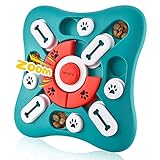
- 【PRODUCT SIZE】10 inch*10 inch*1.3 inch.
- 【3 WAYS TO PLAY, UPGRADE SLOW FEEDER】Our dog mental stimulation toys have a unique squeak button in the middle, which make it easier to attract the attention of dogs and cats. Three different difficulty designs and the 16-hole dog treat dispenser design maximize slow feeding time, even beyond 20 minutes.
- 【FUNNY STIMULATING TOYS】All kinds of dogs and cats love the puzzle game of Spin & Slide and the Seek & Hide with their smell sense and paw skills to find food. Combining circular orbit sliding game and linear orbit sliding game, smart dog and cat must move the slider correctly to get the food reward hidden in the maze.
- 【NON-REMOVABLE PARTS DOG PUZZLE】Our dog treat puzzle is made of non-toxic materials, very durable and suitable for pets to play for a long time. This dog toy has no removable parts because the design has built-in play parts that fold tightly and won't fall off easily.
- 【ANTI-SLIP & EASY TO CLEAN】: The four corners of the bottom are equipped with four anti-skid pads, which can be well fixed during the dog's slow food process; It is easy to clean, also dishwasher safe.
Are bark collars safe?
Veterinary behavior authorities do not recommend aversive devices as a first choice. Shock, spray, ultrasonic and other bark collars can suppress a sound without changing fear, frustration, pain or separation distress; they may also add fear and make the trigger more threatening. The American Veterinary Society of Animal Behavior states, “There is no evidence that aversive training is necessary for dog training or behavior modification.”
Dr. Katherine Houpt of Cornell University College of Veterinary Medicine summarized the trade-offs this way: “Shock is nasty, ultrasound only works a few times, and citronella is okay, but it’s still punishment.” RSPCA Australia’s guidance likewise says, “Training should be reward-based and use positive reinforcement.”
For a fear, aggression or compulsive case, punishment can suppress warning signals while leaving the emotional problem intact. Choose management, reinforcement and professional assessment instead.
Independent reader supportYour contribution helps us test, update, and keep practical guides available for everyone.Which tools actually help with barking?
Choose an aid by asking four questions: does it reduce exposure to a known trigger, add safe enrichment or deliver reinforcement; can it be used without pain or fear; can you supervise and size it correctly; and does it support a behavior plan rather than conceal a medical or anxiety problem?
- Interactive dog puzzle toys and food-stuffed toys: provide enrichment and a calm activity. Supervise initially, select a size the dog cannot swallow and stop if the toy breaks or causes guarding.
- High-value training treats: make it possible to reinforce quiet, orientation to you and calm choices around triggers. Use tiny pieces so many repetitions do not become a full meal.
- Removable privacy window film: reduces visual alarms while preserving light and can be removed when the dog no longer needs it.
- Gates and opaque barriers: prevent access to doors, windows or fence lines and make it easier to deliver a mat or settle routine.
- Sound masking: can reduce reactions to other dogs’ barking when paired with distance and redirection. It should not replace investigating why the dog is vocalizing.
Any item can be misused. Check fit, inspect it regularly, supervise chews and stop using a tool that increases fear, guarding or arousal.
PC Slower Than It Used to Be?
A free scan shows the junk files, broken settings and background clutter dragging Windows down - then fixes them in one click.Free scan · Windows 10 & 11Crashes, No Sound, or Screen Glitches?
Random freezes, missing sound and display glitches usually trace back to one bad driver. Find and replace yours safely.Free scan · under a minuteWhen should I get professional help?
Contact a veterinarian, veterinary behaviorist or qualified reward-based trainer when barking involves fear, aggression, compulsive repetition, self-injury, severe separation distress, injury risk, major neighbor disruption or no meaningful improvement despite consistent management. A veterinarian can address medical contributors; a behavior professional can design controlled exposure and reinforcement steps.
Bring your barking log and short, safely recorded observations. Include the dog’s adoption date, previous history if known, daily routine, sleep, appetite, medications and every strategy you have tried. Accurate context prevents a professional from treating a greeting problem as separation distress or a pain problem as disobedience.
Also popular on Amazon

- 【Product Size】10 inch*10 inch*1.2 inch.
- 【Interactive Dog Puzzle Toys 】This is a fun interactive puzzle toy,which can encourage and train your dogs or cats to seek foods by sliding the slider, helping pets to increase IQ by learning sequential steps and the challenging play.
- 【Squeaky Dog Toys】This dog puzzle toys is designed with a sounding device in the middle of the toy,which is to attract the pet's attention.Also,you would enjoy the fun of dog squeak puzzle toy with your pets, greatly improve relations with your pets and get fun during interactive dog games.
- 【Mental Excecise&Boredom Buster】Our memory training puzzle toy can keep smart dogs busy and engaged in more thinking and activities.Therefore,clot stimulation toys are great for reducing dogs’boredom,anxiety and destructive behaviors.
- 【Food-Safe PP Material】This dog treat puzzle is made with toxic-free, food-grade PP material. It is durable for interactive play and mental enrichment but not designed as a chew toy. Always supervise your pet during use.Easily washable with water or in the dishwasher.Note: No toy is indestructible. Remove and replace the toy if damaged.
What progress should I expect?
Measure improvement by fewer episodes, lower intensity, shorter duration and faster recovery—not by perfect silence. Setbacks are common after a move, a visitor, a schedule change or an unexpectedly close trigger. Return to an easier step rather than correcting the dog for struggling.
There is no reliable universal timeline. Cause, learning history, health, environment and how often the dog rehearses barking all affect the pace. Consistent routines, blocked triggers and rewards for calm give you the best chance of steady progress while preserving the dog’s sense of safety.
Frequently Asked Questions
Should I ignore every bark from a newly adopted dog?
No. First check for a medical change, a genuine safety concern or a trigger the dog cannot escape. For attention barking, withhold the requested interaction during the bark and reinforce a quiet alternative; ignoring fear or pain without changing the situation is not a training plan.
Can white noise stop my dog reacting to neighborhood barking?
Sound masking can lower exposure to another dog’s bark, especially in an interior room, but it works best alongside blocked windows and early redirection. Keep the volume comfortable and discontinue it if your dog becomes more alert or distressed.
What should I do if my dog stops eating during trigger training?
Move farther from the trigger or make the situation easier immediately. Refusing food usually means the dog is too stressed to learn; continue only when the dog can relax and take treats, or ask a qualified professional to adjust the setup.
How can I tell whether a food toy is safe for my rescue dog?
Watch the first sessions, choose a toy large enough that it cannot be swallowed, and inspect it for cracks or loose pieces. Remove it if the dog guards it intensely, breaks off chunks or becomes frustrated rather than calmly engaged.





Leave a Reply