
Do these 3 things before closing this tab:
1Clear out junk files and repair common Windows errors2Scan for outdated or missing drivers - takes under a minute3Repair Windows errors before they cause bigger problemsSome links on this page are affiliate links: if you buy through them we may earn a commission, at no extra cost to you.
Bring a stray dog home only when you can do so without risking a bite, a traffic accident, an escape, or disease exposure to people and resident animals. Watch the dog before touching it. A calm, cooperative dog may be guided with food and a secure leash; an injured, highly fearful, aggressive, or impossible-to-load dog needs animal control or another qualified local service. Once secured, put the dog in a closed, escape-resistant room that your dogs and cats cannot enter. Use separate bowls, bedding, and toilet supplies, arrange a microchip scan and veterinary assessment, and follow local lost-dog and holding rules before considering adoption or introductions.
What should I do before touching a stray dog?
Pause and assess the dog, the surroundings, and your own ability to control the situation. Human safety and the safety of resident pets come before capture. Do not chase, corner, grab, or loom over a dog that is warning, panicking, or unable to move normally.
As an Amazon Associate I earn from qualifying purchases.
The Tool Desk
Outbyte PC Repair FREEClear out junk files and repair common Windows errorsFree Scan →Outbyte Driver Updater FREEFix the driver behind crashes, sound loss and screen glitchesFind Drivers →Look for signs that require professional help
- Labored breathing, collapse, uncontrolled bleeding, severe pain, or an obvious fracture.
- Neurologic changes such as staggering, seizures, unusual confusion, or inability to stand.
- Growling, snapping, lunging, repeated charging, a rigid body, raised hackles, or a bite attempt.
- Extreme fear, frantic escape attempts, or behavior suggesting the dog cannot tolerate a person approaching.
- A location where capture would expose you or the dog to traffic, heights, water, or other immediate hazards.
Call animal control, a municipal shelter, or the equivalent local service when any of these conditions apply. Humane handling standards favor the least-aversive capture method and only the restraint needed to keep people and animals safe. Improvised restraint of a terrified or aggressive dog can turn a recoverable situation into a bite or escape.
When a calm approach may be reasonable
Stay side-on rather than facing the dog head-on. Speak quietly, avoid sudden movements, and let the dog choose whether to approach. Toss small pieces of food on the ground instead of reaching over its head. Keep children and your own pets away, and ask another adult to open gates or control doors so the dog cannot run into traffic or a house full of animals.
Popular on Amazon
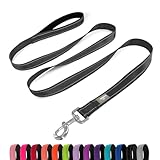
- TWO STYLES:We have two different styles of dog leash for you to choose from,High Brightness Reflective dog Leashs would be reflective when lights shine on it at night. Can keep your doggie safe during evening walks or runs ,And There is another style available,Our basic nylon dog leashe without reflective effect,Soft and lightweight, hand washable add durability,suitable for daily dog walking.
- SIZE OPTIONS: Length:6 FT. Dog Leashs are Choose 3 width sizes . The 5/8'' width version fits small dogs, and the 3/4'' width version suits medium dogs. and the 1'' width version suits large dogs .So you can choose the size that works best for your dog.
- MATERIAL: Nylon fabric with high density webbing to add durability.The handles have a soft cushion padding on the inside grip, Although your pet is very active, this handle is also very comfortable to hold.protect your hand from rope burn.DURABLE 360°METAL CLASP,The easy to use clasp is composed of a nickel-plated zinc alloy for durability.Maintain control while walking your pet with a Pet Safe Nylon Leash!
- Reflective dog Leashs available in 9 colors.(Black.Red.Green. Blue.Purple.Pink.Green.Sky Blue.Hot Pink) Our soft, flexible basic nylon leashes are available in 9 colors too (Black.Red.Blue.Green.Blue.Purple.Light Blue.Pink.Hot Pink.Orange.)
- The matching reflective nylon collar is available by searching the asin "B0CRTFFH15" The matching basic nylon collar is available by searching the asin "B09M2ZGZ9B"
If the dog remains relaxed and allows handling, clip a properly fitted leash or slip lead without placing your face near its mouth. Keep the leash short enough to prevent bolting but do not jerk, drag, or tie the dog to an unsafe object. A cooperative dog can then be moved to a secure vehicle or crate. If the dog stiffens, freezes, backs away, growls, or tries to flee, stop and call animal control rather than escalating the restraint.
How can I transport the dog without exposing my pets?
- Prepare the route first. Close doors and gates between the capture point and the vehicle. Remove resident dogs and cats from the vehicle and from any hallway the stray will use.
- Use secure equipment. A calm dog may travel on a leash; a crate can add containment if the dog is comfortable entering it. Check that doors, windows, and the crate latch are secure before moving.
- Keep physical distance. Do not allow nose-to-nose contact with your pets at the vehicle, doorway, or destination. Covering a crate can reduce visual stimulation, but it does not replace ventilation or supervision.
- Drive directly to the isolation area or an agreed veterinary or shelter intake. Avoid stops where the dog could slip out. Never leave a stray unattended in a vehicle, especially in heat or cold.
- If loading becomes unsafe, stop. A dog that cannot be loaded without wrestling, cornering, or repeated attempts should be handled by animal-control personnel with appropriate equipment.
Transporting the dog in your car does not make it yours. Keep any receipt, intake number, or report supplied by the shelter, veterinarian, or authority; it can help establish where and when the dog was found.
How do I set up a true isolation space at home?
Choose a room with a solid, closable door that resident animals cannot open or bypass. A bathroom, laundry room, spare bedroom, or secure utility area is usually easier to clean than a carpeted living space. A pet gate can provide a second barrier, but it is not enough by itself for an escape-prone dog; the closed door remains the primary control.
Set up the room before bringing the dog inside
- Remove hazards, breakables, medications, chemicals, electrical cords, and objects the dog could swallow.
- Provide the stray’s own food and water bowls, washable bedding, and a separate toilet area.
- Use surfaces that can be cleaned and disinfected. Keep resident-pet bowls, toys, bedding, litter equipment, and grooming tools out of the room.
- Check window screens, vents, door gaps, and any second exit. Block escape routes without reducing airflow.
- Place cleaning supplies outside the room so you can clean without leaving the door open.
Keep the dog and resident pets completely apart: no shared yard time, play, greetings under the door, or access to the same bowls and bedding. Wash your hands after handling the stray, its waste, bowls, or bedding and before touching your own animals. Change or cover contaminated clothing when practical, and clean shared surfaces such as door handles and floors.
Make the first hours quiet
Limit visitors, noise, handling, and forced interaction. Offer water and a small meal unless a veterinarian has instructed otherwise. Do not punish accidents, barking, hiding, or defensive behavior. Record what the dog eats, drinks, urinates, defecates, and how it responds to people; these observations help the veterinarian and shelter make safer decisions.
How do I find the owner and follow the law?
Check for a collar and readable identification tags without putting your fingers near a fearful dog’s mouth. Arrange a microchip scan as soon as possible through an animal shelter, veterinary hospital, council, or animal-control service. A chip may be registered outside your city, so ask the scanning organization to follow its contact procedure rather than assuming no owner exists.
Also popular on Amazon

- ENHANCED NIGHT VISIBILITY: Keep your dog safe during early morning or evening walks. The upgraded double-sided reflective stitching catches streetlights and car headlights brightly, ensuring you both remain highly visible to traffic in low-light conditions
- CUSHIONED ANTI-BURN HANDLE: A savior for hands when walking active dogs that pull. The soft, thick interior padding prevents painful rope burn and strain, providing a secure, comfortable grip for better control when your furry friend lunges. Includes a sturdy metal D-ring for clipping poop bag dispensers
- PERFECT 6FT BALANCE: The ideal length for urban walks, offering your dog enough freedom to sniff around while keeping them close enough for easy command in busy areas. Choose the 3/4'' width for small breeds, or the robust 1.0'' width for powerful medium to large dogs
- HEAVY-DUTY TANGLE-FREE CLASP: Features a strong metal spinning snap that allows 360° movement, preventing frustrating leash tangles so your dog can move freely around you. Built with high-density nylon webbing for reliable daily strength. NOTE: While tough for pulling, this nylon material is NOT chew-proof. Don't leave unattended with chewers
- COMPLETE THE LOOK: Available in vibrant colors tailored to match your dog's style. For the ultimate coordinated walking set, pair this leash with our matching Joytale reflective nylon collar
Post a factual found-dog notice using the local lost-pet system and notify the authority that handles strays in your municipality. Describe the general location, date, approximate size, sex, coat, and visible identification; keep one or two identifying details private so a claimant can demonstrate ownership. Meet potential claimants through the authority or in a safe public setting, not alone at your home.
Do not promise, sell, give away, transport across a border, or advertise the dog as available for adoption before the applicable legal hold and reunification process ends. Rules differ by location:
| Jurisdiction or procedure | Period or requirement | Source and qualification |
|---|---|---|
| England and Wales | Local authorities must hold collected strays for 7 full days | Department for Environment, Food & Rural Affairs, 2026 |
| Victoria, Australia | 8 days of quarantine after vaccination in the shelter code | Agriculture Victoria, 2022 |
| Rabies bite observation used by some authorities | 10 days | Los Angeles County Veterinary Public Health and Texas Department of State Health Services guidance accessed in 2026 |
| San Diego County, California | Finder must notify animal services; keeping the dog requires the legal adoption route | San Diego County guidance |
These periods are not interchangeable. A legal stray hold concerns owner reunification; shelter quarantine concerns infection control; and a rabies observation period concerns a specific exposure investigation. Your local authority can tell you which rules apply to the place where the dog was found and whether you may move the dog to another jurisdiction.
What should a veterinarian or shelter intake check?
An injured dog needs prompt veterinary care, even if it appears friendly. Tell the clinician that the dog was found stray, where it was found, when you first saw it, whether it has bitten or scratched anyone, and what contact it may have had with your pets or wildlife.
Outdated Drivers Are Slowing You Down
One free scan finds every outdated or missing driver and matches the right update for your exact hardware.Free scan · exact hardware matchPC Slower Than It Used to Be?
A free scan shows the junk files, broken settings and background clutter dragging Windows down - then fixes them in one click.Free scan · Windows 10 & 11Typical intake elements
- A physical examination, including wounds, pain, dehydration, breathing, mobility, skin, eyes, ears, and mouth.
- Vaccination planning and parasite prevention appropriate to the dog’s condition and local disease risks.
- Infectious-disease testing when symptoms, exposure history, or regional guidance indicate it.
- A microchip scan and documentation of tags, photographs, and identifying marks.
- A behavior history or observation covering handling tolerance, guarding, fear, arousal, and reactions to people and other animals.
No single behavior evaluation reliably predicts how a stray will behave in a home. A dog that is quiet in a kennel may be overwhelmed in a living room, while a frightened dog may improve after rest and pain relief. Keep the isolation plan in place until the veterinarian and relevant authority agree that contact is appropriate.
How long should I quarantine a stray dog?
There is no universal number of days that applies to every stray, country, disease risk, and exposure. Continue physical separation until the veterinarian and animal-control or public-health authority have addressed medical risk, and until any legal holding requirement is complete.
Also popular on Amazon

- Made with high quality nylon.
- Lightweight and simple design, matching all collar of your dogs.
- Easy on and easy off hook.
- Suitable for small and medium size breeds.
- Dimension: length: 6 feet. Width: 1 inch and 3/4 inch for your choice.
Keep three different timelines separate
- Medical isolation: the period needed to monitor symptoms, complete indicated testing, and reduce the chance of spreading infection or parasites to resident animals.
- Legal stray hold: the time the authority must allow an owner to reclaim the dog.
- Rabies exposure observation: a public-health procedure triggered by a bite or qualifying exposure, often involving a 10-day observation rule in some jurisdictions.
A vaccination date can also affect shelter quarantine. Agriculture Victoria’s 2022 shelter code specifies eight days of quarantine after vaccination; that is a shelter standard for that jurisdiction, not a worldwide home-quarantine rule. England and Wales’ seven-full-day stray hold is a legal reunification period, not proof that a dog is disease-free.
Ask for a written release or clear instructions when the dog leaves a shelter or clinic. If the dog develops coughing, vomiting, diarrhea, nasal or eye discharge, skin lesions, marked lethargy, fever, neurologic changes, or worsening pain, call the veterinarian before moving it near other animals.
Recommended Free Tools
How do I keep my dog or cat safe during separation?
Plan movement through the home so the stray and resident animals are never loose together. Feed them in separate rooms, clean the stray’s area last, and use separate waste bags and tools when possible. Cats need a secure refuge with their own food, water, litter, and vertical escape options; do not let the stray wait outside a cat’s only exit.
Prevent accidental contact
- Use a closed door plus a second barrier when opening the isolation-room door.
- Tell every household member which doors must stay closed and post a reminder if necessary.
- Leash the stray before opening the room, even if it has seemed calm.
- Do not allow children to enter unsupervised or attempt introductions.
- Keep resident animals from sniffing contaminated bedding, feces, vomit, or food bowls.
Monitor resident pets for illness, appetite changes, diarrhea, coughing, skin problems, unusual fatigue, or stress behaviors. Contact their veterinarian if signs appear or if they had direct contact with the stray before separation began.
When can I introduce the stray to resident pets?
Introduce animals only after legal requirements and veterinary concerns are addressed and the professionals involved consider contact reasonable. This is an individualized behavior and health decision, not a fixed day-count rule.
A cautious progression
- Start with scent. Exchange clean bedding or cloths while both animals remain separated. Stop if either animal becomes highly distressed, guards the item, or cannot settle.
- Use a visual barrier. Allow brief views through a securely latched gate or partially opened door while each animal has space to retreat. Keep sessions short and end before arousal rises.
- Move outdoors or to neutral, easy-clean space when advised. Use two handlers and loose, controlled leashes. Avoid tight restraint that can increase frustration.
- Increase duration gradually. Reward calm orientation, disengagement, and relaxed movement. Do not force face-to-face greetings or shared food, toys, beds, or doorways.
- Supervise every interaction. Separate the animals when no capable adult is watching, including at night.
End a session immediately for escalating fear, stiff posture, hard staring, guarding, chasing, repeated mounting, snapping, or aggression. Return to the last successful step and ask a veterinarian or qualified behavior professional for a plan. A successful first greeting does not establish that unsupervised cohabitation is safe.
Also popular on Amazon

- 【Autolocking Aviation Aluminum Carabiner】MORXIL dog leash features a super lightweight and secure auto locking carabiner, made from Aviation Aluminum. You can operate it with one hand. Simply twist the barrel and press the spring, and it opens. When you release your hand, the carabiner will automatically lock immediately. First-rate safety for you and your furry friends.
- 【Thicker Climbing Rope】Our climbing rope dog leash is made of 0.51"(13mm) thick rope that is woven from genuine polyamide nylon. Very soft and comfortable to hold. More durable, thicker and stronger than other dog rope leashes.
- 【Leather Connector and Strong Stitching】our rope dog leash connector is made of durable leather and strong stitching. Say goodbye to connection problems for good!!!
- 【O-ring Included】Equipped with an O-Ring can hang your dog poop bag holder, keys, water bottle... To make all of your errands and pit stops as quick and convenient as possible.
- 【Available in 6 beautiful colors and comes in 2 sizes】4/6 foot dog leash is great for walking, running, hiking or training, and is a perfect balance between freedom and control. Give your dog plenty of freedom while keeping everything under your control.
What should I do if the stray bites or scratches someone?
Separate the animals and secure the stray without putting anyone else at risk. Wash a human wound promptly with soap and running water and seek medical advice. For an exposed pet, Colorado guidance specifies washing the wound with soap and running water for at least 10 minutes, followed by immediate veterinary care.
Contact animal control and the relevant public-health authority promptly. Give them the location where the dog was found, its description, vaccination or chip information if known, the time and circumstances of the bite, and the names of exposed people or animals. Do not move, release, rehome, or dispose of an animal that authorities may need to observe or test unless they instruct you to do so.
Keep the exposed pet away from all other animals until a veterinarian gives instructions. Bring vaccination records to the appointment. Public-health officials, not a household guess, determine whether observation, testing, quarantine, vaccination, or additional medical care is required.
What if the dog escapes or I cannot maintain separation?
Close interior doors, secure exterior exits, and move resident pets to a separate locked area. Do not chase a loose fearful dog; chasing often drives it farther away. Call animal control, provide the dog’s last location and direction of travel, and warn nearby residents without creating a crowd.
Free tools Windows power users keep installed
One-click scans. No signup required.
If your home cannot provide a genuinely closed, cleanable, escape-resistant room, ask a shelter, veterinarian, foster coordinator, or animal-control service for an approved temporary placement. Do not improvise by keeping the dog in a garage, balcony, vehicle, or outdoor run that lacks safe temperature control, shelter, and supervision.
Which supplies are useful for a temporary isolation setup?
Gather supplies before opening the vehicle door or isolation-room door:
Also popular on Amazon

- ENHANCED NIGHT VISIBILITY: Keep your dog safe during early morning or evening walks. The upgraded double-sided reflective stitching catches streetlights and car headlights brightly, ensuring you both remain highly visible to traffic in low-light conditions
- CUSHIONED ANTI-BURN HANDLE: A savior for hands when walking active dogs that pull. The soft, thick interior padding prevents painful rope burn and strain, providing a secure, comfortable grip for better control when your furry friend lunges. Includes a sturdy metal D-ring for clipping poop bag dispensers
- PERFECT 6FT BALANCE: The ideal length for urban walks, offering your dog enough freedom to sniff around while keeping them close enough for easy command in busy areas. Choose the 3/4'' width for small breeds, or the robust 1.0'' width for powerful medium to large dogs
- HEAVY-DUTY TANGLE-FREE CLASP: Features a strong metal spinning snap that allows 360° movement, preventing frustrating leash tangles so your dog can move freely around you. Built with high-density nylon webbing for reliable daily strength. NOTE: While tough for pulling, this nylon material is NOT chew-proof. Don't leave unattended with chewers
- COMPLETE THE LOOK: Available in vibrant colors tailored to match your dog's style. For the ultimate coordinated walking set, pair this leash with our matching Joytale reflective nylon collar
- A secure leash or slip lead for a dog that is calm enough to handle.
- A properly sized crate or other secure transport option that the dog can enter safely.
- Separate food and water bowls, washable bedding, and toilet supplies.
- Disposable gloves for cleaning animal-exposure waste or bodily fluids, while remembering that gloves do not make unsafe handling safe.
- Cleaning and disinfecting products suitable for the room’s surfaces, used according to their labels.
- Paper towels, sealed waste bags, a flashlight, and a written log of observations and contacts.
Equipment reduces opportunities for escape and contamination; it does not replace professional capture, veterinary assessment, or local legal instructions.
Frequently Asked Questions
Can I let a stray dog sleep in my bedroom for one night?
Only if the room can be completely closed off from resident animals and cleaned afterward, and the dog can be contained without force. A separate bathroom or utility room is usually safer because it limits contamination and prevents accidental contact during the night.
Should I bathe a stray dog before bringing it inside?
Do not force a bath on a frightened, painful, or potentially aggressive dog. Bathing can worsen stress and may spread contaminated water; ask a veterinarian or shelter about cleaning after the dog has been assessed.
Can my resident dog meet the stray through a fence?
Fence-line contact can still cause lunging, barrier frustration, bites through the gaps, and disease transfer. Keep a solid door between them until medical and legal clearance, then use the controlled introduction plan advised by professionals.
What information should I record when I find a stray dog?
Write down the exact location, date and time, weather or hazards, the dog’s behavior, visible injuries, identifying marks, tag numbers, microchip result, and every authority or clinic you contact. This record supports owner reunification, medical decisions, and any bite investigation.





Leave a Reply