
Some links on this page are affiliate links: if you buy through them we may earn a commission, at no extra cost to you.
Move an injured dog only as much as necessary to escape danger and reach veterinary care. First make the area safe, approach slowly, keep your face away from the mouth, and call a veterinary hospital for instructions. If a neck, back, spinal, neurologic, or major fracture injury is possible, keep the head, neck, and spine aligned on a flat, firm support. Small dogs can usually be lowered into a top-opening carrier or strong ventilated box; large, weak, or nonwalking dogs need a blanket, board, or other stretcher and several helpers when available. Control obvious bleeding with firm direct pressure, but do not remove embedded objects or repeatedly manipulate an injury. Pain and fear can make even a gentle dog bite, so human safety is part of first aid.
What should I do first when my dog is injured?
The first priorities are scene safety, a veterinary phone call, and limiting movement. Do not rush to pick up the dog before you know whether traffic, fire, collapsing structures, electrical hazards, aggressive animals, or other dangers threaten you both.
As an Amazon Associate I earn from qualifying purchases.
What’s actually slowing this PC down?
Pick the symptom - the matching free tool is one click away.
- Make the scene safe. Stop traffic or move yourself out of danger before approaching. Speak quietly, move slowly, and keep your face away from the dog’s mouth. Pain, panic, and confusion can trigger a bite from a normally friendly dog.
- Call a veterinary hospital before moving when possible. Explain what happened and report the dog’s breathing, responsiveness, bleeding, and visible injuries. Tell the clinic you are coming and follow its instructions about transport and urgency.
- Plan the shortest safe move. Move only far enough to reach safety and veterinary care. Gather a carrier, blanket, coat, board, sled, towel, or other firm support before lifting if you have time.
- Assign helpers. For a large or nonwalking dog, have another person take the head-and-neck position and coordinate the lift. A slow, even lift is safer than several people lifting at different times.
The AVMA emphasizes that first aid is not a substitute for veterinary care, although it may save a pet’s life until professional care is available. Treat transport as a bridge to the clinic, not as a complete treatment.
How do I choose a safe way to carry an injured dog?
Choose the method that gives the dog the most whole-body support while requiring the least twisting, squeezing, or pushing through an opening. The dog’s size, ability to walk, suspected injuries, number of helpers, and the need to keep the head and neck aligned determine the safest option.
Popular on Amazon

- 【For Large Dogs】: 264lbs max load | 45" x 22" "golden size" fits 90% of medium & large breeds (Golden Retrievers, Labradors, Huskies); Adjustable padded shoulder straps make this pet transport stretcher safer and easier
- 【Foldable & Portable Design】: Foldable compact structure saves space and simplifies transport; This portable pet stretcher fits easily in cars, RVs, and narrow storage corners—ideal for outdoor rescue and on-the-go pet care
- 【Durable & sturdy Construction】: High-strength steel pipe with titanium alloy brackets provides heavy duty support and rust resistance; The PVC load-bearing surface is waterproof, moisture-proof, stain-resistant, and easy to clean
- 【Upgraded Smooth Quiet Wheels】: Premium silent wheels (far superior to standard hard plastic) deliver quieter, smoother, and more wear-resistant performance; They glide gently on rough ground without startling injured or anxious pets
- 【Safe and Comfortable】: 3 easy-to-use safety belts secure pets firmly, prevent slipping or secondary injuries, and improve rescue efficiency; The breathable grid design enhances comfort and airflow during transport
| Situation | Preferred support | Loading approach | Helper guidance |
|---|---|---|---|
| Small dog that can be contained safely | Carrier with a removable top or a strong, ventilated box | Lower the dog through the opened top; do not force it through a small front door | One careful handler may manage the move if the dog is light and stable |
| Large, weak, or nonwalking dog | Blanket, coat, board, sled, or other support under the entire body | Slide the support underneath, then lift slowly and evenly from several points | Use another person whenever available; PDSA gives about 15 kg (33 lb) as a rough point above which a solo lift should not be attempted |
| Possible neck, back, spinal, neurologic, or major fracture injury | Flat, firm board or similarly rigid surface | Keep the head, neck, and spine in one line while transferring | Use coordinated helpers so no section of the body drops or twists |
| Dog struck on a road | Blanket, towel, board, or parcel-shelf-like support | Move only when rescuers are safe, then transport immediately | Get help if possible and contact the veterinary practice before departure |
How should I move a small dog?
A small dog is safest in a carrier that opens from the top, because you can lower the body in without bending the neck or forcing painful limbs through a doorway. If your carrier has a removable top, take it off before loading. A strong, ventilated box can work when it is large enough for the dog to lie without being compressed and sturdy enough to keep its shape during carrying.
Support the chest and hindquarters together, keeping the body level. If the dog is painful, do not pull a leg, lift by the collar, or press on the abdomen. Once inside, keep the carrier level and prevent it from sliding during transport.
The Tool Desk
Outbyte Driver Updater FREEFix the driver behind crashes, sound loss and screen glitchesFind Drivers →Outbyte PC Repair FREEClear out junk files and repair common Windows errorsFree Scan →How can I move a large or nonwalking dog?
Ask another person to help whenever possible. Roll or slide a blanket, coat, board, sled, or similar support under the dog rather than dragging the body across the ground. If rolling is unavoidable, keep the head, neck, and back aligned and use a single coordinated movement; do not roll the dog back and forth to “make room” for the support.
Place one helper at the shoulders and head, another at the hips, and additional hands under the torso if available. Lift on a verbal count, rise together, and set the support down without dropping one end first. A dog around 15 kg (33 lb) is a rough PDSA threshold above which a person should not attempt a solo lift; the dog’s condition and the handler’s strength may make assistance necessary at a lower weight.
How do I move a dog with a suspected spinal injury?
Assume a spinal injury is possible after a fall, vehicle strike, crushing event, or trauma that causes weakness, inability to walk, unusual posture, severe neck or back pain, or loss of coordination. Keep the head, neck, and spine aligned and prevent twisting.
- Place a flat, firm board or other rigid support alongside the dog if space allows.
- Have one person stabilize the head and neck while others support the shoulders, chest, pelvis, and hindquarters.
- Slide the support under the body, or move the dog and support together in one controlled transfer. Avoid bending the spine.
- Secure the dog gently enough to prevent rolling or sliding. Keep straps, cloth, or tape off the skin and do not bind the chest so tightly that breathing is restricted.
- Carry the support level, with the head and neck in line with the torso. Do not repeatedly test movement, straighten a limb, or attempt a home reduction of a suspected fracture.
A rigid support is especially important when the dog cannot stand or when the injury involves the neck, back, or nervous system. If no board is available, use the firmest broad surface you can find and keep the dog as still and level as possible while going directly to veterinary care.
Also popular on Amazon

- Load Capacity & Durability: High-strength aluminum alloy frame reinforced with dual steel bars supports up to 260 lbs, delivering high load capacity that outperforms standard stretchers—engineered to withstand real emergencies without bending or warping
- Designed for Safe Transport: Three adjustable quick-release safety straps (one on chest, two on legs) securely immobilize patients. Wide non-slip rubber grip handles on both ends ensure a secure hold and protect hands, even in wet conditions
- Wipes Clean in Seconds: Premium 600D Oxford fabric with waterproof, fireproof, and anti-stain coating ensures hygiene across any environment. Wipes clean in seconds—ideal for hospitals, clinics, and ambulances where rapid sanitization between uses is essential
- Ready in Seconds, Stows Anywhere: Collapses from full size (84" × 22") to a compact 42" × 8" in under 10 seconds—no tools or assembly required. The lightweight, space-saving design fits easily into any vehicle trunk or emergency kit
- Built for Any Setting: Designed for hospitals, clinics, ambulances, fire stations, gyms, hiking trails, and home care. Ideal for EMTs, first responders, caregivers, and outdoor rescue teams. Rubber non-slip feet provide stable ground contact during pet transfer on any surface.
What can I use as a dog stretcher?
A dog stretcher can be a purpose-made rigid stretcher, a board, a sled, a folded blanket, or a heavy coat that supports the body from underneath. The best choice is broad enough for the dog to lie on, strong enough not to sag sharply, and easy to carry without forcing the dog through a narrow opening.
Blanket or coat stretcher
Use a thick blanket or coat for a dog that needs whole-body support but does not require a completely rigid surface. Work the fabric under the dog with small, deliberate movements. Keep the head supported and have helpers lift the corners together. Fabric can sag, so a rigid board is preferable when spinal injury or an unstable fracture is suspected.
Board or sled
A board or sled gives better rigidity and helps keep the spine from flexing. It may be harder to slide under a heavy dog, so coordinate several helpers and avoid forcing the board against painful areas. Keep fingers clear of pinch points as the support is moved.
Carrier or ventilated box
For a small dog, a top-opening carrier is easier to load than a front-opening kennel. A box must be strong, ventilated, and large enough for the dog to lie without pressure on the chest or injured body part. Never use a flimsy container that can collapse while being carried.
Quick wins for a faster PC:
Clear out junk files and repair common Windows errorsFree Scan →Fix the driver behind crashes, sound loss and screen glitchesFind Drivers →Repair Windows errors before they cause bigger problemsFix Now →How do I control bleeding or protect a visible wound?
For obvious external bleeding, place clean gauze, a towel, or another clean material directly over the wound and apply firm, steady pressure while arranging transport. If blood soaks through, add more material on top; do not peel away the original layer, because doing so can disturb clots.
Do not remove a knife, stick, glass, or other embedded object. Keep it as stable as possible and let veterinary staff remove it. Avoid probing a wound, repeatedly lifting the dressing to inspect it, or applying a complicated splint when you are unsure how to do so. A wound that looks small can accompany internal damage, especially after major trauma.
Also popular on Amazon

- Designed for Large Dogs: 0.98" steel frame supports large breeds. Works as a dog trolley or pet carrier on wheels for injured or post-surgery dogs.
- Smooth Silent Wheels: 5" diameter silent wheels glide across indoor floors and rough outdoor surfaces without startling your dog. Ideal for vet clinics, home care, or emergency rescue.
- Secure Safety Straps: Three buckle straps keep your dog firmly in place, preventing secondary injuries during transport. Reduces stress for both pet and handler.
- Foldable & Portable: Folds to 21.7"x22.8"x2.8" and weighs only 11 lbs. Easy storage in cars, RVs, or closets.
- Durable & Easy Clean: Breathable mesh and waterproof surface resist stains and allow airflow. Ideal for post-surgery recovery.
What should I do if a dog was hit by a vehicle?
Do not enter traffic or put yourself in the path of another vehicle. Once rescuers are safe, use a blanket, towel, board, or parcel-shelf-like support to move the dog out of the roadway. Call the veterinary practice and go immediately, even if the dog is standing or no wound is obvious.
Vehicle impacts can cause internal bleeding, organ damage, fractures, or spinal injuries that are hidden under the coat. Keep movement to the minimum needed to reach the vehicle, support the whole body during loading, and do not delay transport while searching for a visible injury.
How should I handle a painful dog that might bite?
Keep your face away from the mouth, avoid hugging the dog, and use a calm voice. A muzzle is only a conditional safety tool, not routine equipment for every injured animal.
When a muzzle may be appropriate
A muzzle may help with a painful dog when breathing is normal and there is no vomiting, unconsciousness, chest injury, short-nosed anatomy, or mouth or facial injury. Use it only long enough to move the dog and never leave a muzzled dog unattended. Continue watching breathing throughout transport.
When not to muzzle
- Do not muzzle a dog that is struggling to breathe or has a chest injury.
- Do not muzzle a dog that is vomiting, unconscious, or unable to protect its airway.
- Do not muzzle a short-nosed dog, such as a brachycephalic breed, when the muzzle could further limit airflow.
- Do not muzzle a dog with an injury to the mouth or face.
If a muzzle is unsafe, reduce stimulation instead. A cloth placed loosely over the head and eyes may help block visual triggers, but it must never cover the nose or obstruct breathing. Keep monitoring the dog rather than leaving the covering in place and walking away.
Independent reader supportYour contribution helps us test, update, and keep practical guides available for everyone.How can I keep the dog safe during the car ride?
Keep the dog quiet, supported, and protected from jolts. Secure the carrier or stretcher so it cannot slide, and maintain the head and neck alignment you established during loading. Keep the dog warm unless heatstroke is the concern; overheating a heatstroke patient can worsen the emergency.
Also popular on Amazon
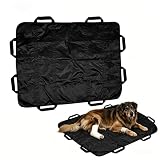
- 300 LBS Large Weight Capacity This dog stretcher for large dogs is made of high-quality durable Oxford fabric, strong enough to support pets up to 300 pounds. It provides safe and reliable support for transporting large, senior, injured, or post-operation dogs without tearing or deformation.
- Flexible Soft Design with 8 Comfort Handles Unlike rigid stretchers, this soft emergency dog carrier adapts to narrow spaces, stairs, and complex outdoor terrain. Equipped with 8 reinforced handles, it allows balanced lifting by multiple people, reducing strain and ensuring pet stability during transport.
- Spacious 48 x 30 Inch Size Measuring 48 x 30 inches, this large pet stretcher offers ample space for most large dog breeds including Labradors, German Shepherds, Golden Retrievers, and other big breeds. It is widely used for animal rescue, emergency carrying, and daily safe transfer.
- Lightweight & Foldable for Easy Storage Our portable dog stretcher weighs only 800g and features a foldable design, making it ultra-light and easy to carry, store, and travel with. It takes minimal space at home or in your car, ideal for both indoor and outdoor use.
- Stylish Pattern & Wide Application Designed with a modern, delicate pattern, this pet rescue stretcher is both practical and attractive. Perfect for pet emergency, animal rescue, vet visits, injury recovery, and daily mobility assistance for senior or disabled dogs.
For a confused dog after trauma, keep the head level or slightly elevated while preserving a straight neck. Provide adequate ventilation. When possible, one person should drive while another watches the dog’s breathing, responsiveness, bleeding, and position. If the dog deteriorates, pull over safely and call the veterinary hospital for instructions rather than attempting a moving adjustment.
Which common handling mistakes make injuries worse?
- Approaching without a plan: A frightened dog can bite, and a rushed lift can increase spinal or fracture movement.
- Hugging or placing fingers near the mouth: Pain changes behavior, even in a normally gentle dog.
- Forcing a dog through a carrier door: Pushing a painful body through a small opening can twist the spine or limbs.
- Dragging or lifting from one end: The unsupported torso can sag and the neck or back can bend.
- Repeatedly manipulating the injury: Straightening, testing, or “checking” a suspected fracture or spine injury adds movement without treating the cause.
- Using an improvised splint incorrectly: A tight or poorly positioned splint can impair circulation; when uncertain, support the whole body and let veterinary staff manage the limb.
- Applying a muzzle automatically: Muzzles are dangerous with breathing difficulty, vomiting, unconsciousness, chest injury, short-nosed anatomy, or mouth and facial injuries.
- Delaying care because the dog looks better: Internal injuries may not be visible after a fall or vehicle strike.
What is the safest decision sequence to remember?
- Protect people and the dog from the scene’s hazards.
- Approach slowly, speak calmly, and keep your face away from the mouth.
- Call a veterinary hospital and describe the event, breathing, responsiveness, bleeding, and visible injuries.
- Choose the least-movement method: top-opening carrier for a small dog, or blanket/board support with helpers for a large or nonwalking dog.
- Align and support the head, neck, and spine whenever trauma could involve them.
- Apply firm direct pressure to obvious external bleeding; add layers instead of removing a soaked dressing.
- Do not remove embedded objects, force a carrier entry, or attempt complicated splinting.
- Secure the dog for a quiet, ventilated ride and go directly for veterinary assessment.
Frequently Asked Questions
Can I use a towel as a sling under an injured dog?
A towel can provide temporary support for a small or moderately sized dog when it is broad, strong, and held by several people. It is less rigid than a board and may allow the spine to bend, so choose a firm surface instead when a spinal injury or unstable fracture is possible.
How should two people coordinate lifting a heavy dog?
Choose one person to give the commands and stabilize the head and neck. Both handlers should lift and lower on the same count, keep the support level, and stop if the dog’s breathing or responsiveness changes.
Is a cardboard box safe for transporting an injured dog?
Only a strong, ventilated box that will not collapse and that lets the dog lie without chest pressure is suitable for a small dog. A weak box, narrow opening, or poor ventilation can cause additional injury or breathing problems; a top-opening carrier is preferable when available.
Crashes, No Sound, or Screen Glitches?
Random freezes, missing sound and display glitches usually trace back to one bad driver. Find and replace yours safely.Free scan · under a minuteWindows Errors? Fix Them Before They Spread
Repair common Windows errors and clear accumulated junk for a smoother, more stable PC - no reinstall needed.Free scan · no reinstallShould I wait to see whether my dog improves before calling a veterinarian?
No. Trauma can cause internal injuries that are not visible, and a dog may briefly appear normal while deteriorating. Call a veterinary hospital as soon as possible and follow its transport instructions, even when the dog can stand or the skin looks intact.





Leave a Reply