Choose the fish and aquarium footprint together, then build a stable habitat for their adult size, social structure, and preferred zone. Use tested, hard, alkaline water; fine, smooth sand; secure rocks or empty shells as appropriate; effective filtration and aeration; and verify that ammonia and nitrite are zero before adding fish.
There is no single Lake Tanganyika aquarium setup for every cichlid. Species-specific needs and stable conditions matter more than forcing every tank toward one exact water target.
| # | Preview | Product | Price | |
|---|---|---|---|---|
| 1 |

|
Seachem Tanganyika Buffer 500gram | $16.75 | Buy on Amazon |
| 2 |
|
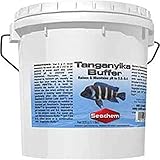
Tanganyika Buffer, 4 kg / 8.8 lbs | $86.90 | Buy on Amazon |
| 3 |

|
Seachem Tanganyika Buffer 1 Kilo | $32.48 | Buy on Amazon |
| 4 |

|
Tanganyika Buffer, 250 g / 8.8 oz | $11.69 | Buy on Amazon |
| 5 |

|
Continuum Aquatics Basis Tanganyika Cichlid Buffer for Rift Lakes, 4KG | $86.49 | Buy on Amazon |
Key takeaways
- Plan around the named species, adult size, habitat zone, behavior, and group needs; some fish need species-only setups.
- OATA’s broad African lake cichlid guidance is 23–27°C, pH 8.0–8.6, GH 12–18°dH, and KH 10–15°dKH. Treat these as a starting point, not a universal Tanganyika prescription.
- Test source water and aquarium water; avoid abrupt changes and routine buffer dosing without a measured need.
- Use fine, smooth sand and habitat-specific features: caves and sightline breaks for many rock dwellers, and empty shells for shell dwellers.
- Provide mechanical and biological filtration, vigorous aeration, routine maintenance, and gradual stocking only after ammonia and nitrite are zero.
Why must species choice come first?
Species choice determines aquarium footprint, group structure, substrate, hardscape, feeding plan, and compatibility. Shell dwellers, rock dwellers, sand-associated fish, open-water species, and large predators need different proportions, territories, shelters, and stocking plans.
According to the Ornamental Aquatic Trade Association (OATA), the group includes small shell dwellers as well as much larger frontosa. Its examples include a 45 cm minimum tank length for a pair of the smallest shell dwellers and about 180 cm for frontosa. These are examples for very different fish, not a generic Tanganyika tank-size rule.
Quick wins for a faster PC:
Fix the driver behind crashes, sound loss and screen glitchesFind Drivers →Repair Windows errors before they cause bigger problemsFix Now →Scan for outdated or missing drivers - takes under a minuteDriver Scan →#1 Best Overall
- Adjusts pH to 9.0-9.4
- Raises KH as well pH
- Will not affect GH
| Habitat group | Layout priority | What the aquarium must provide | Common mistake |
|---|---|---|---|
| Shell dwellers | Open bottom footprint | Fine sand, empty shells, and room for digging and shell movement | Filling the bottom with rocks or providing too few usable shells |
| Rock dwellers | Three-dimensional shelter | Stable caves, crevices, visual barriers, and retreat points | Providing one cave that all fish must defend |
| Sand-associated fish | Uninterrupted sand | Broad open substrate and suitable shelter for subordinate fish | Covering the usable sand with excessive decoration |
| Open-water species | Swimming space | Unobstructed midwater room and compatible habitat if mixed | Using a rock pile that removes most swimming space |
| Large species | Adult dimensions and footprint | Aquarium sized for adult fish, territories, filtration, and maintenance access | Planning only for juvenile size |
Choose the species, adult size, number of fish, and social structure before buying the aquarium or hardscape. Schooling, colonial, territorial, and solitary fish have different space and group requirements. Where possible, select fish that use different zones and do not compete directly for the same resources; some species need a species-only aquarium.
How large should a Lake Tanganyika aquarium be?
There is no reliable single volume recommendation for every Tanganyika cichlid. Tank size depends on adult dimensions, footprint, territory, group structure, swimming space, and habitat zone.
OATA’s examples—a 45 cm minimum tank length for a pair of the smallest shell dwellers and about 180 cm for frontosa—illustrate why a tank suitable for small shell dwellers cannot automatically house a frontosa group. Aqueon gives broad examples of 30–50 gallons for dwarf Tanganyikan communities or 15–20 gallons for species tanks, but these are not guarantees for every species or stocking combination.
| Sizing question | Why it matters | How to apply it |
|---|---|---|
| How large will the fish become? | Adult length and body depth affect swimming room and bioload. | Plan for adult dimensions, not purchase size. |
| What social structure does it need? | Pairs, groups, and colonies use space differently. | Size for the intended group. |
| Which habitat zone does it use? | Volume cannot make up for missing shells, sand, rock, or swimming space. | Prioritize the appropriate footprint and habitat features. |
| Can territories be separated? | Unbroken sightlines can make it harder for subordinate fish to retreat. | Use hardscape and open areas to form usable zones. |
| Can the aquarium be maintained safely? | Equipment and hardscape need service access. | Leave room to clean, siphon waste, and reach equipment. |
For a first aquarium, a species-focused setup is usually easier to plan than a mix of unrelated Tanganyikan species. A larger aquarium alone does not make incompatible territorial behavior safe.
Recommended Free Tools
What pH and hardness do Lake Tanganyika cichlids need?
Lake Tanganyika water is generally hard, alkaline, mineral-rich, and stable, though conditions vary by location and depth. OATA’s general African lake cichlid guidance gives these ranges; confirm the needs of the selected species and prioritize stable conditions over chasing a number.
| Parameter | OATA general guidance | How to interpret it |
|---|---|---|
| Temperature | 23–27°C | Keep stable and match replacement water closely. |
| pH | 8.0–8.6 | Use as broad group guidance, not a universal target. |
| GH | 12–18°dH | General hardness reflects dissolved minerals. |
| KH | 10–15°dKH | Carbonate hardness relates to buffering capacity. |
| Ammonia and nitrite | 0 mg/L each | Confirm both are zero before adding fish. |
| Nitrate | No more than 20 mg/L above normal tap-water level | OATA’s general guidance; monitor and manage through maintenance. |
OATA’s figures are general African lake cichlid guidance, not a species-by-species Tanganyika standard. Aqueon provides broader Rift Lake figures of pH 8.0–9.0, alkalinity 10–25°dKH, and 74–80°F. These recommendations differ in scope, so set a stable target based on the fish and source water rather than combining them into one exact range.
Test source water before adding any mineral or carbonate product. Measure pH, GH, and KH in the source or prepared water and in the aquarium. Avoid sudden changes in pH, hardness, or temperature.
Rank #2
- Adjusts pH to 9.0-9.4
- Raises KH as well pH
- Will not affect GH
What is the difference between Tanganyika buffer and mineral salt?
A carbonate buffer affects alkalinity, buffering capacity, and pH. Seachem says its Tanganyika Buffer does not change GH; it is only relevant when testing shows the water needs adjustment. Do not assume every Tanganyika aquarium needs a buffer, and follow the product directions rather than dosing by guesswork.
Mineral supplements are a separate consideration from carbonate buffering. Check the specific product’s documented effect and measure the water before and after preparation. If using very soft or reverse-osmosis water, determine the required adjustment from measured chemistry and the selected fish’s needs.
| Approach | Purpose | When to consider it |
|---|---|---|
| Carbonate buffer | Adjusts alkalinity and may raise pH | When testing and species requirements show carbonate buffering is needed |
| Mineral adjustment | Addresses mineral hardness needs | When source water lacks minerals required by the fish |
| No adjustment | Preserves existing chemistry | When source water is already stable and suitable |
What filtration and oxygenation does a Tanganyika tank need?
Provide mechanical filtration to remove particles and biological filtration to process fish waste. Canister filters, sumps, and large internal filters can all work depending on tank size and stocking. Slightly overbuilding filtration can be sensible for substantial bioloads, but a powerful filter does not replace regular maintenance.
Use strong circulation and vigorous aeration while avoiding a current that makes the habitat difficult for the fish to use. Ensure water moves through the aquarium and does not leave stagnant waste-prone areas.
When cleaning filter media, rinse biological media gently in aquarium water rather than untreated tap water, and avoid cleaning all biological media at once. Maintain the filter so flow does not become severely restricted.
The Tool Desk
Outbyte PC Repair FREEClear out junk files and repair common Windows errorsFree Scan →Outbyte Driver Updater FREEScan for outdated or missing drivers - takes under a minuteDriver Scan →How long should you cycle a Tanganyika aquarium?
There is no supported universal number of days for cycling a Tanganyika aquarium. Do not assume that running a new aquarium for a fixed period makes it safe; establish and verify biological filtration, and confirm ammonia and nitrite are zero before adding fish.
- Fill the aquarium with dechlorinated water, install the filter and heater, and begin the chosen cycling method.
- Run equipment continuously and monitor ammonia, nitrite, nitrate, pH, and relevant hardness values.
- Do not add the planned stock while the cycle is unverified or ammonia and nitrite are detectable.
- Add the first fish conservatively once biological filtration is established, then test as the bioload increases.
- Increase stocking only when water quality remains stable and fish have adequate territory and feeding access.
What sand is safe for a Lake Tanganyika fish tank?
Fine, smooth, inert sand is a practical choice for many Tanganyika setups, especially for fish that dig or sift. The specialist Tanganyika.si setup guide suggests grains around 0.5–2 mm and at least 5 cm depth, particularly for digging fish; treat these as that guide’s recommendations rather than a universal standard.
Rank #3
- Adjusts pH to 9.0-9.4
- Raises KH as well pH
- Will not affect GH
Avoid sharp substrate that could injure fish. Check whether sand is chemically inert: the specialist guide cautions that some aquarium sands may lower pH, which may conflict with the hard, alkaline conditions these fish generally need.
| Criterion | Preferred characteristic | Reason |
|---|---|---|
| Grain | Fine and smooth | Supports digging and reduces injury risk. |
| Chemistry | Known to be inert or compatible with the target water | Avoids unexpected effects on pH or hardness. |
| Shell-dweller use | Open, accessible sand around shells | Allows excavation and shell movement. |
| Maintenance | Accessible areas for siphoning | Enables waste removal without disturbing the whole habitat. |
How should rocks and caves be arranged?
Rockwork provides shelter, spawning sites, visual barriers, and territories. Build stable caves and crevices for rock dwellers, leave suitable open sand for fish that use the bottom, and avoid sharp edges.
Free tools Windows power users keep installed
One-click scans. No signup required.
Because digging can undermine stacked structures, make rockwork stable and protect the tank base where appropriate. Place rocks securely rather than relying on loose sand to hold them in place. Limestone-based rock may suit hard, alkaline water, but do not assume any rock is chemically neutral; test the aquarium after adding hardscape.
Arrange caves and barriers so subordinate fish have retreat points and sightlines are broken. Keep access to the front glass, equipment, and areas where waste collects.
How do you set up shells for shell dwellers?
Shell dwellers need empty shells for shelter and breeding sites, along with a broad sand bed. Spread clean, empty, aquarium-safe shells across usable substrate rather than placing them in one inaccessible pile. OATA recommends thoroughly rinsed escargot shells as one practical option.
There is no universal shell count for every species, group, or footprint. Provide a surplus of usable shells and room for fish to excavate and move them. For a first setup, a species-only shell-dweller aquarium is a straightforward compatibility plan. Do not combine small shell dwellers with a much larger predator merely because both come from Lake Tanganyika.
What lighting and plants work in a Tanganyika aquarium?
Lighting should suit the fish. Dim or shaded areas may help species from deeper or shaded habitats; plants are optional, and many habitats have little vegetation. Digging fish may uproot plants, though robust plants can work in suitable setups.
Rank #4
Choose plants, if any, with the fish’s diet and habitat in mind. Plants cannot replace the shells, caves, open sand, water quality, or filtration the fish need.
Which Tanganyika cichlids can live together?
Compatibility depends on adult size, diet, territory, aggression, social organization, and habitat zone—not simply on sharing a lake. Some fish require species-only setups. Hardscape can help create territories but does not make incompatible fish compatible.
| Stocking approach | Habitat requirement | Main risk | Practical guidance |
|---|---|---|---|
| Single shell-dweller species | Open sand and a shell bed | Territorial behavior around shells | Consider when the footprint supports the group. |
| Single rock-dweller species | Secure caves and broken sightlines | Defense of limited shelters | Provide multiple retreats. |
| Carefully researched mixed setup | Distinct habitat zones | Overlapping territories and feeding competition | Check exact species, adult size, and behavior first. |
| Large predator with small shell dwellers | Adult predator-sized aquarium | Predation and size mismatch | Do not treat these groups as interchangeable. |
Watch for persistent pursuit, fin damage, a fish unable to reach food, or a subordinate fish trapped in the open. Reassess the combination promptly; separating territories, reducing stock, or returning an incompatible fish may be necessary.
How should Tanganyika cichlids be fed?
Feed according to the exact species’ diet. Tanganyika cichlids include herbivores, omnivores, shell specialists, predators, and open-water feeders, so a food labelled for African cichlids is not automatically appropriate for every species.
| Feeding type | Example | Feeding consideration |
|---|---|---|
| Herbivorous or grazing fish | Tropheus-style fish | Choose formulation and protein level for the species. |
| Shell specialists | Shell dwellers | Use appropriately small food and keep the shell bed accessible. |
| Omnivores | Species with mixed feeding behavior | Use balanced, species-appropriate food and observe body condition. |
| Predators | Large predator species | Match food and pellet size to the adult fish. |
| Open-water feeders | Midwater species | Ensure subordinate fish can feed without being excluded. |
Remove uneaten food before it harms water quality. A fish repeatedly losing access to food may be stressed or poorly matched with tankmates.
What maintenance does a Tanganyika aquarium need?
Maintenance should preserve stable chemistry, oxygenation, biological filtration, and safe territories. OATA and specialist guidance emphasize suitable water quality and stable replacement water. Aqueon suggests 10% weekly or 25% every two weeks for African Rift Lake cichlids; treat this as general publisher guidance and adjust to stocking and measured water quality.
- Test pH, GH, KH, ammonia, nitrite, and nitrate as appropriate to the aquarium’s stage and stocking.
- Condition replacement water as needed and keep its temperature and chemistry close to the aquarium’s.
- Base any buffer or mineral adjustment on measured water and the selected fish’s needs.
- Remove waste from accessible areas without loosening rock foundations or destroying shell beds.
- Inspect shells, caves, and rockwork for trapped, injured, or persistently bullied fish.
- Clean filter media as needed; rinse biological media gently in aquarium water and avoid disrupting all of it at once.
What is the safest setup sequence?
Plan the fish and footprint first, test water, build the habitat, establish biological filtration, and stock gradually.
Best Value
- Multi-component blended buffering system designed to raise the alkalinity of Tanganyika African Cichlid and other hardwater, high pH aquariums
- Automatically regulates pH and will keep pH levels stable over a wide range of conditions providing safety for the aquarium system and inhabitants
- Package Weight: 12.4 pounds
- Age range description: All Life Stages
- Select the fish. Confirm adult size, social structure, diet, habitat zone, and whether a species-only aquarium is appropriate.
- Choose the footprint. Plan for adult fish, territories, group requirements, swimming space, and maintenance access.
- Test source water. Measure pH, GH, and KH before deciding whether any adjustment is needed.
- Install equipment. Provide mechanical and biological filtration, a dependable heater and thermometer, circulation, and vigorous aeration.
- Add substrate. Use fine, smooth sand compatible with the intended water and fish.
- Build hardscape. Secure rocks, create suitable caves and sightline breaks, and preserve cleaning access.
- Add shells if needed. Provide clean, empty shells and open sand for shell dwellers.
- Establish the cycle. Run the aquarium and chosen cycling method while testing; verify ammonia and nitrite are zero before fish are added.
- Stock gradually. Monitor water and behavior as the bioload increases.
- Maintain consistently. Keep replacement water stable, remove waste, maintain filtration, and respond to bullying or water-quality problems.
Common avoidable errors include choosing fish without considering adult requirements, dosing buffer without testing, mixing territorial species solely because they share a lake, and replacing usable shell or sand habitat with decorative rock.
FAQ
What temperature is suitable for a Lake Tanganyika aquarium?
OATA’s general African lake cichlid guidance is 23–27°C. Confirm the needs of the selected species and avoid abrupt temperature changes.
Do Lake Tanganyika cichlids need a buffer?
Not automatically. Test source and aquarium water first; consider a carbonate buffer only if measured chemistry and the selected fish’s requirements justify adjustment.
When is a new Tanganyika tank ready for fish?
Do not rely on a fixed number of days. Verify the biological filtration and confirm ammonia and nitrite are zero before adding fish.
What’s actually slowing this PC down?
Pick the symptom - the matching free tool is one click away.
Do shell dwellers need empty shells?
Yes. Empty shells provide essential shelter and breeding sites. Provide clean, usable shells and enough open sand for fish to move them.
Can different Tanganyika cichlids share an aquarium?
Sometimes, but compatibility depends on the exact species, adult size, behavior, social needs, and habitat zones. Some species need species-only setups, and décor alone cannot ensure compatibility.
The Bottom Line
Build a Lake Tanganyika aquarium around the selected fish: provide stable, species-appropriate water, suitable sand and habitat features, effective filtration, vigorous aeration, and verified biological filtration before gradual stocking. Test before adjusting water, and keep replacement water and maintenance consistent.
Quick Recap
Product prices and availability are accurate as of the date/time indicated and are subject to change. Any price and availability information displayed on Amazon at the time of purchase will apply.




