
What’s actually slowing this PC down?
Pick the symptom - the matching free tool is one click away.
Some links on this page are affiliate links: if you buy through them we may earn a commission, at no extra cost to you.
To stop a small dog barking at visitors, prevent frantic door rehearsals first, then teach a mat or “place” behavior, reinforce brief pauses with a calm “quiet” cue, and gradually pair door sounds and approaching people with food. The right sequence depends on whether your dog is greeting, guarding territory, reacting from fear, or barking because attention has paid off.
Do not aim for absolute silence. The ASPCA says the practical goal is to decrease barking rather than eliminate it. A dog that can notice a visitor, recover, and settle behind a gate or on a mat is showing useful behavior even if it gives an occasional alert bark.
As an Amazon Associate I earn from qualifying purchases.
Free tools Windows power users keep installed
One-click scans. No signup required.
Why does my small dog bark at visitors?
Small dogs use the same emotional and learning processes as larger dogs. Size, breed label, or a “yappy” reputation cannot tell you why an individual dog is barking; watch the body language and the sequence around each episode.
| Likely pattern | Clues before and during barking | What the dog may be trying to achieve |
|---|---|---|
| Greeting excitement | Loose, wiggly body; tail wagging; whining; moving toward the person | Access to the visitor, play, sniffing, or social contact |
| Territorial or alarm barking | Focus on someone approaching the home, window, porch, hallway, or door; stiff posture may appear | Make the approaching person leave or alert the household |
| Fear or anxiety | Low or tucked tail, ears back, lip licking, panting, looking away, leaning away, hiding, or attempts to escape | Increase distance from something that feels threatening |
| Attention-maintained barking | The dog looks at people while barking and has previously received talking, touching, play, release, or access to the visitor | Obtain a response that has been rewarded in the past |
A single arrival can contain more than one motivation. A dog may bark at the door from alarm, then switch to frantic greeting once the guest enters. Note what happens immediately before the bark, what the dog does while barking, and what happens afterward. That pattern determines which replacement behavior to teach.
Popular on Amazon

- 【Humane & Effective Bark Control – No Pain, Just Smart Training】 If your dog’s barking has been a challenge, you’re not alone — and you don’t need to resort to painful methods. The updated Elecane Bark Collar is designed with small dogs in mind (5–15 lbs), offering four gentle training modes: Beep, Vibration, Beep + Vibration, and Test Mode. The collar automatically adjusts the strength and duration of the sound and vibration based on how long your dog continues barking, gently encouraging your dog to stop — without stress or pain. It’s ideal for small and medium-sized dogs and perfect for anyone looking for a safe, thoughtful solution.
- 【Designed for Comfort – Ultra-Lightweight & Adjustable for All Breeds】 We know how important comfort is — especially for small breeds. This model is 30% lighter and more compact than standard bark collars, so your pup can wear it all day without irritation. The adjustable 600D heavy-duty nylon strap ensures a secure yet comfortable fit for dogs between 5–50 lbs with neck sizes from 6 to 23 inches. Whether you have a tiny barker or a medium-sized companion, this collar was made with your dog’s comfort in mind.
- 【Fast Charging & Long-Lasting Battery – Only Two Hours to Charge, 20 Days Standby】 No more constantly recharging or worrying about battery life. Thanks to our exclusive technology, this collar powers up fully in just two hours and lasts up to 20 days on standby. The magnetic charging port is not only easy to use but also waterproof — making it one of the most reliable collars for busy dog parents.
- 【Advanced Smart Chip – No False Triggers, Only Responds to Your Dog】 Tired of collars that activate at random sounds? Our advanced sound recognition chip ensures the collar reacts only to your dog’s bark — not to other dogs, background noise, or human voices. With a lightning-fast 0.1-second response time, your pup gets instant feedback. And that’s key: when the correction comes immediately, dogs are much more likely to understand the cause-and-effect relationship and learn faster — making training smoother and more effective.
- 【Waterproof & Weather-Resistant – Train in Any Condition】 Life doesn’t stop when the weather changes, and now, neither does your training. With its IP67 waterproof rating, this collar can handle rain, puddles, mud, and more. It’s perfect for outdoor adventures and daily walks — no matter the season.
When is visitor barking a safety issue?
Stop planned greetings and obtain professional help if your dog has lunged, snapped, bitten, cannot recover after the person leaves, or seems suddenly different. The RSPCA recommends veterinary assessment and a humane, individualized plan; UC Davis also advises discussing unusual or complex behavior with a veterinarian. A sudden change can have a medical component, so do not treat it as a simple obedience problem.
Until a qualified veterinarian or behavior professional assesses the dog, use barriers and distance rather than asking visitors to approach, pet, or hand-feed. A small body can still inflict a serious bite, and fear can intensify when the dog is cornered.
Do these 3 things before closing this tab:
1Fix the driver behind crashes, sound loss and screen glitches2Repair Windows errors before they cause bigger problems3Scan for outdated or missing drivers - takes under a minuteWhat should I do before opening the door?
Move the dog away from the entry before touching the handle. Management prevents another full-speed charge while training changes the underlying response; it is not a cure by itself, but it stops the barking routine from being practiced repeatedly.
- Choose a safe station. Use a baby gate, a closed interior door, a comfortable crate, a leash held by an adult, or a mat positioned well away from the doorway. Use a crate only if the dog already relaxes there; forcing a fearful dog into it can make the crate another trigger.
- Block visual triggers. If passers-by at a window start the episode, close curtains or apply removable opaque window film or a spray-on glass coating designed to obscure the lower view. Keep the dog away from the window during busy periods.
- Give visitors a script. Ask them to enter quietly, avoid eye contact and reaching, and ignore the dog until you release them to interact. Tell them not to knock repeatedly, tease, or loom over the dog.
- Prepare food before the arrival. Have tiny, high-value treats ready so you can reinforce a pause or a glance toward you without searching for supplies while the dog is aroused.
For deliveries or repair visits, keep the dog behind the barrier for the entire interaction. There is no training benefit in allowing a rushed stranger to crowd the dog at the threshold.
How do I teach my dog to go to a mat?
Teach “go to your mat” when no one is visiting. The mat gives the dog an incompatible action: a dog lying on a station cannot simultaneously rush the door. VCA describes this response-substitution approach, and the ASPCA recommends a “go to your spot” routine for arrivals.
- Place a nonslip mat in a quiet area where the dog can see you but is not pressed against the doorway.
- Drop a treat on the mat. When the dog steps onto it, mark the moment with a calm word such as “yes” and feed another treat on the mat.
- Reward lying down, looking at you, and remaining there. Release the dog with a consistent word, then repeat.
- Gradually add distance, a few seconds of duration, and mild household movement. Increase only one difficulty at a time.
- When the behavior is reliable, add the cue “mat” or “place” just before the dog moves there.
Next, rehearse with a helper. The helper approaches only as close as the dog can handle without barking, pauses, and leaves while you feed calm behavior. Progress from a person outside, to a knock, to the doorbell, to the door opening, and finally to a guest sitting down. If barking starts, the step was too difficult; increase distance or return to an easier version.
The Tool Desk
Outbyte PC Repair FREEClear out junk files and repair common Windows errorsFree Scan →Outbyte Driver Updater FREEFix the driver behind crashes, sound loss and screen glitchesFind Drivers →Also popular on Amazon

- SAFE & SMART: Trigger Prevention uses enhanced sound recognition to minimize ambient noise interference, while Auto-Protection Mode pauses operation for one minute after seven activations within a minute to prevent overstimulation, and the Wearing Safety Reminder ensures a comfortable fit through the two-finger rule.
- MAGNETIC FAST CHARGE & LONG BATTERY LIFE: Equipped with a strong magnetic charging port compatible with standard 5V USB chargers, PCs, and power banks, the collar achieves a full charge in just 2 hours while offering up to 15 days of standby time and 5–7 days of active use, ensuring extended worry-free operation with minimal charging interruptions.
- SELF-ACTIVATED DOG BARK COLLAR: The bark collar for Medium Small dogs adopts a fully automatic mode. Just put it on the dog's neck, and it will eliminate annoying dog barking when you are not at home or at night, making your relationship with your neighbors more harmonious
- MAGNETIC FAST CHARGE & LONG BATTERY LIFE: Equipped with a strong magnetic charging port compatible with standard 5V USB chargers, PCs, and power banks, the collar achieves a full charge in just 2 hours while offering up to 15 days of standby time and 5–7 days of active use, ensuring extended worry-free operation with minimal charging interruptions.
- UPGRADED AI TECHNOLOGY to PREVENT FALSE TRIGGERING: ALKD smart bark collar for small dogs adopts advanced AI intelligent dog barking recognition chip and motion detection technology. It has 7 sensitivity levels. At 3-5 sensitivity, it will only activate when motion and barking are detected. At 6-7 sensitivity, it will only activate when dog barking is detected. This can safely and effectively filter out the barking of other dogs, prevent false triggering, and protect your dog from unnecessary punishment
How do I teach “quiet” without making barking worse?
Use “quiet” to label a pause, not to argue with the dog. The ASPCA warns that shouting can become part of the arousal, so say the cue once in a calm voice.
- Allow a few alert barks when you are practicing safely.
- Say “Quiet” once, softly and clearly.
- The instant the dog pauses, mark the pause and deliver a treat close to you or on the mat.
- Repeat over short sessions until the dog begins to pause when it hears the cue.
- Build the pause gradually: wait about two seconds, then five, then 10, feeding only while the dog remains quiet. Increase the interval in small steps rather than demanding a long silence immediately.
Pair the cue with the mat, a sit, or eye contact so “quiet” has a visible alternative. Do not reward barking with conversation, petting, play, opening the door, or release from the station. If you need to move the dog for safety, do so neutrally and reset the exercise rather than scolding.
How can I desensitize my dog to the doorbell and approaching visitors?
Desensitization means presenting the trigger below the level that causes a reaction, then increasing intensity in small increments. Counterconditioning pairs that trigger with something the dog values, usually food. AAHA notes that a properly conducted session should not produce arousal; Merck gives the example of pairing a softly played doorbell with a sit, stay, relaxation, and treats.
Doorbell recording or sound
- Record your own bell or use a helper to produce it at very low volume and from a distance.
- Play the sound once, immediately feed several high-value treats, and stop while the dog is relaxed.
- Repeat on several days each week in brief sessions.
- Increase volume or proximity by a very small amount only after repeated calm responses. If the dog barks, stiffens, pants, trembles, tries to escape, or becomes excited, stop and make the next session easier.
Approach to the home
Start with a helper standing far from the property or visible only briefly through a blocked window. Feed while the person remains still, then have the person move away. Over later sessions, add a few steps, a pause near the gate, a knock, and finally the door opening. Keep the dog behind its barrier or on the mat; the helper should not reach toward the dog.
End every session on a calm repetition. VCA advises that sessions may be brief or longer depending on the stimulus, but they should not be stressful. Flooding—holding the dog near a trigger until it barks or panics—can worsen fear and behavior, according to Merck and AAHA.
What should guests do after they enter?
Keep the dog at its station or beside you while the guest sits. Once the dog’s body is loose and it can take food, provide a supervised food-stuffable puzzle toy or another enrichment item suited to its size and chewing habits. This gives the dog a quiet activity while the household settles.
Also popular on Amazon

- Safe, Effective, Easy Setup: The dog bark collar has 4 working modes; 5 adjustable sensitivity levels. Just press the M button at any time to enjoy quiet time. Please refer to the user manual before use for optimal performance and safety
- Automatically Stop Dog Barking: FAFAFROG bark collar for large dogs is equipped with an upgraded smart dog barking recognition chip with 2 activation conditions: The dog keeps barking and vibration from vocal cords (No remote)
- Protect Mode: The smart color display clearly shows the working status and power level; If the dog bark collar has been activated 6 times continuously, it will stop working for 30 seconds (the digital display changes to "8"), protecting your dog from unnecessary activation. FAFAFROG bark collar is a tool of love, not punishment
- Fast Charging & Waterproof: The bark collar for medium dogs features new charging for simple operation and more stable charging; A full charge in 2 hours works for about 15-20 days; The bark collar for large dogs has an IP67 waterproof design, so you can enjoy training time with your dog in the pool, park, beach, or backyard. Your dogs will enjoy bathing, swimming or playing in the rain
- Fits Most Dogs: Our bark collar is 27 inches long and weighs 0.17 lbs, suitable for dogs weighing 8 to 150 lbs with neck sizes from 8 to 25 inches, and is ideal for dogs over 6 months old. The bark collar length can be adjusted as your dog grows
For a social, excitable dog
Release the dog only after a quiet pause and a loose body. Ask the guest to stand sideways, keep hands low, and let the dog choose whether to sniff. If barking returns when the guest moves, calmly guide the dog back to the mat and increase distance before trying again.
For a fearful dog
Do not require contact. The guest should ignore the dog, avoid leaning over it, and allow the dog to remain behind a gate or closed door. Tossing a treat away from the guest can create distance and choice; hand-feeding is inappropriate if the dog is hiding, freezing, growling, or unable to eat.
For repeated visits
Use the same entry routine each time: station, quiet arrival, ignored dog, calm release if appropriate, and a return to the station when arousal rises. Consistency prevents one guest from rewarding the very barking that everyone else is trying to reduce.
Should I use a bark collar, yelling, or punishment?
No. Do not yell, hit, confront, or use shock, prong, choke, or other aversive equipment to suppress visitor barking. UC Davis cautions that punishment can increase fear when barking is fear-related. Merck reports that punishment and confrontation can produce fear, avoidance, and increased aggression, while reward-trained dogs have fewer behavioral problems and are less fearful.
A bark collar may interrupt sound without changing the dog’s emotional response to visitors. A fearful dog can learn that people predict both the visitor and an unpleasant correction, which may make the person more threatening. RSPCA guidance is explicit that training should be reward-based and use positive reinforcement.
How should the plan be adapted for a small dog?
The learning principles do not change, but equipment, food size, and physical handling do. Use treats small enough for frequent repetitions, a properly fitted harness or collar, and a mat the dog can reach without being dragged or lifted onto it. A station should leave enough room to turn, lie down, and retreat from the doorway.
Crashes, No Sound, or Screen Glitches?
Random freezes, missing sound and display glitches usually trace back to one bad driver. Find and replace yours safely.Free scan · under a minutePC Slower Than It Used to Be?
A free scan shows the junk files, broken settings and background clutter dragging Windows down - then fixes them in one click.Free scan · Windows 10 & 11Also popular on Amazon

- For Small Breeds & Puppies: Our bark collar fits dogs with neck sizes from 6 to 20 inches. Thanks to this effective accessory, enjoy peaceful nights and positive interactions with neighbors
- 100% Humane and Safe Training Method: Our no shock bark collar uses gentle vibrations and sound to correct bad barking habits, effectively reinforcing good behavior without causing harm to your pet
- Lightweight Design for Maximum Comfort: With a feather-light design that weighs only 0.6 oz, our dog bark collar ensures comfort and all-day wearability, ideally suited for small and medium-sized dogs
- Advanced False Alarm Prevention: Stay worry-free as our 2024 chip-equipped anti bark collar is designed to respond to your dog's barks by filtering out background noise. Has 7 sensitivity levels
- Water-Resistant for Outdoor Adventures: Fearlessly tackle nature's elements with the bark collar for small dogs IP67 waterproof rating. Rain, beach trips, swimming- this accessory can handle it all
- Measure treats as part of the dog’s daily food allowance, especially during several practice sessions.
- Choose barriers that the dog cannot squeeze under or jump over.
- Keep leash tension loose; constant pulling can add frustration.
- Do not assume barking is harmless because the dog is light enough to pick up. Evaluate tail, ears, posture, distance-seeking, and recovery time.
- Supervise puzzle toys and select a size and firmness appropriate for the dog’s chewing style.
What if the training is not working?
Change the setup before repeating the same cue. Persistent barking usually means the dog is over threshold, the reward arrives too late, or the environment is paying the dog better than the trainer can.
The dog barks before I reach the door
Move the station farther from the entry, block the window, and begin with a helper outside at a distance. Practice the mat behavior separately so the dog is not learning it for the first time during a crisis.
The dog will not take treats
Refusal usually means the trigger is too intense or too close. End the repetition, increase distance, lower the sound volume, or return to a quiet room. Do not push food into the dog’s mouth or continue until it panics.
The dog settles, then erupts when the guest stands
Train movement as its own trigger. Have the seated helper shift one inch, feed, and sit again; build to standing, walking, and leaving. Keep the dog behind a barrier until each stage is easy.
The dog barks at some people but not others
Record differences such as height, clothing, voice, mobility aids, hats, or direct eye contact. Arrange helpers who vary one feature at a time and work at the dog’s calm distance. Never use a surprising stranger as a test.
Progress disappears when visitors arrive unexpectedly
Use the management plan without attempting a training session: place the dog behind a door or gate, ask the visitor to ignore it, and wait for calm. Planned rehearsals can resume when you control the distance and timing.
Also popular on Amazon
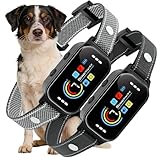
- Precision Sonic Training & Custom Modes Humanely stop unwanted barking with 5 intelligent training modes and 7 adjustable sensitivity levels, tailored to your dog’s breed, size and behavior. One quick "M" button press for instant, no complex settings.
- 3-Layer Safety & Anti-False Trigger Smart anti-misfire chip cuts false triggers by 67%*, paired with 0-7 sensitivity and auto safety mode (pauses after 3 activations in 45s). Safe for 40+ breeds (11-120lbs)
- One-Click Operation & Easy Setup Dual-button control for instant sensitivity/mode adjustment, plus visual quick-start guide and test mode. 2-minute setup, perfect for first-time pet owners.
- IP67 Waterproof & Long-Lasting Battery All-weather tough (dustproof/waterproof) for beach, hikes, rainy walks—ideal for outdoor adventures. 15-day battery life with 2-hour magnetic quick charging (cable included).
- Koguzl Quality Guarantee 100% customer satisfaction promise! Enjoy a 60-Day No-Hassle Money-Back Guarantee and 2-Year Manufacturer Warranty for total peace of mind.
When should I call a professional?
Arrange veterinary advice for sudden onset, unusual intensity, pain signs, sensory changes, or behavior that is difficult to interpret. Seek a qualified, reward-based behavior professional for lunging, snapping, biting, escape attempts, prolonged inability to recover, or a household that cannot safely manage arrivals.
Ask what methods the professional uses and avoid anyone who promises instant silence, relies on intimidation, or recommends flooding. A good plan identifies the trigger, sets a safety distance, teaches replacement behaviors, and gives every visitor the same instructions.
How do I know whether the plan is improving?
Track observable changes rather than waiting for perfect silence. Note the trigger, distance, number of barks, whether the dog can eat, how quickly it returns to the mat, and whether it can remain relaxed when the visitor moves. Progress may appear first as a shorter barking burst, a quicker recovery, or the ability to respond to “mat” before the door opens.
Veterinary and welfare guidance does not establish one universal success-rate percentage for visitor-barking programs. Outcomes depend on the dog’s motivation, health, history, environment, and how consistently arrivals are managed, so use the dog’s recovery and safety as the meaningful measures.
Frequently Asked Questions
Should I pick up my small dog when someone knocks?
Picking a dog up can add excitement and removes its ability to choose distance. Use a practiced mat, gate, or interior room instead; pick the dog up only as an emergency safety measure, while keeping the visitor away.
Why does my dog bark at people wearing hats or uniforms?
Unfamiliar silhouettes, sounds, or movement can be separate triggers. Work with helpers who change one feature at a time, beginning far enough away that your dog can eat and look back at you.
Recommended Free Tools
Can visitors give my dog treats?
Only when the dog is relaxed and voluntarily approaching. For a worried dog, have the visitor toss food away from their body so the dog can eat without being pressured into hand contact.
How should I handle delivery drivers and other unexpected arrivals?
Treat them as management situations, not training sessions. Put the dog behind a barrier before opening the door, ask the person not to interact, and begin planned practice later with a calm helper.
Will my dog ever stop barking completely?
Some alert barking is normal communication, and the ASPCA recommends reducing rather than eliminating it. A realistic outcome is a brief alert followed by a reliable pause, retreat to a station, and safe recovery.





Leave a Reply