Quick wins for a faster PC:
Fix the driver behind crashes, sound loss and screen glitchesFind Drivers →Repair Windows errors before they cause bigger problemsFix Now →Scan for outdated or missing drivers - takes under a minuteDriver Scan →There is no reliable number of attention minutes that fits every dog. A dog is probably getting enough attention when its overall welfare is good: it receives friendly social contact, appropriate exercise, chances to use its brain, uninterrupted rest, and proper health care, and it can settle safely when you are unavailable. Judge the pattern over several days and in context, not one clingy greeting or one quiet afternoon.
Some dogs actively seek interaction; others prefer brief contact followed by sleep or independent exploring. A food toy can occupy a dog, but it cannot replace companionship or treat anxiety. The useful question is whether your dog’s needs are being met and whether its behavior is stable, relaxed and safe.
As an Amazon Associate I earn from qualifying purchases.
What “enough attention” looks like in a complete welfare routine
Animal Welfare Victoria, the Merck Veterinary Manual and the World Small Animal Veterinary Association (WSAVA) all frame canine welfare broadly. Companionship is one part of the picture, alongside physical activity, mental enrichment, rest and health. Looking only at how often your dog asks to be petted can therefore mislead you.
| Area to assess | What to look for | When to investigate |
|---|---|---|
| Companionship and positive contact | Your dog seeks or accepts calm interaction, enjoys shared activities and can also disengage without panic. | Contact-seeking is frantic, constant, newly intense, or accompanied by distress when interaction ends. |
| Physical activity | Movement is appropriate for age, breed type, fitness and health; the dog can recover and rest afterward. | Exercise causes pain, exhaustion, persistent over-arousal, or is suddenly avoided. |
| Mental enrichment | Safe sniffing, exploring, chewing, training, play or food-based problem-solving are available. | The dog has no safe outlets and repeatedly invents risky ones, or shows little interest in previously enjoyable activities. |
| Rest and independence | The dog sleeps, relaxes and spends short periods occupied safely without needing continuous human input. | It cannot settle, paces for long periods, or becomes distressed whenever you move away. |
| Health and comfort | Eating, drinking, toileting, movement, coat and body condition are broadly normal for that individual. | There is pain, illness, a sudden behavior change, or a new problem with elimination, appetite or sleep. |
“Enough” is individual. A young, energetic dog may need more active engagement than an elderly dog with arthritis; a confident dog may choose more solitary rest than a social dog. The standard is a sustainable routine that fits this dog’s body and temperament, not a universal quota.
#1 Best Overall

- [Treat Distribution] Our food dispenser has differently sized spheres at both ends. As dogs push the toy, it moves within a fixed area, allowing dogs to continuously chase and play with it. During movement, food is dispensed from the food holes on both sides of the toy.
- [Adjustable Switch] Each of the two spheres with a food dispensing switch, making it suitable for various sizes and types of pet dry food or snack. The switch can be adjusted according to the different sizes of dog food. It also allows control over the amount of food dispensed, extending or shortening the time it takes for pets to obtain food. It is more conducive to a healthy dog diet.
- [Increase Pet Intelligence] This dog treat puzzle toy combines intellectual training with food rewards. When pets push this toy, it will not only be to get delicious food, but it will also stimulate their intelligence and hunting instinct. This design not only meets the needs of pets but also encourages them to learn and grow in the game.
- [Prolonged Play] The dog enrichment toy is designed to limit the amount of treats your dog gets while encouraging more extended playtime. This is intended for effective playtime for dogs and is NOT a chewed toy. It is also dog boredom buster toys and best dog gift to keep them busy when dogs are left home alone, relief anxiety.
- [Attract Dogs' Attention] With barbell shaped design and bright color, the dog puzzle toy ball can attract your dog's attention, stimulate their curiosity and drive them crazy to roll it. Size: 6.1*3.44*3.44in/15.5*8.7*8.7cm.
Read behavior as a pattern, not a single sign
Keep a simple record for several days. Note what happened before a behavior, what the dog did, how long it lasted and what happened afterward. Include walks, play, meals, naps, visitors, departures and health changes. Patterns are more informative than isolated incidents.
Behaviors that can be normal outlets
- Chewing an appropriate item, sniffing and exploring.
- Short bursts of social play followed by a break.
- Bringing a toy, leaning in for contact or choosing to lie near you.
- Sleeping for long stretches after activity.
- Moving to another room or bed when the dog has had enough interaction.
Merck describes chewing, social play, rest and food or toy enrichment as normal outlets. A dog can learn planned periods of independent rest or activity when its needs are met and its environment is safe.
Signals that deserve closer observation
- Repeatedly interrupting you, pawing, vocalizing or following you despite having had a chance to exercise, toilet and rest.
- Destructive chewing, digging or scavenging that is new, intense or unsafe.
- Inability to settle after ordinary activity, or persistent agitation when attention stops.
- Loss of interest in food, play, exploration or social contact.
- Changes in sleep, appetite, toileting, movement or tolerance of touch.
None of these signs proves that a dog is “lonely” or has a behavior disorder. Pain, gastrointestinal disease, sensory change, medication effects, fear and other medical or environmental factors can look like an attention problem.
Windows Errors? Fix Them Before They Spread
Repair common Windows errors and clear accumulated junk for a smoother, more stable PC - no reinstall needed.Free scan · no reinstallCrashes, No Sound, or Screen Glitches?
Random freezes, missing sound and display glitches usually trace back to one bad driver. Find and replace yours safely.Free scan · under a minuteAttention-seeking, boredom and distress are not the same thing
A dog may bring a toy, nudge your hand or bark once because it wants a walk, a toilet break or a brief social interaction. If you meet that ordinary need, the dog may relax, play appropriately or sleep. Boredom is more likely when there are few safe activities and the behavior appears during otherwise uneventful periods, then improves after suitable movement or mental work.
Distress has a different pattern. The dog may be unable to settle, escalate as you prepare to leave, or show repeated fear-related behavior while alone. It may not be able to use a favorite toy or food item when the person is absent. Behavior that reliably tracks departures, occurs across multiple absences and eases when the person returns deserves a veterinary discussion rather than a simple assumption that the dog needs more petting.
Context matters in the other direction too. A dog that follows you from room to room may be seeking information, warmth or routine, not necessarily suffering from separation anxiety. A single chewed shoe, bark at a noise or accident does not identify the cause. Record what precedes the behavior, whether basic needs were met, and how the dog recovers.
What happens when your dog is left alone?
Pay special attention to behavior that occurs specifically during absences. Animal Welfare Victoria, Singapore’s Animal and Veterinary Service (AVS), and the American Animal Hospital Association (AAHA) list behaviors associated with distress or separation problems, including pacing, panting, barking or other vocalizing, excessive salivation, chewing or destruction, and inappropriate urination or defecation.
The Tool Desk
Outbyte Driver Updater FREEScan for outdated or missing drivers - takes under a minuteDriver Scan →Outbyte PC Repair FREERepair Windows errors before they cause bigger problemsFix Now →Rank #2

- 【PRODUCT SIZE】10 inch*10 inch*1.3 inch.
- 【3 WAYS TO PLAY, UPGRADE SLOW FEEDER】Our dog mental stimulation toys have a unique squeak button in the middle, which make it easier to attract the attention of dogs and cats. Three different difficulty designs and the 16-hole dog treat dispenser design maximize slow feeding time, even beyond 20 minutes.
- 【FUNNY STIMULATING TOYS】All kinds of dogs and cats love the puzzle game of Spin & Slide and the Seek & Hide with their smell sense and paw skills to find food. Combining circular orbit sliding game and linear orbit sliding game, smart dog and cat must move the slider correctly to get the food reward hidden in the maze.
- 【NON-REMOVABLE PARTS DOG PUZZLE】Our dog treat puzzle is made of non-toxic materials, very durable and suitable for pets to play for a long time. This dog toy has no removable parts because the design has built-in play parts that fold tightly and won't fall off easily.
- 【ANTI-SLIP & EASY TO CLEAN】: The four corners of the bottom are equipped with four anti-skid pads, which can be well fixed during the dog's slow food process; It is easy to clean, also dishwasher safe.
These are clues, not a diagnosis. A dog may bark at outdoor sounds, destroy an item because it is accessible, or have an accident because of illness or an inadequate toilet opportunity. Separation anxiety is more likely when signs reliably begin around departure or while the dog is alone, recur across absences and ease when the person returns. A camera recording can reveal what happens after you leave, when a neighbor’s complaint or a single chewed object cannot.
A practical alone-time observation
- Choose a normal, safe absence. Remove hazards, provide water and leave only items your dog already uses safely. Do not stage a frightening departure.
- Record the first 30 to 60 minutes if possible. A phone or home camera should show the dog’s resting area and access points without being used to interact remotely.
- Log timing and intensity. Write down the first vocalization, pacing, panting, salivation, elimination, escape attempt or destructive episode, and whether the dog eventually settles.
- Compare contexts. Contrast a routine departure with a brief separation after exercise, a different household member leaving, or the dog remaining with a trusted person. Differences help a veterinarian identify triggers.
- Stop if safety is at risk. Do not prolong an absence to “test” the dog when it is panicking, injuring itself or attempting to escape.
Bring the recordings and time notes to a veterinarian. They are more useful than a label such as “clingy.”
How to build attention into a balanced day
Think in repeating blocks rather than one long entertainment session. A workable routine combines brief social contact, movement, mental work and protected downtime.
Positive contact
Use calm petting, grooming, a short training session, play or simply sitting together. Let the dog opt in and pause if it turns away, stiffens, hides or shows other discomfort. Interaction should not always be exciting; quietly sharing space is valuable companionship.
Physical activity
Match duration and intensity to the dog’s age, health, weather and fitness. Sniffing walks, gentle exploration and short play sessions may be more appropriate than repetitive high-impact games for some dogs. Ask your veterinarian for limits if your dog is overweight, lame, recovering from surgery or has heart, breathing or joint disease.
Mental work
Rotate safe activities: scatter a portion of the normal diet for supervised sniffing, practice simple cues, offer a durable chew suited to the dog, or use a puzzle that it can solve without frustration. Novelty does not have to mean expensive equipment; changing the route or teaching a new behavior can provide useful cognitive work.
Rest and predictable independence
After activity, provide a quiet bed or pen where the dog will not be repeatedly disturbed. Reinforce calm settling rather than calling the dog back every time it walks away. Start with very short, easy periods in which the dog remains relaxed, then increase duration gradually. Independence is a learned coping skill, not a withdrawal of affection.
Rank #3

- 2 Levels in 1 Toy: start your pups off with a level 1 puzzle, add some treats in the base compartments and watch your dogs get their tasty reward by nudging the lids. For dogs who have mastered level 1, for added challenge in level 2, just put some treats in the top compartments, teach your dogs to press the top cover to dispense treats down into the base compartments and finally enjoy their reward
- Slow Feeder: The large capacity top transparent granary saves you the hassle to refill dog food frequently. The product can also be used as a slow feeder utensil for your dogs, which promotes healthy ingestion by slowing down eating speed by over 10x. Great for large and small dogs
- Not Easy to Tip Over: 4 non-slip rubber mats and weighted base hold the dog puzzle toy firmly in place when dogs eat and nudge and prevent the toy from tipping over
- We Prioritize Safety: the dog puzzle toys are designed with your pet’s health in mind, made of durable food-grade PP materials. Non-removeable parts make it safe and easy to clean. And you can give puzzles toy to your dog or directly out of the box, just no assembly!!
- Trains Dog’s Intelligence: interactive treat puzzle game challenges your puppies to get their reward of treats, works your dog's mind while reducing boredom and destructive behavior like chewing, digging and excessive barking. Size: 4.2 inch height
Choosing enrichment safely
A suitable activity depends on the dog’s age, size, health, chewing style, motivation and supervision needs. Food puzzles are not automatically appropriate: some dogs guard them, swallow pieces, become frustrated or need a simpler design.
Do these 3 things before closing this tab:
1Scan for outdated or missing drivers - takes under a minute2Clear out junk files and repair common Windows errors3Fix the driver behind crashes, sound loss and screen glitches| Option | Useful when | Check before offering |
|---|---|---|
| Food-dispensing puzzle | The dog enjoys food and you want a measured meal to last longer. | Use part of the daily ration; choose a size and difficulty the dog can manage; supervise the first sessions and inspect for damage. |
| Sniffing or scatter feeding | The dog likes to explore and the area can be controlled. | Prevent access to toxic plants, dropped objects and other animals; avoid scattering where the dog must race or fight for food. |
| Chew item | The dog has a safe, appropriate chewing need. | Consider dental health, hardness, choking and obstruction risk. Remove it if it splinters or breaks apart. |
| Training and interactive play | You are available for a short, positive session. | Keep repetitions brief, stop before frustration and avoid games that encourage painful collisions or guarding. |
| Social time with people or compatible dogs | The individual dog enjoys that type of contact. | Match play style, supervise interactions and allow escape space and rest. |
Use a food toy to occupy a dog during a brief, safe interval, not as a substitute for social contact. It is not a treatment plan for separation anxiety. If the dog will not eat when alone, that can itself be a sign of high distress.
Age, health and temperament change the answer
Puppies and adolescents
They need frequent toilet opportunities, sleep, short training sessions and carefully managed social experiences. Overtired puppies can become mouthy or frantic; adding more excitement is not always the answer. Build calm pauses into the day and increase alone time in tiny, successful steps.
Adult dogs
Adults still need daily movement, social contact and mental outlets, but the balance varies widely. A dog that sleeps after a walk, eats normally, engages with a toy and greets you without panic may be well served even if it does not seek constant interaction.
Older dogs or dogs with medical conditions
Reduced play can reflect pain, arthritis, hearing or vision loss, cognitive change or another illness rather than satisfaction with less attention. Arrange a health check for a noticeable change, and adapt activity to what the veterinarian considers safe.
When your schedule includes long absences
Consider the entire period, not just the moment you leave. Before an absence, provide a toilet opportunity and only an activity the dog has already shown it can use safely. During the day, consider whether a trusted person can provide companionship, a walk or a check-in when that is appropriate for the dog. A second animal is not an automatic solution: compatibility, supervision and the individual dog’s preferences matter.
UK DEFRA dog day-care guidance emphasizes monitoring behavior, providing enrichment and responding to signs of anxiety or stress. That principle also applies at home: observe whether the dog rests and recovers, rather than assuming that a long-lasting toy makes a long absence harmless.
Rank #4
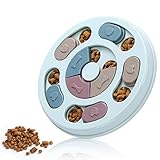
- 【Size】: L9.44" * W9.44"* H1.14" suitable for cats, puppies and small dogs.
- 【Interactive Dog Toys】This is a interactive puppy puzzle , which can easily become the closest companion and toy for your puppies and cats, and will release pressure for dogs. Find food by sliding parts to improve eating pleasure and IQ.
- 【Slow Feed Bowl】This encourages pets to eat at a slower speed, helps to slow down the feeding time to help the dog digest, and can provide your dog with a variety of healthy snacks.
- 【Slow Feede toys】 Use this educational game toy to exercise the dog’s brain, which will help meet the dog’s instinct needs, train the pet’s sense of smell, and let the dog enjoy feeding when using the nose or paw to move the slider, while providing spirit stimulate.
- 【Dog toys】No toy is indestructible. Do not leave toys with unsupervised pets. Remove and replace toy if damaged.
Statistics about time alone need careful interpretation
Animal Welfare Victoria’s “Your dog’s welfare needs” page reports that 8% of dogs are regularly left alone for more than 12 hours, 15% for 8 to 12 hours, 39% have no other animals for company while owners are out, 63% are not walked daily, and 62% did not attend puppy socialisation classes. The page material does not state the underlying survey year or methodology, so these figures should not be treated as current population-wide estimates.
The figures do show why a routine deserves scrutiny: long absences, limited exercise and little social opportunity can create welfare risks for some dogs. They do not establish a universal maximum absence or prove that any individual dog is distressed. Judge your own dog’s recorded behavior, welfare and health.
When to involve a veterinarian or behavior professional
Book a veterinary assessment for recurring distress when alone, sudden or major behavior changes, self-injury, escape attempts, persistent vocalizing, repeated destruction, inappropriate elimination, heavy salivation, appetite change or signs of pain. A veterinarian can rule out medical causes and recommend a behavior plan. A suitably qualified behavior professional may then help with gradual independence training and environmental changes.
AAHA’s 2015 Canine and Feline Behavior Management Guidelines include pacing, panting, vocalizing, urination, destruction and salivation among examples of anxiety-related signs, but those examples cannot diagnose an individual dog. WSAVA’s 2019 welfare guidance likewise emphasizes individual variation, social companionship and freedom from distress. Bring dated notes and recordings so the clinician can distinguish a health problem, a situational fear and a learned routine.
Do not punish barking, destruction, accidents or fearful behavior after the fact. Punishment can increase fear and does not teach the dog what to do instead. Avoid deliberately leaving a panicking dog alone for longer to force habituation. Until professional advice is available, reduce the intensity of absences where possible, use safe supervision and keep a precise record of triggers and timing.
A seven-day check you can use at home
- Day 1: map the routine. Record meals, walks, play, training, naps, departures and returns.
- Day 2: assess settling. Note whether the dog can rest undisturbed after activity and whether it chooses a bed or quiet area.
- Day 3: assess engagement. Offer one safe enrichment activity and record interest, frustration and recovery.
- Day 4: observe a normal absence. Use a camera or audio recording if safe, noting the first and last signs of distress.
- Day 5: check physical comfort. Watch movement, toileting, appetite and tolerance of touch; arrange a veterinary visit if anything is abnormal.
- Day 6: review triggers. Separate attention-seeking that follows boredom from behavior tied specifically to departures, noises, visitors or handling.
- Day 7: make one change. Add a brief positive interaction, adjust exercise or provide a calmer rest area, then observe whether the pattern improves. Escalate rather than experimenting further if distress is severe or worsening.
This process will not diagnose a disorder, but it turns a vague worry into information you and your veterinarian can act on.
What’s actually slowing this PC down?
Pick the symptom - the matching free tool is one click away.
Frequently Asked Questions
How many hours of attention does a dog need each day?
No cited welfare authority sets one daily minute target. Assess companionship, suitable activity, enrichment, rest, health and the dog’s ability to settle safely; the balance varies by age, health and temperament.
Best Value

- 【Product Size】10 inch*10 inch*1.2 inch.
- 【Interactive Dog Puzzle Toys 】This is a fun interactive puzzle toy,which can encourage and train your dogs or cats to seek foods by sliding the slider, helping pets to increase IQ by learning sequential steps and the challenging play.
- 【Squeaky Dog Toys】This dog puzzle toys is designed with a sounding device in the middle of the toy,which is to attract the pet's attention.Also,you would enjoy the fun of dog squeak puzzle toy with your pets, greatly improve relations with your pets and get fun during interactive dog games.
- 【Mental Excecise&Boredom Buster】Our memory training puzzle toy can keep smart dogs busy and engaged in more thinking and activities.Therefore,clot stimulation toys are great for reducing dogs’boredom,anxiety and destructive behaviors.
- 【Food-Safe PP Material】This dog treat puzzle is made with toxic-free, food-grade PP material. It is durable for interactive play and mental enrichment but not designed as a chew toy. Always supervise your pet during use.Easily washable with water or in the dishwasher.Note: No toy is indestructible. Remove and replace the toy if damaged.
Is following me everywhere proof my dog is lonely?
No. Following can reflect routine, curiosity or a desire for contact. It becomes more concerning when it is newly intense, frantic or paired with distress when you move away or leave.
What are signs of separation anxiety?
Repeated pacing, panting, barking or other vocalizing, heavy salivation, destruction, escape attempts or inappropriate elimination that reliably occur around absences are clues. They are not a diagnosis; a veterinarian should assess recurring signs.
Can a puzzle toy replace attention?
No. A suitable food toy can provide occupation during a brief, safe interval, but it cannot replace companionship or treat separation anxiety. Supervise new toys and match them to the dog’s size, health and chewing style.
Free tools Windows power users keep installed
One-click scans. No signup required.
Should I leave my dog alone longer so it gets used to it?
Do not prolong an absence when the dog is panicking, injuring itself or trying to escape. Build independence only in short, successful periods and seek professional guidance for recurring distress.
When should a veterinarian check an attention problem?
Arrange an assessment for sudden behavior changes, pain, appetite or sleep changes, repeated accidents, persistent vocalizing, self-injury, escape attempts, heavy salivation or destruction during absences.
Does getting another dog solve loneliness?
Not automatically. Dogs differ in their need for canine company, and compatibility and supervision matter. Observe the individual dog and discuss options with a veterinarian or qualified behavior professional.
How can I tell whether my dog is content when alone?
Use a safe camera or audio recording to note whether the dog rests, engages with a familiar safe activity and eventually settles. Record timing and intensity rather than relying on one chewed object or a neighbor’s report.
The Bottom Line
Your dog is likely receiving enough attention when it enjoys appropriate companionship, activity and enrichment, gets restorative rest, remains medically comfortable and can spend safe periods independently. Watch the pattern, especially during absences; recurring or worsening distress calls for veterinary help rather than more attention alone.
Quick Recap
Product prices and availability are accurate as of the date/time indicated and are subject to change. Any price and availability information displayed on Amazon at the time of purchase will apply.




