
Recommended Free Tools
Some links on this page are affiliate links: if you buy through them we may earn a commission, at no extra cost to you.
The most reliable way to tell whether your dog is overweight is to assess body condition, not to compare the number on a scale with a breed chart. On the standard nine-point body-condition scale, a score of 4 or 5 is generally ideal: you should be able to feel the ribs without pressing through a thick fat layer, see a waist from above, and see the abdomen rise toward the pelvis from the side. A scale, calorie calculation, and weight-loss rate then help you plan and monitor progress. They do not replace a veterinarian’s examination, especially when your dog is markedly overweight, losing weight unexpectedly, or has breathing, mobility, or other health problems.
How can I tell if my dog is overweight at home?
Stand your dog squarely on a level surface and assess the ribs, waist, and abdominal tuck. These observations are a screening tool rather than a diagnosis, but they are more informative than pounds alone.
As an Amazon Associate I earn from qualifying purchases.
Do these 3 things before closing this tab:
1Repair Windows errors before they cause bigger problems2Scan for outdated or missing drivers - takes under a minute3Clear out junk files and repair common Windows errorsCheck the ribs with flat fingers
Run your fingers lightly over the rib cage. At an ideal condition, the ribs are easy to feel but are not visibly protruding and are not covered by a thick layer of fat. If you must press firmly to locate them, excess fat is likely present. Prominent ribs with little soft tissue can indicate that the dog is too thin.
Look from above for a waist
With your dog standing, look down from the spine toward the floor. The body should narrow behind the ribs before widening slightly toward the hips. A straight-sided or rounded outline suggests excess fat, while a sharply sunken waist may indicate inadequate condition or a naturally lean build.
Popular on Amazon
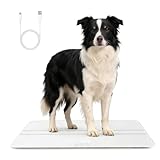
- DOG WEIGHING SCALE SIZE :27.16 x 12.99 inches, lighter and easier to carry. This dog scale size is easier to weigh dogs. Medium-sized dogs are very easy to weigh, but weighing large dogs sometimes requires good cooperation with the owner. NOTE: Not suitable for weighing giant dogs
- DOG SCALE SCALE LINE :There is a 68 cm/26.77 inch length scale line on the weighing platform to track the length of the pet's body. LARGE DOG SCALE CAPACITY 7oz-220 lbs, Measurement MEASUREMENT ACCURACY 0.35oz/10g, TARE Function, 3 UNITS: kg, lb, st
- HIGH QUALITY :The pet scale is designed with a glass weighing surface, which not only looks elegant, but also ensures that the surface is durable and easy to clean.
- RECHARGEABLE DIGITAL ANIMAL SCALE :The digital pet scale is powered by a 3.7V, 200mAh rechargeable battery. It saves the trouble of buying batteries.
- WIDELY USED: This dog weighing scale suitable for families, pet grooming care, pet clinics, pet stores and other places, it can track the weight and height of pets and monitor the health of cats and dogs,you can also keep a close eye on your child's weight and height, and continuously monitor whether your child maintains healthy standards.
Look from the side for an abdominal tuck
Viewed from the side, the abdomen should rise from the deepest part of the chest toward the pelvis. A level or sagging underside is a common sign of excess fat. Coat length, body shape, age, and posture can make this visual check difficult, so confirm what you see by feeling the ribs.
Use the nine-point body-condition scale
Cornell University College of Veterinary Medicine places ideal condition at 4 or 5 on a 1–9 scale. AAHA describes the same pattern of easily felt ribs, a visible waist, and an abdominal tuck. Ask your veterinarian to assign the score if you are uncertain, because owners often underestimate body fat when judging their own dog.
| Body-condition score | Approximate interpretation relative to score 5 |
|---|---|
| 4–5 | Generally ideal body condition |
| 6 | Approximately 10% overweight |
| 7 | Approximately 20% overweight |
| 8 | Approximately 30% overweight |
| 9 | Approximately 40% overweight |
The AAHA percentages are rough estimates, not a diagnosis. A dog’s muscle mass, frame, age, and medical status can make the same scale weight mean something very different in two individuals.
Why does body condition matter more than the number on the scale?
There is no single healthy-weight number that applies to every dog, even within a breed. AAHA recommends combining body weight with a body-condition score and a muscle-condition score as part of a nutritional assessment. A muscular dog may weigh more than a less muscular dog of similar height, while an apparently average-weight dog may carry too much fat and too little muscle.
WSAVA’s Global Nutrition Committee defines the goal this way: "The ideal body weight of your pet is the weight that keeps them at an ideal body condition." That definition explains why a target must be confirmed against the dog’s physical examination rather than selected from a breed-independent chart.
What is a healthy weight for my dog?
Your dog’s healthy weight is the weight at which the ribs, waist, abdominal tuck, and muscle condition are appropriate for that individual. You can estimate a starting target from the current weight and body-condition score, then have a veterinarian refine it.
Free tools Windows power users keep installed
One-click scans. No signup required.
Also popular on Amazon

- Product Introduction: Measuring range: 0.45-220 pounds/200 g-100 kg (measurement accuracy: ±0.0039 lb), size: 27”×13”×1.4”, weight: 11.03 pounds, function switching: (touch button on/off, leather Re-measurement, zeroing function, fixed display), Measurement and display units: (KG, LB, OZ), Power supply: 3.7 V 200 mAh rechargeable battery Please note: the animal weighing scale will automatically turn off when not in use
- Material: The dog scale is made of ABS+tempered glass material, with LED LCD display and anti-slip design on the four corners of the bottom. The dog scale has excellent thermal stability and safety
- Daily Management: The pet scale is simple to operate and convenient for weighing, and is used for obesity control, diet management and postoperative care. Weight is a barometer of health, especially in medium-sized dogs (Labradors, Border Collies, or other medium-sized mutts) that have chronic illnesses, are undergoing treatment, or are adults
- How to Use: The medium-sized pet scale consists of a tempered glass platform (27 x 13 inches) and is used for weighing pets from small to medium-sized pets. You can simply press the [Tare] button to subtract excess weight and weigh your pet
- Details: LED LCD display design: You can clearly read the bright data on the digital pet scale even in a dark place. (Note 1: Medium-sized pet scales can be used in a variety of places, including homes, pet shops, veterinary offices, children's schools, gyms, farms, and warehouses. 2: If used for large pets such as dogs, be sure to check the pet before ordering size. To avoid unnecessary trouble due to product size issues)
Estimate a target from the body-condition score
AAHA’s nine-point table treats scores 6 through 9 as approximately 10%, 20%, 30%, and 40% overweight compared with an ideal score of 5. To estimate an ideal weight from one of those percentages, divide the current weight by 1 plus the estimated excess fraction.
- At score 6, divide current weight by 1.10.
- At score 7, divide current weight by 1.20.
- At score 8, divide current weight by 1.30.
- At score 9, divide current weight by 1.40.
These calculations only translate an approximate score into an initial number. They should not be used to set a restrictive diet without veterinary review.
Use AAHA’s body-fat equation when an estimate is available
AAHA also publishes this estimate:
ideal body weight = current body weight × (100 − estimated body-fat percentage) ÷ 0.8
Use the body weight and body-fat percentage in the same units. If a veterinarian estimates 30% body fat, the calculation is current weight × 70 ÷ 80, or 0.875 times current weight. For example, a 40 kg dog would have an initial estimate of 35 kg. This is an illustration of the arithmetic, not a universal target for every 40 kg dog.
The Tool Desk
Outbyte PC Repair FREERepair Windows errors before they cause bigger problemsFix Now →Outbyte Driver Updater FREEScan for outdated or missing drivers - takes under a minuteDriver Scan →Body-fat estimates and body-condition scores are themselves imperfect. Have a veterinarian confirm the target by examining fat cover, muscle, frame, and any conditions that could affect weight.
How do I calculate how many calories my dog needs?
Calorie math provides a starting point for a feeding plan. AAHA’s equation for resting energy requirement (RER) is:
Also popular on Amazon

- WIDE WEIGHING PLATFORM: This electronic scale has a large 33 x 19 inch (840 x 480mm) tempered glass weighing platform with a 0.3 inch (8mm) extra thickness, fitting most dog and cat breeds and super easy for maintenance.
- MULTIPURPOSE SCALE: This scale is versatile and can be used for weighing various items such as food, postal items, luggage, and more. It has an animal weighing mode to ensure stable readings when animals move.
- EASY TO USE: The scale has a large, backlit LCD display that makes it easy to read measurements even in low-light conditions. It has a simple, user-friendly interface with intuitive buttons for easy operation.
- PRECISE WEIGHING: This electronic scale features high-precision strain sensor technology for accurate weight readings. It offers unit conversion between pounds and kilograms, making it suitable for various applications.
- CONVENIENT FEATURES: The scale has a voice announcement (VA) feature that audibly indicates weight readings. The scale has a zero/tare function to easily reset the weight to zero. It also has a 2-minute auto shutdown feature to conserve battery life. Additionally, it has a low power alarm, an anti-interference indicator, and a USB connectivity port for easy data transfer.
RER = 70 × body weight in kilograms0.75
A life-stage or weight-loss factor is then applied to produce a starting daily calorie target. The appropriate factor depends on the individual dog’s age, reproductive status, activity, medical condition, and whether the goal is maintenance or weight reduction. The guideline treats the result as a starting estimate, not a prescription: follow-up weight and body-condition data determine whether calories need to be adjusted.
Why the equation cannot stand alone
Two dogs with the same weight can have different energy needs because of differences in metabolism, activity, muscle, illness, and medication. A dog may also eat more calories than the owner realizes through chews, table food, supplements, or food used to give medication. Record every source before deciding that the calculated allowance is failing.
How much should an overweight dog eat?
Feed a measured, nutritionally complete plan based on the veterinarian-confirmed target and the dog’s response. Do not simply remove a large portion of the current maintenance food without checking calorie density and nutrient adequacy.
- Record the current intake. Write down the food brand and formulation, grams or cups offered, treats, chews, scraps, supplements, and medication rewards. Include food other household members provide.
- Choose the diet with veterinary guidance. Cornell reports that weight-loss diets often provide fewer calories per cup and more fiber. A purpose-formulated diet can allow an appropriate volume of food while supplying required nutrients. Cutting the volume of a regular maintenance diet can create deficiencies if the restriction is substantial.
- Set a daily calorie and portion allowance. Use the RER calculation and the veterinarian’s life-stage or weight-loss factor as the starting point. Convert the calorie target into a weighed food portion using the food’s stated calories, rather than relying on an unverified scoop.
- Measure every meal consistently. Weighing food in grams generally gives more repeatable portions than estimating by eye. Keep the same measuring routine so that a change in body weight reflects a real change in intake.
- Reserve calories for extras. WSAVA recommends keeping treats at about 10% or less of daily calories. Count dental chews, training rewards, leftovers, supplements, and medication carriers within that limit.
- Review the plan instead of making abrupt cuts. If weight is not changing, contact the veterinarian to reassess the recorded intake, target, activity, body-condition score, muscle condition, and possible medical causes.
How fast should my dog lose weight?
The safe rate is individualized and veterinarian monitored. Cornell reports 1–2% of body weight per week as a commonly safe expectation during an active weight-loss plan. An AAHA owner page gives a different convention of 1–3% per month. Because published guidance is not identical, your veterinarian should set the patient-specific rate and interpret the trend.
| Source | Published rate | How to use it |
|---|---|---|
| Cornell University College of Veterinary Medicine, updated 2024 | 1–2% of body weight per week | A commonly safe expectation reported for weight-loss programs |
| AAHA owner guidance | 1–3% of body weight per month | An alternative published convention; the veterinarian individualizes the target |
Do not accelerate loss because a scale reading is disappointing. Faster-than-planned loss, lethargy, vomiting, loss of muscle, or other illness signs require a prompt plan review. The aim is reduction of excess fat while preserving muscle and normal behavior.
How should I monitor a dog’s weight-loss plan?
Establish a baseline weight, body-condition score, muscle-condition score, food intake, and activity pattern. Cornell advises weighing at least every two weeks during active loss. Use the same scale when possible, at a similar time and under similar conditions, and record the date and result.
Also popular on Amazon

- 🔧 No Assembly Required: The all-in-one design enhances stability and durability, requiring no assembly. Ready to use right out of the box, it’s ideal for busy pet owners who want convenience and reliability in one product
- ⚖ Accurate Weighing for Small Pets:30g‑40kg (88LB) weighing range with 5g precision.Ideal for whelping breeders, track weight gain of newborn puppies and kittens in litter, monitor health for each newborn pet, ensuring accurate weight readings every time for all types of pets
- 🚀 Convenient Hold Function: The Hold function captures your pet’s weight even when they move, making the process stress-free and simple. No need for your pet to stay still-just place them on the scale and get an accurate result
- 📺 Clear LED Display: The bright LED display ensures easy reading even in dim light, making it ideal for senior users. Track your pet’s weight day or night with effortless clarity
- 🌍 Multi-Unit Options for Versatility: Switch seamlessly between g, kg, oz, lb, and lb oz with the push of a button. This feature is perfect for global users and varying pet measurement needs
Track more than pounds
- Body weight: shows the trend but does not reveal whether lost weight is fat or muscle.
- Body-condition score: documents changes in rib cover, waist, and abdominal tuck.
- Muscle condition: helps identify unwanted muscle loss.
- Food and treat records: reveal uncounted calories and make adjustments possible.
- Comfort and function: note walking tolerance, mobility, breathing, energy, and appetite.
Bring the record to rechecks so the veterinarian can adjust calories or portions from evidence rather than a single weigh-in. AAHA states that a nutritional assessment, including body- and muscle-condition scores, should ideally be performed at every examination.
What exercise is appropriate for an overweight dog?
Increase walking, swimming, or another low-impact activity gradually. An inactive dog may need short, easy sessions before duration or intensity increases. Dogs with joint disease, breathing difficulty, or severe obesity need veterinary advice before an exercise increase; forcing activity can worsen pain or injury.
Exercise supports calorie control and preserves function, but it is one component of the plan rather than a substitute for measuring food. If mobility improves as weight falls, activity can be progressed under guidance.
Why might an overweight dog fail to lose weight?
First verify the portions and the complete calorie record. The most common practical explanation is that extras were omitted or portions were estimated inconsistently. If the record is accurate and the trend still stalls, the veterinarian should reassess the target, food calories, activity, body-condition score, muscle condition, and health status.
AAHA lists hypothyroidism, Cushing’s disease, osteoarthritis, and some medications, including corticosteroids, as factors that can contribute to weight gain or interfere with loss. Pain can reduce activity, while endocrine disease can alter energy balance. A stalled plan is therefore a reason for evaluation, not an automatic reason to keep cutting food.
Independent reader supportYour contribution helps us test, update, and keep practical guides available for everyone.When should a veterinarian set the target weight?
Arrange a veterinary assessment when you are unsure of the body-condition score, your dog is markedly overweight, or you cannot distinguish fat from muscle or a normal body shape. Professional input is especially important for puppies, seniors, dogs with chronic disease, and dogs taking medications that affect appetite, activity, or metabolism.
Also popular on Amazon

- 𝗗𝗲𝘀𝗶𝗴𝗻𝗲𝗱 𝗳𝗼𝗿 𝗚𝗿𝗼𝘄𝗶𝗻𝗴 & 𝗔𝗴𝗶𝗻𝗴 𝗣𝗲𝘁𝘀: Easily monitor your pet’s weight from kitten and puppy growth to adult care and senior health. Ideal for multi-pet homes, foster families, and anyone who wants a simple way to support pet wellness between vet visits.
- 𝗪𝗶𝗴𝗴𝗹𝗲-𝗣𝗿𝗼𝗼𝗳 𝗪𝗲𝗶𝗴𝗵𝗶𝗻𝗴 𝗬𝗼𝘂 𝗖𝗮𝗻 𝗧𝗿𝘂𝘀𝘁: Pets don’t always sit still, so the scale is built to account for natural movement and stabilize readings as they move. A paw icon appears on the display when the weight is locked in, making it easy to read with confidence.
- 𝗡𝗼𝘁𝗶𝗰𝗲 𝘁𝗵𝗲 𝗦𝗺𝗮𝗹𝗹 𝗖𝗵𝗮𝗻𝗴𝗲𝘀: With 0.1 lb precision and a 44 lb capacity, this scale helps you see subtle changes in your pet’s weight over time. Ideal for breeders monitoring puppies and for pet owners supporting a healthy weight at home.
- 𝗠𝗮𝗱𝗲 𝗳𝗼𝗿 𝗘𝘃𝗲𝗿𝘆𝗱𝗮𝘆 𝗨𝘀𝗲: The tare function lets you weigh your pet with a bowl, blanket, or favorite spot—just zero it out for an accurate reading. The 24 x 11.5 in removable tray makes cleanup simple and adds flexibility for different pets and setups.
- 𝗔 𝗥𝗲𝗹𝗶𝗮𝗯𝗹𝗲 𝗧𝗼𝗼𝗹 𝘄𝗶𝘁𝗵 𝗥𝗲𝗮𝗹 𝗦𝘂𝗽𝗽𝗼𝗿𝘁: Built around a single-sensor design that keeps readings consistent from one weigh-in to the next. Switch seamlessly between lb, lb:oz, and kg, start right away with 4 AAA batteries included, and count on our St. Louis team for support, backed by 5-year product coverage.
Seek prompt veterinary help for breathing difficulty, reduced mobility, sudden weight change, persistent vomiting, lethargy, or loss of muscle. These signs can indicate a problem that a feeding adjustment alone will not solve.
What does a practical weight-loss plan look like?
- Examine and score: obtain a baseline weight, body-condition score, muscle-condition score, and medical history.
- Set an initial target: use the score-based estimate or body-fat equation only as a starting point, then have the veterinarian confirm it.
- Calculate calories: apply the RER equation and an individualized life-stage or weight-loss factor.
- Select adequate food: use a complete diet appropriate for controlled weight loss rather than severely restricting a maintenance diet without guidance.
- Control extras: keep treats around 10% or less of daily calories and include all chews, scraps, supplements, and medication food.
- Measure and recheck: weigh portions, record intake, and check weight at least every two weeks while loss is active.
- Adjust safely: change the plan with veterinary oversight when the rate is too fast, too slow, or accompanied by illness signs.
Frequently asked questions
Can I use my dog’s breed-weight range as the goal?
A breed range can provide context, but it cannot establish an individual target. The clinically meaningful endpoint is the weight that produces an ideal body and muscle condition for your dog, confirmed by examination.
What’s actually slowing this PC down?
Pick the symptom - the matching free tool is one click away.
What if my dog is heavy but also very muscular?
Muscle can raise scale weight without indicating excess fat. Ask the veterinarian to assess muscle condition separately from fat cover; a single percentage-based estimate may be misleading when body composition is unusual.
Should I keep reducing food until the scale moves?
No. Recheck the complete calorie record, portion measurement, diet adequacy, activity, and medical status first. Continued restriction without those checks can compromise nutrient intake or muscle and may miss a condition such as hypothyroidism, Cushing’s disease, pain, or a medication effect.
What information should I bring to a weight consultation?
Bring recent weights with dates, the current body-condition observations, a several-day record of every meal and extra, food labels or calorie information, medication details, and notes about activity, appetite, mobility, and breathing. This gives the veterinarian enough context to distinguish inaccurate portions from a medical or nutritional problem.
Frequently Asked Questions
Can I use my dog’s breed-weight range as the goal?
A breed range can provide context, but it cannot establish an individual target. The clinically meaningful endpoint is the weight that produces an ideal body and muscle condition for your dog, confirmed by examination.
What if my dog is heavy but also very muscular?
Muscle can raise scale weight without indicating excess fat. Ask the veterinarian to assess muscle condition separately from fat cover; a single percentage-based estimate may be misleading when body composition is unusual.
Should I keep reducing food until the scale moves?
No. Recheck the complete calorie record, portion measurement, diet adequacy, activity, and medical status first. Continued restriction without those checks can compromise nutrient intake or muscle and may miss a condition such as hypothyroidism, Cushing’s disease, pain, or a medication effect.
What information should I bring to a weight consultation?
Bring recent weights with dates, the current body-condition observations, a several-day record of every meal and extra, food labels or calorie information, medication details, and notes about activity, appetite, mobility, and breathing. This gives the veterinarian enough context to distinguish inaccurate portions from a medical or nutritional problem.





Leave a Reply