
Some links on this page are affiliate links: if you buy through them we may earn a commission, at no extra cost to you.
The right dog coat stays centered and secure while your dog can breathe, walk, turn, sit, lower its head, groom, and toilet normally. Check fit in three stages: measure your standing dog against the garment maker’s chart, inspect every opening and closure indoors, then watch a short familiar walk. A coat is too tight if it presses the throat or ribs, rubs the armpits, or changes movement; it is too loose if it twists, slides, bunches, exposes the dog, or creates snagging and toileting hazards. Your dog’s behavior—scratching, freezing, panting, or trying to remove it—is important fit evidence, not something to ignore.
What measurements do I need before buying a dog coat?
Measure your dog standing naturally on all four paws, then match the results to the exact product’s size chart. “Small,” “medium,” and “large” are not consistent between manufacturers, so a generic label cannot establish fit. VCA and the Ontario SPCA both recommend recording back, chest, and neck measurements before ordering.
As an Amazon Associate I earn from qualifying purchases.
The Tool Desk
Outbyte Driver Updater FREEScan for outdated or missing drivers - takes under a minuteDriver Scan →Outbyte PC Repair FREERepair Windows errors before they cause bigger problemsFix Now →| Measurement | Where to measure | Why it matters |
|---|---|---|
| Back length | From the base of the neck to the base of the tail, with the dog standing naturally | Shows whether the coat covers the needed back without extending over the tail |
| Chest girth | Around the widest part of the ribcage, just behind the front legs | Determines room for breathing and movement without squeezing the ribs |
| Neck circumference | Around the area where the coat’s neckline will sit | Prevents pressure on the throat and helps the neckline stay in place |
How should I take accurate measurements?
- Stand your dog on a level surface with all four paws bearing weight. Do not measure while the dog is sitting, lying down, or stretching.
- Use a soft tape measure. If you use string, mark the length and then measure the string against a ruler.
- Keep the tape level and snug against the fur without compressing the coat or skin.
- Repeat each measurement and record the larger or consistent result. Compare all three numbers with the manufacturer’s chart for that exact coat.
If the chart identifies one measurement as the deciding factor, follow that instruction. A coat that matches back length but cannot accommodate the chest or neck is not the right size.
How do I check a coat indoors before taking my dog outside?
Put the coat on indoors, where you can remove it immediately if your dog is uncomfortable. Check the garment while your dog performs ordinary movements rather than judging it only while standing still.
Popular on Amazon

- Durable Protection For Active Dogs: Durable dog coat with iconic roots for the hardest working dogs. Fully insulated firm-hand duck canvas perfect for dogs who need a tough, reliable dog winter jacket in cold, windy conditions
- Built For Tough Conditions: Built with heavy duty firm-hand duck canvas the 12-Ounce exterior shell is crafted to handle the toughest outdoor conditions, offering durability and protection against wind and cold weather. The triple needle stitch on main seams ensures a long lasting product
- Insulated Interior For Cold Weather| Designed as a dog winter coat, this insulated dog jacket features a quilted liner and corduroy-lined collar for added warmth, keeping your dog comfortable even in cold temperatures. Warmer than a traitonal dog puffer jacket
- Easy To Adjust And Wear: The improved neck and chest tabs, along with loop-lined straps for chest and waist, ensure a secure, adjustable fit for small, medium, and large dogs
- Sizing: Offering dog jackets for small dogs(Chest Girth: 16"- 21"), dog jackets for medium dogs (Chest Girth 22"- 28"), dog jackets for large dogs (Chest Girth 25"- 38"), and dog jackets for extra large dogs (Chest Girth 30"- 45") See sizing chart in images
Inspect the neckline and chest
The neckline should sit where you measured it, without pressing on the throat or rubbing the underside of the neck. Fasten the chest closure as directed by the manufacturer; it should hold the coat in position without compressing the ribcage. Your dog should breathe normally and be able to lower its head.
Check the belly panel and leg openings
Look under the dog for bunching, exposed skin that needs protection, or fabric that reaches the genital area. Leg openings should not cut into the armpits or elbows. Ask your dog to walk, turn, sit, and stand; watch for shortened steps or a reluctance to move a shoulder.
Do these 3 things before closing this tab:
1Fix the driver behind crashes, sound loss and screen glitches2Clear out junk files and repair common Windows errors3Scan for outdated or missing drivers - takes under a minuteTest the tail and toileting clearance
The coat must not extend over the tail or obstruct urination or defecation. Take your dog through the motions it normally uses to toilet. If the belly panel or rear edge needs constant repositioning, the cut is unsuitable even if the listed measurements appear correct.
Examine closures and lead access
Check every buckle, toggle, hook-and-loop panel, and zipper for secure engagement. Nothing should hang where it can catch on furniture, branches, fencing, or another dog. If the coat has a lead opening, confirm that the leash can attach without pulling the garment into the neck.
What should I watch for when my dog walks in the coat?
After the indoor check, take a short walk in a familiar, low-risk area. The coat should remain centered and stable as your dog changes speed and direction.
- Stay centered: The back seam or spine panel should remain over the dog’s back rather than rotating to one side.
- Hold its position: The coat should not slide backward, ride up toward the neck, or bunch behind the shoulders.
- Preserve gait: Your dog should take normal steps, turn, sit, and move its shoulders and front legs freely.
- Remain dry and comfortable: On returning indoors, inspect the skin and fur for dampness, pressure marks, or rubbed areas.
Stop the walk if your dog appears distressed. Remove the coat and inspect the area that seems to be causing the problem before changing an adjustment or size.
What’s actually slowing this PC down?
Pick the symptom - the matching free tool is one click away.
How tight should a dog coat be?
There is no universal finger-clearance number that works for every coat design. The defensible standard is functional: the coat must stay in place without throat or chest pressure, rubbing, breathing restriction, or reduced movement. Use the product’s adjustment instructions and chart, then confirm the result on a moving dog.
Signs the coat is too tight
- Pressure or redness at the neckline, chest, armpits, elbows, or closure points
- Rubbing, chafing, or compressed fur after a short walk
- Shortened stride, reluctance to turn, sit, lower the head, or raise a leg
- Visible breathing difficulty or panting that is unusual for the activity and weather
Signs the coat is too loose
- Twisting, sliding backward, or exposing areas the coat is meant to protect
- Loose straps or hardware that can snag, tangle, or become a choking hazard
- Fabric bunching under the chest or around the legs
- Rear coverage that interferes with the tail or toileting
Do not compensate for a poor cut by tightening one strap until another area is compressed. If a larger size solves chest room but creates excessive length, loose straps, tail coverage, or toileting problems, neither size is suitable; choose a different cut or return the garment.
What does my dog’s behavior tell me about coat fit?
Behavior is practical evidence. Scratching, biting at the fabric, rubbing against furniture, freezing, refusing to walk, repeatedly trying to remove the coat, or showing unusual panting means you should stop and reassess rather than assuming the dog will simply get used to it.
Also popular on Amazon
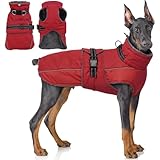
- SNOW & WATER RESISTANT DOG COAT: The dog winter coat is made of premium water-resistant fabric with fleece lining. The windproof dog jacket turtleneck design can keep the dog warm even in cold weather. Ideal for indoor and outdoor activities
- EASY TO WEAR: Quick release buckle and adjustable strap on back make the large dog coat easy to put on and take off. There are adjustable elastic straps on collar that can adjust the tightness and prevent wind and snow. QBLEEV dog clothes can machine washable
- REFLECTIVE DOG COAT WITH HARNESS BUILT IN: This dog winter jacket is designed with reflective strips, which ensuring your dog's safety in low-light conditions. There are two D-rings on the neck, which can be attached to a leash, making outdoor walking more convenient
- WATERPROOF THERMAL DOG JACKET FOR COLD DAYS: Our dog cold weather coats are great for walking, hiking, running, climbing, snow skiing, jogging, camping. Also provides optimal warmth and dryness in foggy, lightly rainy, and snowy conditions. QBLEEV warm dog coat is ideal for winter daily wear
- 6 SIZES AVAILABLE FOR SMALL MEDIUM LARGE DOGS: S, M, L, XL, XXL, XXXL. The fleece dog coat fits for nearly all kinds of breed furry friend. Such as Chihuahua, Beagle, Poodle, Bulldog, Schnauzer, Labrador, Golden Retriever, Teddy, Yorkshire Terrier, Maltese, Pekingese, Pomeranian, Cocker Spaniel, Jack Russel, Pug, Husky, Samoyed, Boston Terriers, etc
Scratching, biting, or rubbing
These behaviors can indicate a rubbing edge, pressure point, trapped fur, or a closure that is irritating the skin. Remove the coat, inspect the affected area, and repeat the indoor movement check only after correcting the cause.
Freezing or refusing to walk
A dog that will not move may be restricted at the shoulders, chest, legs, or neck, or may be overwhelmed by the garment. Check whether the coat twists or catches as the dog takes a step. If movement remains abnormal, use a different design rather than forcing the dog to continue.
Unusual panting or lethargy
Panting can signal overheating, especially when a coat is used on a thick-coated or flat-faced dog, indoors, or during exertion. Heavy panting, difficulty breathing, excessive drooling, lethargy, vomiting, or collapse are heatstroke warning signs identified by the RSPCA. Remove the coat, stop activity, begin cooling, and seek urgent veterinary help when heatstroke is suspected.
When does a dog actually need a coat?
Coats are most useful when a dog loses heat readily or faces cold, wet, windy, or prolonged outdoor exposure. Dogs that may benefit include many small, short-coated, thin-coated, young, old, recently clipped, or medically vulnerable dogs. The decision still depends on the individual dog and conditions; a coat is not automatically appropriate for every animal or every temperature.
VCA distinguishes waterproof jackets for winter protection from sweaters that add warmth indoors. PDSA identifies winter coats, high-visibility jackets, and boots as useful in appropriate situations. RSPCA discusses boots for cold ground, rock salt, and grit. Select protection for the actual hazard rather than adding layers that reduce movement or make the dog overheat.
Crashes, No Sound, or Screen Glitches?
Random freezes, missing sound and display glitches usually trace back to one bad driver. Find and replace yours safely.Free scan · under a minutePC Slower Than It Used to Be?
A free scan shows the junk files, broken settings and background clutter dragging Windows down - then fixes them in one click.Free scan · Windows 10 & 11Which type of coat is easiest to fit safely?
Compare garments on coverage, weather protection, mobility and adjustment, and safety features. A coat that excels in one category can fail in another, so assess all four before purchase.
| Coat feature | What to verify | Typical use |
|---|---|---|
| Coverage | Back, chest, and belly protection with tail and toileting clearance | Cold or wet exposure where more of the body needs shielding |
| Weather protection | Whether the outer fabric is intended for rain and wind or only for dry warmth | Waterproof jacket for wet winter conditions; sweater for added indoor warmth |
| Mobility and adjustment | Flexible shoulder and leg openings plus closures that hold without pressure | Active walks where the dog turns, climbs, or changes pace |
| Safety features | Visibility, secure lead access, and no loose snagging hardware | Low-light walks, crowded areas, or environments with brush and obstacles |
When are boots a better addition than a heavier coat?
Boots address hazards under the feet, including cold ground, rock salt, and grit, which a torso coat cannot protect against. They must still allow normal walking and must not become loose or tangled. Introduce only the protection needed for the conditions so the dog retains normal movement and temperature control.
Independent reader supportYour contribution helps us test, update, and keep practical guides available for everyone.How can I troubleshoot a coat that almost fits?
Make one change at a time and repeat the complete movement check. Adjusting a closure may solve a small positioning issue, but it cannot correct a fundamentally mismatched proportion.
The chest fits, but the back is too long
Do not fold or pin excess fabric near the tail. Extra length can interfere with the tail or toileting and may cause the coat to slide. Look for a shorter-back cut with equivalent chest capacity.
Also popular on Amazon

- 【Triple-Shield Protection】This dog coat features a windproof, waterproof, and dirt-resistant softshell, keeping your dog warm and dry in harsh winter weather.
- 【3-Layer Fabric】Built with durable 150D 4-way stretch outer layer, TPU waterproof breathable membrane, and soft thermal fleece lining for comfort and warmth.
- 【Functional Fit for All Dogs】Adjustable neck buckle, elastic belly band, rear leg straps, and tail-end buckle provide a secure fit for small, medium, and large dogs.
- 【Pet-Friendly Design】High collar blocks cold wind, U-shaped belly cut ensures no interference for male or female dogs, while dual zipper leash opening makes walks easier.
- 【Safety in Low Light】Reflective strips increase visibility during evening walks, ensuring your dog stays safe outdoors. Available in multiple sizes from S to 2XL for breeds like Pomeranian, Corgi, Labrador, and Golden Retriever.
The back fits, but the chest is tight
Do not loosen the chest until the coat can rotate or expose the dog. A broader cut or a different pattern is safer than compressing the ribs or restricting the shoulders.
The coat shifts to one side
Check that the neckline and chest closure are positioned correctly and that the belly panel is not pulling unevenly. If the coat still twists during a short walk, its shape does not match your dog’s proportions.
The dog gets damp underneath
Inspect for trapped moisture, bunching, or a fabric type that is unsuitable for the weather. Remove the coat, dry the dog, and choose protection whose stated weather purpose matches the conditions.
How do I prevent overheating and other clothing hazards?
Clothing can interfere with walking, toileting, grooming, and temperature control. A loose or tangled coat can also become a snag or choking hazard. Supervise your dog whenever a new garment is worn, particularly around obstacles, other animals, and equipment.
- Use the lightest protection that covers the relevant weather or ground hazard.
- Check for heavy panting, breathing difficulty, excessive drooling, lethargy, vomiting, or collapse.
- Remove the coat immediately if it becomes wet inside, twists, catches, or causes distress.
- After each early outing, inspect skin and fur at the neck, chest, armpits, elbows, and closures.
- Do not leave a coat on when you cannot respond to a snag, overheating, or toileting problem.
The RSPCA’s welfare test is simple: the garment should be comfortable enough for the dog to behave normally, including going to the toilet easily. If it fails that test, change the garment or stop using it.
What is the final fit decision?
Keep the coat only when all three checks agree: the measurements match the manufacturer’s chart, the indoor inspection shows no pressure or obstruction, and a short walk leaves the garment centered without behavior or skin problems. A coat that cannot meet those conditions is not made suitable by a tighter strap or longer adjustment. Choose another size, a different cut, or no coat for that situation.
Frequently Asked Questions
Should I measure my dog while it is sitting or lying down?
No. Measure with the dog standing naturally on all four paws so the back, chest, and neck dimensions reflect the position the coat will occupy. Repeat the measurements before comparing them with the product chart.
Can a sweater and a waterproof jacket be used interchangeably?
Not necessarily. VCA distinguishes waterproof jackets for winter protection from sweaters intended to add warmth indoors, so check the garment’s stated weather purpose before relying on it in rain or wind.
Quick wins for a faster PC:
Fix the driver behind crashes, sound loss and screen glitchesFind Drivers →Clear out junk files and repair common Windows errorsFree Scan →What should I do if my dog shows heatstroke signs in a coat?
Remove the coat and stop the activity immediately. Heavy panting, difficulty breathing, excessive drooling, lethargy, vomiting, or collapse require cooling measures and urgent veterinary help, according to the RSPCA.
Are reflective or high-visibility details enough to make a coat safe?
Visibility is only one safety feature. The coat must also have secure lead access and no loose hardware that can snag or tangle, and it still needs the same movement, pressure, and toileting checks as any other garment.





Leave a Reply