Recommended Free Tools
KASIKS is a wet-food-only canned cat food line. Its recipes are built around named animal proteins, including chicken, turkey and salmon, plus a Fraser Valley recipe that pairs salmon with black soldier fly larva. The most useful way to judge it is recipe by recipe rather than as one product. In the 2026 Cats.com review, the chicken formula is presented as the reviewer’s leading general option, and the salmon formula is the lower-carbohydrate choice among the recipes reviewed.
What KASIKS sells
Cats.com describes KASIKS as a canned line with four recipes it reviewed: Cage-Free Chicken, Cage-Free Turkey, Wild Coho Salmon and Fraser Valley Grub. The reviewed can sizes are 5.5 ounces and 12.2 ounces. Catalog and pack sizes change, so check the current listing before you order.


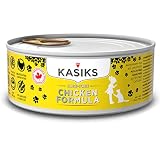

| Recipe | Named protein and notable ingredients | Carbohydrate estimate (dry matter, Cats.com) | Calories (Cats.com) |
|---|---|---|---|
| Cage-Free Chicken | Boneless chicken, water, pea starch, then minerals, taurine, kale, berries and coconut | About 24% | 331 per 12.2-ounce can |
| Cage-Free Turkey | Boneless turkey, water, pea starch and chicken liver, then minerals, taurine, vitamins and small amounts of plant ingredients | About 24% | About 27 per ounce |
| Wild Coho Salmon | Boneless, skinless salmon, water, pea starch, supplements, taurine and small amounts of kale, berries and coconut | About 14% | Not stated |
| Fraser Valley Grub | Salmon as the primary protein, with black soldier fly larva as an additional protein source | Not stated | Not stated |
The chicken and turkey figures come from Cats.com’s own calculation. Calorie and carbohydrate values for the salmon and Fraser Valley recipes are not stated in the review.
Reading the ingredient panels
The company describes each recipe’s main protein as single-source, but the ingredient panels do not match in every case. Two details matter most when comparing them.
Quick wins for a faster PC:
Scan for outdated or missing drivers - takes under a minuteDriver Scan →Clear out junk files and repair common Windows errorsFree Scan →#1 Best Overall
- Chicken starts with boneless chicken, water and pea starch. It is the most straightforward panel of the set.
- Turkey also starts with boneless turkey, water and pea starch, but it lists chicken liver as well. A cat that must avoid chicken should not be given the turkey recipe on the assumption that it is chicken-free.
- Salmon starts with boneless, skinless salmon, water and pea starch, with the same supplement base and small amounts of kale, berries and coconut found in the chicken formula.
- Fraser Valley Grub is the only recipe built around an insect protein. Cats.com notes that its salmon is the primary protein, with black soldier fly larva as a secondary source.
Cats.com highlights the short, clearly named ingredient lists and the gum-free formulas as strengths. Pea starch is the main drawback it raises, because it contributes to the carbohydrate total.
Carbohydrates: the number that separates the recipes
The carbohydrate estimate is the figure that most often decides which KASIKS recipe suits a given cat. Cats.com calculates dry-matter carbohydrates from each recipe’s guaranteed analysis. It reports about 24% for the chicken and turkey recipes and about 14% for the salmon recipe.
These values are calculated, not measured. The review states that its nutrient charts are generated automatically from guaranteed analysis and may not reflect typical values for the product. Treat the percentages as a way to compare recipes against one another, not as a laboratory result for any individual can.
Cats.com also quotes the company’s explanation of why carbohydrates appear in canned food:
“Carbohydrates have some important body functions and can have a protein-sparing effect in the body. If the diet supplies adequate carbohydrates, protein will be spared from being used for energy and can instead be used for tissue repair and growth. Furthermore, carbohydrates also supply carbon skeletons for the formation of amino acids by the body.”
That is KASIKS’s own position as the review reproduces it, not an independently verified scientific consensus. Readers who want a lower-carbohydrate wet food should weigh it against the reviewer’s concern about pea starch.
Is KASIKS a healthy choice for your cat?
The review does not give a single answer, and neither can this article. Whether a recipe is appropriate depends on the individual cat, its health status and the feeding plan a veterinarian recommends. KASIKS should not be presented as a treatment for allergies or any other condition.
The retailer describes the chicken product as complete and balanced and suitable for all life stages. That statement is printed for that product, so do not assume it applies to every KASIKS recipe. Check the nutritional adequacy statement on the label of the exact recipe and can size you buy.
A practical way to choose among the recipes:
- Start with the protein your cat can eat. If chicken is off the table, the turkey recipe is excluded because it contains chicken liver. The salmon recipe is the one to compare.
- If lower carbohydrates are a priority, the salmon recipe is the reviewed option with the lowest estimate, at about 14% on a dry-matter basis.
- If you want the reviewer’s default pick, the chicken recipe is the one Cats.com rates as its leading general option.
- If you are curious about insect protein, the Fraser Valley Grub recipe is the only one in the line that uses it, and no carbohydrate or calorie figure for it is stated in the review.
Calories and cost
Cats.com reports 331 calories per 12.2-ounce chicken can and about 27 calories per ounce for the turkey recipe. For a cost example, the review assumes a 10-pound cat eating 200 calories per day and estimates about $2.20 per day using Chewy pricing at the time of the 2026 review. Retail prices change often, so use that figure only as a rough benchmark.
Recalls and safety record
Cats.com reports that it did not find an apparent KASIKS recall. Petful’s recall tracker reported no FDA or manufacturer recalls for KASIKS through September 3, 2026. Those results are a record of what was found on those checks, not a guarantee that no safety issue will ever arise. If your cat shows a sudden change in appetite, stool or energy after a food change, stop the new food and contact your veterinarian.
Where to buy
Cats.com links its reviewed chicken recipe to an Amazon listing. Can & Clover also lists the product with its ingredient information, though its 156 g x 24 can selection was showing as sold out at the time of checking. A useful search phrase is “KASIKS Cage-Free Chicken Formula canned cat food.” Compare the ingredient panel on the listing with the can you receive, because retailer descriptions are a summary and not a substitute for the package label.
The Bottom Line
KASIKS is a reasonable option for owners who want wet food built around named proteins, short ingredient panels and no gums. The chicken recipe is the reviewer’s default pick, the salmon recipe has the lowest estimated carbohydrate level of those reviewed, and the turkey recipe is not suitable for a cat that must avoid chicken. Pea starch and the calculated carbohydrate figures are the main trade-offs. Confirm the nutritional statement and pack size on the label of the specific recipe you buy.
What’s actually slowing this PC down?
Pick the symptom - the matching free tool is one click away.
Quick Recap
Product prices and availability are accurate as of the date/time indicated and are subject to change. Any price and availability information displayed on Amazon at the time of purchase will apply.




