Do these 3 things before closing this tab:
1Clear out junk files and repair common Windows errors2Scan for outdated or missing drivers - takes under a minute3Repair Windows errors before they cause bigger problemsMegaraptor namunhuaiquii was a large-clawed theropod from Late Cretaceous Patagonia, not a small dromaeosaurid like Velociraptor. It belongs to the megaraptoran lineage, whose members are known for powerful forelimbs and large hand claws. Its fossils come from the Portezuelo Formation of Neuquén, Argentina; a 2022 scientific paper assigns the taxon to the Coniacian.
Megaraptor is known from incomplete fossils, so its exact adult length and mass are not established by the research reviewed here. A 2025 study discusses South American megaraptorids as exceeding 7 meters and 1,000 kilograms in a clade-level size estimate, but that estimate should not be treated as a precise measurement of Megaraptor itself.
Quick facts about Megaraptor
| Fact | What the research supports |
|---|---|
| Scientific name | Megaraptor namunhuaiquii |
| Group | Megaraptora, a lineage of large-clawed predatory theropods |
| When it lived | Late Cretaceous; a 2022 paper assigns it to the Coniacian |
| Where it lived | Portezuelo Formation, Neuquén, Argentina |
| Size | No exact adult length or mass for this species is established in the reviewed sources |
| Signature feature | Powerful forelimbs and large claws on the first two fingers, as seen in derived megaraptorans |
“Raptor” does not mean Velociraptor
The word “raptor” may bring to mind small, sickle-clawed dromaeosaurids such as Velociraptor. Megaraptor was not one of those dinosaurs. It was a large theropod in Megaraptora, a distinct lineage of carnivorous dinosaurs known for large claws.
The shared “raptor” wording does not establish close membership in the dromaeosaurid group. It is clearer to call Megaraptor a megaraptoran theropod and explain the distinction when using the familiar word “raptor.”
Recommended Free Tools
#1 Best Overall

- Resin Cast Replica
- 5.5 inches
How a hand claw changed the dinosaur’s identity
The first described fossil that drew attention to Megaraptor was a very large claw. It was initially interpreted as a foot claw, prompting comparisons with dinosaurs known for enlarged toe claws. Later anatomical interpretation placed the famous claw on the hand instead.
That distinction matters: derived megaraptorans are recognized for powerful forelimbs and large claws on the first two fingers. These features support the view that the hands played an important role in interacting with prey, but the fossils do not establish one exact attack technique.
The evidence supports a distinctive grasping apparatus, not a definitive account of how every hunt unfolded. Claims that Megaraptor always killed prey with a particular slashing or stabbing motion go beyond what the fossils can show.
What did Megaraptor look like?
A large, two-legged predator
Megaraptor was a predatory theropod. Its fossils are incomplete, and the sources reviewed do not establish a precise whole-body reconstruction or exact adult dimensions. Illustrations necessarily include informed interpretation where bones are missing.
The Tool Desk
Outbyte Driver Updater FREEFix the driver behind crashes, sound loss and screen glitchesFind Drivers →Outbyte PC Repair FREERepair Windows errors before they cause bigger problemsFix Now →Elongated skull and low-crowned teeth
Derived megaraptorans are characterized by elongate skulls and low-crowned teeth. The exact anatomy of Megaraptor should be described cautiously because the fossil record is fragmentary and different species preserve different parts of the skeleton.
These features are consistent with a meat-eating theropod, but they do not by themselves reveal a complete diet or a specific prey species.
Air-filled bones
Extensive pneumaticity—air-filled spaces in parts of the bones—is among the traits reported for derived megaraptorans. The amount and distribution of pneumaticity vary across the skeleton. It is better to describe the specific skeletal feature than to reduce it to the broad claim that the dinosaur was simply “hollow-boned.”
Rank #2
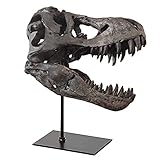
- 【Home Office Desktop Shelf Decor 】Dinosaur head sculptures skull model is hand cast from high-quality solid resin. The surface is made of antique craftsmanship, and the convincing colours and details make it look very realistic and eye-catching. Add some aesthetic to your room
- 【Supplement Your Collection】T-Rex is one of the most popular dinosaurs in the world. For dinosaur lovers or palaeontology lovers, the tyrannosaurus rex skull is a fantastic replica. It will also be a fun teaching tool for any child or teen
- 【Home Decor and Conversation Starter】A lifelike dinosaur skeleton decor. This impressive sculpture looks great on a table or bookshelf. It will be a great conversation starter and conversation piece for any family
- 【Suitable for Many Occasions】This Tyrannosaurus Rex skull replica comes with a metal base. There are 4 non-slip pads on the bottom of the stand to protect the surface of your furniture. It can be placed on various occasions such as office, hallway, TV cabinet, wine rack, living room, etc
- 【Perfect Christmas/Birthday Gift】10.2x 5.9x 11.8 inches.It only takes 2 minutes to complete the installation.Give it as a gift to children, adults, husbands, and friends, no one will refuse it
How large was Megaraptor?
The available research does not establish an exact length or mass specifically for Megaraptor namunhuaiquii. Most megaraptoran fossils are fragmentary, and relatively few taxa preserve overlapping bones, which limits confident comparisons and reconstructions.
Outdated Drivers Are Slowing You Down
One free scan finds every outdated or missing driver and matches the right update for your exact hardware.Free scan · exact hardware matchPC Slower Than It Used to Be?
A free scan shows the junk files, broken settings and background clutter dragging Windows down - then fixes them in one click.Free scan · Windows 10 & 11A 2025 study discusses South American megaraptorids as exceeding 7 meters and 1,000 kilograms in a clade-level size-evolution estimate. This is a broader hypothesis about megaraptorids, not a secure individual measurement for Megaraptor. Do not present it as a definitive length or mass for this species.
How does Megaraptor compare with other megaraptorids?
Comparisons should distinguish species-specific measurements from estimates made for the broader megaraptorid group. Fossil completeness also matters: an estimate based on an incomplete animal is not equivalent to a direct measurement of a complete skeleton.
| Comparison | What can be said | Important limitation |
|---|---|---|
| Megaraptor namunhuaiquii | A megaraptoran from the Portezuelo Formation of Neuquén, Argentina | The reviewed sources do not establish its exact adult length or mass |
| South American megaraptorids | A 2025 study discusses estimates exceeding 7 meters and 1,000 kilograms | This is a clade-level estimate, not a precise measurement of Megaraptor |
| Joaquinraptor casali | A 2025 study reports a 685 mm femur | This measurement belongs to Joaquinraptor, not Megaraptor |
The evidence here does not support naming a largest megaraptorid or asserting that Megaraptor is, or is not, the current size record-holder. Such a ranking requires a clearly defined comparison and reliable, comparable estimates.
Where and when did Megaraptor live?
Megaraptor namunhuaiquii is known from the Portezuelo Formation in Neuquén, Argentina. The fossils place it in the Late Cretaceous, and a 2022 paper assigns the taxon to the Coniacian.
Free tools Windows power users keep installed
One-click scans. No signup required.
The broader region preserves an important record of South American dinosaurs. However, the available sources do not identify a particular prey species or provide enough evidence to describe every detail of Megaraptor’s local environment.
What did Megaraptor eat?
Megaraptor was a carnivorous theropod. Its large claws and powerful forelimbs, along with the traits reported for megaraptorans, suggest an important role in prey interaction.
Rank #3

- Utahraptor was a large theropod dinosaur that lived during the Early Cretaceous period, known for its sharp claws and hunting abilities
- This replica is based on a real Utahraptor fossil discovered in Utah, accurately capturing the shape and detail of the original claw
- The Utahraptor’s curved claw was used for gripping and slashing, making it a key tool for hunting prey
- Cast in durable resin, this 5.5-inch replica offers museum-quality detail and texture
- Made in the USA, this fossil reproduction is perfect for collectors, educators, and dinosaur enthusiasts
The reviewed research does not establish a precise menu for Megaraptor or confirm that it hunted a named dinosaur species. Keep claims about particular prey or hunting behavior separate from what the fossils directly show.
Was Megaraptor related to tyrannosaurs, allosaurs, or coelurosaurs?
Megaraptora is a recognized theropod group, but its position within the theropod family tree remains controversial. Scientific analyses have proposed competing placements, and the incomplete fossil record makes confident comparisons difficult.
What’s actually slowing this PC down?
Pick the symptom - the matching free tool is one click away.
Many megaraptorans preserve different parts of the skeleton, with few taxa sharing enough overlapping bones for straightforward comparisons. New fossils can add important evidence, but the group’s higher-level evolutionary relationships remain an active research question.
The safest summary is that Megaraptor was a megaraptoran theropod. Avoid presenting a disputed placement among larger theropod groups as settled fact.
Why Megaraptor still matters
Megaraptor matters because its large hand claws help illustrate how different it was from the small dromaeosaurids many readers associate with the word “raptor.” Its anatomy also contributes to research on megaraptorans, a distinctive group of predatory theropods.
Fragmentary fossils and limited overlap between specimens leave important questions about anatomy, size, and evolutionary relationships unresolved. That uncertainty is part of why new specimens and careful comparisons matter.
FAQ
Was Megaraptor a real raptor?
It was a real predatory theropod, but it was not a dromaeosaurid like Velociraptor. Megaraptor belongs to Megaraptora, a distinct lineage of large-clawed theropods.
Rank #4

- IT FROM XUQCAH MATERIAL AND FOIMOJSK PAR ENT AND Thurder LOVER
- Museum Quality Replica
- Please thoroughly read discription
How big was Megaraptor?
The reviewed research does not establish an exact adult length or mass for Megaraptor namunhuaiquii. A 2025 study discusses estimates exceeding 7 meters and 1,000 kilograms for South American megaraptorids as a group; those figures should not be assigned as precise measurements for this species.
What made Megaraptor different from other meat-eating dinosaurs?
It belonged to a group known for powerful forelimbs and large claws on the first two fingers. Derived megaraptorans also had elongate skulls, low-crowned teeth, and extensively pneumatized bones.
Where did Megaraptor live?
Its fossils come from the Portezuelo Formation of Neuquén, Argentina. A 2022 paper assigns the taxon to the Coniacian stage of the Late Cretaceous.
What was the giant Megaraptor claw used for?
The claw belonged to the hand, and megaraptoran forelimbs and claws likely played an important role in interacting with prey. The exact use and attack behavior are not established.
Is Megaraptor the largest known megaraptorid?
The research dossier does not establish a current size record-holder. It reports a clade-level estimate for South American megaraptorids, not a definitive comparison that ranks Megaraptor against every other member of the group.
The Bottom Line
Megaraptor namunhuaiquii was a large-clawed megaraptoran theropod from Neuquén, Argentina—not a dromaeosaurid like Velociraptor. Its distinctive forelimbs and hand claws help set it apart, but incomplete fossils leave its exact size and broader evolutionary placement uncertain. Keep group-level size estimates separate from measurements of this individual species.
Quick Recap
Product prices and availability are accurate as of the date/time indicated and are subject to change. Any price and availability information displayed on Amazon at the time of purchase will apply.




