Free tools Windows power users keep installed
One-click scans. No signup required.
Three previously undescribed sea-spider species appear to obtain methane-derived carbon indirectly. Bacteria living on their exoskeletons process methane or methanol, and the sea spiders seem to feed on the microbial growth that forms on their bodies.
Three previously undescribed sea-spider species appear to obtain methane-derived carbon indirectly: bacteria living on their exoskeletons use methane or methanol as fuel, and the sea spiders seem to feed on the resulting microbial growth.


As an Amazon Associate I earn from qualifying purchases.
That distinction matters. The animals are not eating methane gas, breathing it, or surviving on methane alone. Instead, they may be carrying a living microbial “coat”—a surface garden that converts chemicals from a dark ocean seep into food.
Recommended Free Tools
A sea spider with a microbial food source
The animals belong to Sericosura, a genus in the sea-spider family Ammotheidae. Sea spiders are pycnogonids: marine arthropods that are only distantly related to the spiders found on land.
#1 Best Overall
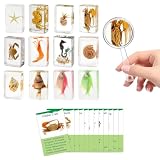
- 【12 Unique Marine Specimens】Embark on a voyage of discovery with this complete collection! This set features 12 authentic marine organisms—such as starfish, seahorses, fish, crabs, and shells—each perfectly preserved in crystal‑clear resin. Includes a magnifying glass and informative identification cards for an engaging hands‑on exploration
- 【Reliable & Crystal‑Clear Resin Material】These marine specimens are permanently encased in high‑quality, durable resin. This material is safe, sturdy, scratch‑resistant, and designed not to yellow or fade over time, ensuring the fine details of each sea creature remain vividly preserved for years to come
- 【Spark Curiosity & Discovery】Ocean enthusiasts can observe intricate anatomical details up close with the magnifier, learn fascinating species facts from the cards, and gain a richer appreciation of marine life, biology, and the diversity of ocean ecosystems—all through personal exploration
- 【Stunning Marine Biology Decor & Conversation Starter】Elevate any space with the beauty of the deep blue! Each resin block (1.7" x 1.1" x 0.6") is a unique piece of marine‑themed decor. Display them on desks, shelves, or in offices as elegant paperweights or as a captivating curiosities collection that sparks conversations about the wonders of the ocean
- 【The Ultimate Gift for Ocean Enthusiasts】Presented in a beautiful gift box, this set is the perfect present for any occasion. It’s an unforgettable gift for ocean lovers, collectors of taxidermy animals, nature enthusiasts, or anyone fascinated by the beauty and mystery of marine life
Researchers found the three undescribed species at methane seeps along the eastern Pacific margin, from California to Alaska. At these sites, hydrocarbon-rich fluids escape from the seafloor and support communities adapted to chemical energy rather than sunlight.
The sea spiders’ exoskeletons carried dense aggregations of bacteria. Genetic analyses identified methane- and methanol-oxidizing groups, including members of the bacterial families Methylomonadaceae, Methylophagaceae, and Methylophilaceae. Microscopy showed that these microbes were concentrated on the animals’ external surfaces rather than merely appearing as a trace of surrounding seawater.
How methane becomes food
Methane is a simple, one-carbon compound. Certain bacteria can oxidize it, using the chemical reaction to obtain energy and to build cellular material. Other bacteria specialize in related compounds such as methanol. In doing so, they turn seep chemicals into living biomass.
PC Slower Than It Used to Be?
A free scan shows the junk files, broken settings and background clutter dragging Windows down - then fixes them in one click.Free scan · Windows 10 & 11Outdated Drivers Are Slowing You Down
One free scan finds every outdated or missing driver and matches the right update for your exact hardware.Free scan · exact hardware matchThe proposed food chain for the sea spiders is therefore:
- Methane or methanol emerges from the seep environment.
- Methanotrophic or methylotrophic bacteria process those compounds.
- The bacteria grow as a coating on the sea-spider exoskeleton.
- The sea spider farms, grazes on, or otherwise consumes some of that microbial growth.
- Carbon that began in methane or methanol enters the animal’s tissues.
This is why the phrase “methane-powered sea spider” is vivid but incomplete. The bacteria are the methane processors. The sea spiders appear to benefit from the bacteria—and possibly from managing or eating the bacterial coating—not from digesting methane gas directly.
Rank #2

- Echinoderm Anatomy Preserved Sea Urchin Specimen: High-quality formalin-preserved sea urchin specimen for studying marine invertebrate anatomy, echinoderm biology, and species identification.
- Hands-On Marine Biology Learning: Perfect for students exploring echinoderms, marine invertebrates, and evolutionary adaptations in classroom and lab settings.
- Explore Key Sea Urchin Traits: Study the test (shell), spines, tube feet, water vascular system, Aristotle’s lantern, and internal organs to support lessons in feeding and locomotion.
- Invertebrate Adaptations & Systems: Examine radial symmetry, defensive structures, and hydraulic movement unique to echinoderms, highlighting functional anatomy.
- Perfect for Lab & Classroom: Each specimen measures approximately 2–3 inches, preserved for long-term use and suitable for 1–2 students per dissection.
Evidence that methane-derived carbon reached the animals
The conclusion rests on several complementary observations rather than on the presence of bacteria alone.
- Natural carbon isotopes: The carbon-isotope values of sea-spider tissues collected in their natural habitat were strongly consistent with a contribution from methane-derived carbon.
- Carbon-13 experiments: In live-animal incubations, researchers supplied carbon-13-labeled methane and methanol.
- NanoSIMS imaging: This high-resolution technique detected labeled carbon in bacterial cells and in sea-spider tissues.
- Genetic surveys: Environmental metagenomics and 16S rRNA sequencing characterized the microbial community associated with the animals.
- Microscopy: Fluorescence and electron microscopy revealed dense bacterial aggregations on the exoskeleton.
In the reported experiments, labeled carbon appeared in animal tissues within five days of exposure. Taken together, the results support the assimilation of carbon from methane and methanol into the sea spiders.
What’s actually slowing this PC down?
Pick the symptom - the matching free tool is one click away.
They do not, however, answer every question about the relationship. The observations support the researchers’ proposal that the animals farm or feed on their microbial coats, but the exact mechanics of grazing have not been established in every detail. The study also does not prove that the bacteria are obligate symbionts—organisms that cannot live without the host—or that the sea spiders are entirely dependent on them.
A possible microbial inheritance route
Adult male sea spiders carry egg sacs. Researchers found microbes on those egg sacs that matched microbes found on adult animals.
This pattern raises the possibility that useful bacterial partners are transferred from adults to offspring. It is consistent with vertical transmission, in which a host passes microbes to the next generation. But matching microbes on egg sacs are not the same as observing transmission through an entire life cycle. The cautious interpretation is that the finding suggests a possible transmission route; it does not prove that the bacteria are genetically inherited or that every offspring receives them.
Rank #3

- Extensive Oceanic Collection: you will get 9 pieces of ocean insects in resin specimens and magnifying glass, including 9 different ocean animal insect styles, these real ocean animal are transparent resin, sufficient quantity, and rich styles, enough to meet your daily use and learning needs, you can share them with your family
- Suitable Size for Learning: each ocean theme resin specimens are about 1.7 x 1.1 x 0.7 inches, a suitable size for you to learn and use, easy to carry and store; They are nice learning materials, artwork or gifts
- Quality Transparent Resin Material: our ocean animal specimen bugs collection is made of quality resin material, safe and unbreakable, portable and lightweight, not easy to break or deform, and these real ocean animal specimens are also secure and have no bad smell, friendly to your Bodies
- Captivating Decorations: our sea animals in resin clearly show the structure and body details of animals and plants, maintaining the appearance and color of original creatures, lifelike, suitable as decorations in homes, cars, offices and other places, bringing the beauty of nature to them natural beauty
- Educational Significance: this ocean animal specimen are a good starting point for you to understand nature, providing a safe and easy way for you to learn about marine life; Cultivate your curiosity about nature and improve your attention and observation skills; Notice: Not edible. Do not put in mouth or swallow. Children should use under adult supervision
Why methane seeps support unusual partnerships
Methane seeps are sometimes described as oases of the deep ocean, but they are not hot environments in the way hydrothermal vents are. A cold seep is defined by the release of chemically rich fluids, not by extreme water temperature.
The Tool Desk
Outbyte PC Repair FREERepair Windows errors before they cause bigger problemsFix Now →Outbyte Driver Updater FREEScan for outdated or missing drivers - takes under a minuteDriver Scan →Because sunlight does not penetrate to these depths, seep communities rely heavily on chemosynthetic microbes. Those microbes use chemical energy from substances such as methane, sulfide, or hydrogen to build biomass. The biomass then supports animals and food webs in the surrounding darkness.
Many familiar seep animals obtain microbial nutrition through intimate internal partnerships. Mussels and tubeworms, for example, are well-known examples of animals associated with chemosynthetic bacteria. The Sericosura finding points to a different arrangement: a host may carry its microbial resource externally, as a coat on its body, and consume that surface growth.
That possibility expands the range of ways animals can exploit C1 compounds—one-carbon molecules such as methane and methanol. It does not mean all sea spiders use this strategy. The evidence currently concerns particular Sericosura animals living at methane seeps along the eastern Pacific margin.
What makes the result unusual
A surface microbial coat could offer advantages in an environment where chemical conditions vary over small distances. The bacteria would remain attached to a mobile animal that moves through seep habitat, while the animal would carry a renewable source of microbial biomass.
That interpretation also raises important biological questions. Do the sea spiders actively cultivate particular bacteria, or do the microbes simply colonize a favorable surface? How often do the animals remove and consume the coating? Do specialized mouthparts or feeding behaviors help them graze? Does the microbial community change as a sea spider moves between methane-rich and methane-poor patches?
The study’s evidence cannot answer all of those questions yet. It shows a dense and metabolically relevant association, along with the movement of methane- and methanol-derived carbon into animal tissues. Direct observations of feeding and longer-term experiments would help distinguish active farming from opportunistic grazing or another form of host–microbe interaction.
Independent reader supportYour contribution helps us test, update, and keep practical guides available for everyone.What the discovery does not show
- The sea spiders do not appear to digest methane gas directly.
- They have not been shown to live anywhere on methane alone.
- The finding does not apply automatically to unrelated sea-spider species.
- The animals have not been shown to survive in ordinary aquaria or to consume methane in engineered systems.
- The three species were described in the research record as undescribed species; formal species names should not be added without a later taxonomic publication.
- The bacteria should not yet be called proven obligate symbionts.
These limits do not weaken the central result. They define it more accurately: particular deep-sea sea spiders appear to use methane-fed bacteria on their exoskeletons as a route to methane-derived nutrition.
A wider view of deep-sea survival
The discovery connects three kinds of biology that are often studied separately: animal behavior, microbial metabolism, and deep-ocean exploration. A sea spider’s body is not just a protective shell in this system. It may also provide a habitat where bacteria grow—and a food source that the animal can carry with it.
For readers who want broader context on how animals survive in the deep ocean, The Biology of the Deep Ocean is useful further reading on deep-ocean conditions, animal populations and lifestyles, and the methods scientists use to study life at depth.
Future work will need to determine how widespread this strategy is, whether the same bacterial partners persist across generations, and how much nutrition the microbial coat contributes compared with other food sources. For now, the sea spiders offer a striking example of how animals can turn an otherwise inaccessible chemical resource into food—with microbes doing the crucial conversion first.
Frequently Asked Questions
Do these sea spiders eat methane directly?
No. The evidence indicates that bacteria process methane or methanol first. The sea spiders appear to obtain methane-derived carbon by consuming or farming the microbial coating on their exoskeletons, not by digesting methane gas.
Which sea spiders use methane-fed microbial coats?
The study found three undescribed species of Sericosura in methane-seep habitats along the eastern Pacific margin, from California to Alaska. It does not show that all sea spiders use the same strategy.
Quick wins for a faster PC:
Repair Windows errors before they cause bigger problemsFix Now →Fix the driver behind crashes, sound loss and screen glitchesFind Drivers →Clear out junk files and repair common Windows errorsFree Scan →How do scientists know methane-derived carbon reached the sea spiders?
Researchers used carbon-isotope measurements, carbon-13-labeled methane and methanol, NanoSIMS imaging, DNA-based microbial surveys, and fluorescence and electron microscopy. Labeled carbon was detected in sea-spider tissues within five days in the reported experiments.
Do the sea spiders pass the bacteria to their offspring?
Matching microbes were found on male-carried egg sacs and adult sea spiders. That suggests possible vertical transmission, but it does not prove that the bacteria are inherited across generations.
The Bottom Line
The newly studied Sericosura sea spiders appear to obtain methane-derived carbon through bacteria coating their exoskeletons. The microbes process methane or methanol and grow as biomass; the animals likely farm or graze on that microbial layer. It is an indirect methane-based food pathway, not direct digestion of methane gas, and the precise feeding and transmission mechanisms remain under study.
Quick Recap
Product prices and availability are accurate as of the date/time indicated and are subject to change. Any price and availability information displayed on Amazon at the time of purchase will apply.




