
Outdated Drivers Are Slowing You Down
One free scan finds every outdated or missing driver and matches the right update for your exact hardware.Free scan · exact hardware matchPC Slower Than It Used to Be?
A free scan shows the junk files, broken settings and background clutter dragging Windows down - then fixes them in one click.Free scan · Windows 10 & 11Some links on this page are affiliate links: if you buy through them we may earn a commission, at no extra cost to you.
Yes. Air pollution can make a flower’s odor plume chemically different before a bee reaches it, shortening the distance over which the scent is useful and making a familiar blend difficult to recognize. In a 2023 wind-tunnel study, honeybees recognized a learned four-chemical floral blend 52% of the time at 6 meters in the plume center, but only 10% at 12 meters in the most degraded plume-edge treatment. Ozone can also interfere with the bee itself: an acute-exposure study found that 80 parts per billion (ppb) ozone reduced recall of learned odor associations. The evidence shows a clear problem for odor-guided foraging, although no validated global percentage of crop losses has yet been attributed specifically to disrupted scent trails.
What does polluted air do to a flower’s scent trail?
Flowers release mixtures of volatile organic compounds (VOCs), creating intermittent plumes that wind carries through the landscape. Bees detect those chemical packets and use them to locate rewarding flowers. Ozone, nitrate radicals and hydroxyl radicals react with the VOCs in the air, removing some molecules and changing the proportions of others.
As an Amazon Associate I earn from qualifying purchases.
Free tools Windows power users keep installed
One-click scans. No signup required.
That means pollution does more than dilute an odor. Because oxidants react faster with certain VOCs, the blend arriving at a bee can have a different chemical “recipe” from the one released by the flower. Ben Langford, who led the 2023 honeybee work, described the degraded signal in The Atlantic as the bee “sniffing a completely different odor at that point.”
How much does pollution reduce honeybee recognition?
Langford and colleagues trained honeybees to recognize a four-VOC blend, then sampled the plume at different downwind distances and positions in a wind tunnel. Recognition declined with distance in the cleaner plume center and fell more sharply in the chemically degraded edge.
Popular on Amazon

- High Precision Ozone Monitoring: Thanks to the electrochemical sensor, this ozone detector can accurately measure ozone concentration from 0-20 PPM with a resolution of 0.01 PPM. High accurate readings of O3 levels make it reliable for detecting ozone air in various environments
- Rechargeable & Long-Lasting: As a rechargeable ozone meter, built-in a 2500 mAh high-capacity battery. Once fully charged, this O3 monitor can continuously operate for up to 16 hours. Whether you’re at home or on the go, allowing you to use the ozone detector anytime and anywhere
- Portable w/ Alarm Protection: This ozone gas detector has three alarm modes, including vibration, sound and flashing lights. The alarm limit value for O3 gas air quality is adjustable. It has a rapid response and can effectively alert you to the leak of ozone gas until the gas concentration is at a safe level
- Multi-Function Ozone Monitor: This ozone gas meter can accurately detect gas/ozone while also keeping track of the ambient temperature (℃/℉) and humidity. Feature manual/auto power off optional to save your battery, also it can record up to 1000 pieces of data for easy ozone monitoring
- Convenient to Use: Ozone gas concentration, Maximum O3 meter values, Temp, and humidity on 2.8” bright backlit LCD screen at the same time. Come with a convenient carrying case and back clip design makes it easy to carry and use
| Plume sample | Distance from source | Honeybees recognizing the learned blend |
|---|---|---|
| Plume center | 6 m | 52% |
| Plume center | 12 m | 38% |
| More degraded plume edge | 6 m | 32% |
| More degraded plume edge | 12 m | 10% |
These are controlled recognition results, not a direct estimate of lost pollination in fields. They show how quickly an altered plume can stop matching a bee’s learned odor memory.
Can ozone also affect a bee’s odor memory and antennae?
Yes. A separate acute-exposure experiment reported that 80 ppb ozone reduced honeybees’ recall of learned odor associations. Antennal activity also changed across treatments from 80 to 200 ppb, indicating that pollution can act on both sides of the communication chain: it modifies the odor in the air and changes how the insect’s sensory system responds.
Quick wins for a faster PC:
Fix the driver behind crashes, sound loss and screen glitchesFind Drivers →Repair Windows errors before they cause bigger problemsFix Now →The two effects should not be conflated. Wind-tunnel plume experiments tested recognition of chemically altered blends, while the acute-exposure study tested the bee after ozone exposure. Together they indicate complementary pathways by which ozone can disrupt odor-guided behavior.
Which pollutants damage floral odors, and how?
| Pollutant or condition | What the evidence shows | Evidence type |
|---|---|---|
| Ozone | Mixing ratios above 60 ppb can substantially reduce a floral-scent footprint; 120 ppb over a 4.5-meter reaction distance reduced the attractiveness of a floral odor to Bombus terrestris. | Atmospheric modelling and bumblebee experiment |
| Nitrate radicals | Highly reactive chemistry can remove key odor compounds and eliminated flower visitation in an experimental nocturnal moth system. | Laboratory/experimental studies |
| Hydroxyl radicals | Reactions alter VOC ratios and shorten the distance at which a plume remains chemically recognizable. | Atmospheric chemistry studies |
| Urban oxidant mixtures | Scents modelled as detectable for kilometres in pre-industrial air could fall below useful detection beyond 200 meters under present polluted conditions. | Global and atmospheric modelling |
The exact outcome depends on the VOC mixture, oxidant concentration, sunlight, wind and turbulence. A pollutant level that leaves one flower’s dominant compound intact may severely alter another species’ blend.
Also popular on Amazon

- High Precision Ozone Monitoring: Thanks to the electrochemical sensor, this ozone detector can accurately measure ozone concentration from 0-20 PPM with a resolution of 0.01 PPM. High accurate readings of O3 levels make it reliable for detecting ozone air in various environments
- Rechargeable & Long-Lasting: As a rechargeable ozone meter, built-in a 2500 mAh high-capacity battery. Once fully charged, this O3 monitor can continuously operate for up to 16 hours. Whether you’re at home or on the go, allowing you to use the ozone detector anytime and anywhere
- Portable w/ Alarm Protection: This ozone gas detector has three alarm modes, including vibration, sound and flashing lights. The alarm limit value for O3 gas air quality is adjustable. It has a rapid response and can effectively alert you to the leak of ozone gas until the gas concentration is at a safe level
- Multi-Function Ozone Monitor: This ozone gas meter can accurately detect gas/ozone while also keeping track of the ambient temperature (℃/℉) and humidity. Feature manual/auto power off optional to save your battery, also it can record up to 1000 pieces of data for easy ozone monitoring
- Convenient to Use: Ozone gas concentration, Maximum O3 meter values, Temp, and humidity on 2.8” bright backlit LCD screen at the same time. Come with a convenient carrying case and back clip design makes it easy to carry and use
Why are plume edges and longer distances especially difficult?
A floral plume is a shifting series of narrow filaments rather than a uniform cloud. At the edge, turbulent mixing brings fresh VOCs into contact with ozone and other oxidants, giving chemical reactions more opportunity to change the blend. Farther downwind, fewer molecules remain and the surviving mixture is increasingly unlike the source odor.
This explains why the 2023 bees performed worse on edge samples than on center samples at the same distance. A bee crossing a plume may therefore encounter alternating pockets of recognizable and chemically altered odor instead of following a continuous trail.
The Tool Desk
Outbyte Driver Updater FREEScan for outdated or missing drivers - takes under a minuteDriver Scan →Outbyte PC Repair FREERepair Windows errors before they cause bigger problemsFix Now →Does the effect occur only in honeybees?
No. Related chemistry and behavioral effects have been reported in bumblebees and in a nocturnal flower-moth system. Bumblebee attraction declined after floral odors passed through ozone, while nitrate-radical chemistry eliminated moth visitation under experimental conditions. Global modelling also indicates that odor-based navigation could be reduced in some urban areas.
A review covering floral signals, pollinator olfaction, learning, memory and behavior places these findings in a broader framework: pollution can disrupt the signal, the receiver, or both.
Also popular on Amazon
- High Precision Ozone Monitoring: Thanks to the electrochemical sensor, this ozone detector can accurately measure ozone concentration from 0-100 PPM with a resolution of 0.01 PPM. High accurate readings of O3 levels make it reliable for detecting ozone air in various environments
- Rechargeable & Long-Lasting: As a rechargeable ozone meter, built-in a 2500 mAh high-capacity battery. Once fully charged, this O3 monitor can continuously operate for up to 16 hours. Whether you’re at home or on the go, allowing you to use the ozone detector anytime and anywhere
- Portable w/ Alarm Protection: This ozone gas detector has three alarm modes, including vibration, sound and flashing lights. The alarm limit value for O3 gas air quality is adjustable. It has a rapid response and can effectively alert you to the leak of ozone gas until the gas concentration is at a safe level
- Multi-Function Ozone Monitor: This ozone gas meter can accurately detect gas/ozone while also keeping track of the ambient temperature (℃/℉) and humidity. Feature manual/auto power off optional to save your battery, also it can record up to 1000 pieces of data for easy ozone monitoring
- Convenient to Use: Ozone gas concentration, Maximum O3 meter values, Temp, and humidity on 2.8” bright backlit LCD screen at the same time. Come with a convenient carrying case and back clip design makes it easy to carry and use
What do field studies show about real-world pollination?
A 2024 report by Knowable and The Atlantic described field plots exposed to ozone and nitrogen oxides. It reported up to 70% fewer insects overall and up to 90% fewer flower visits, along with lower pollination measures. Those figures are secondary reporting of field research and should not be treated as a universal effect size for every crop or location.
Controlled plume studies establish the chemical mechanism and behavioral proxies; they do not yet provide a validated global percentage of crop-yield loss caused specifically by scent-trail disruption. Field conditions add temperature changes, wind shifts, competing flowers, pesticides, habitat structure and many other influences that are difficult to separate.
What should gardeners, growers and conservation groups take from this?
- Air quality is part of pollinator habitat. A flower-rich site can still present a poorer foraging environment when oxidants reshape its odor cues.
- Local measurements need context. An ozone monitor can document exposure, but it is a measurement tool, not a treatment for polluted air.
- Do not infer a crop-loss percentage from one experiment. Recognition rates in a wind tunnel and visitation counts in one field study answer different questions.
- Reducing ozone-forming pollution remains the broad intervention. The studies point to oxidant exposure as the controllable environmental pressure, while the precise benefits for each crop and pollinator community remain location-dependent.
What is the clearest bottom line?
Polluted air can chemically erase the information in a flower’s invisible scent trail and can impair a bee’s ability to remember or process odors. The strongest evidence is experimental, with honeybees, bumblebees and moths all showing vulnerability to oxidant-altered floral signals. The scale of the resulting effect on global food production is still unresolved, but the mechanism is established well enough to make air pollution a genuine pollinator-conservation concern.
Frequently Asked Questions
Can bees smell flowers in a city with poor air quality?
They may still detect nearby flowers, especially when the source is close and the odor is strong. The concern is that oxidants can shorten the useful range and alter the blend, making long-distance navigation less reliable than it would be in cleaner air.
Also popular on Amazon
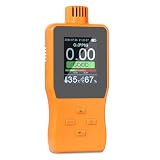
- The air quality monitor features a 2.8in LCD display with high definition colour screen showing gas concentrations, temperature, humidity values and graphical interface.
- Gas exceeds the standard alarm peak buzzer ringing, digital change colour, you can set the alarm value of the gas by yourself.
- Data saving function (can store 100000 pieces of data), set the timer to store, delete data, view historical data.
- The display brightness can be adjusted from 5% to 100%, the default brightness is 60% at power on, and the temperature can be switched between Celsius ℃ and Fahrenheit ℉.
- Air quality monitor comes with a rugged case, easy to carry around and use in different environments, both indoors and outdoors.
Is ozone pollution higher on sunny days?
Ozone commonly forms through sunlight-driven reactions involving precursor pollutants, so concentrations often rise during sunny, stagnant conditions. Local weather and emissions determine the actual level, and a site-specific monitor is needed to know exposure.
Could planting more flowers overcome polluted scent trails?
More flowers can increase the number of nearby odor sources, but planting alone cannot restore VOCs that have already reacted in the air. Habitat quality, floral diversity and air quality address different parts of the pollination problem.
Recommended Free Tools
Are nocturnal pollinators affected in the same way as bees?
Evidence from a flower-moth system shows that reactive pollution can eliminate visitation under experimental conditions. Night-flying species may be especially dependent on chemical cues because visual guidance is limited, although the size of the effect varies with species and atmospheric conditions.





Leave a Reply