Do these 3 things before closing this tab:
1Repair Windows errors before they cause bigger problems2Fix the driver behind crashes, sound loss and screen glitches3Clear out junk files and repair common Windows errorsA microchip can give a lost cat a way home—but only if the chip can be read and its registration leads to you. Implantation is quick, but the important work continues afterward: register the number, keep your contact details current, and have the chip checked at routine veterinary visits.
Here is what microchipping does, how it works, what can go wrong, and how to make it useful if your cat ever disappears.
What is a cat microchip?
A pet microchip is a tiny glass-encased RFID transponder, roughly the size of a grain of rice. It carries a unique identification number, usually consisting of 9, 10, or 15 digits. It does not store your name, telephone number, address, medical history, or vaccination records.
The chip has no battery and does not need charging. When a compatible scanner passes over it, the scanner’s radio signal activates the chip and displays its number. A shelter, veterinary clinic, or animal-control officer can then use that number to search a recovery database.
#1 Best Overall
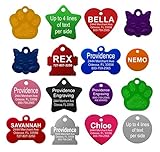
- These aluminum pet ID tags for cats and dogs come in 8 shapes and 9 colors, so you can create a tag that matches your pet's collar and personality
- The small size measures approximately 1 inch in diameter and is recommended for cats and small dog breeds while the large size measures about 1.25 inches and works best for medium to large dog breeds
- Each tag includes up to 4 lines of custom text on each side, and the lettering is applied using precise CO2 laser engraving for maximum readability
- These animal name tags are manufactured and engraved in the United States from lightweight aircraft-grade aluminum, and their anodized finish is great for vibrant color and excellent durability
- A comlimentary split ring is included with each tag to make collar attachment easy and convenient
A microchip is not a GPS tracker. It cannot show your cat’s location while she is outdoors. GPS requires a powered device, such as a GPS collar or tracking fob. The microchip is a permanent identification method, not a live-location system.
How microchipping is done
A veterinarian implants the chip beneath the skin using a hypodermic needle. In most cats, this takes only a few seconds and does not require surgery or anesthesia. The needle is larger than one used for some routine injections, so your cat may briefly react, but the procedure is generally straightforward.
In the United States and many other countries, the usual location is the subcutaneous tissue along the dorsal midline, just in front of or between the shoulder blades. Continental Europe commonly uses the left side of the neck. The exact placement matters when a shelter or clinic scans for the chip, particularly if staff are checking a cat for travel paperwork.
- Ask the veterinarian which chip is being implanted and which registry maintains its records.
- Have the veterinarian scan the chip immediately after implantation.
- Write down the complete identification number and keep it with your cat’s veterinary records.
- Complete the owner registration rather than assuming the clinic, shelter, or rescue has done it for you.
Implantation and initial registration should be performed by a veterinarian or under veterinary supervision. If you are planning international travel, timing is especially important: many destinations require the chip to be implanted and read before the rabies vaccination used for travel.
The Tool Desk
Outbyte PC Repair FREEClear out junk files and repair common Windows errorsFree Scan →Outbyte Driver Updater FREEFix the driver behind crashes, sound loss and screen glitchesFind Drivers →Is microchipping safe?
Microchipping is generally considered safe, and complications are uncommon. Possible problems include:
- Migration of the chip away from its original location
- Temporary swelling or tenderness
- Hair loss at the site
- Infection
- Chip failure
- Rarely, a mass or tumor associated with the implantation area
A small amount of irritation immediately after the injection may not be unusual. Contact your veterinarian if you notice persistent swelling, discharge, pain, a lump that grows, or a new mass near the implant site. Do not assume that every lump is caused by the chip; a veterinarian needs to examine it and determine the cause.
Rank #2

- Ultimate Durability: Our stainless steel dog tag withstands even the most active pet adventures, ensuring it outshines and outlasts flimsy aluminum tags. Join the ranks of happy pet parents who can finally bid farewell to worries of bent or broken tags
- Crystal Clear Engraving: Laser engraved on a mirror-finish surface, offering high readability and ensuring your pet's vital information is always legibl
- Click Customize Now: Unleash your pet's inner superstar and get creative with up to 8 lines of text- up to 4 lines on the front of tag and 4 lines on back of the tag - letting their personality shine through and making their tag the envy of every furry friends in the neighborhood
- Perfect Size for All Pets: Tailor-made to adorn your furry companions, our regular size (1.3 inches) ensures larger and medium-sized dogs exude sheer majesty, while our small size (1 inch) elevates the elegance of cats and smaller breeds
- Peace of Mind: Our permanent laser engraving is scratch and rub-resistant, guaranteeing that your pet's information remains clear and legible over time, and ensuring the safe return of your pet from any unexpected adventures
Migration is one reason a lost cat should be scanned over the entire body, not only between the shoulder blades. A chip can move under the skin, and a quick scan over one spot can miss it.
The American Animal Hospital Association recommends checking the chip’s function and location at least annually, usually during your cat’s routine examination. This is a sensible time to confirm that the number in the medical record matches the number in the database.
Registration is what makes the chip useful
Implantation alone does not identify the owner. The chip number must be linked to current contact information in a pet recovery database. A veterinarian may implant the chip without registering it, and a shelter or rescue may have started the process without completing it in your name.
Ask these questions before leaving the appointment:
- What is the full microchip number?
- Which company or registry maintains it?
- Has it already been registered?
- Do I need to finish the registration myself?
- Is there a fee or an account I need to create?
There is not one universal database that automatically contains every pet’s information. A chip is normally associated with a manufacturer’s or recovery company’s registry. The veterinarian is not the registry, and having the number written in a clinic file is not a substitute for registering it with a recovery service.
Update the record whenever you:
- Move to a new address
- Change your telephone number or email address
- Transfer ownership
- Change your emergency contact
- Adopt a cat whose previous owner’s details are still attached to the chip
Disconnected phone numbers and unmonitored email accounts are among the most common reasons a microchipped pet cannot be returned. Adding the chip to a second recovery database may provide extra coverage, but it does not replace updating the registry associated with the chip.
Recommended Free Tools
Rank #3

- Real-time alerts - Get alerts when someone scans Pet Tag's custom QR code so you know they've been found.
- Pet Profiles - Automatically share a personalized Pet Profile with photos, medical info, and more.
- Anonymous communication - Get contacted by your pet's rescuer by call or text - without either of you sharing personal info or numbers.
- Join the party - Experience a new way to neighbor by helping lost dogs find their way home with Ring’s Search Party feature and your outdoor cameras.
- Petco Love Lost - Easily upload your pet's picture to Petco Love Lost to get a list of similar animals found at nearby shelters and around the community—so if you see your pet, you'll know who to contact.
How to find an unknown microchip registry
If you do not know where your cat’s chip is registered, start by having a veterinary clinic, shelter, or animal-control facility scan her and give you the complete number.
- Enter the number into the AAHA Microchip Registry Lookup Tool.
- Enter the 9-, 10-, or 15-digit number without spaces or punctuation.
- Review the possible registries returned by the search.
- Contact the listed registry or registries directly to ask about ownership and updating the record.
The AAHA lookup tool identifies possible registries. It does not display the owner’s private information and does not itself register or update a chip. Numbers beginning with “900” can produce more than one possible registry, so contact the listed companies, starting with the most recently updated registry.
AAHA also reports that Save This Life ceased operations. Chips beginning with 991 or 900164 may need to be registered with another recovery database. In most cases, the chip itself does not need to be replaced simply because the original registry is no longer operating.
What if a scanner cannot find the chip?
A negative scan does not prove that a cat has no microchip. Several things can produce a false negative:
Quick wins for a faster PC:
Scan for outdated or missing drivers - takes under a minuteDriver Scan →Repair Windows errors before they cause bigger problemsFix Now →- The chip has migrated from the standard implantation site.
- The scanner does not support that chip’s frequency or protocol.
- The scanner is not functioning properly.
- The operator scans too quickly or does not cover enough of the body.
- The chip has failed.
A thorough search should use a true universal scanner and cover the normal shoulder-blade area as well as the rest of the body. Multiple scans may be necessary. If a clinic finds nothing, ask whether another scanner can be used and whether the cat was scanned slowly from the neck through the torso and limbs.
A chip that reads but has no owner information is not entirely useless. The number may allow a shelter or veterinarian to trace the cat through a manufacturer, breeder, rescue, seller, or earlier shelter record. However, recovery is much less reliable when the owner never completed registration.
Rank #4

- ˏˋ♥︎︎ˎˊ˗ Takes time, perfect artwork is worth the wait! 𖥧 𓇣 𓂃𓋪◌
- Our pet tags are both beautiful and practical. They can not only help pets prevent getting lost, but also have multiple uses.
- Laser engraving makes the pattern clearer, even complex patterns can be easily engraved. 316L stainless steel material, wear-resistant and durable.
- Tags are not only for pets cat dog collar˓ ˓♡, but can also be hung on backpacks as decorations, or as accessories for your favorite dolls.
- There are three sizes: small size is suitable for kittens and puppies, medium size is suitable for small adult cats and puppies, and large size is suitable for adult dogs. (The above is for reference only, you can choose according to your preferences) ♡
Microchip and collar: use both
A microchip should supplement, not replace, visible identification. A neighbor can read a telephone number on a collar immediately; finding a microchip requires a scanner and access to the correct database.
If your cat wears a collar, choose a properly fitted, cat-specific breakaway or snap-open collar and attach current contact information. Check the fit regularly, especially for growing kittens. Include an identification tag and, where applicable, a rabies tag.
Indoor cats benefit from identification too. A door left open, a damaged window screen, a house move, a natural disaster, or a frightened dash during a veterinary visit can put an indoor-only cat outside. A collar may be lost, but a registered microchip remains with the cat.
Independent reader supportYour contribution helps us test, update, and keep practical guides available for everyone.How much does microchipping improve recovery?
Microchipping is not a guarantee, but it can make a significant difference when a lost cat enters a shelter or clinic. In a national shelter study summarized by Ohio State University, owners were identified for 72.7% of microchipped animals. For cats, the return-to-owner rate was approximately 20 times higher for microchipped cats than for stray cats overall.
Those figures apply to animals entering participating shelters; they do not promise that every microchipped cat will be found or returned. The biggest obstacles were practical ones: incorrect or disconnected contact details, owners who did not respond, unregistered chips, and records held in a database different from the one searched.
The takeaway is simple: the chip improves the odds only when the number can be read and the registry points to someone who answers.
What’s actually slowing this PC down?
Pick the symptom - the matching free tool is one click away.
Best Value

- SMALL: ~1 inch, LARGE: ~1.5 inch: PERSONALIZED IDENTIFICATION FOR YOUR DOG AND CAT - Rest easy knowing your pet is wearing a strong, quality, durable ID identification tag that will work for even the most active pets. You will Dr. Fremont's custom colorful anodized pet tags are perfect for vacation, travel, and everyday wear.
- MANY COLORS: Whether you need a large dog tag engraved for pets or a gift for pet lovers in general, we have you covered. Our personalized cat name tags and dog name tags are available in many different shapes and colors. Choose from black, blue, green, pink, purple, red, silver, orange, and yellow. Tags may vary in shade (i.e. a pink tag might be more light pink, hot pink, or classic pink) due to different anodization processes during manufacturing.
- MANY SHAPES: Our custom pet identification tags are available in large bone, small bone, large round circle, small round circle, large heart, small heart, large paw, small paw, large cat face, and small cat face. Tags may have slight variation in shape due to different manufacturing processes (i.e. for the heart tag, the hole to put the ring to attach to the collar my be at the top of the tag above the heart or at the top of the heart).
- STRONG ID TAGS: If you are looking for a durable pet tag or a custom way to add safety to your pet, Dr. Fremont's has you covered. These tags are made from super strong anodized aluminum and will last for years. There are even options during customization that will enable our guarantee that the tag text will never fade.
- HOW TO ORDER: You can place an order for a Dr. Fremont's custom pet tag by clicking on the "Customize Now" button and filling out the information. You can do front and back side laser engraved tags and each tag includes the split ring to attach to your pet's collar!
Microchipping and international travel
Travel rules vary by destination and can change. If you plan to cross a border with your cat, contact a USDA-accredited veterinarian early and check the destination’s current requirements every time you travel.
Many destinations, including countries in the European Union, require an ISO-compliant microchip. They may also require the chip to be implanted and scanned before the rabies vaccination used for travel. If your cat has a non-ISO chip, the destination may require you to carry a compatible scanner or have a second ISO-compliant chip implanted. Both numbers may need to appear on the health certificate.
Do not assume that a chip used in the United States will be readable everywhere, or that microchipping by itself satisfies airline, vaccination, border, or health-certificate requirements. Confirm the sequence and paperwork with your veterinarian before booking the trip.
A practical microchip checklist
| When | What to do |
|---|---|
| At implantation | Ask for the chip number, registry name, and implantation location. Have the chip scanned immediately. |
| After the appointment | Register the number with your current contact details and save confirmation. |
| After a move or phone change | Update the registry, veterinary clinic, shelter or rescue records, and your cat’s visible identification tag. |
| At least annually | Ask your veterinarian to scan the chip and confirm that its number and location are recorded correctly. |
| If your cat goes missing | Notify the registry, local shelters, animal control, veterinary hospitals, and your microchip company. Ask that the lost-pet alert be activated. |
| If a found cat has a negative scan | Use a universal scanner, scan slowly over the entire body, and repeat the scan if necessary. |
The Bottom Line
Microchipping is a quick, generally safe way to give your cat permanent identification, but implantation is only the first step. Register the chip, keep the information current, use a visible ID tag as well, and have the chip scanned at annual veterinary visits. Those simple habits determine whether a scanner reading turns into a phone call from someone who can reunite you.
FAQ
Does microchipping hurt cats?
The chip is implanted with a needle and the sensation is generally comparable to an injection, although the needle is larger. Surgery and anesthesia are not normally required. Your veterinarian can discuss pain control if your cat is unusually anxious or sensitive.
Can I track my cat with a microchip?
No. A microchip has no battery and cannot transmit a location. It provides an identification number when scanned. Use a separate GPS tracking device if you need live location information.
How do I update my cat’s microchip information?
First identify the registry associated with the chip number. If you do not know it, have the chip scanned and use the AAHA Microchip Registry Lookup Tool with the full number entered without spaces or punctuation. Then contact the identified registry directly to update your address, phone number, email, or emergency contact.
Should my cat still wear a collar after being microchipped?
Yes, when a collar is appropriate and safely fitted. A breakaway collar with a current identification tag can help a finder contact you without needing a scanner, while the microchip provides permanent backup if the collar is lost.
Outdated Drivers Are Slowing You Down
One free scan finds every outdated or missing driver and matches the right update for your exact hardware.Free scan · exact hardware matchWindows Errors? Fix Them Before They Spread
Repair common Windows errors and clear accumulated junk for a smoother, more stable PC - no reinstall needed.Free scan · no reinstallQuick Recap
Product prices and availability are accurate as of the date/time indicated and are subject to change. Any price and availability information displayed on Amazon at the time of purchase will apply.




