What’s actually slowing this PC down?
Pick the symptom - the matching free tool is one click away.
Whether a dog can visit someone in the hospital depends on what kind of visit it is. Therapy-dog visits are usually arranged through a hospital program; personal-pet visits depend on the facility’s rules and the patient’s condition. A disability-related service animal is a separate category and is generally allowed in hospital areas open to patients or the public, subject to limited exceptions. Ask the patient’s care team before bringing a personal pet.
How therapy dogs, personal pets, and service animals differ
“Therapy dog” is often used casually for a visiting dog, but hospital guidance distinguishes organized animal-assisted activities from formal treatment. Neither category is the same as a patient’s own pet or an ADA service animal.
| Category | Purpose | Who arranges it | What governs access |
|---|---|---|---|
| Animal-assisted activity (AAA) | A program intended to enhance patients’ quality of life through animal visits in common areas or individual rooms. | Usually the hospital’s animal-visit program and its handlers. | The facility’s program and infection-control decisions. CDC advises case-by-case consultation with attending physicians and nursing staff, along with patient consent, for room visits. CDC guidance. |
| Animal-assisted therapy (AAT) | A goal-directed intervention incorporating an animal into treatment provided by a credentialed therapist. | A credentialed therapist as part of treatment. | The clinical plan and facility rules. This is more specific than the everyday use of “therapy dog.” CDC guidance. |
| Personal pet | A visit from the patient’s own companion animal, not automatically a therapy program or treatment. | The patient or family, with the hospital’s permission. | The hospital’s local visitation policy and the patient’s circumstances. Policies vary; ask before making plans. |
| ADA service animal | A dog individually trained to perform work or tasks directly related to a person’s disability. | The person with a disability who uses the animal. | ADA service-animal rules, not the ordinary pet-visit policy. DOJ says service animals generally must be allowed in patient rooms and other areas open to patients or the public, subject to limited exceptions. DOJ ADA FAQ. |
Can you bring a personal pet to visit someone in the hospital?
Sometimes, but there is no single rule for every hospital. A therapy-dog program does not mean the hospital allows patients’ personal pets. The facility may not permit personal-pet visits, or it may approve them only in specified circumstances, locations, or time windows. For example, UVA Health describes registered therapy-dog visits through its program and considers personal pets only in special circumstances under conditions that include clinician approval and behavior and infection-control requirements. That is one facility’s policy, not a nationwide standard. UVA Health’s policy.
A 2024 study of U.S. infectious-disease specialists reported that 58% of respondents said their facility did not allow personal-pet visits and 40% said it did; the percentages may not total 100% because of nonresponses or rounding. These are respondents’ reports, not a census of hospitals or a guide to any particular facility’s current policy. Ben-Aderet et al., 2024.
Quick wins for a faster PC:
Fix the driver behind crashes, sound loss and screen glitchesFind Drivers →Repair Windows errors before they cause bigger problemsFix Now →#1 Best Overall

- 【You will receive】The package contains a WINSEE dog vest harness and 7 pieces of dog patches with sewed letters, such as “Service dog”, “do not pet”, “in training”, “emotional support” and “best friend”, enough quantity for you to decorate the dog’s vest harness.
- 【No pull & choke-free】WINSEE no pull dog harness featuring 2 sturdy D rings on the front/back range for attaching leash, a front clip that prevents pulling, and a back one for relaxed walking. The 2 D rings are reinforced on the extensional part which is not easily ripped off even by heavy pulling. Especially the metal buckle for a leash on the back give you more safety. Pulling pressure is evenly distributed to the body to prevent choking.
- 【Reflective Nylon】- Higher visibility of the dog training harness allows you and your dog to be seen on early morning or evening strolls. With a Unique Design sturdy handle on the front you can easily and urgently restrain even extra-large dogs. Pulling pressure is evenly distributed to the body to prevent choking.
- 【Adjustable & customizable neck and chest girth fit】The fit of this pet harness can be completely customized for your pet using the slide adjusters on the chest and neck. Double stitching, lots of reinforcement stitching at high stress points, easy to fit and put on, and nicely padded for your dog's comfort.
- 【Perfect fit】 SMALL SIZE: Perfect for pets weighing 25-35 lbs., neck measurement 16-20.5 in; chest measurement 17-26 in, MEDIUM SIZE: perfect for pets weighing 35-50 lbs., neck measurement 17-24 in; chest measurement 18-31.5 in, LARGE SIZE: perfect for pets weighing 50-80 lbs., neck measurement 18-27 in; chest measurement 24-38 in; XL SIZE: perfect for pets weighing 80-140 lbs., neck measurement 21-33 in; chest measurement 24-49 in.
What to ask before arranging a pet visit
- Contact the care team first. Ask the patient’s nurse or doctor, visitor-services office, or animal-program coordinator before bringing an animal.
- Confirm the local rules. Ask whether personal-pet visits are allowed, which species may visit, which areas or rooms are eligible, and whether advance approval, a scheduled time, or a visit limit applies.
- Discuss the patient’s condition. Ask whether allergies, asthma, immune suppression, isolation precautions, or the care area make a visit inappropriate or require extra precautions. CDC recommends case-by-case judgment for animal-assisted visits involving immunocompromised patients. It does not offer a general recommendation for personal-pet visits to terminally ill immunosuppressed patients outside protective-environment units. CDC guidance.
- Get the animal and handler requirements. Follow instructions about health records, immunizations, grooming, supervision, behavior, hand hygiene, and cleaning. CDC recommends healthy animals with recommended immunizations for animal-assisted programs and handlers who know the animal and its behavior. CDC guidance.
- Plan the visit only after approval. Ask where the animal should enter, where it may go, and whom to contact if the patient’s condition or the unit’s precautions change.
How hospitals manage infection-control and safety concerns
Animal visits involve practical precautions: hand hygiene after contact, avoiding direct contact with saliva, urine, and feces, and routine cleaning of surfaces afterward. CDC recommends an infection-control risk assessment and coordination with the handler to decide whether a visit belongs in a public area or an individual patient room. Grooming to remove loose hair or using a therapy-animal cape may help reduce shedding; neither replaces facility requirements. CDC animal guidance and CDC environmental infection-control recommendations.
Hospitals may limit even organized animal-assisted activities in particular areas based on infection prevention and clinical needs. In a 2023 survey, respondents most often reported restrictions in operating rooms (83%), isolation rooms (75%), and intensive-care units (46%). Those percentages describe surveyed facilities, not binding rules for every hospital. Ben-Aderet et al., 2024.
Rank #2

- 2 Free Removable Reflective Removable Patches one for each side of Harness
- 2 Adjustable Straps for premium & custom fit
- D-Ring on top for leash or clip your ID to
- Lightweight & Breathable material with Reflective Stripe on each side
- Side quick release buckle makes it easy to put on and take off
Allergies are another reason to coordinate in advance. CDC cites the American Academy of Allergy, Asthma, and Immunology’s estimate that dog or cat allergies occur in approximately 15% of the population. A hospital can weigh the needs of the patient, visitors, and staff when deciding whether and where an animal visit can happen. CDC guidance.
What to know if the animal is a service dog
A service animal is not a therapy dog or a personal pet simply because it provides comfort. Under the ADA definition, a service animal is a dog individually trained to do work or perform tasks for a person with a disability; comfort from the dog’s presence alone does not meet that definition. DOJ says service animals generally must be permitted in hospital patient rooms and other areas open to patients or the public, with limited exceptions. DOJ ADA FAQ.
Free tools Windows power users keep installed
One-click scans. No signup required.
Rank #3
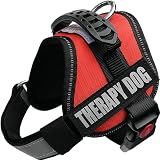
- Clear Therapy Dog ID: Includes 2 removable THERAPY DOG patches and reflective stitching for visibility during therapy visits, volunteer programs, training classes, and dawn/dusk low-light walks.
- Measure Chest First: XXS 15–18", XS 16.5–20.5", S 20–27", M 24–30", L 27–36", XL 33–44.5" — measure the widest chest just behind the front legs, tape snug with one finger underneath. If between sizes, size up.
- Comfortable All-Weather Build: Woven nylon oxford, soft breathable mesh padding, and reinforced stitching for daily therapy work and active training. Hand wash cold and air dry, or spot clean after visits.
- Secure Patch Panels: 2 heavy-duty hook-and-loop patch panels hold the included THERAPY DOG patches firmly through active movement — swap easily for in-training or working dog roles. Additional patch styles sold separately.
- HANDLE AND HONEST USE: Reinforced top handle for firm control during visits. D-ring for leash or ID tag. Designed for registered therapy handlers, hospice volunteers, and certification candidates. Important: therapy dog vests do not create ADA service dog public access rights. Use only where dogs are already invited or approved.
If the dog’s role is not obvious, DOJ says staff may ask whether the dog is required because of a disability and what work or task it has been trained to perform. They may not require certification documentation. The ADA also does not require a service dog to wear a vest, ID tag, or specific harness. DOJ ADA FAQ (last updated February 28, 2020). For legal questions, check current DOJ guidance and applicable state or local law.
Independent reader supportYour contribution helps us test, update, and keep practical guides available for everyone.Are therapy-dog visits proven to improve recovery?
Some patients may find animal contact comforting or beneficial, but it should not be presented as a proven treatment or a guarantee of recovery. CDC notes that reported benefits in healthcare settings are largely based on anecdotal reports and observations, and that formal scientific studies of zoonotic-transmission risks in healthcare settings outside laboratories are lacking. CDC guidance.
Quick Recap
Best Value
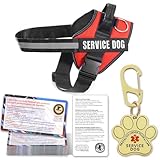
- Note: First point: If you want to quickly fit your "son" and "daughter" into well-fitting dog vests, you must measure their neck girth and chest girth, not just rely on suggested weights; this is a serious mistake. Second point: We do not provide services for engraving names and mobile phone numbers on dog tags. You can go to a pet store near you to have them engraved.
- Warning: This product has been registered and registered with USPTO & US Copyright Registration (OAS) and issued a certificate. Plagiarism, re-engraving, and legal risks will face it !
- Service Dog Vest: This service dog vest kit comes with a service dog vest*1, service dog patches*2 and service dog tag*1, and service dog information cards*50. It includes everything you need to safely use a service dog.
- Service Dog Harness: This service dog harness is specially designed for service dogs and can meet the needs of service dogs of different sizes. It can be evenly distributed on the service dog's body to prevent suffocation, ensuring that your service dog performs tasks in this best condition.
- Service Animal Vest for Dogs: This service animal vest for dogs are equipped with reflective tape to enhance visibility in low light conditions to ensure the safety of both the owner and the service dog. This sturdy D-ring on the service animal vest for dogs allows for easy attachment of your leash, making it perfect for both urban and outdoor activities.
Rank #4

- Size: 3.5 x 1.77 inches
- Package includes: 2pcs of THERAPY DOG PLEASE PET ME hook and loop embroidered patch
- Hook and Loop Backing: the back of the embroidered fastener hook and loop patches are well designed to be easily pasted on the dog's vest, which is removable and interchangeable
- Quality material: these tactical dog patches are made of quality canvas material, fine workmanship and exquisite appearance, decorated with colored embroidery, soft and comfortable to touch, suitable for a vest, harness, collar
- Wide Applications: these dog patches are widely applied for dog harness, vest, collar, leash, backpack and so on, very suitable for dogs and any service dog trainers
Product prices and availability are accurate as of the date/time indicated and are subject to change. Any price and availability information displayed on Amazon at the time of purchase will apply.




