
Some links on this page are affiliate links: if you buy through them we may earn a commission, at no extra cost to you.
If your dog runs toward a stranger, prevent contact first: shorten and control the leash, create distance, and ask the person not to reach for the dog. Give one calm recall cue, reward the instant your dog turns to you, and end the approach by moving away. Do not chase, punish the return, or force a greeting. Then train the behavior in small, controlled steps so your dog learns that checking in with you—not rushing at people—is what earns access.
The safest response depends on why your dog is approaching. A loose, wiggly body may signal excitement, while a tense posture, avoidance, barking, growling, or lunging can indicate fear or uncertainty. Read those signals before deciding whether to redirect calmly or increase distance and seek professional help.
As an Amazon Associate I earn from qualifying purchases.
What should I do immediately when my dog runs toward someone?
Keep the situation boring, controlled, and brief. Your first goal is to stop an unwanted greeting, not to test your dog’s obedience in a difficult moment.
- Control the leash and create space. Shorten the leash without jerking, step off the path, turn away, or move behind a barrier. Ask the stranger to pause and not reach for your dog. Dogs Trust advises keeping a dog on a lead around strangers when jumping or rushing is possible. A long line belongs only in a safe, open area where it cannot lead your dog into traffic or wrap around people.
- Use one recall cue. Say your dog’s name followed by the single “come” cue you have trained, using a light, happy voice. As soon as your dog turns toward you—even before reaching you—mark the response with praise and deliver a treat or toy.
- Pay for calm behavior. Feed small, high-value treats while your dog keeps four paws on the ground or looks at you. Keep the reward stream moving as you increase distance from the stranger, then finish by leaving rather than allowing the dog to rush back.
- Do not force contact. Excited dogs may jump; worried dogs may bark, growl, lunge, freeze, or try to avoid the person. A dog is not required to greet everyone, and the safest choice may be no greeting at all.
If the person is already close, use a simple script such as “Please give us space; my dog is in training.” Stand between the dog and the stranger when you can do so safely, and keep your attention on the dog rather than apologizing or explaining at length.
Popular on Amazon
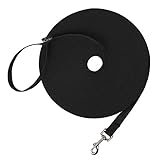
- DIMENSIONS - This dog leash measures 3/4in wide by 30 feet long. Great for hiking, camping, training, hunting, backyard, beach, recall training, outdoor play with tennis balls, and swimming!
- LONG LEASH: This training leash is great for teaching your dog recalls. It has the length needed to allow them to wander and ensure your command to come! is obeyed.
- NYLON TRAINING LEAD - This durable, long, nylon dog training leash will outlast cotton leashes. All stitching is reinforced and the nickel plated clip swivels to resist twisting. Our long dog leash is great for medium and large dogs. You'll love using it as a backyard dog leash, for off leash dog training, and more.
- Allows you to teach your dog recalls and other obedience skills.
- Swivel-style bolt snap resists twisting
How can I tell whether the approach is excitement or fear?
The same forward movement can have opposite meanings. Loose muscles, a wiggly body, and a relaxed wag often accompany an excited greeting. A tense body, ears held back, a tucked or lowered tail, avoidance, barking, or growling can indicate fear or uncertainty.
When the dog is excited
Redirect before the dog reaches the person. Ask for a known behavior such as looking at you, sitting, standing calmly, or touching your hand, then reward it. If the dog jumps, have the person turn away and stop the interaction; access to the person resumes only when all four paws are on the ground.
Quick wins for a faster PC:
Clear out junk files and repair common Windows errorsFree Scan →Scan for outdated or missing drivers - takes under a minuteDriver Scan →Repair Windows errors before they cause bigger problemsFix Now →When the dog is worried or reactive
Increase distance immediately. Do not drag the dog toward the person, demand a sit while the dog is overwhelmed, or punish barking and growling. Those signals are information that the dog needs more space. Cornell’s veterinary guidance notes that reactivity is not automatically aggression, but repeated lunging, growling, snapping, biting, or escape attempts can worsen without appropriate support.
What should I do if an unfamiliar dog runs up to me?
Do not run or stare directly at the dog. Stay still, turn your body slightly sideways, and let the dog sniff or pass if it chooses.
- Keep your hands quiet and avoid reaching over the dog’s head.
- If the dog continues to approach, back away slowly rather than turning and sprinting.
- Use a firm, calm voice if you need to discourage contact.
- Ask the owner before touching the dog.
- Supervise children closely around every dog, including a familiar family pet.
If you are knocked down, curl into a ball, protect your head, neck, and ears, and place a bag, coat, or other object between you and the dog. Stay as still as possible until the dog moves away or help arrives. The Centers for Disease Control and Prevention emphasizes that most dog bites are preventable; avoiding pursuit, startling movements, and unwanted handling reduces risk.
Also popular on Amazon
- Dimensions - This dog leash measures 3/4in wide by 20 feet long. Great for hiking, camping, training, hunting, backyard, beach, recall training, outdoor play with tennis balls, and swimming!
- Long Leash: This training leash is great for teaching your dog recalls. It has the length needed to allow them to wander and ensure your command to come! is obeyed.
- Nylon Training Lead - This durable, long, nylon dog training leash will outlast cotton leashes. All stitching is reinforced and the nickel plated clip swivels to resist twisting. Our long dog leash is great for medium and large dogs. You'll love using it as a backyard dog leash, for off leash dog training, and more.
- Allows you to teach your dog recalls and other obedience skills.
- Swivel-style bolt snap resists twisting
What if my own dog is loose and running toward people?
Chasing usually turns the event into a game. Instead, make yourself the more interesting destination and remove opportunities for the dog to leave the area.
Recommended Free Tools
- Move away happily. Use an upbeat voice and run or walk in the opposite direction if it is safe. AVSAB recommends making distance from the dog while acting inviting rather than pursuing it.
- Use a familiar lure. Shake a treat bag, show a favorite toy, or offer a high-value food reward if doing so will not put you or others at risk. Avoid cornering the dog.
- Block escape routes. Close a gate, block a doorway, or have another adult stand at an exit. Keep strangers from crowding the dog.
- Secure the dog quietly. Once the dog comes within reach, attach the leash or guide it through the gate without scolding.
- Prevent the next escape. Check doors, gates, and latches, and begin separate door-stay and recall training. Do not assume that recovering the dog once has taught it to stay home.
How do I train a reliable recall around strangers?
Recall is built from easy successes, not repeated shouting in situations your dog cannot yet handle. Practice the foundation indoors, add distance gradually, and introduce people only while your dog can still think and eat.
1. Teach the name-and-look response
In a quiet room, say your dog’s name once. The instant the dog looks toward you, reward it. Repeat until turning to you is automatic, then practice in other rooms and with mild household distractions.
2. Build one recall cue
Say the cue once, then reward immediately when your dog moves toward you. Never punish a slow return or scold the dog after it arrives; doing so can make the cue predict something unpleasant. Start on a leash, increase distance in small increments, and add distractions one at a time.
3. Add controlled freedom
In a secure, open area, use a supervised long line or long rope so your dog can explore without being free to reach roads, cyclists, or strangers. Keep the line away from legs and obstacles, and handle it so a sudden run does not cause a burn or fall. Recall is never guaranteed, so use a regular leash near roads and heavy traffic.
Free tools Windows power users keep installed
One-click scans. No signup required.
Also popular on Amazon

- Various Size&Dia. Long Dog Leash: 10FT, 16FT, 30FT, 50FT,and 100FT , various sizes can meet different training purpose. Our Dog Leash available in diameter 1/3 inch, 3/8 inch, 1/2inch. The diameter of 1/3 inch can meet small dogs, cats or other small animals. The diameter of 3/8 inch and 1/2 inch is the best choice for training leashes for large dogs or medium dogs.
- Dog Tie Out Cable: Both ends of our rope dog leash leash have a heavy duty stainless steel swivel hook that can rotate 360 degree. You can tie one end of this training leash to your body or trees etc.,so that you can free your hands when traning, hiking,walking,etc.
- Reflective for Night Safety: We’ve added a reflective stitching around this strong training lead to make sure it is visible in low light. Your pup’s safety is always our highest priority.
- Durable and Lightweight Dog Rope Leash: This training Lead is made of high strenth wear-resistant polyeste which is lightweight and environmentally friendly, not easy to pull off, and has strength, will not be entangled with trees, grass, etc.The pull is up to 8-10 KN by professional tensile test which allow for total control of your dog and also allow it the freedom to do its business.
- Excellent Outdoor Dog Leash: Great dog leash for outside sports such as hiking, camping, training, hunting, backyard, beach, mountain climbing, walking, running, and so on.Any problem don't hesitate to contact with us.
4. Replace rushing with a greeting behavior
Teach the dog that sitting, standing calmly, or touching your hand earns access to a person. Ask the person to wait while you cue the behavior. If the dog jumps, pulls, barks, or becomes worried, the person should pause or step away and you should increase distance.
5. Counter-condition the sight of strangers
Work at the distance where your dog notices a stranger but can still respond to you and take food. Mark the sight of the person and feed. If the dog reacts, you are too close; move farther away and wait for the dog to settle. With repetition, the dog can learn that seeing people predicts good things and checking back with the handler is worthwhile.
6. Generalize instead of assuming
Practice with different people, clothing, locations, weather, and levels of activity. A recall learned in a quiet living room may fail on a busy sidewalk because the environment is different. Change only one difficulty at a time and return to an easier level after a mistake.
Which equipment helps prevent unwanted approaches?
Equipment supports training; it does not replace supervision or a management plan.
Do these 3 things before closing this tab:
1Scan for outdated or missing drivers - takes under a minute2Clear out junk files and repair common Windows errors3Fix the driver behind crashes, sound loss and screen glitches| Tool | Best use | Important limit |
|---|---|---|
| Regular leash | Daily walks, roads, heavy traffic, and places where contact must be prevented | It cannot teach recall by itself; the handler still has to create distance and reward attention |
| Long line | Supervised recall practice and exploration in a secure, open area | Keep it away from traffic, obstacles, and people; it is not a substitute for a leash near hazards |
| High-value treats or a favorite toy | Immediate reinforcement for turning back, calm attention, and counter-conditioning | Rewards must be delivered promptly, before the dog reaches the stranger |
| Secure barriers and gates | Preventing door-bolting and blocking exits during a loose-dog incident | Barriers need to be checked and used with separate door-stay training |
How should I manage walks while training is in progress?
Management prevents your dog from rehearsing the rush while new skills are developing. Choose routes and times that let you see approaching people early, cross the street, step behind a parked car, or turn around before the dog is overexcited.
Also popular on Amazon
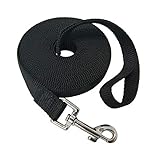
- Dog Leash Dimensions: training leash measures 3/4 inch width by 20 feet length, offering you dog for more wandering area and freedom.
- Nylon Long leash: long lead is made of strong wear-resistant nylon, available in Black, Blue, Red,Green color.
- Dog training leashes: suitable for teaching your dog/puppy recall and other obedience skills, great for small, medium, large dogs.
- Easy on and Easy off: Swivel-style bolt snap resists twisting. 360 degree tangle free swivel heavy duty clasp gives your dog best freedom.
- The dog training leash is built to last. If you have any question, please contact us, we will solve the problem until you are satisfied.
- Keep enough leash slack for communication but not enough for a sudden charge.
- Carry rewards where you can reach them instantly.
- Scan ahead and make your space request before a stranger enters your dog’s comfort zone.
- Do not allow a friendly stranger to lure the dog into a greeting if the dog is pulling or jumping.
- End the session after a successful calm response rather than adding a harder challenge immediately.
Freedom should increase only when the dog can respond reliably at the current difficulty. Safety comes before enrichment: a regular leash and distance are appropriate whenever the surroundings make a mistake dangerous.
When should a veterinarian or behavior professional get involved?
Arrange a veterinary examination if the behavior changes suddenly. Pain, illness, or another medical problem can alter a dog’s tolerance and responses, and training alone will not address an untreated physical cause.
Seek a qualified, reward-based behavior professional when your dog repeatedly lunges, growls, snaps, bites, escapes, or cannot stay calm far enough away from people to learn. Bring a record of what happened, the distance involved, the dog’s body language, and what helped. A professional can separate excitement from fear, design a safe exposure plan, and coordinate with your veterinarian when medication or additional assessment may be appropriate.
What mistakes make the problem harder?
- Repeating the recall angrily: the cue becomes background noise or predicts punishment.
- Chasing a loose dog: pursuit can increase speed and excitement.
- Allowing “just one” uncontrolled greeting: each rush gives the behavior another chance to be reinforced.
- Correcting warning signals: punishing barking or growling may suppress communication without changing the underlying fear.
- Moving too close during training: a dog that is already reacting cannot learn the new response you want.
- Assuming indoor skills transfer outdoors: distractions, surfaces, people, and distance change the task.
How can I make greetings safer for strangers and my dog?
Ask for consent before allowing contact and give the person an easy way to decline. Keep the dog beside you, cue the replacement behavior, and let the person approach only while the dog remains loose and calm. A brief greeting is optional; walking away is a successful outcome.
Tell children to stand still, keep their hands to themselves, and call an adult rather than approaching a running dog. Adults should not encourage a dog to chase, hug, or corner anyone. Consistency and patience are essential to training, as UC Davis School of Veterinary Medicine advises.
Also popular on Amazon

- Dimensions - This dog leash measures 3/4in wide by 30 feet long. Great for hiking, camping, training, hunting, backyard, beach, recall training, outdoor play with tennis balls, and swimming!
- Long Leash: This training leash is great for teaching your dog recalls. It has the length needed to allow them to wander and ensure your command to come! is obeyed.
- Nylon Training Lead - This durable, long, nylon dog training leash will outlast cotton leashes. All stitching is reinforced and the nickel plated clip swivels to resist twisting. Our long dog leash is great for medium and large dogs. You'll love using it as a backyard dog leash, for off leash dog training, and more.
- Allows you to teach your dog recalls and other obedience skills.
- Swivel-style bolt snap resists twisting
Frequently Asked Questions
Should I create a special emergency recall word?
A single, consistent cue is easier for a dog to recognize than several improvised commands. Choose one phrase, practice it first in easy settings, and reserve it for situations in which you can immediately deliver an especially valuable reward.
How long will it take before my dog can greet people safely?
There is no universal timetable, and official veterinary guidance does not establish a guaranteed success rate. Progress depends on the dog’s emotional response, the quality of management, and how gradually distractions are increased; stay at each level until the dog can respond comfortably.
Should strangers offer my dog treats?
Only if you are directing the interaction and the dog is calm enough to eat. Have the person toss the treat to the ground or place it near you rather than reaching over the dog, and end the interaction if the dog becomes tense, jumps, or stops taking food.
Can a dog that runs up play safely at a dog park?
Not until you can reliably prevent unwanted approaches and recall the dog around substantial distractions. A fenced area removes some traffic risk, but it does not remove the need to supervise body language, obtain consent from other handlers, and leave when your dog becomes overexcited or worried.





Leave a Reply