
Some links on this page are affiliate links: if you buy through them we may earn a commission, at no extra cost to you.
Feed a low-energy adult dog a complete-and-balanced adult diet in a measured calorie allowance, not an unlimited bowl. Start with calories based on ideal body weight, then adjust portions as the dog’s weight and 1–9 body-condition score change. If your dog is sedentary, already overweight, or seems hungry on a small portion, ask your veterinarian whether a weight-management formula is safer than sharply restricting a regular food.
The right choice is identified by the label’s calorie density, nutritional-adequacy statement, life-stage designation, and the amount your dog can eat while maintaining an ideal body condition—not by words such as “light” or “healthy” on the front of the bag.
As an Amazon Associate I earn from qualifying purchases.
What should I feed a low-energy adult dog so he does not gain weight?
Choose a complete-and-balanced food for adult maintenance and feed a precisely measured daily amount. For a dog that gains weight easily, a veterinary weight-management diet can make the plan easier because it is formulated to provide required nutrients with fewer calories, often by using more fiber and less fat. Cornell University College of Veterinary Medicine describes these diets as lower in calories per cup, higher in fiber, and lower in fat; Merck Veterinary Manual explains that they are designed to remain nutrient-adequate at a lower calorie intake.
Do not rely on a food’s marketing name. On the package, verify the nutritional-adequacy statement, calories in kilocalories of metabolizable energy (kcal ME) per kilogram and per cup or can, and that the food is intended for adult maintenance. The feeding chart is only a starting estimate. Your dog’s body condition and weight trend determine whether the daily amount is correct.
Popular on Amazon

- Real turkey as the first ingredient, dog food for weight management helps your dog maintain a healthy weight
- Healthy Weight Support: Dog kibble for weight management uses real turkey as the first ingredient for a high-protein dog food for weight management that offers lean muscle support.
- Fiber-Rich Formula: Dog food to help dogs lose weight with a fiber-rich formula that helps keep them full and supports an ideal body condition for adult dog food dry feeding.
- Complete Nutrition: This complete and balanced nutrition dog food delivers 100 percent complete nutrition with no fillers, plus omega-6 fatty acids for healthy skin and coat.
- Taste and Texture: Purina ONE dog food for healthy weight features the right combination of taste and texture that dogs love.
When a weight-management formula is useful
A weight-management formula is worth discussing with a veterinarian when your dog is overweight, obesity-prone, neutered and inactive, or appears unsatisfied by the small volume allowed by a regular food. A diet with lower calorie density can provide a larger physical portion at the same calorie target, while added fiber may improve fullness. It is not automatically better for every dog: palatability, other diseases, medication, muscle condition, and the dog’s ability to maintain the plan all matter.
Why simply feeding much less regular food can backfire
Severely restricting an ordinary maintenance diet can reduce calories so far that the dog receives inadequate amounts of some required nutrients. Merck advises using a diet formulated for weight management when substantial calorie restriction is needed, rather than improvising a very small portion of a standard food.
Outdated Drivers Are Slowing You Down
One free scan finds every outdated or missing driver and matches the right update for your exact hardware.Free scan · exact hardware matchPC Slower Than It Used to Be?
A free scan shows the junk files, broken settings and background clutter dragging Windows down - then fixes them in one click.Free scan · Windows 10 & 11How many calories does a sedentary adult dog need?
Use an estimate to set the first target, then refine it with measured weight and body condition. Merck gives the resting energy requirement (RER) equation as RER = 70 × body weight in kilograms0.75. For an obesity-prone adult dog, Merck lists 1.4 × RER as a starting maintenance factor. This is not a universal prescription: age, neuter status, activity, ideal rather than current weight, muscle mass, and illness can move the real requirement substantially.
A practical calculation example
Suppose a dog’s ideal weight is 20 kg. Calculate RER from 70 × 200.75, then multiply that result by 1.4 for the initial obesity-prone-adult estimate. Divide the resulting daily kilocalories by the food’s kcal per cup or can to obtain a daily volume. Use ideal weight when current weight is excessive, and have your veterinarian confirm the target if the dog has a medical condition or a large discrepancy between current and ideal weight.
How to convert calories into portions
- Find the food’s metabolizable energy value on the label, such as kcal per cup for dry food or kcal per can for wet food.
- Set a daily calorie allowance from the dog’s ideal-weight estimate and veterinary advice.
- Divide daily calories by calories per household unit. For example, a 360-kcal cup divided into a 720-kcal daily allowance equals 2 level cups per day.
- Split that total into the number of meals your household can deliver consistently.
- Reserve calories for treats before portioning the main food; do not add treats on top of the full calculated ration.
Recalculate whenever you change foods, because two cups of different diets can contain very different calories. Compare dry and canned products by calories, and when relevant by dry-matter nutrient concentrations, rather than by cup volume alone.
How do I choose between regular adult food and weight-management food?
Compare the two diets on the factors below, then select the option your veterinarian considers appropriate and your dog will reliably eat. No brand has established superiority on the evidence available for this topic.
Also popular on Amazon
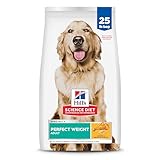
- Breakthrough formula made to positively impact the unique cell function of overweight pets, and support healthy metabolism and body weight
- Safe and effective weight loss with visible results within 10 weeks
- Made with natural ingredients
- Made in the USA with global ingredients you can trust
- Hill's Pet Nutrition is the US Veterinarians' #1 recommended brand
| Comparison point | Regular adult-maintenance food | Weight-management food |
|---|---|---|
| Calorie density | May require a smaller portion if the dog is inactive or prone to gain. | Often lower in kcal per cup or can, allowing more physical food at the same calorie target. |
| Nutritional adequacy | Must carry a complete-and-balanced statement for adult maintenance. | Must also provide complete-and-balanced nutrition; lower calories do not excuse nutrient shortfalls. |
| Fiber and fat profile | Varies widely; high-fat, low-fiber choices can make control harder. | Commonly higher in fiber and lower in fat, although the label values differ by product. |
| Portion volume | Depends on kcal per cup or can; a calorie-dense diet may produce a small serving. | Usually more volume for the same calories, which may help a hungry dog. |
| Adherence | May be more familiar or appealing to an individual dog. | Only useful if the dog eats it consistently and the household measures it. |
| Concurrent disease | May be unsuitable when another condition requires a specialized nutrient profile. | Still requires veterinary selection when diabetes, kidney disease, gastrointestinal disease, or another illness is present. |
Is “light” enough?
Not necessarily. “Light,” “healthy,” or similar front-label wording does not tell you the calorie density or whether the diet is appropriate for your dog. Read the nutritional-adequacy statement and kcal declaration, and judge the result by the dog’s body-condition trend.
What calorie density should I look for?
Cornell’s weight-loss guidance gives around 300 calories per cup as a figure for a diet intended for canine weight loss. Treat that as an example of a lower-density formulation, not a universal target: the correct density depends on the dog’s calorie allowance, the food’s nutrient concentration, and the amount the dog can eat while maintaining ideal condition.
How should I measure my dog’s food and treats?
Accurate portion control is one of the highest-impact changes for an inactive dog. Cornell warns that “heaping” a measuring cup adds unplanned calories, and the British Small Animal Veterinary Association (BSAVA) recommends accurate measurement, including use of scales.
- Weigh the main food. A digital kitchen scale gives repeatable gram amounts and avoids differences between people or cups. If you use a cup, fill it level rather than rounded.
- Pre-measure the whole day. Put the daily ration in a labeled container each morning. Everyone feeds from that container, so a second meal cannot accidentally duplicate the first.
- Count every extra. Include training treats, dental chews, table food, pill pockets, toppers, supplements that contain calories, and food used to give medication.
- Deduct treats first. Reserve no more than 10% of daily calories for treats and other non-main-diet foods; feed the remaining 90% or more as the complete-and-balanced diet.
- Keep the method stable. Changing from weighing to an overflowing cup, or switching between different scoop sizes, makes trend-based adjustments unreliable.
A food-dispensing toy or programmed feeder can control access and add enrichment, but it does not replace calorie accounting. Program the device with the dog’s measured daily amount and include every refill in the day’s total.
Free tools Windows power users keep installed
One-click scans. No signup required.
How much should treats and table food count?
The American Animal Hospital Association recommends keeping treats and other calories outside the complete-and-balanced main diet to 10% or less of daily calories. For a 700-kcal daily allowance, that means no more than about 70 kcal from all extras combined. The remaining calories should come from the nutritionally complete diet.
Ways to make the 10% allowance last
- Use a portion of the dog’s measured kibble as training rewards.
- Break a single treat into several small pieces and count the total calories.
- Offer low-calorie options only when their calories are known and compatible with the dog’s medical needs.
- Avoid unmeasured table scraps and high-fat additions, which can consume the allowance quickly.
High-fat foods, free-choice feeding, frequent scraps, and a sedentary routine are common contributors to canine obesity. A dog that begs is not necessarily underfed; begging can be learned behavior, boredom, or access to calorie-dense extras.
Also popular on Amazon

- High-protein weight management dog food with real chicken to support lean muscle mass.
- Contains 15 percent less fat than Purina Pro Plan adult dog food for weight control.
- Fortified with dog probiotics to support digestive and immune health.
- Includes dog gut health probiotics for a balanced microbiome.
- Crunchy kibble and tender shredded pieces for texture dogs love.
How can I tell whether my dog is at a healthy weight?
Use both scale weight and body-condition scoring. The 1–9 body-condition-score (BCS) system is designed for consistent communication: Cornell identifies BCS 4 or 5 as ideal, with ribs easy to feel but not visible, a tucked abdomen from the side, and a visible waist from above. BSAVA describes BCS 6–7 as overweight and BCS 8–9 as obese; BCS 8–9 corresponds to at least 30% excess weight.
What to check at home
- Ribs: You should be able to feel them under a thin covering of fat without pressing hard.
- Side view: The abdomen should rise behind the rib cage rather than hang level or sag.
- Top view: There should be a waist between the ribs and hips.
- Muscle: Note muscle loss separately from fat cover, especially over the spine, shoulders, and thighs.
Coats, body shape, age, and breed can obscure visual assessment, so ask a veterinary professional to score the dog periodically. AAHA recommends nutritional screening at every visit and an iterative reassessment process; body condition and muscle condition should be recorded separately.
Recommended Free Tools
How often should I adjust the ration?
Record body weight, BCS, muscle condition, daily calories, treats, and activity at regular intervals. A consistent home weigh-in schedule—using the same scale and similar conditions—helps reveal a trend that a single measurement cannot. If weight rises or BCS moves above ideal, reduce calories cautiously with veterinary guidance or change to a lower-density, nutrient-adequate diet. If weight falls unexpectedly, appetite changes, or muscle declines, pause reductions and arrange a veterinary assessment.
What if the dog is still gaining on very little food?
Do not keep cutting the portion indefinitely. Recheck the label’s kcal value, weigh the food, audit every treat and chew, and confirm that another household member is not feeding extras. Merck specifically recommends considering hypothyroidism when the calories needed to maintain ideal condition seem unusually low. Pain that suppresses activity, medication effects, and other illness can also change energy needs and should be investigated.
Independent reader supportYour contribution helps us test, update, and keep practical guides available for everyone.Is home-cooked or raw food a safer low-calorie option?
Home-cooked food can be appropriate only when a board-certified veterinary nutritionist formulates the recipe and provides instructions for supplements, ingredients, and preparation. Merck notes that homemade diets are difficult to make complete and balanced without professional formulation. Raw diets add potential nutrient-imbalance and pathogen risks and are not a shortcut to controlled calories.
If you want to add fresh foods, ask the veterinarian how they fit within the 10% extra-calorie limit and whether they are safe for the individual dog. Never replace most of the complete diet with unbalanced meat, vegetables, or leftovers simply to increase volume.
The Tool Desk
Outbyte PC Repair FREEClear out junk files and repair common Windows errorsFree Scan →Outbyte Driver Updater FREEFix the driver behind crashes, sound loss and screen glitchesFind Drivers →Also popular on Amazon

- REAL CHICKEN FIRST: Blue Buffalo dry dog food starts with real chicken as the first ingredient to help support healthy, lean muscles in adult dogs
- BALANCED NUTRITION TO HELP WEIGHT MANAGEMENT: This BLUE dog food provides the ideal caloric balance and complete daily nutrition for adult dogs with chicken for protein, wholesome carbohydrates for energy, and other natural ingredients
- EXPERT-LED NUTRITION: Designed to help your pet thrive from the inside out, Blue Buffalo dog food formulas are developed by a dedicated team of veterinarians and animal nutritionists
- COMPLETE NUTRITION: This BLUE dog food without grains provides balanced daily nutrition for adult dogs with chicken for protein, wholesome carbohydrates for energy, and other natural ingredients
- SUPPORTS IMMUNE SYSTEM HEALTH: BLUE Life Protection Formula grain free dog food features exclusive LifeSource Bits, a precise blend of antioxidants, vitamins, and minerals that are formed at a lower temperature to ensure optimal potency
What equipment makes weight control easier?
A digital kitchen scale is the most direct portion-control purchase because it makes the amount repeatable in grams. A slow feeder, food-dispensing toy, or automated feeder can distribute meals, reduce rapid eating, and add activity or enrichment. These devices help with routine and access; they cannot correct an incorrect calorie target or an uncounted refill.
When should a veterinarian review the plan?
Arrange a veterinary review before a substantial diet change if the dog is obese, has another diagnosed disease, takes long-term medication, is losing muscle, or has a history of digestive intolerance. Seek an appointment for unexplained gain, a marked drop in activity, persistent hunger despite accurate portions, or calorie needs that seem unusually low. The veterinarian can confirm ideal weight, score body and muscle condition, select a diet compatible with concurrent disease, and investigate conditions such as hypothyroidism.
Frequently Asked Questions
Can I feed my dog once a day to prevent weight gain?
Meal frequency is less important than the total measured calories, but dividing the allowance into two or more meals can make portions easier to manage and may reduce long gaps between feedings. Use the schedule your household can follow without missed or duplicated meals.
Should I leave food out for a dog that seems hungry?
Free-choice feeding makes it difficult to know how many calories were consumed and is a recognized contributor to obesity. Offer measured meals, remove leftovers after the planned feeding period, and discuss persistent hunger with your veterinarian rather than leaving the bowl filled.
Are vegetables automatically free treats for an overweight dog?
No. Some vegetables are relatively low in calories, but they still count as extras and may be unsuitable for a dog with a specific disease or dietary restriction. Include their calories in the daily allowance and keep all extras within the 10% limit.
How do I change foods without upsetting my dog’s stomach?
Ask your veterinarian for a transition schedule suited to the dog’s health and the diets involved. Monitor stool quality, appetite, vomiting, and itching during the change; persistent gastrointestinal signs warrant veterinary advice rather than repeatedly changing foods.





Leave a Reply