
Free tools Windows power users keep installed
One-click scans. No signup required.
Some links on this page are affiliate links: if you buy through them we may earn a commission, at no extra cost to you.
Feed a newly adopted kitten according to two facts: its age and whether it is fully weaned. A kitten eating solid food should receive a commercial diet labeled complete and balanced for growth or all life stages, with fresh water available. Keep the food it was eating before adoption for the first few days, then change gradually if necessary. A kitten that cannot eat solids, is orphaned, or is unable to nurse needs commercial kitten milk replacer and careful temperature, positioning, and timing—not cow’s milk. Coldness, weakness, refusal to eat, vomiting, persistent diarrhea, breathing trouble, or failure to gain weight require prompt veterinary advice.
This first-week plan explains how to identify the right feeding branch, choose food, set a schedule, change diets safely, and monitor a vulnerable kitten.
As an Amazon Associate I earn from qualifying purchases.
Quick wins for a faster PC:
Scan for outdated or missing drivers - takes under a minuteDriver Scan →Repair Windows errors before they cause bigger problemsFix Now →How do I decide what a newly adopted kitten should eat?
Start by establishing the kitten’s weaning status, not by choosing a flavor or brand. Ask the shelter, breeder, or foster carer for the kitten’s birth date, current food, meal times, approximate amounts, and whether it nurses. Then use the branch that fits.
Fully weaned kittens
A kitten that eats wet or dry food independently needs a commercial kitten diet with an AAFCO nutritional-adequacy statement saying it is complete and balanced for growth or for all life stages. Wet food, dry food, or a measured combination can all work when the diet meets that standard. Keep the familiar suitable food during the first days in the new home whenever possible.
Popular on Amazon

- Fancy Feast cat food variety pack specially made for kittens
- Purina Fancy Feast wet food for kittens featuring real ocean whitefish, turkey, chicken or salmon and made without artificial colors or preservatives
- Crafted with real, high-quality ingredients to deliver 100 percent complete and balanced kitten wet food
- Delicious kitten wet food variety pack developed in partnership with our expert nutritionists to create a unique and unforgettable taste experience for your growing feline
- Canned kitten food that’s skillfully crafted in Purina’s own U.S. facilities where it undergoes regular quality and safety checks
Pre-weaning, orphaned, or unable-to-nurse kittens
A kitten that cannot reliably eat solids has a different medical and nutritional problem. Use a commercial kitten milk replacer exactly as its label directs and arrange veterinary support, particularly if the kitten is orphaned, weak, chilled, not suckling, or has been ill. Never substitute cow’s milk.
What does “complete and balanced” mean on kitten food?
Look for the nutritional-adequacy statement on the package before comparing ingredients or marketing terms. AAFCO uses “complete” to mean that all required nutrients are present and “balanced” to mean that those nutrients occur in the correct ratios. The life-stage wording should include growth or all life stages.
VCA’s practical rule is: “If there is no AAFCO Statement on the package, you should not use the food as your kitten’s main diet.” Feeding directions are starting guidelines, not a guarantee for every kitten; AAFCO notes that portions may need adjustment for an individual animal.
| What to check | Why it matters in the first week |
|---|---|
| Complete-and-balanced statement for growth or all life stages | Confirms the food is intended to supply the nutrients a growing kitten needs. |
| Wet, dry, or mixed format | Any format can work if it meets the adequacy statement and the kitten eats it well. |
| Feeding directions and calorie information | Provide a starting amount; your veterinarian can adjust it for growth, body condition, illness, and activity. |
| Continuity with the previous diet | Keeping a familiar food reduces the combined effect of relocation stress and an abrupt diet change. |
| Kitten’s acceptance and stool response | Appetite, stools, and energy show whether the plan is being tolerated. |
| Your ability to provide the required meals | A food plan is only safe if someone can deliver its meals consistently. |
How often should a weaned kitten eat?
Young kittens need more food per pound than adult cats, but they still benefit from measured meals rather than automatic unlimited access. Use the package’s kitten feeding table as the starting amount and divide the daily total into age-appropriate meals.
Kittens from about 6 to 12 weeks
The Royal Veterinary College gives four meals per day as a practical starting schedule for this age group. Offer breakfast, a midday meal, an evening meal, and a later meal at roughly consistent times. Smaller, frequent portions suit a small stomach and make it easier to notice a missed meal.
Kittens up to six months
Cornell advises that kittens generally do best with three meals daily until six months. Some kittens in the younger end of this range still do better with four portions, while a healthy older kitten may manage three. A veterinarian should individualize the schedule if growth, body condition, illness, or activity differs from the usual pattern.
Why measured portions matter
Growing kittens have high energy requirements, but free access can still lead to excessive weight gain. Measure the day’s food, record what is offered, and adjust only from the kitten’s growth and body condition or veterinary advice. Treats, table scraps, and food used for medication count toward the day’s intake.
Also popular on Amazon

- The information below is per-pack only
- Dry Kitten Food with Real Chicken: Purina Kitten Chow Year One Essentials dry kitten food made with real farm raised chicken
- Brain and Vision: Dry kitten food with DHA for early growth in every serving to support her brain and vision development as they grow
- Healthy Muscles: Dry kitten food for growth support made with 25 percent more protein (vs. Cat Chow Complete Adult) to support lean muscle development and a playful lifestyle
- Dry Kitten Food for Growth Support: 100 percent complete and balanced kitten food provides the building blocks for a healthy life
How should I set up food and water in a new home?
Place food in a quiet, predictable area where the kitten can eat without being startled by people, dogs, or loud appliances. Keep the water bowl in a separate location from food and litter when practical; separation can make drinking more appealing and keeps the feeding area cleaner.
Provide fresh, clean water as soon as a weaned kitten drinks independently. Wash bowls regularly and replace water when it is soiled. A kitten on wet food may drink less visibly than one eating dry food, so judge hydration alongside energy, appetite, urination, and stool rather than by the number of visits to the bowl.
What should I feed a kitten that is too young for solid food?
Use a commercial kitten milk replacer, mixed and measured according to that product’s directions. ASPCA notes that a mother’s milk normally supplies complete nutrition for roughly the first four weeks; weaning can then begin gradually. A milk replacer is for a pre-weaning or orphaned kitten, not a supplement for a healthy, fully weaned kitten.
What’s actually slowing this PC down?
Pick the symptom - the matching free tool is one click away.
How often do neonatal kittens need formula?
VCA recommends strict feeds every two to four hours during the first week for orphaned neonates. North Carolina State University gives the practical example that a one-week-old kitten may need feeding about every two hours, with the interval increasing as the kitten grows. These intervals apply to neonatal care and are not a schedule for a healthy kitten already eating solid food.
How do I prepare and offer the bottle safely?
- Warm the replacer. Bring it to approximately body temperature as the product or veterinarian directs. Test the temperature carefully; overheated formula can burn, while chilled formula may be poorly tolerated.
- Use suitable equipment. A controlled-flow kitten nursing bottle and nipple are designed to release liquid slowly. Follow the manufacturer’s instructions for preparing and cleaning them.
- Position the kitten belly-down. Keep the head in a neutral position, as it would be while nursing. Never feed a kitten on its back.
- Let the kitten draw the milk. The nipple should release slowly. Do not squeeze the bottle or push liquid into the mouth.
- Stop for danger signs. Coughing, milk from the nose, breathing changes, sudden distress, or inability to coordinate sucking can indicate aspiration risk. Stop feeding and obtain veterinary help.
Liquid entering the airway can cause aspiration pneumonia or death. A cold, very weak, non-suckling kitten may need warming and urgent veterinary assessment before a feeding plan is attempted; ask a veterinarian rather than improvising volumes or forcing formula.
What records should I keep for a vulnerable kitten?
Weigh an orphaned or recently ill kitten daily on a gram scale and record the time, amount of replacer taken, urine, stool, and behavior. A trend that fails to improve is more informative than a single number. Failure to gain weight, persistent crying, diarrhea, vomiting, refusal to suckle, weakness, or breathing trouble warrants prompt veterinary contact.
Can kittens have cow’s milk, raw food, or human food?
Do not use cow’s milk as a kitten formula. Merck Animal Health’s guidance is direct: “Never feed your kitten cow’s milk or other human foods.” Many cats cannot digest milk well, and it can cause gastrointestinal upset.
Recommended Free Tools
Also popular on Amazon

- GRAIN-FREE WET KITTEN FOOD: This canned cat food is complete and balanced, free from grains, protein-dense, rich in meaty flavor, and nutrient packed to support your kitten's daily needs, with real protein as the first ingredient.
- CHICKEN AND WHITEFISH VARIETY PACK: This healthy, natural food for kittens is an excellent source of protein and essential fatty acids for balanced nutrition. Includes (6) cans of chicken pate and (6) cans of whitefish/tuna pate.
- SUPPORTS HEALTHY HYDRATION: Wet food is an easy way to increase your cat's moisture intake for daily hydration health. We recommend feeding cat food at room temperature and refrigerating the unused portion.
- NO CORN, WHEAT, OR SOY: Cat food doesn't contain added carrageenan, wheat, wheat gluten, corn, soy, artificial colors, or preservatives.
- COMPLETE & BALANCED NUTRITION: Wellness cat food is created by nutritionists & veterinarians to nourish and sustain your pet's wellbeing.
Raw or non-sterilized animal foods can carry infectious hazards. Cornell identifies raw meat as a potential vehicle for toxoplasmosis and other infectious diseases. Homemade diets are also difficult to balance for a rapidly growing kitten; a recipe should not become the main diet unless it has been formulated for that individual by a veterinary nutritionist.
Dog food, table scraps, and treats are not substitutes for a complete kitten diet. They can displace essential nutrients or make it difficult to tell how much balanced food the kitten actually consumed.
How do I change a kitten’s food without causing diarrhea?
Keep the kitten on its familiar suitable diet while it settles in. International Cat Care notes that relocation stress combined with a sudden diet change can upset the stomach and cause diarrhea. If the current food is inappropriate, unavailable, or medically unsuitable, change over about three to seven days while watching appetite and stool.
A practical seven-day transition
- Days 1–2: three-quarters familiar food and one-quarter new food.
- Days 3–4: half familiar food and half new food.
- Days 5–6: one-quarter familiar food and three-quarters new food.
- Day 7: new food only, if appetite and stools remain normal.
For a sensitive kitten, extend a step rather than advancing on the calendar. If the kitten stops eating, vomits, develops ongoing diarrhea, or becomes lethargic, pause the transition and call a veterinarian; do not compensate by offering a succession of unrelated foods.
How much energy does a growing kitten need?
Energy needs are high early in life and fall as growth slows. The American Animal Hospital Association’s 2021 figure is approximately 200 kcal per kilogram per day at 10 weeks, compared with approximately 80 kcal/kg/day at 10 months. Those figures illustrate why a kitten diet and its feeding directions matter; they are not a prescription for an individual kitten and do not replace the calorie information on the package or a veterinary assessment.
Use the food’s stated calories and feeding table to calculate a starting daily amount, then monitor body condition and growth. Two foods can have different calorie densities, so the same volume or cup measure does not necessarily provide the same energy.
What should I monitor during the first week?
Write down meals, water access, stools, urination, energy, and any vomiting. For a neonate or recently ill kitten, add daily body weight and every formula feed to the record. Monitoring turns a vague concern—“the kitten seems off”—into information a veterinary team can use.
Also popular on Amazon
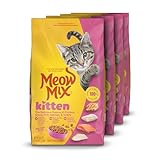
- Contains Meow Mix Kitten Li’l Nibbles Dry Cat Food for kittens, now with a new look
- Introduces kittens to the delicious flavors of chicken, ocean fish, salmon and turkey
- Provides one hundred percent complete and balanced nutrition for growing kittens
- Includes DHA, a nutrient found in mother cats’ milk that helps support vision and brain development
- Produced in the U.S.A. from globally sourced ingredients
- Appetite: note whether the kitten approaches food, eats a normal portion, and returns for later meals.
- Stool: record frequency and consistency. A brief change during a transition deserves observation; ongoing diarrhea needs veterinary advice.
- Energy and behavior: a healthy kitten should have periods of alertness and normal interaction for its age.
- Weight: weigh vulnerable kittens at the same time each day on the same scale and record the trend.
- Formula coordination: watch for coughing, milk from the nose, or abnormal breathing during or after a bottle.
When should I call a veterinarian?
Contact a veterinarian promptly if a kitten is cold, very weak, repeatedly vomiting, has ongoing diarrhea, refuses food, loses weight, cannot suckle, coughs or breathes abnormally during or after formula feeding, or shows a marked change in eating behavior. Orphaned neonates should be assessed early because warmth, toileting assistance, feeding technique, and illness can affect one another.
Do not wait for a routine appointment if breathing is abnormal, the kitten is unresponsive, or aspiration is suspected. A veterinarian can determine whether the problem is feeding technique, dehydration, infection, low blood sugar, inadequate warmth, or another emergency.
Which first-week feeding plan fits your kitten?
| Kitten’s situation | Food | Schedule starting point | What matters most |
|---|---|---|---|
| Weaned, about 6–12 weeks | Complete-and-balanced kitten food for growth or all life stages; wet, dry, or mixed | About four measured meals daily, using package directions | Continue the familiar diet initially and monitor appetite and stool |
| Weaned, up to six months | Complete-and-balanced kitten food | Usually three meals daily; younger kittens may need four | Adjust portions for growth and body condition with veterinary guidance |
| Pre-weaning or orphaned neonate | Commercial kitten milk replacer only, prepared as directed | Every two to four hours in the first week; intervals increase with age | Warmth, belly-down positioning, slow flow, daily weights, and veterinary access |
| Unable to nurse, weak, chilled, or ill | Do not improvise; seek veterinary direction on replacer and timing | Individualized emergency plan | Prevent aspiration and address the underlying problem before force-feeding |
Frequently Asked Questions
How can I tell whether a kitten is truly weaned?
A weaned kitten can lap or chew food independently, swallow without a bottle, and maintain appetite across several meals. If it searches for a teat, cannot manage solids, or tires while eating, treat it as potentially pre-weaning and ask a veterinarian or experienced shelter professional to assess it.
Can I leave dry food out all day for a kitten?
Leaving food available makes intake difficult to measure and can encourage excess weight gain. A measured daily portion divided into meals is easier to monitor; continuous access should be used only if a veterinarian specifically recommends it for that kitten.
What if the shelter cannot tell me what food the kitten was eating?
Choose a food with a clear complete-and-balanced statement for growth or all life stages and offer small measured meals in a quiet area. Once you learn the previous diet, transition gradually rather than changing abruptly again.
How should I clean a kitten nursing bottle?
Follow the bottle and milk-replacer manufacturer’s cleaning directions after every feed, because residue can support bacterial growth. If the nipple flow changes, the nipple cracks, or cleaning cannot remove residue, replace the component and ask your veterinary team about safe preparation.





Leave a Reply