Quick wins for a faster PC:
Repair Windows errors before they cause bigger problemsFix Now →Scan for outdated or missing drivers - takes under a minuteDriver Scan →Clear out junk files and repair common Windows errorsFree Scan →What types of fish do barracudas eat? Barracudas mainly eat other fish, including anchovies, sardines, herrings, mackerel, jacks, reef fish, mullets, and small tunas. Their exact prey changes with species, region, habitat, and body size; some barracudas also eat squid, molluscs, or crustaceans.
That broad answer matters because “barracuda” describes several species rather than one fish with one fixed menu. Great barracudas and California barracudas share a preference for fish, but their documented prey reflects different habitats and local food supplies.
Key takeaways
- Barracudas mainly eat other fish, including anchovies, sardines, herrings, mackerel, jacks, grunts, groupers, snappers, mullets, and small tunas.
- Great barracudas can take larger reef and pelagic fish, while California barracudas commonly eat small schooling fish found along the Pacific coast.
- Some barracuda species also eat squid, molluscs, or crustaceans, but these prey are generally secondary or opportunistic rather than the main food category.
- Diet changes with species, region, habitat, prey availability, and body size; a juvenile barracuda and a large adult may not eat the same prey.
- Published diet percentages are study-specific: one NOAA-hosted study measured fish at 95.5% of great barracuda diet volume, not 95.5% of every barracuda species’ diet.
What types of fish do barracudas eat?
Barracudas mainly eat other fish, and the exact prey depends on the barracuda species, location, habitat, and size. Great barracudas may eat jacks, grunts, groupers, snappers, small tunas, mullets, killifishes, herrings, and anchovies, while California barracudas commonly eat anchovies, sardines, young Pacific mackerel, jack mackerel, grunions, and sometimes squid.
The name “barracuda” covers multiple species in the family Sphyraenidae. The U.S. Food and Drug Administration’s species database separately lists great barracuda (Sphyraena barracuda) and Pacific barracuda (Sphyraena argentea). A prey list for one species should therefore not be treated as a universal menu for every barracuda.
#1 Best Overall

- Made in the USA: Quality and precision for the discerning angler.
- Colors: Effectively attracts various fish species.
- High-quality Hooks: Reliable hooks for secure catches.
- Weight: 1 oz: Ideal for casting and long-distance throws.
Which fish are common barracuda prey?
The most consistently reported prey are smaller schooling fish, although large barracudas can also attack substantial reef fish and fast-swimming pelagic fish.
| Barracuda prey | Where it is documented | What it shows |
|---|---|---|
| Anchovies and herrings | Great barracuda and Pacific barracuda diet references | Small schooling fish are important prey for several species. |
| Sardines | California barracuda | Nearshore Pacific schooling fish form part of the local food supply. |
| Mackerel | California barracuda and great barracuda | Barracudas can pursue active, fast-swimming fish, including young Pacific mackerel and jack mackerel. |
| Jacks, grunts, groupers, and snappers | Great barracuda | Reef-associated prey are important in tropical and subtropical habitats. |
| Mullets, killifishes, gobies, silversides, and grunions | Great barracuda, California barracuda, and regional species references | Coastal and shallow-water fish can be taken when available. |
| Small tunas | Large great barracudas | Adult great barracudas can handle larger prey than juveniles and smaller individuals. |
The Florida Museum of Natural History’s great barracuda profile states: “Great barracudas feed on an array of prey including fishes such as jacks, grunts, groupers, snappers, small tunas, mullets, killifishes, herrings, and anchovies.”
For the California or Pacific barracuda, the Monterey Bay Aquarium profile lists this diet: “Small fish such as anchovies, sardines, young pacific mackerels, jack mackerels, grunions, and squid.”
Do barracudas eat squid or crustaceans?
Some barracudas eat squid, molluscs, or crustaceans, but fish remain the dominant food category in the available studies. These non-fish prey are best described as secondary, occasional, or opportunistic rather than as the standard diet of all barracudas.
Recommended Free Tools
A 2022 study of obtuse barracuda (Sphyraena obtusata) in the southeastern Arabian Sea found that teleost fish were the dominant prey. The crustacean Acetes and the cephalopod Uroteuthis duvauceli occurred less frequently, according to the published diet-composition study.
A separate study of sawtooth barracuda (Sphyraena putnamae) found teleosts were the preferred and dominant food, with molluscs and crustaceans serving as secondary or accessory prey. The sawtooth barracuda feeding study also found that the balance of prey changed among size classes.
How much of a barracuda’s diet is fish?
Fish make up most of the diet in the published examples, but the percentages cannot be combined into one global barracuda diet figure because the studies examined different species, regions, samples, and measurement methods.
Rank #2
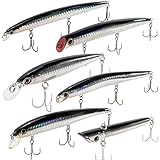
- Holographic silver painting mimic real sea bait fish and create flashing reflection under water, maxmize their attraction in dark sea water
- 2 of them comes with Mustad treble hooks to offer secured hold for huge saltwater species
- Different styles of saltwater baits including poppers and jerkbaits allows you to target different saltwater species in different condition. Covers almost all water column
- Streamlined lure body creates a wobbling swimming action to mimic wounded bait fish. Works like a charm for hungry, fierce sea predators
- Built-in weight chamber increases casting distance. Works for different techniques like surf fishing or offshore boat fishing. Targets species like striper, tarpon, barracuda, snapper and more
| Reported result | Source and date | How to interpret it |
|---|---|---|
| 95.5% fish by volume | NOAA Atlantic Oceanographic and Meteorological Laboratory report (1967) | A result from a historical West Indian reef-fish study; it is not a universal percentage for every barracuda. |
| 66.7% northern anchovy | Ocean Protection Council Pacific barracuda report (2019), citing the underlying diet study | This identifies the proportion of one prey item in one Pacific barracuda diet study, not the proportion of all fish in all barracuda diets. |
| Teleost prey: 87.80% frequency of occurrence, 57.63% by number, 91.82% by volume, and 93.76% index of relative importance | Egyptian Journal of Aquatic Research study (2022) | These are separate measures from an obtuse barracuda study in the southeastern Arabian Sea and should not be read as one combined percentage. |
“By volume,” “by number,” “frequency of occurrence,” and “index of relative importance” measure different aspects of diet. A prey item can occur in many stomachs but contribute relatively little mass, or appear less often while contributing more volume. Keeping those measures separate prevents a study-specific result from being mistaken for a general rule.
Do young and adult barracudas eat different fish?
Yes. Barracuda diet can change as the fish grows because larger individuals have a wider gape, stronger jaws, and the ability to capture and swallow larger prey.
In sawtooth barracuda, crustaceans were the only reported food component in the smallest size class. Molluscs and teleost fish appeared in medium-sized fish, while teleosts dominated the diet of fish above 65 centimeters fork length, according to the peer-reviewed sawtooth barracuda feeding study.
Large great barracudas can also chop large fish into pieces before swallowing them. The Florida Museum of Natural History describes this ability in its great barracuda species profile. That feeding adaptation helps explain how an adult great barracuda can take prey such as larger groupers, snappers, or small tunas even though young barracudas need smaller prey.
How do barracudas catch fish?
Barracudas generally hunt by sight, track prey through the water, and then accelerate into a rapid, powerful bite. Their streamlined bodies support short bursts of speed, and great barracudas can feed at different levels of the water column.
The Tool Desk
Outbyte PC Repair FREERepair Windows errors before they cause bigger problemsFix Now →Outbyte Driver Updater FREEScan for outdated or missing drivers - takes under a minuteDriver Scan →Great barracudas may also herd schooling fish into shallow water, where the prey has fewer escape routes. This combination of visual tracking, stealth or cruising, sudden acceleration, and sharp teeth makes schooling fish especially suitable prey.
Independent reader supportYour contribution helps us test, update, and keep practical guides available for everyone.How do great barracuda and California barracuda diets differ?
Great barracudas are commonly associated with tropical and subtropical reef and coastal habitats, where their prey list includes reef fish as well as larger pelagic fish. California barracudas live in a Pacific coastal environment where small schooling fish such as anchovies, sardines, mackerel, and grunions are prominent documented prey.
Rank #3

- COLOR - Chartreuse, Pink, Orange, Green, Black
- TOTAL LENGTH - 13" : TUBE LENGTH - 10"
- TUBE SIZE - 1/4" : HOOK - 3/0 Mustad Treble Hook
- WIRE - 60 LB Surflon : SWIVEL - 150 LB
- WEIGHT - (2) 1/8 oz egg sinkers : Total weight .5 oz
| Feature | Great barracuda | California or Pacific barracuda |
|---|---|---|
| Scientific name | Sphyraena barracuda | Sphyraena argentea |
| Typical setting | Tropical and subtropical coastal and reef-associated waters | Pacific coastal and nearshore waters |
| Representative fish prey | Jacks, grunts, groupers, snappers, small tunas, mullets, killifishes, herrings, and anchovies | Anchovies, sardines, young Pacific mackerel, jack mackerel, and grunions |
| Other documented prey | Diet varies by location; some regional studies report squid, molluscs, or crustaceans | Squid is listed alongside small fish in the Monterey Bay Aquarium profile |
| Why the diets differ | Reef structure, local prey communities, and adult body size influence available food | Pacific coastal prey availability shapes the documented local diet |
The comparison is regional rather than absolute. A great barracuda may eat a schooling coastal fish, and a Pacific barracuda may take prey not listed in a short species profile. Habitat and prey availability matter as much as the common name.
What is the simplest accurate answer?
Barracudas are fish-eating predators. Their usual prey includes small schooling fish such as anchovies, sardines, herrings, and mackerel, along with coastal and reef fish such as jacks, grunts, groupers, snappers, mullets, and killifishes. Larger barracudas can add larger prey, including small tunas. Some species also eat squid, molluscs, or crustaceans, especially when those prey are available.
Frequently Asked Questions
Do barracudas eat other fish?
Barracudas mainly eat other fish. Common prey includes anchovies, sardines, herrings, mackerel, jacks, grunts, groupers, snappers, mullets, killifishes, and, for larger great barracudas, small tunas.
Do barracudas eat squid?
Yes, some barracuda species eat squid, but squid is generally secondary or opportunistic compared with fish. Studies have also recorded molluscs and crustaceans in some regional barracuda diets.
What do baby barracudas eat?
Young barracudas can eat smaller prey, and their diet may include crustaceans or other small organisms. As barracudas grow, they can capture larger teleost fish; in sawtooth barracuda, teleosts dominated the diet above 65 centimeters fork length.
The Bottom Line
Bottom line: Barracudas mainly eat fish, but the precise menu depends on the species, region, habitat, and life stage. Small schooling fish are common prey, large great barracudas can take reef fish and small tunas, and some regional studies document squid, molluscs, or crustaceans as secondary food.
Quick Recap
Product prices and availability are accurate as of the date/time indicated and are subject to change. Any price and availability information displayed on Amazon at the time of purchase will apply.




