
Some links on this page are affiliate links: if you buy through them we may earn a commission, at no extra cost to you.
A dog that pulls toward one branch of a familiar walk is usually drawing on learned navigation: remembered turns, landmarks, terrain, household routines and scent. Those cues can make a destination predictable without requiring human-like foreknowledge or a perfect internal map. Experiments show that dogs can extract direction from an intact odor trail, remember places in relation to landmarks, and use odors as part of place memory. Field studies also show that navigation is flexible and imperfect: dogs may shortcut or detour rather than replay every turn. The specific dog and video implied by the headline are not identified, so no one can verify what he was thinking. The most defensible explanation is a route preference built from repeated experience, with smell and visual-spatial cues contributing in different situations.
Why does my dog always choose the same walking route?
Repeated walks teach a dog that particular turns lead to rewarding or familiar places. A park, a favorite sniffing area, another dog’s yard, home, or the point where the owner usually turns around can become linked to a sequence of cues. Pulling toward that branch is therefore compatible with learned expectation, not proof that the dog has human-style plans.
As an Amazon Associate I earn from qualifying purchases.
The dog may combine several information sources at once:
- Landmarks and layout: buildings, fences, trees, curbs and the spatial relationship between them.
- Odor: scent trails, animal marks, people and environmental smells that persist along a route.
- Routine: the time of day, leash preparation, the owner’s pace and habitual destinations.
- Surface and terrain: changes in pavement, slopes, grass or crossings that distinguish one branch from another.
A familiar route can be recognized from a combination of these cues even when the dog is not following a single scent from start to finish.
Popular on Amazon

- REAL-TIME GPS TRACKING WITH UNLIMITED RANGE: Track your dog’s live location nationwide with updates every 2-3 seconds—up to 30x faster than competitors who only update once per minute. Perfect for keeping an eye on your dog no matter where they roam.
- VIRTUAL FENCES & LOCATION HISTORY: Set up safe zones and receive alerts when your dog leaves the area. Activate live tracking immediately to recover your dog, and review their location history to see where they've been.
- HEALTH & ACTIVITY MONITORING: Monitor your dog’s daily health, sleep patterns, and activity levels through the Tractive app, available on iOS and Android, so you can keep them in optimal shape.
- LIGHTWEIGHT, WATERPROOF DESIGN & LONG-LASTING BATTERY: This lightweight tracker is waterproof and rugged enough for outdoor adventures. The battery lasts up to 10 days, with extended life using Power Saving Zones.
- RISK-FREE TRIAL: This bundle includes 6 months of free premium service to cover all the costs of the integrated SIM card and data. No additional activation fee is required to start tracking your pet!
How does a dog know which direction to take?
Controlled studies indicate that dogs can use directional information, but performance depends on the cue and the task. No single experiment shows that every household dog carries a complete, human-like map.
What can scent tell a dog?
In a 2005 experiment, Peter G. Hepper and Deborah L. Wells laid a human odor trail for six dogs. The dogs chose the correct direction when five sequential footsteps were available. They failed when only three footsteps were available or when the order of the footsteps was randomized. That pattern supports the use of an ordered odor trail while showing that scent information loses value when too little or too much disturbed evidence is available.
The Tool Desk
Outbyte Driver Updater FREEFix the driver behind crashes, sound loss and screen glitchesFind Drivers →Outbyte PC Repair FREERepair Windows errors before they cause bigger problemsFix Now →A 2020 study, Odour-Evoked Memory in Dogs, trained dogs to remember five reward locations while vanilla odor was dispersed in the environment. The result shows that odor can participate in remembering a place; it does not show that a neighborhood dog is following vanilla-like markers or solving every route by smell.
What do landmarks contribute?
Sylvain Fiset’s landmark-memory experiment moved an array of landmarks and measured where dogs searched. The dogs shifted their search, but not by mechanically copying the landmark movement. They also used broader cues from the room. This supports a flexible system that combines local objects with the overall environmental layout.
Can magnetic cues explain an ordinary walk?
Magnetic orientation is a plausible capability in some contexts, but it should not be the default explanation for a pet choosing a familiar sidewalk. In an eLife field study, Benediktová and colleagues fitted 27 hunting dogs with GPS collars and action cameras and analyzed more than 600 homing trials. During scouting returns, dogs often began with an approximately 20-metre run along the north–south geomagnetic axis. The authors reported that performing this “compass run” significantly increased homing efficiency. Those dogs were hunting animals in a specialized free-roaming task, so the finding cannot establish that a household dog uses a magnetic compass on every neighborhood route.
Does a dog remember the way home?
Often, a dog can return toward a familiar destination, but remembering a route is not the same as replaying it turn by turn. A 2019 PLOS ONE study of 23 skilled guide dogs tested navigation after one unfamiliar journey. Only 30.43% reproduced the original path and 43.47% completed the homing task. When the task allowed a shortcut, 80% succeeded; when it allowed a detour, 86.95% succeeded.
Also popular on Amazon
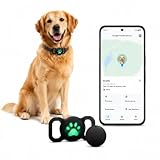
- 【📱 Works with Google Find Hub – Android Only】This dog tracker connects exclusively to Google Find Hub. Unlike tractive gps dog tracker, no monthly fee. Your pet tracker for dogs updates location when near any active Android device (phone/tablet/Wear OS). Not for iOS.
- 【🔋 1-Year Replaceable Battery – No Charging】Forget weekly charging like other dog gps tracker collar devices. This gps tracker for dogs runs 12 months on one CR2032 battery. Simple replacement – perfect for tracking collar for dogs.
- 【💧 IP67 Waterproof & Durable】Rain, mud, puddles, lake splashes – no problem. This gps dog collar is fully sealed. Your dog collar tracker stays protected during outdoor adventures. Rinseable after dirty exploration.
- 【🌐 How Location Works – Google Find Hub Network】This dog gps does NOT have standalone satellite GPS. Your pet tracking device appears in Google Find Hub when your dog passes near any Android phone or tablet. Best for areas with good pet gps tracker network density (suburbs/cities).
- 【🐾 Lightweight Breakaway Safety Collar】This dog collar with tracker includes a breakaway buckle for safety. The dog tracking collar weighs under 1.5 oz – comfortable for daily wear. A reliable pet gps for indoor/outdoor dogs. Gps para perros designed for comfort.
These results suggest that dogs can use a flexible sense of where they are and where a destination lies. A shortcut or detour may be easier than exact route reconstruction. They also show why one impressive return cannot establish a universal canine navigation ability: the sample involved skilled guide dogs, the journey was unfamiliar, and success varied by task.
Is the dog following smell alone?
No. Odor is powerful, but dogs also use sight, spatial relationships, routine and the consequences of previous walks. In a PLOS ONE experiment with 30 adult pet dogs, owners were selected in 96.7% of visible three-person trials at 3 metres. In odor-restricted tests, performance changed with distance, and dogs sometimes used a “win-stay” strategy—returning to the location that had worked on the previous trial. The findings argue against a simple rule that dogs solve route questions by smell alone.
A dog that pauses to sniff at a junction may be gathering information, but the pause does not reveal whether the decision is based on one odor, a landmark, or a learned expectation that several cues jointly support.
What is the difference between route memory, homing and a mental map?
These terms describe different demands, so they should not be treated as synonyms.
| Question | What it requires | What the evidence shows |
|---|---|---|
| Exact route replay | Repeating the same sequence of turns | 30.43% of 23 skilled guide dogs reproduced one unfamiliar path in the 2019 study |
| Homing | Returning toward a destination, possibly by another route | 43.47% completed the guide-dog homing task; shortcut success was 80% and detour success 86.95% |
| Directional odor use | Choosing a direction from an ordered scent trail | Six dogs selected correctly with five sequential footsteps, but not with three or randomized order |
| Landmark-based search | Using objects and their spatial arrangement | Dogs shifted search when landmarks moved and also used global room cues |
| Geomagnetic orientation | Using a directional environmental cue during free roaming | 27 hunting dogs, more than 600 trials; an approximately 20-metre north–south “compass run” was associated with more efficient homing |
A “mental map” is a useful shorthand for flexible spatial knowledge, but the experiments do not reveal a dog’s private representation or prove that every pet forms one in the same way.
How can I observe my dog’s route choice safely?
You can document the behavior without giving the dog uncontrolled access to traffic or wildlife. Treat this as observation, not a validated training method.
Also popular on Amazon

- REAL-TIME GPS TRACKING WITH UNLIMITED RANGE: Track your dog with live location updates every 2–3 seconds. Unlike others that update once a minute, Tractive lets you follow every step with no distance limits, anywhere in the world.
- VITAL SIGNS MONITORING: The Tractive smart tracker monitors changes in your dog’s heart and respiratory rates, helping detect potential issues before they become visible.
- HEALTH & BARKING ALERTS: The tracker learns your dog’s normal behavior and detects changes. If it notices unusual sleep, activity, or barking patterns, you’ll receive an alert so you can take action early.
- ESCAPE ALERTS & LOCATION HISTORY: Create custom virtual fences around your yard, dog park, or neighborhood. Get instant alerts if your dog leaves and review location history to retrace their steps.
- LONG-LASTING BATTERY, LIGHTWEIGHT & WATERPROOF: Tough yet light enough for any dog over 8 pounds. Fully waterproof, with up to 14 days’ battery life. Now featuring a brighter LED and louder sound for easier tracking.
- Choose a familiar, low-risk area and keep the dog physically under control.
- At a safe junction, allow a limited choice between routes rather than letting the dog cross roads or pull into hazards.
- Record whether the dog has walked each branch before, where the dog pauses to sniff, and which landmarks or routine cues are present.
- Repeat on different days and at different times. A one-off turn is weaker evidence than a pattern across comparable walks.
- Use a GPS collar to document the track if desired. A harness or long line can make controlled handling easier; none of these devices improves navigation ability.
Interpret the record cautiously. A dog may choose a route because it leads to a preferred smell or destination, because the owner’s body position cues a turn, or because the branch is simply more familiar. The log can show consistency, not the dog’s exact thought process.
Independent reader supportYour contribution helps us test, update, and keep practical guides available for everyone.What should I make of a viral video claiming a dog “knows exactly” where to go?
Watch for missing context. The clip may not show whether the route is familiar, whether the dog followed an owner’s subtle cue, or whether the destination was associated with repeated rewards. Without the dog’s history, location and prior exposure, the video supports an anecdote rather than a diagnosis of canine cognition.
What’s actually slowing this PC down?
Pick the symptom - the matching free tool is one click away.
The strongest general conclusion is narrower: dogs can learn routes and destinations from repeated experience, integrate odors with landmarks and routines, and sometimes navigate flexibly. The evidence does not identify the dog in the clip, establish deliberate human-like planning, or show that magnetoreception explains ordinary pet walks.
Frequently Asked Questions
Can puppies learn a walking route after only a few trips?
They can begin associating turns with destinations quickly, but the strength and reliability of that memory will vary with age, attention, motivation and how consistent the route is. Early choices should be interpreted as developing familiarity rather than proof of a stable map.
Why does my dog stop and sniff at the same corner every day?
That corner may contain recurring animal or human odors, and sniffing can also be part of a learned routine. A repeated stop does not show that one scent alone determines the next turn; visual landmarks and expected destinations may be contributing.
Could my dog find home in an unfamiliar neighborhood?
The available studies do not justify assuming that every pet can do so. Homing performance varied by task, and the strongest magnetic-orientation result came from specialized hunting dogs in free-roaming trials rather than ordinary household walks.
Windows Errors? Fix Them Before They Spread
Repair common Windows errors and clear accumulated junk for a smoother, more stable PC - no reinstall needed.Free scan · no reinstallOutdated Drivers Are Slowing You Down
One free scan finds every outdated or missing driver and matches the right update for your exact hardware.Free scan · exact hardware matchDoes letting a dog choose the route improve intelligence or navigation?
There is no evidence here that granting route choice increases navigation ability. It can provide a safe opportunity to observe preferences, but handling, traffic awareness and other safety controls remain the owner’s responsibility.





Leave a Reply