
Some links on this page are affiliate links: if you buy through them we may earn a commission, at no extra cost to you.
A parrot can ignore a foraging toy because the activity is unfamiliar, the puzzle is too hard or too easy, or the toy’s material and food presentation do not suit that individual bird. Foraging is an instinct, but the searching and problem-solving skills still have to be learned. Start with familiar food that is easy to see and reach, then add one simple action at a time. Keep ordinary food available, supervise every new object, and change the format if the bird shows no interest. A sudden loss of interest accompanied by appetite, activity, feather, or other behavior changes warrants advice from an avian veterinarian.
Why is my parrot ignoring a foraging toy?
Ignoring one toy does not identify a single cause or prove that a parrot is bored or ill. Treat the bird’s response as information about the task: it may not yet understand the activity, may be unable to solve it, or may prefer a different way of finding and handling food.
As an Amazon Associate I earn from qualifying purchases.
The bird has not learned the behavior
Foraging is not the name of a particular product. The Cummings School of Veterinary Medicine at Tufts University explains that the drive to search for food is instinctive, while the skills needed to search and solve a puzzle are learned. A bird that has always eaten from an open bowl may not recognize that a paper cup or feeder is supposed to be opened.
The challenge does not fit the bird
A task can fail at either extreme. If a bird cannot see how to reach the food, it may give up; if it can remove the food instantly, the activity may hold little interest. Tufts specifically cautions that a large puzzle can overwhelm a budgie or cockatiel, while a paper ball may be too easy for many macaws. Difficulty should follow the individual bird’s demonstrated ability, not a label such as “advanced.”
Popular on Amazon

- Made of acrylic material, this bird forage box is hard to break, ensuring high stability and durability.
- With its transparent design, this forage box allows your bird to see andfor the treats inside, making it an engaging toy for them.It also encourages foraging instincts, keeping them entertained for hours.
- The compact size of this forage box makes it easy to carry and use. It can be easily removed from the cage for cleaning and refilling.
- This forage box can be used as a feeder for your bird, providing both mental and physical stimulation. Its bird- material ensures the safety of your pet while they chew and play.
- Whether you have a small or large , this forage box is a wonderful toy that they will surely love.It provides both entertainment and a source of mental stimulation for your lovely pet.
The material or presentation is a poor match
Parrots vary in the objects they like to chew, pull, lift, shred, or move. The World Parrot Trust describes variation in foraging preferences and recommends changing the approach when an enrichment item attracts no interest. A bird that ignores a hanging puzzle might investigate food in a floor-level box, or prefer several small food stations to one complicated device.
The toy does not create a usable foraging sequence
Foraging enrichment should encourage a bird to search for food, obtain it, and extract or process it. The Association of Avian Veterinarians (AAV) describes those functions as the point of enrichment. A container that technically holds food but leaves it invisible, unreachable, or impossible to manipulate may not give the bird a meaningful task.
Quick wins for a faster PC:
Repair Windows errors before they cause bigger problemsFix Now →Scan for outdated or missing drivers - takes under a minuteDriver Scan →A health or environmental problem may be affecting interest
Do not assume a new toy will resolve feather-picking, withdrawal, appetite changes, or other abnormal behavior. The UC Davis School of Veterinary Medicine notes that feather-picking can have behavioral, environmental, and health contributors and recommends veterinary guidance about feeding and care changes. A single rejected toy is usually a training or preference question; a broader change in behavior deserves a health assessment.
How do I introduce foraging without overwhelming my parrot?
Begin with the bird’s normal food and make the first success almost effortless. The goal is to teach a sequence—notice food, interact with an object, obtain the food—before asking for complicated manipulation.
- Keep the food familiar. Use a portion of the bird’s usual diet rather than introducing a new food and a new task simultaneously. A difficult puzzle must never be the bird’s only route to adequate food.
- Offer several obvious choices. Put a few small bowls in different locations or at different heights in the cage or room. The Tufts guide calls this a starting point, and the AAV handout also suggests moving a bowl or adding another one. The bird can learn that food may appear in more than one place without having to defeat a puzzle.
- Make only a small part of the food less visible. Cover a small portion with a loose piece of paper while leaving the rest plainly visible. The AAV’s Foraging for Parrots handout gives this kind of partial covering as an early step.
- Add one simple action. Place a small amount of familiar food in folded or crumpled paper, an open paper cup, or a cardboard tube. Keep the barrier easy to move, tear, or open, and position it so the bird can see or smell the food.
- Pause and watch. If the bird approaches, touches, pulls, or tears the material, allow it time to work. Avoid repeatedly intervening while it is making progress. If it walks away or cannot reach the food, simplify the setup, change its location, or use another format.
- Confirm the payoff. The bird should eventually get to eat. If the food remains trapped, open the item or offer the food separately rather than allowing frustration or hunger to build.
- Increase one feature at a time. After the easy version succeeds, add a little more wrapping, another layer, a small amount of movement, or a different location. Return to the last successful version if the bird stops engaging.
Tufts’ practical advice is simple: “Start small.” The same article recommends adding challenges according to “your own bird’s demonstrated ability and natural habitat,” rather than forcing a preset progression.
What should a first foraging setup look like?
A progression makes it easier to see whether the bird is learning or whether a particular step is too difficult. Move forward only when the current version produces repeated, calm success.
What’s actually slowing this PC down?
Pick the symptom - the matching free tool is one click away.
| Stage | Example setup | What success looks like | If the bird does not engage |
|---|---|---|---|
| 1. Search | Several small bowls placed in familiar and new locations or at varied heights | The bird investigates more than one station and eats normally | Keep locations easy to reach; make food more visible |
| 2. Notice a barrier | A loose paper sheet covering only a small portion of food | The bird moves, pecks, or lifts the paper to reach food | Expose more food or use a lighter, looser covering |
| 3. Manipulate | Food in folded or crumpled paper, an open paper cup, or a cardboard tube | The bird tears, pulls, rolls, or opens the item | Use a larger opening, less wrapping, or a shorter tube |
| 4. Process | A small box or cup that requires an additional simple movement | The bird repeats the action and obtains the food without help | Return to the previous stage and change only one feature |
| 5. Vary | Different safe objects, locations, or food stations | The bird explores new presentations rather than waiting for one toy | Offer the familiar successful format before introducing another |
This sequence is a teaching framework, not a timetable. A small parrot may need many repetitions at the first stage, while a confident chewer may progress quickly. The bird’s actions—not the appearance or price of the toy—determine when to move on.
Also popular on Amazon

- FOR MEDIUM to LARGE BIRDS – The PVC Forager bird toy by Super Bird Creations is the perfect size for Ringnecks, Medium Conures, Quakers, Caiques, Pionus, Senegals, Amazons, African Greys, Eclectus, Small Cockatoos, Mini Macaws and similarly sized pet birds.
- DESIGN FEATURES – This PVC Forager bird toy is crafted with drinking water grade PVC, colorful plastic beads and bird-safe hardware. Designed to allow easy introduction of your bird's favorite treats. Dishwasher safe.
- ENRICHMENT BENEFITS - the PVC Forager bird toy is designed to not only entertain but also to help satisfy a parrot's instinctual drive to forage. Foraging devices require birds to search for their food. Placing foraging toys at various levels in the cage will promote movement.
- RELIEVES BOREDOM – Properly designed bird toys are more than “just toys”. Super Bird Creations parrot toys are “Playthings with a Purpose” that help to ward off boredom, depression, aggression and destructive behaviors in parrots by stimulating physical activity, curiosity and mental engagement.
- BIRD SAFE COMPONENTS & DESIGN – Recommended by avian professionals worldwide, our products are expertly designed to maximize the safety and enrichment benefits to pet parrots. Proudly assembled in the USA since 1992.
Which homemade foraging activities can I try?
Commercial equipment is optional. The AAV and veterinary enrichment guidance describe ordinary paper and cardboard as useful ways to present food when the materials are appropriate for the individual bird and supervised.
Paper wraps and loose folds
Wrap a small amount of normal food in a single sheet or fold the paper around it loosely. Leave an edge the bird can grab and make the contents partly visible at first. As the bird learns to open it, a more complete wrap can provide a slightly harder version.
Paper cups
An open cup lets the bird see the food while requiring a reach, lift, or tip. A closed paper cup can be introduced later if the bird already manipulates cups safely. The Clinician’s Brief review of environmental enrichment for pet psittacines gives examples such as hiding a treat in a paper box or closed paper cup and wrapping food in paper.
Cardboard tubes and small boxes
A short tube or small box can hold food that is visible through a wide opening. Start with no closure or a very loose paper cover. Increase the amount of tearing or movement only after the bird can reliably extract the food.
Multiple food stations
Several small bowls distributed around the cage or room create searching without requiring a manufactured puzzle. This is particularly useful for a bird that is cautious around unfamiliar objects or has not yet learned to manipulate barriers.
Remove any homemade item when it becomes wet, heavily soiled, damaged, or small enough to swallow. Paper and cardboard are not automatically safe in every form; inks, adhesives, coatings, strings, clips, and loose fragments require individual judgment and supervision.
Do I need to buy a commercial parrot foraging toy?
No. A commercial puzzle feeder is one possible format, not a requirement for providing foraging opportunities. Choose it for a good fit, not because a product claims to be advanced.
Windows Errors? Fix Them Before They Spread
Repair common Windows errors and clear accumulated junk for a smoother, more stable PC - no reinstall needed.Free scan · no reinstallCrashes, No Sound, or Screen Glitches?
Random freezes, missing sound and display glitches usually trace back to one bad driver. Find and replace yours safely.Free scan · under a minuteAlso popular on Amazon

- FOR MEDIUM to LARGE BIRDS – The Bottom's Up bird toy by Super Bird Creations is the perfect size for Ringnecks, Medium Conures, Quakers, Caiques, Pionus, Senegals, Amazons, African Greys, Eclectus, Small Cockatoos, Mini Macaws and similarly sized pet birds.
- DESIGN FEATURES – The Bottom's Up bird toy is crafted with dishwasher safe acrylic cups, colorful plastic components and bird-safe hardware. The crystal clear acrylic cups will show off your birds treats and entice them to forage.
- ENRICHMENT BENEFITS - the Bottom's Up bird toy is designed to not only entertain but also to help satisfy a parrot's instinctual drive to forage. Foraging devices require birds to search for their food. Placing foraging toys at various levels in the cage will promote movement.
- RELIEVES BOREDOM – Properly designed bird toys are more than “just toys”. Super Bird Creations parrot toys are “Playthings with a Purpose” that help to ward off boredom, depression, aggression and destructive behaviors in parrots by stimulating physical activity, curiosity and mental engagement.
- BIRD SAFE COMPONENTS & DESIGN – Recommended by avian professionals worldwide, our products are expertly designed to maximize the safety and enrichment benefits to pet parrots. Proudly assembled in the USA since 1992.
| Consideration | Simple DIY activity | Commercial puzzle or food-dispensing toy |
|---|---|---|
| Difficulty | Easy to adjust by changing the opening, wrapping, or amount of food | May arrive with a fixed mechanism; verify that the bird can solve it |
| Food visibility | Can be made partly or fully visible at the beginning | Some designs hide food completely; select one that allows a clear first step |
| Fit and manipulation | Can be sized to the bird’s beak and preferred actions | Check dimensions, moving parts, and whether the bird can safely grip them |
| Safety and supervision | Inspect every material and discard it when damaged | Confirm non-toxic construction, inspect seams and hardware, and supervise use |
| Adaptability | Easy to change or replace when interest fades | Useful variety, but a rejected design should not be made progressively harder |
For shoppers, “parrot foraging toy” is a reasonable category search term. It does not identify a particular safe listing, construction, seller, or price, so evaluate each item against the bird’s size, ability, and supervision needs. The AAV and Clinician’s Brief sources both support homemade activities as well as suitable commercial options.
How should difficulty differ between species and individual birds?
Species can suggest a starting point, but the bird’s actual behavior is the deciding evidence. A large macaw and a budgie do not have the same beak strength, body size, reach, or tolerance for a large puzzle. Even two birds of the same species may prefer different materials and actions.
- For a budgie or cockatiel: use small, light objects with wide openings and food that remains easy to see. Avoid assuming that a puzzle designed for a larger parrot is merely “challenging”; its parts may be physically unsuitable.
- For a larger parrot such as a macaw: a loose paper ball may provide little work. A larger, sturdy paper or cardboard activity can add appropriate tearing or manipulation, provided the bird cannot ingest or become trapped by parts.
- For a cautious or inexperienced bird: begin with bowls and partly covered food before introducing an object that moves or makes noise.
- For an experienced problem-solver: vary the location, presentation, or extraction step instead of simply making the food harder to reach.
Use demonstrated actions as your guide. A bird that can open one folded paper does not automatically have the skill for a tightly packed box, and a bird that solves a box does not have to like a hanging feeder.
How can I tell whether the puzzle is too hard or too easy?
Observe the complete sequence from approach to eating. The useful question is not whether the toy looks complicated, but whether the bird can understand and complete the task without becoming distressed.
The Tool Desk
Outbyte Driver Updater FREEFix the driver behind crashes, sound loss and screen glitchesFind Drivers →Outbyte PC Repair FREEClear out junk files and repair common Windows errorsFree Scan →Signs it may be too difficult
- The bird cannot see or smell where the food is.
- It touches the object briefly, then repeatedly abandons it.
- It manipulates the toy but never reaches the food.
- The opening, mechanism, or barrier is too large, heavy, tight, or awkward for the bird’s beak and feet.
Make the food more visible, enlarge the opening, remove one layer, or return to the last version the bird completed. Do not respond to failure by withholding the bird’s regular meal.
Signs it may be too easy
- The bird obtains the food immediately without searching or processing.
- It loses interest after one quick removal even though it is otherwise active.
- The same presentation is solved instantly every time.
Add only one small action—such as a second fold, a different location, or a little more tearing—while keeping the food accessible. A harder task is useful only when the bird chooses to continue interacting with it.
How do I make foraging safe?
Safety depends on the bird, the material, the construction, and the way the object is used. The AAV advises choosing bird-safe materials, avoiding items that could be toxic or trap the bird, and consulting an avian veterinarian when suitability is uncertain.
Also popular on Amazon

- Natural Materials: Kyouki bird toys made from eco-friendly, pet-safe pine cones, apple wood,apple wood chew block,coconut shells,sola fibers,loofahs,spiral seegrass,wicker balls and corn,no metals, paints,plastic or dyed items, ensuring hours of worry-free fun for your bird friends.
- Boosts Natural Foraging Skills: Whether the apple wood, coconut, seagrass, cornor,wicker ball or the pine cone—has a range of sizes, shapes, and texture,encourages your bird's natural instincts by providing a variety of textures and materials to explore, chew, and shred, perfect for mental stimulation and physical activity.
- Snack & Seek: Maybe you can tasty treats inside the box, and let the foraging games begin! Your bird will feel like a tiny detective, uncovering hidden treasures and munching on surprises. It’s like a birdie version of hide-and-seek, but with snacks as the ultimate prize!
- Versatile for Various Bird Species: Perfectly suited for parakeets, cockatiels, conures, lovebirds,macaws, parrotlets,quakers, and african greys and other small to medium-sized birds, providing endless variety and fun for all types of feathered companions.
- Happy Bird, Happy Life: It’s like giving your bird a new playground filled with textures, colors, and fun challenges. Kyouki bird toys is a guaranteed mood booster. Whether they’re shredding paper, nibbling on wood, or tossing around sola balls, your bird will be chirping with joy. A happy bird means a happy home—let the fun begin!
- Inspect every item before use for sharp edges, loose threads, staples, clips, unstable hardware, flaking coatings, and detachable pieces.
- Choose a size that cannot be swallowed and a construction that cannot close around a toe, beak, head, or wing.
- Supervise new activities closely enough to see whether the bird chews, shreds, ingests, or becomes caught in a part.
- Discard objects when they are damaged, contaminated, or reduced to pieces that could be ingested.
- Keep a normal, nutritionally adequate food supply available while teaching a new activity.
- Ask an avian veterinarian about unfamiliar woods, dyes, glues, metals, plastics, or materials marketed for other animals.
The Clinician’s Brief article likewise recommends assessing enrichment objects for safety before offering them. A toy’s marketing description cannot replace inspection of the individual item or observation of the individual bird.
Recommended Free Tools
Can foraging stop feather-picking or other abnormal behavior?
Foraging can add appropriate activity and choice, but it is not a stand-alone treatment for feather-picking. UC Davis lists multiple possible behavioral, environmental, and health contributors and advises owners to consult a veterinarian about feeding and care changes.
If a bird ignores a toy while otherwise eating, moving, and behaving normally, adjust the teaching plan. If disinterest appears with feather damage, appetite or activity changes, unusual sleep, weight concerns, or other behavior changes, arrange an avian veterinary evaluation instead of escalating the puzzle.
What should I do if my parrot still ignores every toy?
Stop treating the rejected object as a test and troubleshoot the presentation in a controlled order. Keep one familiar successful food routine in place while you change only one variable.
- Return to open food. Offer several small bowls in accessible places and confirm that the bird is eating normally.
- Change the location. Move the activity to a familiar perch, cage area, or room location where the bird already explores.
- Change the action. Replace a hanging item with a flat paper fold, cup, tube, or box, or reverse that change.
- Make the food obvious. Use a larger opening or leave part of the food uncovered so the bird can connect the object with the reward.
- Reduce the amount of novelty. Keep the material familiar and introduce only one unfamiliar feature at a time.
- Watch for a preference. Note whether the bird likes pulling, shredding, lifting, rolling, reaching, or searching; select the next activity around that action.
- Stop if health or behavior changes are present. Veterinary advice takes priority over further enrichment experiments.
Changing the approach is more productive than repeatedly increasing the difficulty of one rejected toy. The World Parrot Trust’s guidance supports varying enrichment when a bird shows no interest in the current format.
How can I keep foraging interesting over time?
Once a bird succeeds, preserve the skill by varying presentation rather than turning every activity into a harder puzzle. Rotate among safe paper, cardboard, bowls, locations, and simple commercial feeders that the bird can already operate. Keep some easy activities in the mix so foraging remains rewarding and does not become a sequence of failures.
Use the bird’s own choices to decide what to offer next. A parrot that consistently seeks food on the floor may prefer low stations; one that enjoys tearing may prefer paper wraps; another may investigate several open cups more readily than a mechanical feeder. The objective is a usable search-and-obtain sequence that fits this bird, not completion of a particular product.
Also popular on Amazon
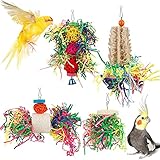
- 【Safe To Play】: These Parrot Cage Shredder toys are made of natural loofah, rattan balls,wood, stuffe with brightly colored crinkly papers which is very safe for your bird friends to chew. Hand-woven bird toys you can hide their treats in it which is an excellent selection for your pet friends who have a urge to chew and forage.
- 【Keep Active】:A busy Mr. or Mrs. bird is a happy Mr. or Mrs. bird.Those bird shredder toys are stuffed with brightly colored crinkly paper, which will catch bird's eyes immediately.And then they will pull them out just for great fun.It's a great chose to give your bird entertainment and physical exercise.
- 【The Bird Rope Perch】:The bird rope perch is made of the flexible, soft, durable, multi-colored cotton which is easy to connect to your bird cage.You can create different shape of perches for your lovely birds.
- 【Excellent for foraging】:Chewing and shredding is a bird natural behavior, which can improve your bird’s physical and emotional active.With the pretty colorful things to chew on,your birds will fall into a good way immediately, excellent for foraging.
- 【Easy to install】: All bird cage accessories toys come with a hook which can attach to the bird cage simply can provide hours of fun every day.Save space and a good decoration of your bird cage.Nice for small to medium birds,such as small parakeets, cockatiel, conures, macaws, parrots, love birds, Mynah, finches ,pineapple and so on.
When should an avian veterinarian be involved?
Contact an avian veterinarian when you are unsure whether a material or feeder is safe, or when disinterest is part of a wider change. Prompt professional advice is especially important with feather-picking, altered appetite, reduced activity, weight concerns, injury, breathing changes, or persistent withdrawal. A veterinarian can assess medical and environmental contributors that a foraging toy cannot diagnose.
For ordinary toy refusal without other warning signs, begin with the easy-food progression, maintain access to regular food, and observe whether a different safe format produces voluntary interest.
Frequently Asked Questions
How long does it take a parrot to learn foraging?
There is no reliable timetable that applies to every parrot. Progress depends on prior experience, confidence, physical ability, and how closely the task matches the bird’s preferences; repeated easy successes are more useful than a deadline.
What if my parrot chews the paper instead of finding the food?
Chewing and tearing can be part of the manipulation sequence, provided the material is bird-safe and the bird is not swallowing harmful pieces. Supervise the activity, remove damaged fragments, and make the food visible so chewing remains connected to an obtainable reward.
Should I rotate foraging toys on a fixed schedule?
No universal rotation interval is established. Change the presentation when interest fades, while keeping at least one familiar, successful activity available and inspecting every item before it is offered again.
Can a foraging toy replace social interaction or out-of-cage time?
No. Foraging is one form of enrichment and does not replace appropriate social contact, exercise, rest, or veterinary care. Treat it as an optional activity that complements the bird’s broader daily environment.
Free tools Windows power users keep installed
One-click scans. No signup required.





Leave a Reply