What’s actually slowing this PC down?
Pick the symptom - the matching free tool is one click away.
A cat’s brain supports basic life functions, movement, decision-making, learning, memory, and responses to people and the environment. Researchers have investigated many of these abilities, but feline cognition is still an incomplete field: confident claims about exactly how smart cats are—or what they understand—often go beyond the evidence.
1. A cat’s brain has three major divisions
The Merck Veterinary Manual describes the brain in three main sections, each with a distinct role:
As an Amazon Associate I earn from qualifying purchases.
- Brainstem: controls basic life functions.
- Cerebrum: serves as the center of conscious decision-making.
- Cerebellum: contributes to movement and motor control.
These are broad functional descriptions, not a claim that cat and human brains work identically.
Recommended Free Tools
2. Brain cells communicate through circuits and chemical messengers
Neurons connect in circuits and transmit electrical signals. At connections between cells, neurotransmitters carry signals onward; they can also pass messages to muscles and glands. That communication helps the nervous system coordinate activity throughout the body.
#1 Best Overall

- 28 piece calico cat anatomy model. Finished model measures 11.57" long.
- Transparent case to show interior anatomical organs. Highly accurate skeletal, muscular, and digestive organs.
- Fine detailed sculpture with hand-painted pieces. Includes assembly instructions.
- Great gift or desk accessory for any biology or animal fan.
- Since founded in 1997, Fame Master has been specializing in designing, manufacturing and exporting plastic educational toys, puzzle educational toys and figurine toys of high quality and innovation on a worldwide basis.
3. Cat cognition research spans more than “intelligence” tests
A 2015 review by Kristyn R. Vitale Shreve and Monique A. R. Udell surveys research on cat perception, object permanence, memory, physical causality, quantity and time discrimination, sensitivity to human cues, vocal recognition, communication, attachment, personality, and cognitive health. The authors also emphasize that research on domestic-cat cognition is relatively limited and remains incomplete. Findings about one ability do not establish a single, all-purpose measure of feline intelligence.
Read the 2015 review of cat cognition research.
4. Scientists have investigated whether cats understand that hidden objects still exist
Object permanence—the idea that something continues to exist when it is out of sight—is one of the topics covered in cat cognition research. Its inclusion in the research literature shows that scientists have studied the question; it should not be treated as proof that cats reason about hidden objects in the same way people do.
Rank #2
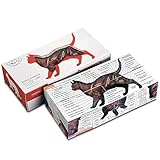
- Innovative 3D Learning Tool – Explore feline anatomy in a whole new way with a foldable cube featuring 10 detailed cat systems, including muscles, skeleton, organs, and more!
- Compact & Portable Design (8 x 8 x 8 cm) – Fits perfectly in your hand or on a desk; ideal for studying on the go or displaying as a unique educational model.
- Hands-On Discovery that Boosts Memory – The tactile folding design encourages hands-on interaction, helping learners absorb complex anatomical structures through movement, touch, and repeated physical exploration.
- High-Quality Print – Crafted from sturdy materials with crisp illustrations that hold up to repeated folding and handling.
- Perfect for Students, Teachers & Animal Enthusiasts – A fascinating gift for vet students, biology teachers, or cat lovers who appreciate learning through hands-on discovery.
5. Cat brains can respond to human cues and voices
The cognition review also covers cats’ sensitivity to human cues, vocal recognition, and communication. These are separate research questions: responding to a cue or recognizing a voice does not, by itself, reveal exactly what a cat understands about a person’s intention or words.
6. MRI research has found age-associated gray-matter changes
In a 2022 MRI study, Hamamoto and colleagues analyzed 65 cats without apparent neurological or behavioral signs. They reported age-associated decreases in gray matter in bilateral parietal regions. The authors noted that this observed atrophy may not produce neurological or behavioral signs. A structural difference on a scan, therefore, is not the same as a diagnosis of cognitive impairment.
Rank #3

- ❤Enhance Learning: The interactive nature of this model allows for a deeper understanding of feline anatomy, enabling students to retain information more effectively.
- ❤Practical Training: Veterinary professionals can use this model to practice surgical procedures and demonstrate anatomical concepts to clients.
- ❤Engaging Teaching Tool: Educators can make anatomy lessons more engaging and interactive by using this model to visually demonstrate the cat's internal structure.
- ❤Accurate Representation: The detailed design of each organ and body part ensures an accurate representation of feline anatomy, providing a reliable resource for studying and teaching.
- ❤Durable and Long-lasting: Made from high-quality materials, this model is built to withstand frequent use and handling, ensuring its longevity in educational settings.
7. Older-cat behavior changes can have several causes
Cornell’s Feline Health Center lists disorientation, altered sleep-wake cycles, less interest in play, unusual vocalizing, and house-soiling among possible signs associated with cognitive dysfunction. Similar changes can also be related to other conditions, including arthritis, kidney disease, hyperthyroidism, hypertension, dental disease, or neurological disorders. A new behavior change warrants veterinary assessment rather than an owner’s assumption that a cat has dementia.
Cornell quotes Alexander de Lahunta, DVM, former emeritus professor of anatomy at Cornell University College of Veterinary Medicine: “when examining a cat, if it is acting as if it’s in a world of its own, doesn’t respond to me, paces in a circle, or gets itself in a corner and just stays there, I’ll consider that to be a prosencephalon problem.” This is a clinician’s observation about possible neurological signs, not a diagnostic rule for owners.
Rank #4

- ✔ With 28 detachable parts, this model allows for a hands-on learning experience. Each organ and body part is intricately designed to accurately represent the cat's anatomy. The transparent body provides a clear view of the organs, enabling easy identification and examination.
- ✔ Accurate Representation- The detailed design of each organ and body part ensures an accurate representation of feline anatomy, providing a reliable resource for studying and teaching.
- ✔ Durable and Long-lasting- Made from high-quality materials, this model is built to withstand frequent use and handling, ensuring its longevity in educational settings.
- ✔ Practical Training- Veterinary professionals can use this model to practice surgical procedures and demonstrate anatomical concepts to clients.
- ✔ Standard Model- It is a rare teaching aid for animal husbandry teaching demonstration, and it is also a recommended display model for pet clinic values and it is a rare tool for students to carry out relevant practical training.
See Cornell’s guidance on feline cognitive dysfunction.
8. Night-time vocalizing is not specific to dementia
A 2021 clinical review reports owner observations from a selected group of 37 cats with cognitive dysfunction and increased vocalization: 67% vocalized more at night, and 64% vocalized more during the day. These percentages describe that group, not cats generally, and vocalizing alone cannot establish a diagnosis.
Best Value

- Jaw on spring
- Mounted on base
9. Enrichment is discussed as a possible management support
A 2021 review by Lorena Sordo and Danièlle A. Gunn-Moore discusses possible approaches to managing feline cognitive dysfunction, including environmental enrichment. The cited literature does not establish that a particular toy or puzzle feeder improves intelligence, prevents age-related decline, or treats cognitive dysfunction. If offering enrichment, choose an activity the individual cat can use and enjoys, and introduce it without creating frustration; no particular feeder is clinically validated by the cited sources.
Read the 2021 review of cognitive dysfunction and management.
10. Easy access to resources matters for older cats
The same clinical review discusses easy access to key resources as a possible management support. In practice, consider whether a cat can comfortably reach food, water, resting places, and the litter box, especially if mobility is limited. Cornell also discusses ramps and accessible resources for cats with mobility problems. These adjustments support access; they are not a proven way to prevent dementia or restore cognition.
Quick wins for a faster PC:
Fix the driver behind crashes, sound loss and screen glitchesFind Drivers →Clear out junk files and repair common Windows errorsFree Scan →Scan for outdated or missing drivers - takes under a minuteDriver Scan →Quick Recap
Product prices and availability are accurate as of the date/time indicated and are subject to change. Any price and availability information displayed on Amazon at the time of purchase will apply.




