
Free tools Windows power users keep installed
One-click scans. No signup required.
Some links on this page are affiliate links: if you buy through them we may earn a commission, at no extra cost to you.
The clearest signs that a dog may be going into labor soon are nesting, restlessness, panting, trembling, reduced appetite, a rectal-temperature drop, changes in vaginal discharge, and increasingly forceful contractions. These signs are clues rather than a diagnosis, and not every dog shows all of them.
Before your dog’s due window, ask your veterinarian for an individualized whelping plan, the number to call after hours, and the criteria for going straight to an emergency clinic. Difficult birth (dystocia) can endanger the mother and puppies, so do not wait for a general “normal” timeline if your veterinarian has given you different instructions.
As an Amazon Associate I earn from qualifying purchases.
Do these 3 things before closing this tab:
1Scan for outdated or missing drivers - takes under a minute2Repair Windows errors before they cause bigger problems3Fix the driver behind crashes, sound loss and screen glitchesFirst, know what “labor soon” means
Labor is usually described in stages. During first-stage labor, the cervix dilates and the uterus becomes more active. Behavioral changes are common, but you may not yet see obvious abdominal pushing. During second-stage labor, strong contractions and abdominal straining result in the delivery of puppies.
Published veterinary references give different average durations for first-stage labor—roughly 6–12 hours in some guidance and 12–24 hours in other clinical references. The difference reflects how labor is defined and monitored. Treat these figures as general context, not as a guaranteed timetable.
Popular on Amazon

- 【Whelping Kits For Puppy Kitten In All】 A set of Pet puppy whelping kits includes essential whelping supplies for a safe and comfortable birthing experience for your furry friend. 15 puppy whelping collars, 15 cord clamps, 6 record keeping charts, 4 Puppy feeding tubes, 5 pacifier, 1 kitten baby bottle with cups,1 pet pill syringe,1 plastic scissor,1 Digital pet scale, 1 digital thermometer,1 bulb aspirator,2 pairs blue disposable gloves,1 Box,1 storage bag(first aid bag)
- 【Nursing Feeding Bottles Kit】Including kitten bottle and puppy feeding tube,feeding syringe; this puppy kit makes it easy to feed your newborn pets; The smooth function ensures reducing upset during feeding times, setting your puppies up for growth; These pacifiers equipped puppy feeding tube syringes come in a range of capacities, making them ideal for meeting the diverse feeding requirements of young pets at different stages
- 【Powerful Record Keeping】 The puppy whelping supplies record ID form allows you to keep detailed records of when your new baby pet was born, feedings time, weight, vaccinations, new owner information and more. With colorful puppy collars to help you quickly identify each newborn puppy or kitten. Recording this information about your pet can help us better understand how they are growing and better adjust the amount of feeding
- 【Dogs & Cats Thermometer Pet Scale for Whelping supplies】 The pet digital thermometer adopts a soft silicone design, which is not harmful to pets. And gives the temperature in only 20 seconds. Multifunction scale weight know your puppy bron & grown to 5kg, the unit can change to g/lb; The PE Transparent weighing platform make your newborn puppy safety, and Easy to clean and waterproof
- 【Pet First Aid Kit】: The whelping kit for puppies birth, suitable for kittens, puppies, goats, rabbits, and more. Birthing Essentials Kit for Newborn Puppy is made from durable materials that are easy to clean and sanitize, be prepared for you litters birth with a kit for a safe and successful birth. Our dog breeding supplies are enough for feeding little puppies, which can meet your most using needs, you do not need to purchase them separately, time saving and labor saving
Pregnancy dating also has limits. A breeding date does not precisely identify the date of conception. A pregnancy that appears to extend beyond approximately 70–72 days from a known breeding date needs veterinary assessment rather than an assumption that the dates are correct.
10 signs your dog may be going into labor soon
1. Nesting, digging, or rearranging bedding
A dog close to whelping may scratch at bedding, dig, circle, paw at the floor, rearrange blankets, or repeatedly try to make a bed. Some dogs use the prepared whelping box; others try to choose a closet, corner, bedroom, or another secluded location.
Recommended Free Tools
Set up a clean, quiet, contained area before labor begins. If your dog chooses another location, do not create unnecessary stress by repeatedly forcing her back and forth. Instead, make the chosen location safe if possible, keep other animals away, and continue close supervision.
2. Restlessness or an inability to settle
First-stage labor can make a dog appear uncomfortable without the forceful contractions associated with puppy delivery. She may pace, circle, repeatedly lie down and get up, change positions, move between rooms, or seem unable to relax.
Restlessness is more meaningful when it appears with other signs—such as panting, nesting, appetite loss, or a temperature drop—than when it occurs by itself.
3. Seeking seclusion—or unusually seeking you
Some mothers-to-be hide or retreat to a quiet room. Others become unusually attached and want their owner to remain nearby. Both patterns can occur as labor approaches.
The Tool Desk
Outbyte PC Repair FREEClear out junk files and repair common Windows errorsFree Scan →Outbyte Driver Updater FREEFix the driver behind crashes, sound loss and screen glitchesFind Drivers →Allow the dog to remain in the safe place where she is least anxious while keeping her under observation. Avoid crowds, frequent handling, loud noises, and unnecessary movement. A calm support person is generally more helpful than a busy household gathered around the whelping area.
Also popular on Amazon
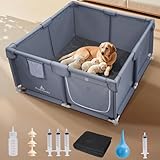
- 【Spacious and Secure Design】The Pawtenda Dog Whelping Box provides ample space with its 47 x 47 x 24 inch dimensions, making it perfect for expectant dog mothers and their newborn puppies. The 24 inch height effectively prevents dog moms from jumping out, ensuring a safe and secure environment.
- 【Premium Oxford Sides】Crafted with 150D Oxford fabric instead of fragile mesh, the side panels of this whelping box offer enhanced tear resistance, effectively withstanding scratching and chewing from puppies for your peace of mind.
- 【Sturdy and Stable Construction】The dog playpen is equipped with a sturdy base and anti-slip suction cups, providing enhanced stability. This ensures that the whelping box stays in place, preventing it from tipping over or moving easily, which is crucial for the safety of the mother and puppies.
- 【Multipurpose Usage】The versatile design of this dog playpen allows it to be used not only as a whelping box for dog but also as a playpen for small pets. It can help keep your home clean and safe by confining your pets to a specific area, and the large zone also enables owners to comfortably interact and play with their pets inside the pen.
- 【Additional accessories】Besides the dog whelping box itself, the product package also includes a whelping box liner mat and a puppy care kit comprising feeding bottle, feeding syringes, feeding tube, Bulb Aspirator, and imitation nursing nipples.
4. Panting
Panting is common during first-stage labor and may begin before visible pushing. It can reflect hormonal changes, uterine activity, discomfort, anxiety, or heat.
Panting alone does not prove that delivery is imminent. Consider it alongside the dog’s temperature readings, nesting behavior, appetite, discharge, general condition, and the expected labor timeline. Heavy panting accompanied by collapse, severe pain, weakness, breathing difficulty, or a very ill appearance is not something to monitor casually—call a veterinarian immediately.
5. Trembling, shivering, or shaking
Some dogs tremble or shake during first-stage labor. Mild, intermittent trembling may occur with excitement, discomfort, or hormonal changes.
What’s actually slowing this PC down?
Pick the symptom - the matching free tool is one click away.
Marked or persistent shaking is more concerning when it occurs with weakness, collapse, severe discomfort, pale gums, repeated vomiting, fever, or an inability to stand. Those combinations warrant urgent veterinary advice rather than assuming the shaking is a normal labor sign.
6. Reduced appetite, food refusal, or occasional vomiting
Many dogs eat less or refuse food during the final day or days before whelping, although this is not universal. Intermittent vomiting can also occur during first-stage labor.
Keep fresh water available and follow your veterinarian’s feeding instructions. Contact the veterinary team if vomiting is persistent, the dog cannot keep water down, she becomes markedly weak, or she appears ill. Do not force food into a dog that is actively nauseated or beginning delivery.
7. A drop in rectal temperature
A rectal temperature commonly falls below approximately 99°F (37.2°C) before labor. In many dogs, delivery follows within about 8–24 hours, but the reading is not an exact countdown and some dogs do not show a clear drop.
Windows Errors? Fix Them Before They Spread
Repair common Windows errors and clear accumulated junk for a smoother, more stable PC - no reinstall needed.Free scan · no reinstallOutdated Drivers Are Slowing You Down
One free scan finds every outdated or missing driver and matches the right update for your exact hardware.Free scan · exact hardware matchAlso popular on Amazon

- Extra Includes Puppy Whelping Supplies - Pig Rail *1, 50*50in washable puppy mat *1, puppy collars *12 and growth charts *3.
- Indispensable Pig Rail - Over 15% of newborn puppies suffer from suffocation accidents due to being crushed by the mother dog. Pig Rail can greatly reduce such problems.
- Sturdy & Easy Install - Roslaemic welping box is made of Pet-friendly plastic. The 19-inch-tall dog whelping pen has internal dimensions of 48 x 48 inches. Installation takes only five minutes and no tools are required.
- Step Design - Different heights of entrances and exits can be set up to make it easy for the mother dog to enter and exit and to prevent the puppy from climbing out.
- Easy to Clean - The dog birthing box can be cleaned by wiping. Maintaining a clean and hygienic rearing cage regularly has a great impact on the development of puppies.
Temperature tracking is most useful when started before the expected due window and performed consistently with the same thermometer and method. Record the time, temperature, and any accompanying signs. A single unexpected reading can result from measurement variation, so ask your veterinarian how to confirm an apparent drop.
A temperature drop followed by more than 24 hours without labor signs is a reason to contact the veterinarian. A temperature above 103°F (39.4°C), especially with weakness or other illness, requires prompt veterinary advice.
For preparation, a digital rectal thermometer for dogs can make consistent monitoring easier. It is a tracking tool—not a substitute for veterinary assessment or an exact prediction of when puppies will arrive.
8. A change in vaginal discharge
Discharge can change around labor, but its color, odor, amount, and timing matter:
- Clear fluid may occur as delivery begins.
- Green discharge after a puppy has been born can be normal because placental material may be expelled.
- Green discharge before the first puppy, particularly when no puppy follows promptly, may signal placental separation and fetal distress.
- Foul-smelling discharge, persistent fresh bleeding, or heavy bleeding is abnormal and requires urgent veterinary attention.
Do not treat every green discharge as an emergency regardless of timing—but do not dismiss green discharge before the first puppy. Note when it began and call the veterinary team for instructions.
9. Visible abdominal straining or increasingly forceful contractions
The transition into active delivery is characterized by forceful uterine contractions and visible abdominal straining. You may see the abdomen tighten repeatedly, with the dog bearing down as she attempts to deliver a puppy.
Strong contractions for approximately 20–30 minutes without producing a puppy are an emergency warning sign. A puppy or fluid-filled membrane visibly stuck in the birth canal is also an emergency. Do not pull forcefully on a puppy or insert instruments; call the veterinarian or emergency clinic while following their instructions.
Also popular on Amazon

- Our high-quality and durable kit includes everything you need to ensure a successful birthing experience. The included storage bag keeps all the supplies neatly organized and easily accessible, making it convenient for you to find what you need when the time comes.
- IDEAL SIZE FOR PUPPIES AND KITTENS: Our dog birthing pen is about 31 inches in diameter and 8 inches high, foldable and portable, easy to clean, and the size is suitable for small dog breeds such as 6-pound Maltese, your newborn pet will have plenty of space to grow and play;
- High Quality and Durable: Our kit is made with premium materials to ensure durability and long-lasting use
- FEEDING SUPPLIES: Contains essential feeding equipment designed specifically for newborn puppies and kittens
- VERSATILE USE: Suitable for both cat and dog births, providing essential tools for breeders and pet owners during the whelping process
10. A changing pattern as puppies arrive
Once the first puppy is born, write down the time of every delivery. Continue watching the mother’s contractions, condition, discharge, and the interval between puppies. If more puppies are expected, an apparently quiet interval may still require action.
Veterinary thresholds vary according to the mother, litter, contractions, imaging findings, and whether obstruction or fetal distress is suspected. Examples of concerning patterns include:
- More than 30 minutes between puppies when the mother has clear, active contractions.
- More than two hours between puppies when contractions have stopped but additional puppies are expected.
- More than two to four hours between puppies without active contractions, depending on the clinical circumstances and your veterinarian’s instructions.
Use the individualized limits provided by your veterinarian rather than waiting for the longest published interval. Call promptly if the pattern changes or the mother becomes exhausted or unwell.
When to call a veterinarian or emergency clinic immediately
Call your veterinarian or an emergency veterinary clinic immediately if any of the following occurs:
- Green discharge appears before the first puppy, especially if a puppy does not follow within roughly 15–30 minutes.
- Strong contractions continue for 20–30 minutes without a puppy.
- A puppy or fluid-filled sac is visibly stuck in the birth canal.
- There is persistent fresh blood, heavy bleeding, or foul-smelling discharge.
- The dog has a fever above 103°F (39.4°C), collapses, shows severe pain, vomits repeatedly, becomes very weak, or appears seriously ill.
- Weak contractions continue for one to two hours without progress.
- More than two to four hours pass between puppies when more puppies are expected, or the interval exceeds the limit your veterinarian gave you.
- More than 24 hours pass after a documented temperature drop without progression to labor.
- The pregnancy appears to extend beyond approximately 70–72 days from a known breeding date.
Dystocia can result from weak or absent contractions, an obstructed birth canal, an oversized or malpositioned puppy, fetal abnormalities, illness, stress, or exhaustion. Brachycephalic breeds, dogs carrying very small or very large litters, and dogs with previous reproductive complications may have increased risk. These dogs need particularly clear instructions before labor starts.
What to do before labor begins
- Confirm the due window. Ask your veterinarian how the pregnancy was dated and what signs should trigger a call.
- Prepare a quiet whelping area. It should be clean, dry, away from other pets, and large enough for the mother to move freely while keeping puppies contained.
- Start a written log. Record temperature readings, appetite, behavior, discharge, the time straining begins, each puppy’s birth time, and the interval between births.
- Keep contact details visible. Have the primary veterinarian, after-hours service, and nearest emergency clinic numbers ready. Confirm whether the emergency clinic accepts patients overnight and how to get there.
- Stay close during delivery. Especially with a first litter or a high-risk dog, do not leave the mother without an appropriate monitoring plan.
- Prepare basic supplies. Have clean towels, washable bedding or newspaper, a thermometer, sterilized scissors, unwaxed dental floss for cord tying if your veterinarian instructs you to use it, iodine for umbilical-cord care, a bulb syringe, and a baby scale.
A dog whelping kit can be a convenient way to assemble basic supplies in advance, provided it contains appropriate, cleanable items. Supplies are for preparation and observation only; they cannot treat an obstructed delivery or fetal distress.
Choosing and using the whelping area
A suitable whelping box lets the mother turn around and lie down comfortably while preventing newborn puppies from wandering away. Choose a location that is quiet, dry, clean, and separated from other household animals. Line it with materials that can be changed quickly.
Also popular on Amazon

- ALL-IN-ONE JounLoin KIT: The JounLoin Whelping Kit includes 34 pieces of essential whelping supplies for birthing and caring for newborn puppies and kittens goats, rabbits,Cows, and etc.From umbilical cord clamps to feeding syringes, ensure a smooth and stress-free birthing experience.Pouch can be stored a full set of tools,convenient, portable.
- Items Your PET Needs, in One Package: this puppy and kitten whelping kit has the items for newborn puppies and kittens with 4 puppy feeding tubes, 1 kitten baby bottle, 3 pet nipples,1 piercing pin,1 bottle cleaning stick,2 pairs of disposable gloves,8 puppy whelping collars, 1 pair of scissors, 1 Hemostatic Forceps,10 umbilical cord clamps, 1 bulb syringe, 1 red storage bag.This is a good combination of simple and convenient to help your newborn kitten and puppy with their whelping needs.
- Nursing Feeding Bottle Kit: Easy to Feed Newborn Pet,including kitten baby bottle and puppy feeding tube,this kit makes it easy to feed your newborn pets; setting your puppies up for growth.These pacifier equipped puppy feeding tube syringes come in a range of capacities,it ideal for meeting the diverse feeding requirements of young pets at different stages.
- Expandable Newborn Puppy Collars:Comfortable, gentle, easy, and long lasting. A set of 8 whelping collars help identify all puppies and kitten,A variety of bright colors for tracking footprints,and notice if an individual puppy needs extra help.
- Newborn Dog Cat Aspirator is specially designed for smaller pets:For neonatal resuscitation.It can gentle suction clears puppy and milk or food from or kittens nostrils. safe and durable for long time use.
Newborn puppies cannot regulate their body temperature well. If supplemental warmth is used, provide a cooler area the mother and puppies can move away from, monitor the environment carefully, and avoid overheating. A warming device should never be allowed to become dangerously hot or trap puppies against it.
A washable whelping box for puppies may be useful when setting up a contained, cleanable area. Select one based on the mother’s size, safe containment, ease of cleaning, and adequate ventilation—not on brand claims alone.
What not to do
- Do not give oxytocin, calcium, or other labor medications at home unless a veterinarian specifically directs and manages their use. These treatments depend on whether contractions are weak, whether the birth canal is obstructed, and whether puppies are in distress. Giving them in the wrong situation can be dangerous.
- Do not assume that panting or a temperature drop guarantees delivery within a precise number of hours. Keep monitoring and follow the veterinary plan.
- Do not pull on a stuck puppy or sac. Seek urgent professional guidance.
- Do not rely on online timing thresholds instead of your veterinarian’s instructions. The appropriate response depends on the dog’s breed, history, litter, contractions, imaging, and overall condition.
- Do not leave a laboring dog completely unattended. Problems can develop quickly, particularly during active delivery.
After the puppies begin arriving
Continue recording birth times and observing the mother. A newborn puppy scale can help breeders and veterinarians monitor early weight trends after delivery, but weighing should not delay treatment when the mother or a puppy is in distress. Keep towels clean and dry, and ask the veterinarian in advance how they want you to handle umbilical cords and newborn concerns.
Seek immediate help if a puppy is unresponsive, breathing abnormally, cold, or unable to nurse, or if the mother’s condition deteriorates. The emergency priority is always the health of the mother and puppies—not completing a checklist of home procedures.
Frequently Asked Questions
How long after a dog’s temperature drops will she give birth?
A rectal temperature commonly falls below about 99°F (37.2°C) before labor, and delivery often follows within roughly 8–24 hours. It is not an exact countdown, and more than 24 hours without labor signs should prompt a call to your veterinarian.
Is green discharge normal during dog labor?
Green discharge can be normal after a puppy has been born. Green discharge before the first puppy, especially when no puppy follows within roughly 15–30 minutes, may indicate placental separation and fetal distress and requires immediate veterinary advice.
Quick wins for a faster PC:
Clear out junk files and repair common Windows errorsFree Scan →Fix the driver behind crashes, sound loss and screen glitchesFind Drivers →Repair Windows errors before they cause bigger problemsFix Now →How long can a dog labor between puppies?
There is no single safe interval for every dog. More than 30 minutes between puppies with clear contractions, or more than two hours without contractions when more puppies are expected, is concerning. Some veterinary guidance uses a two-to-four-hour threshold depending on the situation. Follow the individualized limit your veterinarian provided.
Can I give my dog calcium or oxytocin during labor?
Not unless a veterinarian specifically directs and manages it. These drugs require assessment for obstruction, weak contractions, fetal distress, and other causes of dystocia; using them without veterinary guidance can be dangerous.
The Bottom Line
Nesting, restlessness, panting, shaking, appetite loss, a temperature drop, discharge changes, and stronger contractions can all signal that whelping is approaching. Watch the pattern rather than one symptom, log important times, and keep veterinary help available. Green discharge before the first puppy, strong contractions without delivery, a stuck puppy, heavy bleeding, severe illness, or prolonged gaps between puppies are reasons to seek urgent care.





Leave a Reply