Cats can carry several different kinds of worms, and they do not look, behave or spread alike. The ten entries below are the worm types that veterinary parasite references name in cats: intestinal roundworms, hookworms and tapeworms, stomach worms, lungworms and one lung fluke. Only some of them are ever visible to an owner, and no worm can be identified with certainty by appearance alone. A veterinarian confirms infection with a test, and treatment depends on which parasite is involved.
How this list was chosen
Veterinary sources do not agree on a single ranking of the most common worms in cats, and the prevalence figures they publish vary by region, cat population and age. This article therefore does not claim that these are the ten most prevalent worms. It lists the ten named worms or worm groups that the veterinary references reviewed for this article describe as infecting cats, and it groups them by the part of the body they occupy. Where a worm is uncommon, localized or dependent on a particular exposure, the entry says so.
Two scope decisions shape the list. Protozoa, which are single-celled organisms and not worms, are excluded. Heartworm, Dirofilaria immitis, is also excluded because it is spread by mosquitoes and lives in the heart and lungs rather than in the intestines or other places an owner might encounter. It is a serious cat parasite, but it does not fit a list built around worms that can appear in stool, vomit or the respiratory tract. The lung fluke Paragonimus is included even though it is a trematode (a flatworm) rather than a roundworm or tapeworm, because it appears in Merck Veterinary Manual’s cat owner guidance alongside the other entries.
What kind of worms does my cat have?
The table gives the working picture for each entry. “Can an owner see it?” refers only to the worm or its segments, not to symptoms, which are covered in the entries below.
#1 Best Overall
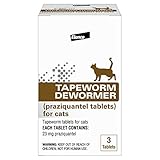
- 3-count bottle of tapeworm dewormer for cats
- Easy effective way to remove common tapeworms in cats
- Tablets may be crumbled and mixed with food or taken by mouth
- Tapeworm Dewormer for Cats will remove the common tapeworms, Dipylidium caninum and Taenia taeniaeformis, from cats and kittens
- For use in cats over 6 weeks of age
| Worm | Where it lives | Can an owner see it? | Main caveat |
|---|---|---|---|
| Roundworms (Toxocara cati, Toxascaris leonina) | Intestine | Adults can be seen in vomit or stool | Many infections are found only by fecal examination |
| Hookworms (Ancylostoma species, Uncinaria stenocephala) | Intestine | Usually not | Can cause blood loss severe enough to cause anemia |
| Flea tapeworm (Dipylidium caninum) | Intestine | Segments may be seen | Routine fecal flotation can miss it |
| Prey-associated tapeworm (Taenia taeniaeformis) | Intestine | Segments may be passed; the reviewed sources do not describe their appearance separately | Cats may show few or no signs |
| Whipworms | Intestine | Not stated in the reviewed sources | Uncommon in cats in the United States |
| Ollulanus tricuspis (stomach worm) | Stomach | Not stated in the reviewed sources | Infections are described as sporadic |
| Physaloptera species (stomach worm) | Stomach | Not stated in the reviewed sources | Rare |
| Aelurostrongylus abstrusus (lungworm) | Lungs | Not stated in the reviewed sources | Diagnosis can be difficult |
| Eucoleus aerophilus (lungworm) | Lungs, as described by Merck Veterinary Manual | Not stated in the reviewed sources | Infective eggs are consumed with food or water |
| Paragonimus species (lung fluke) | Lungs | Not stated in the reviewed sources | Not a routine risk for every cat |
What do cat worms look like?
An appearance check is useful only for a few worms, and even then a look at the stool is not a diagnosis. A worm that looks like the description below may still be something else, and a worm that cannot be seen may still be present. Bring any suspected worm or segment to a veterinarian in a sealed container, and do not handle it with bare hands.
1. Roundworms: Toxocara cati and Toxascaris leonina
Adult roundworms are cream-colored and cylindrical. Cornell Feline Health Center describes adults as around three to five inches long. Because they are the largest worms on this list, they are the ones an owner is most likely to notice, typically as a worm passed in vomit or stool. Cornell’s page, last updated June 2018, gives an estimated range of 25% to 75% for roundworm infection among cats, with higher rates in kittens. That is an older estimate for the populations Cornell described, not a current figure for every region or cat population.
2. Hookworms: Ancylostoma species and Uncinaria stenocephala
Hookworms are small and slender, and they are usually not visible in stool. An owner is unlikely to identify them by sight, so the signs of infection are more useful clues than the worm itself. Those signs are covered in the section on symptoms below.
3. Flea tapeworm: Dipylidium caninum
For this tapeworm, the useful picture is a segment, not the whole worm. Fresh segments may resemble grains of rice, and dried segments may resemble sesame seeds. Segments may be seen on the fur around the tail or in fresh stool, and they can look like something else until they dry. If you see something that might be a segment, a veterinarian can assess it, but a segment alone does not show how heavy the infection is.
Outdated Drivers Are Slowing You Down
One free scan finds every outdated or missing driver and matches the right update for your exact hardware.Free scan · exact hardware matchPC Slower Than It Used to Be?
A free scan shows the junk files, broken settings and background clutter dragging Windows down - then fixes them in one click.Free scan · Windows 10 & 11Rank #2

- BROAD-SPECTRUM WORM CONTROL – Targets common intestinal worms, including tapeworms, roundworms, and hookworms, helping provide effective and convenient deworming care for cats and kittens.
- DUAL-ACTIVE DEWORMING FORMULA – Each scored tablet delivers 18.2 mg of Praziquantel and 72.6 mg of Pyrantel Pamoate, providing targeted support against common intestinal worms in cats and kittens.
- FOR CATS & KITTENS 2–20 LBS – Suitable for cats and kittens weighing 2 to 20 lbs, with a scored tablet design that makes weight-based dosing simple and convenient.
- SIMPLE WEIGHT-BASED DOSING – Easy single-dose oral administration based on your cat’s weight. If reinfestation occurs, repeat as directed on the label. Always weigh your cat before use for accurate dosing.
- FOR CATS & KITTENS 3+ WEEKS – Suitable for cats and kittens 3 weeks and older weighing 2 lbs or more. Follow label directions for proper use, and consult your veterinarian before use for cats with existing health conditions or those that are pregnant or nursing.
4. Prey-associated tapeworm: Taenia taeniaeformis
This tapeworm is acquired by eating infected prey, not by swallowing fleas. Cats with this infection may show few or no signs, so the first sign may be a segment, or the infection may only be found during testing. The reviewed sources do not describe the segments of this species separately from other tapeworms, so an owner should not assume a particular appearance means a particular tapeworm.
5. Whipworms
Whipworms are uncommon in cats in the United States. Heavy infection may cause diarrhea, which is the main reason they are worth knowing about. They are not one of the infections most often seen in cats, and an owner should not expect to identify one by eye.
6. Stomach worm: Ollulanus tricuspis
Infections with this stomach worm are described as sporadic. Vomiting and weight loss may occur. Diagnosis may involve examining vomit, which is one reason that persistent vomiting should be reported to a veterinarian rather than assumed to be a diet problem.
7. Stomach worm: Physaloptera species
This group of stomach worms is rare in cats. Infection is associated with insects or transport hosts, such as mice, which are the routes a veterinarian would consider when taking a history.
Recommended Free Tools
Rank #3

- Broad-Spectrum Intestinal Care Support - Designed to support routine intestinal wellness, helps maintain balance for common intestinal worms, including tapeworms, roundworms, and hookworms, as part of a regular deworming care routine.
- Supports Digestive Health & Daily Vitality - Helps support normal digestive balance and overall wellness by promoting a healthy intestinal, helping cats maintain their active and comfortable lifestyle.
- Easy to Use - Each tablet provides a simple and consistent way to follow your cat’s daily care routine. Tablets can be given directly or mixed with food for flexible use based on your cat’s preferences
- Suitable for Cats at Different Life Stages - Designed for kittens and adult cats, making it a practical choice for multi-cat households, breeders, rescues, and pet owners who prioritize regular feline wellness care.
- Quality Formula for Everyday Cat Care - Made with carefully selected ingredients and quality standards, this cat wellness supplement provides dependable support for your cat’s routine health management and everyday care needs.
8. Lungworm: Aelurostrongylus abstrusus
This lungworm is acquired when cats eat prey that has itself eaten infected slugs or snails. Coughing and difficulty breathing can occur. Diagnosis can be challenging, and a negative result does not always settle the question, so a cat with respiratory signs and a history of hunting may need repeated assessment rather than a single test.
9. Lungworm: Eucoleus aerophilus
Merck Veterinary Manual identifies this as another feline lungworm. Its eggs are infective, and cats may take them in with food or water. Signs are similar to those of other lungworms, which is why a respiratory picture alone does not identify the species.
10. Lung fluke: Paragonimus species
This is a trematode, a flatworm that is not a roundworm or a tapeworm. In cat owner guidance it is associated with eating raw crayfish or crabs. It is not a routine risk for every cat, and an owner whose cat has no access to raw crustaceans is unlikely to be exposed to it.
How do cats get worms?
Routes of infection differ by worm, and several worms have more than one route. The most useful way to think about them is by how the worm reaches the cat:
Rank #4

- 3-IN-1 BROAD SPECTRUM DEFENSE – Don’t guess which worm is bothering your pet. Our tablets contain Praziquantel to specifically remove Tapeworms (Dipylidium caninum & Taenia), while Pyrantel Pamoate clears Roundworms and Hookworms. A comprehensive solution for common intestinal issues
- VET-GRADE ACTIVE INGREDIENTS – Get the same professional-grade standard without the expensive fee. Each tablet contains 18.2 mg Praziquantel and 72.6 mg Pyrantel Pamoate, the gold-standard combination for effective worm removal in felines
- SCORED TABLETS FOR PRECISE DOSING – Our tablets are physically scored (marked with a break line), making it easy to split them in half by hand or with a pill cutter. This ensures you can provide the exact, safe dosage tailored to your cat’s specific weight, from small kittens to large adults
- FAST ACTING, VISIBLE RESULTS – Ideal for cats showing symptoms like "rice-like" segments in fur, scooting, weight loss, or dull coats. Our formula begins working immediately to detach and flush out worms, helping to restore your cat’s digestive health quickly
- Suitable FOR KITTENS & ADULT CATS – Suitable for all breeds of cats and kittens 2 months of age or older (weighing at least 2 lbs). An essential part of your pet's healthcare routine, especially for multi-cat households, foster homes, and regular deworming schedules
- From mother to kitten: roundworms may be passed to kittens, which is one reason kittens have higher rates in the Cornell estimate above.
- From eggs in the environment: roundworms can be acquired through eggs, and Eucoleus aerophilus eggs are consumed with food or water.
- Through the skin: hookworm larvae may penetrate skin, and hookworms can also be swallowed.
- By swallowing fleas: the flea tapeworm Dipylidium caninum is acquired when a cat swallows an infected flea while grooming.
- By eating prey: Taenia taeniaeformis follows eating infected prey, and Aelurostrongylus abstrusus follows eating prey that has eaten infected slugs or snails. Roundworms may also be acquired through prey.
- By eating insects or transport hosts: Physaloptera species are associated with insects or hosts such as mice.
- By eating raw crustaceans: Paragonimus species are associated with raw crayfish or crabs.
The reviewed sources do not state the route of infection for whipworms or Ollulanus tricuspis, so this article does not assign one.
Signs to watch for, and when to call a veterinarian
Many cats with worms show few or no obvious signs. When signs do occur, they are nonspecific and overlap across worm types. Possible signs include:
- Vomiting or diarrhea
- Weight loss or poor growth, particularly in kittens
- A pot-bellied appearance
- Anemia, including pale gums
- Dark, tarry stool, which can accompany severe blood loss from hookworms
- Coughing or difficulty breathing
- Visible worms or segments in vomit, stool or around the tail
Some signs need prompt attention rather than a wait-and-see approach: persistent vomiting or diarrhea, weakness, pale gums, breathing difficulty, or a kitten that is not growing normally. An owner should contact a veterinarian rather than treating these at home.
Independent reader supportYour contribution helps us test, update, and keep practical guides available for everyone.How do vets diagnose worms in cats?
The diagnostic approach depends on the suspected parasite. Veterinary testing may include fecal testing and microscopy, antigen tests, PCR, imaging, or examination of vomit. The same stool sample can miss some infections, so a single negative result does not rule out every worm.
Best Value

- ✅ POWERFUL DAILY ORAL CLEANSE: Formulated with Wormwood & Black Walnut, this herbal supplement gently cleanses your pet’s body, supporting Digestive Antioxidant Support, and promotes overall intestinal wellness.
- ✅ DIGESTIVE HEALTH: Enhanced with probiotics to naturally encourage healthy digestion, balanced gut flora, and intestinal harmony. Daily use helps maintain optimal digestive function in pets of all ages, breeds, and sizes.
- ✅ VETERINARIAN-DEVELOPED: Expertly crafted by qualified veterinarians, ensuring safety, purity, and potency. Gentle enough for puppies and kittens as young as three weeks old, providing trusted care for pets.
- ✅ HASSLE-FREE LIQUID FORMULA: Forget pills or tablets—our convenient liquid drops offer accurate, weight-based dosing, eliminating the stress typically associated with traditional pet supplements.
- ✅ EASY DAILY ADMINISTRATION: Recommended dosage: pets under 10 lbs – ½ dropper, 10–20 lbs – 1 dropper, 20–35 lbs – 2 droppers, 35+ lbs – 3 droppers (1 dropper = 1 ml). The product can be given directly by mouth (slowly and gently) or mixed into food (do not mix with water). Use daily for up to 4 weeks, or as recommended by your veterinarian. Suitable for pets from 12 weeks old.
- Fecal flotation can miss tapeworms. Tapeworm eggs and segments may be unevenly distributed, so a negative routine fecal flotation does not always rule out infection with a tapeworm.
- Lungworm larvae are hard to find consistently. For this reason, a respiratory cat may need more than one test or a different test.
- Kittens need more frequent testing. The Companion Animal Parasite Council’s feline hookworm guidance, last updated February 28, 2025, recommends more frequent testing for kittens than for adults. The right frequency depends on a cat’s health and lifestyle, so the schedule should be set with a veterinarian.
- Older guidance on tapeworms. The Companion Animal Parasite Council’s cestode guidance was last updated November 1, 2016. It is useful background on tapeworm diagnosis, but a veterinarian will apply current testing practice.
How are worms treated?
Treatment depends on the parasite, and no single dewormer covers every worm on this list. The steps below describe the process rather than a dose.
- Book a veterinary visit and describe the cat’s symptoms, diet, outdoor access, prey access and flea status. Bring a fresh stool sample if the cat has diarrhea or if a worm was seen.
- Ask the veterinarian which parasite is suspected or confirmed, and which tests will confirm it.
- Follow the veterinarian’s prescription and the product directions exactly. Cornell reports that treatment of gastrointestinal parasites often requires a medication prescribed by a veterinarian.
- Ask about prevention of reinfection. This may include flea control, limiting access to prey and cleaning up cat waste, depending on the worm.
- Ask when the cat should be retested. Kittens may need more frequent testing, as noted above.
Do not give a cat a dewormer intended for another species or for a different worm, and do not assume that a product that worked for one cat is right for another.
Preventing reinfection
Prevention is mostly about breaking the routes described above. Practical steps include:
- Remove feces promptly from the yard and litter box.
- Clean the litter box frequently.
- Wash hands after handling cat waste.
- Limit hunting or scavenging where possible, especially for cats that catch rodents or birds, slugs, snails, insects or crustaceans.
- Control fleas, which is the clearest preventive step against the flea tapeworm Dipylidium caninum.
These steps reduce exposure but do not guarantee a worm-free cat, and reinfection can follow ongoing exposure even after treatment.
Quick wins for a faster PC:
Repair Windows errors before they cause bigger problemsFix Now →Fix the driver behind crashes, sound loss and screen glitchesFind Drivers →Clear out junk files and repair common Windows errorsFree Scan →Quick Recap
Product prices and availability are accurate as of the date/time indicated and are subject to change. Any price and availability information displayed on Amazon at the time of purchase will apply.




