Outdated Drivers Are Slowing You Down
One free scan finds every outdated or missing driver and matches the right update for your exact hardware.Free scan · exact hardware matchPC Slower Than It Used to Be?
A free scan shows the junk files, broken settings and background clutter dragging Windows down - then fixes them in one click.Free scan · Windows 10 & 11These 17 freshwater tropical fish can suit beginners when their adult size, social needs, and water preferences match the aquarium. Before buying any fish, cycle the tank, test your water, and choose compatible species; “beginner-friendly” does not mean suitable for an uncycled tank or neglect.
Most tropical freshwater fish do well around 74–80°F (23–27°C), but individual species vary. A heater, thermometer, filter, and appropriate tank size help keep conditions stable.
Set up the aquarium before buying fish
- Choose the aquarium first. A 5-gallon tank may suit one betta, while angelfish, pearl gouramis, and adult livebearers need substantially more room.
- Install a filter, heater, thermometer, and lid. Most tropical freshwater fish do well at approximately 74–80°F (23–27°C), although individual species vary.
- Treat tap water. Use a water conditioner that neutralizes chlorine and chloramine.
- Cycle the tank. A new aquarium is ready when tests show 0 ppm ammonia, 0 ppm nitrite, and nitrate being produced. Running the filter for 24–48 hours does not establish a nitrogen cycle; cycling commonly takes several weeks.
- Test your source water. Test pH, general hardness (GH), and carbonate hardness (KH). Hard, alkaline water often suits livebearers, while many tetras and some other South American fish prefer softer, more acidic water.
- Add fish gradually. Adding a full stocking list at once can cause an ammonia or nitrite spike. Test between additions and quarantine new fish when possible.
Schooling fish generally need a group of at least six of the same species; livebearers do best with more females than males. Do not use the “one inch of fish per gallon” rule. It ignores adult body shape, swimming habits, territorial behavior, oxygen use, and filtration capacity.
Quick comparison
| Species | Adult size | Practical minimum | Best kept | Important consideration |
|---|---|---|---|---|
| Betta | 2.5–3 in | 5 gal for one | Alone or carefully selected community | Males must be kept separately |
| Guppy | About 2 in | 10 gal | Group | Breeds rapidly |
| Platy | About 3 in | 10 gal | Group | Hard water and breeding |
| Molly | 4–5 in | 20 gal | Group | Needs space and mineral-rich water |
| Swordtail | 4–5 in | 20 gal; larger is better | Group | Active and prolific |
| Zebra danio | 2–2.5 in | 10 gal; 20 gal preferred | School | Constantly active and prone to jumping |
| Harlequin rasbora | About 2 in | 10 gal; 20 gal preferred | School of 6 or more | Too small for large tank mates |
| Neon tetra | 1–1.5 in | 10 gal | School of 6 or more | Needs mature, stable water |
| Black neon tetra | About 1.5 in | 15–20 gal | School of 6 or more | Not a solitary fish |
| Cherry barb | About 2 in | 20 gal preferred | Group | Males may chase |
| Corydoras | 1–3 in | 20 gal; varies by species | Group of 6 or more of one species | Needs sinking food and smooth substrate |
| Kuhli loach | About 4 in | 20 gal | Group of 3–6 or more | Nocturnal and secretive |
| Bristlenose pleco | 4–5 in | About 30 gal | Usually one | Do not confuse with common plecos |
| Honey gourami | About 2 in | 10 gal for one | Alone or compatible group | Often mislabeled as dwarf gourami |
| Pearl gourami | Up to 5 in | 29 gal for one | Group in larger tanks | Needs calm tank mates |
| Angelfish | About 6 in body length | 55 gal preferred | Adult community setup | Can eat small fish |
| Bolivian ram | About 3 in | 30 gal for a pair/community | Pair or peaceful community | Requires mature, clean water |
17 beginner-friendly tropical fish
1. Betta
Betta splendens is one of the best choices for a small heated aquarium. One betta can live comfortably in a filtered aquarium of 5 gallons or more, with gentle water movement, plants or other cover, and a secure lid. Aim for approximately 76–85°F and pH 6.8–7.5.
Quick wins for a faster PC:
Clear out junk files and repair common Windows errorsFree Scan →Scan for outdated or missing drivers - takes under a minuteDriver Scan →Repair Windows errors before they cause bigger problemsFix Now →#1 Best Overall

- FUN and REWARDING: Are you looking to buy an aquarium for your family, owning an aquarium can be a really fun rewarding experience while providing many wellness benefits.
- DAZZLING COLORS: Energy-efficient LED lighting with 7 dazzling color selections to brightly illuminate your fish; choose daylight white, blue, green, amber, aqua, purple, or red depending on the time of day or your viewing pleasure.
- COMPLETE FILTRATION: Powerful internal power filter cleans and purifies aquarium water at a flow rate of 45 gallon per hour, effectively removing fish waste and debris; uses Koller Products S replacement filter cartridges (AQ10FC-60), available on Amazon.
- IMPACT-RESISTANT CONSTRUCTION: Manufactured of impact-resistant plastic with crystal-clear clarity so good that most think it is made of glass, providing leak-proof confidence.
- BUILT-IN LIGHT TIMER: Set your LED light to come on at the same time every day, select light settings of 4 hours, 8 hours, or continuous On, easily with a flick of your finger.
Male bettas must be housed separately from other males. A male may work in a peaceful community aquarium of around 15 gallons or larger, but compatibility varies by individual. Bettas sold in cups or bowls are not proof that bowls are suitable: small, unfiltered containers change temperature and water quality quickly.
2. Guppy
Guppies are colorful, active livebearers that usually suit hard, mineral-rich water with a pH around 7.0 or higher. A 10-gallon aquarium can house a small group, while 20 gallons gives them more swimming room and provides a buffer when babies arrive. Approximately 76–78°F is a common target.
They reproduce quickly. Keep approximately one male to two or three females, or choose an all-male group if you do not want fry. Some highly bred fancy guppies are less robust than hardier, more naturally shaped varieties.
3. Platy
Platies are peaceful, hardy fish for a 10-gallon aquarium or larger. They generally prefer neutral to alkaline, moderately hard water and are active without being as frantic as danios.
The Tool Desk
Outbyte Driver Updater FREEFix the driver behind crashes, sound loss and screen glitchesFind Drivers →Outbyte PC Repair FREERepair Windows errors before they cause bigger problemsFix Now →A mixed-sex group can produce more young than a beginner can house. Platies can also crossbreed with other platies and with swordtails, so keep that in mind if you want predictable offspring.
4. Molly
Mollies are larger and more active than guppies or platies. Allow at least 20 gallons, with 29–55 gallons better for larger varieties such as sailfin mollies. They usually do best in warm, hard, alkaline water, around 75–80°F.
Many mollies are raised in mineral-rich or mildly brackish conditions. Moving one suddenly into very soft freshwater can cause problems, so compare the store’s water with your own and acclimate gradually. Test GH and KH rather than guessing.
5. Swordtail
Swordtails are active livebearers that commonly reach 4–5 inches. A 20-gallon aquarium is a reasonable starting point, but a long 29- or 40-gallon tank is more appropriate for adult groups. They generally suit warm, moderately hard to hard water.
What’s actually slowing this PC down?
Pick the symptom - the matching free tool is one click away.
Keep more females than males because males continually court females. Swordtails are usually peaceful but can be boisterous, and they can hybridize with platies.
6. Zebra danio
Zebra danios are exceptionally active schooling fish. A small group may be kept in a 10-gallon aquarium, but a long 20-gallon tank is a much better home because they spend much of the day swimming.
They tolerate a fairly broad range of conditions and are commonly kept at 72–78°F. Their speed and activity can stress slow-moving or long-finned fish. They also jump, so the aquarium needs a lid.
7. Harlequin rasbora
Harlequin rasboras are peaceful schooling fish that reach about 2 inches. Keep at least six, with a 20-gallon aquarium giving the group better swimming space than a small nano tank. Stable, clean water around 74–80°F suits them well.
They are small enough to be eaten by larger tank mates, including many adult cichlids and gouramis. Choose similarly sized, peaceful companions.
8. Neon tetra
Neon tetras are small, peaceful fish with a bright blue-and-red stripe. Keep at least six in a 10-gallon aquarium or larger; a longer aquarium is preferable for a school.
Rank #2
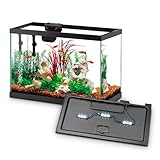
- PERFECT FOR BEGINNERS AND SEASONED AQUATIC HOBBYISTS: User-friendly setup designed for quick aquarium assembly and maintenance.
- COMPLETE STARTER KIT: Includes a 10-gallon glass rectangle aquarium, low profile hood with cool white LED lighting and feeding door, SmartClean filtration, EcoRenew cartridge, preset heater 50W, thermometer, fish net, premium fish food and a water conditioner.
- SIMPLE MAINTENANCE: SmartClean internal power filter provides quick and easy water changes to help improve water quality.
- IDEAL TEMPERATURE: Preset heater keeps your aquarium temperature at a constant 78 degrees, appropriate for most tropical fish.
- DURABLE GLASS CONSTRUCTION: Ensures clarity and durability, providing a safe environment for your fish. Made from high-quality materials for long-lasting use.
Neons can be delicate when newly purchased, especially if they have been transported, exposed to poor water quality, or housed with aggressive fish. A mature, stable aquarium and quarantine for new arrivals improve their chances. They are commonly kept around 72–78°F; FishBase lists a natural pH range of 5–7.
9. Black neon tetra
Black neon tetras are schooling fish with a dark horizontal stripe and a bright contrasting line. Keep six or more in approximately 15–20 gallons.
They are often hardier than standard neon tetras, but that does not make them suitable for an uncycled tank or a solitary setup. Keep temperature and water quality stable and avoid large or aggressive tank mates.
10. Cherry barb
Cherry barbs are among the more peaceful barbs and reach about 2 inches. A 20-gallon aquarium is preferable for a proper group. They are commonly kept at 75–80°F, with pH around 6.8–7.8.
Keep approximately one or two females per male. Males may display and chase one another, but cherry barbs are considerably less troublesome than tiger barbs. Dense plants give females places to retreat.
11. Corydoras catfish
Corydoras are peaceful bottom-dwelling schooling fish. Keep at least six of the same species, and choose the aquarium size according to the species: many standard corydoras are best in 20 gallons, while some pygmy types can live in smaller tanks with an appropriate footprint. Temperature needs vary by species; many tolerate roughly 72–82°F.
Recommended Free Tools
Use sand or smooth gravel because sharp substrate can damage their sensitive barbels. Feed sinking wafers, pellets, or other dedicated foods. Corydoras are not tank cleaners or garbage disposals. Their fin spines can produce mild venom when they are stressed, so handle them carefully.
12. Kuhli loach
Kuhli loaches are peaceful, eel-shaped bottom dwellers that grow to about 4 inches. A 20-gallon aquarium with a broad footprint, smooth sand, plants, driftwood, and caves is a good starting point. Warm, stable water around 74–82°F is commonly used.
They are most active at night and may hide all day. A single kuhli in a bare, brightly lit aquarium can appear to have vanished, so provide a group of three to six or more and plenty of cover.
13. Bristlenose pleco
A bristlenose pleco is a useful option for a larger community aquarium. Adults commonly reach 4–5 inches, so plan on approximately 30 gallons for one, with caves, driftwood, strong filtration, and regular maintenance.
Do not buy a “common pleco” for a typical beginner tank. Common plecos can approach 2 feet and create a substantial waste load. Bristlenose plecos also need food such as algae wafers and suitable vegetables; they do not live on fish waste or aquarium algae alone.
14. Honey gourami
Honey gouramis are small, generally peaceful centerpiece fish for a 10-gallon aquarium when kept singly. A 20-gallon or larger aquarium allows more room for a compatible group. They are commonly kept around 74–82°F and can tolerate a broad pH range of roughly 6.0–8.0.
Check the scientific name before buying. Honey gouramis are Trichogaster chuna; they are not the same as dwarf gouramis, Trichogaster lalius. Store labels and color varieties can cause confusion, and the two species do not have identical care or temperament.
15. Pearl gourami
Pearl gouramis are calm, attractive fish that can reach about 5 inches. Allow roughly 29 gallons for one adult and 55 gallons or more for a group. They prefer warm, stable water around 75–80°F.
Free tools Windows power users keep installed
One-click scans. No signup required.
Rank #3

- 🐠 ALL-IN-ONE AQUARIUM KIT, PACKED WITH VALUE - Comes complete with HD float 6 gallon glass tank, heater, hang on back filter with media, COB light, substrate sand, rocks, 5-in-1 cleaning tool set — just unpack, add water, and introduce your fish! The complete starter kit for instant aquatic enjoyment.
- 🔥 KEEPS TROPICAL & COLD-SENSITIVE FISH COMFORTABLE - Unlike most aquarium kits, ours comes with a reliable heater—essential for keeping delicate fish warm and healthy year-round.
- ✨ PREMIUM CRYSTAL-CLEAR GLASS FOR AN IMMERSIVE VIEW - Crafted from ultra-clear 5mm thick HD glass with 92% light transmittance, this tank offers a stunning, distortion-free view of your fish.
- 🌊 ADVANCED FILTRATION FOR CLEAN WATER - The included hang-on-back filter features both mechanical and biological filtration - sponge for debris and ceramic rings for impurities, harmful chemicals removal. This system keeps your tank water clean and clear, while enhancing oxygen exchange for healthier aquatic life.
- ⚠️ IMPORTANT SAFETY REMINDER - Do not bury the heater in sand or substrate. Keep at least 2 inches of clearance from the water surface. Always ensure the heater is fully submerged before plugging it in. Unplug the heater and let it cool for 10–20 minutes before removing it from the tank for cleaning or water changes.
Because they are relatively large and slow-moving, avoid fin-nipping or hyperactive companions. They are not a good choice for a typical nano aquarium.
16. Angelfish
Angelfish are rewarding but require more planning than their juvenile size suggests. Adults can reach approximately 6 inches in body length and become much taller with their fins. A tall 55-gallon aquarium is a sensible target for an adult community setup.
Angelfish are cichlids and may become territorial, particularly when paired or spawning. They can also eat small tetras, shrimp, and other animals that fit in their mouths. Choose tank mates for the adult angelfish, not the small fish seen at the store.
17. Bolivian ram
Bolivian rams are one of the more manageable beginner cichlids. They reach about 3 inches and can work as a pair or in a peaceful community aquarium of around 30 gallons. They are commonly kept at approximately 72–79°F and pH 7.0–8.0.
They are more tolerant than German blue rams, but they are not suitable for a newly set-up or unstable aquarium. Provide clean, mature water, hiding places, and peaceful tank mates of a similar size.
Independent reader supportYour contribution helps us test, update, and keep practical guides available for everyone.Common beginner mistakes
A betta bowl is not low-maintenance
Bettas can breathe atmospheric air, but that does not make a small bowl stable. A filtered, heated aquarium of 5 gallons or more is easier to keep at a safe temperature and water quality.
Bottom dwellers do not clean the aquarium
Corydoras and plecos still produce waste. They may eat certain foods or algae, but they do not replace a filter, gravel vacuum, water changes, or a maintenance routine.
A recently filled tank is not cycled
Test ammonia and nitrite rather than relying on how clear the water looks. Clear water can still be toxic. If either ammonia or nitrite is above zero, stop adding fish and address the water quality.
Do these 3 things before closing this tab:
1Scan for outdated or missing drivers - takes under a minute2Clear out junk files and repair common Windows errors3Fix the driver behind crashes, sound loss and screen glitches“Tropical” does not mean every fish belongs together
Temperature is only one compatibility factor. Match adult size, temperament, swimming speed, water hardness, and group requirements. For example, a group of guppies may thrive in hard alkaline water, while some tetras are better suited to softer, more acidic water.
Fish-store stocking is not a model to copy
Retail tanks are temporary holding systems with frequent maintenance. Overstocking a home aquarium or adding too many fish at once can trigger New Tank Syndrome, an ammonia or nitrite spike that harms or kills fish.
Good starting choices by aquarium size
| Aquarium | Potential choices | What to avoid |
|---|---|---|
| 5 gallons | One betta | Schools, livebearer groups, plecos, angelfish |
| 10 gallons | One betta, a small livebearer setup, honey gourami, or a carefully planned small school | Mollies, swordtails, adult angelfish, pearl gouramis |
| 20 gallons | Guppies, platies, danios, rasboras, tetras, cherry barbs, kuhli loaches, or smaller corydoras communities | Large plecos, adult angelfish, crowded mixed communities |
| 29–30 gallons | Pearl gourami for one, bristlenose pleco, Bolivian ram pair, or a larger community | Overlooking territorial behavior or adult size |
| 55 gallons or larger | Angelfish, pearl gourami groups, larger mixed communities | Small fish that can fit in an adult predator’s mouth |
FAQ
What is the easiest tropical fish for a beginner?
A betta is often the simplest choice for a single-fish aquarium, provided it has a heated, filtered tank of at least 5 gallons. For a community aquarium, guppies, platies, harlequin rasboras, black neon tetras, and honey gouramis can be good choices when kept in appropriate groups and water conditions.
How many tropical fish can go in a 10-gallon tank?
There is no reliable universal number. Base stocking on adult size, swimming behavior, filtration, footprint, and the fish’s social needs—not the one-inch-per-gallon rule. A 10-gallon aquarium may suit one betta, one honey gourami, or one carefully planned small group, but it is too small for adult mollies, swordtails, angelfish, and common plecos.
Do tropical fish need a heater?
Usually, yes. Most tropical freshwater fish need stable warm water, commonly around 74–80°F. Use a heater controlled by a thermostat and verify the temperature with a separate thermometer. Room temperature can fluctuate too much for many species.
Can beginner fish live in an uncycled aquarium?
They should not. An uncycled aquarium can accumulate toxic ammonia and nitrite even when the water looks clear. Cycle the aquarium first, then confirm 0 ppm ammonia and 0 ppm nitrite with nitrate being produced before adding fish.
The Bottom Line
The safest beginner choice is not simply the hardiest-looking fish at the store. Start with a cycled, heated aquarium, test your tap water, and select fish whose adult size, social needs, temperament, and preferred hardness match the tank. For a small setup, consider one betta or a carefully planned small community; for larger aquariums, schools of rasboras, tetras, danios, or barbs and peaceful species such as corydoras, honey gouramis, or Bolivian rams offer more options.
Quick Recap
Product prices and availability are accurate as of the date/time indicated and are subject to change. Any price and availability information displayed on Amazon at the time of purchase will apply.




