
Some links on this page are affiliate links: if you buy through them we may earn a commission, at no extra cost to you.
The best live aquarium plant is the one that matches your tank’s light, substrate, fish, available space, and willingness to trim. For most low-tech freshwater aquariums, the safest starting points are Anubias, Java fern, Bucephalandra, Java moss, Cryptocoryne, Vallisneria, and a controlled amount of floating cover.
Live plants can add shade, structure, spawning surfaces, grazing areas, and refuge for shrimp and fry. They can also absorb some nutrients as they grow, but they do not replace a cycled aquarium, biological filtration, water changes, testing, or sensible stocking. The guide below separates genuinely aquatic plants from conditional or semiaquatic choices and explains how to plant, feed, and maintain each one.

As an Amazon Associate I earn from qualifying purchases.
Choose for the aquarium you have
A plant labeled “easy” can still be a poor choice for a particular aquarium. Amazon sword is hardy but can overwhelm a small tank. Hornwort may survive with little effort but grow into a tangled mass that needs frequent thinning. A slow Anubias may be ideal for a low-maintenance tank but collect algae under an overly strong light. A delicate stem may thrive in one aquarium and shed leaves in another.
Before buying, identify five things:
- Fish behavior: Goldfish, mbuna, larger cichlids, silver dollars, crayfish, and digging fish may eat, uproot, or destroy plants that are easy to grow.
- Tank footprint and height: Mature size matters more than the size of the plant in its store cup.
- Light: Low-light tolerant does not mean no light. It means the plant generally handles less intense light than demanding carpeting or red-stem plants.
- Substrate: Root feeders need access to nutrients in the substrate or from root tabs; rhizome plants should usually be attached to wood or rock.
- Maintenance tolerance: Fast-growing plants remove nutrients quickly but require harvesting and thinning. Slow plants need less pruning but may not outcompete algae.
The plant database at Tropica groups aquarium plants by growth form and gives relative light and carbon-dioxide requirements. Those categories are more useful than treating a plant’s common name or a universal watt-per-gallon formula as a guarantee.
Popular on Amazon
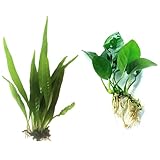
- IMPORTANT: Please note that during times of extreme weather, live plants will can suffer due to extreme temps. During winter, do not order live plants when temperatures are expected to go below 30F at the lowest point during the day.
- LIVE AQUARIUM PLANT - 1 anubias barteri and 1 Java fern
- SIZE: Anubias Barteri 2-6 inches Java fern 4-8 inches. Size will vary as these are live plants.
- LIVE ARRIVAL GUARANTEE - We guarantee live arrival on all of our livestock provided you don't order when temperatures are expected to go below 30F at the lowest point during the day. If a plant ever arrives dead send us a clear photo of the plant in the unopened bag and we will replace once verified.
- We do our very best to respond fast and ship happy, healthy plants. If you have any questions or concerns please message us we are always happy to help!
Quick-pick guide to the 18 plants
The ratings below are practical starting points for ordinary freshwater aquariums, not promises that a plant will thrive under every fixture or in every water chemistry.
| Plant | Best placement | Light | Injected CO2 | Nutrition | Growth | Fish toughness | Main warning |
|---|---|---|---|---|---|---|---|
| Anubias barteri var. nana | Foreground or midground hardscape | Low | Not needed | Water column | Slow | Robust | Keep the rhizome exposed |
| Java fern — Microsorum pteropus | Midground or background hardscape | Low | Not needed | Water column | Slow | Robust | Do not bury the rhizome |
| Bucephalandra | Nano foreground, wood, or rock | Low | Not needed | Water column | Very slow to slow | Moderate | Slow growth can invite algae |
| Java moss — Taxiphyllum barbieri | Wood, rock, fry refuge, shrimp areas | Low | Not needed | Water column | Moderate | Moderate | Traps debris if left untrimmed |
| African water fern — Bolbitis heudelotii | Midground or background hardscape | Low to medium | Helpful, not essential | Water column | Slow to moderate | Moderate to robust | Prefers clean, moving water |
| Cryptocoryne wendtii | Midground rosette | Low | Not needed | Roots and water column | Slow to moderate | Moderate | May melt after planting |
| Cryptocoryne beckettii ‘Petchii’ | Foreground or low midground | Low | Not needed | Roots and water column | Slow | Moderate | Allow room for spreading |
| Amazon sword — Echinodorus grisebachii ‘Bleherae’ | Large-tank background or centerpiece | Low to medium | Helpful, not essential | Heavy root feeder | Moderate | Moderate | Can reach roughly 12–20 inches |
| Vallisneria | Background grass and visual barrier | Low to medium | Not needed | Root and substrate feeder | Fast-spreading | Moderate | Runners can overtake small tanks |
| Dwarf sagittaria — Sagittaria subulata | Foreground or low midground | Low to medium | Not needed | Root feeder | Moderate | Moderate | May grow taller than expected |
| Bacopa caroliniana | Background stem group | Low to medium | Helpful, not essential | Water column and roots | Moderate | Moderate | Needs trimming to stay bushy |
| Water wisteria — Hygrophila difformis | Background or floating cover | Low to medium | Not needed | Water column and roots | Fast | Moderate | Can shade slower plants |
| Water sprite — Ceratopteris thalictroides | Floating cover or planted background | Low to medium | Not needed | Water column | Fast | Moderate | Surface growth can block light |
| Hornwort — Ceratophyllum demersum | Floating or loosely anchored cover | Low to medium | Not needed | Water column | Fast | Moderate | Becomes dense and tangled |
| Limnophila sessiliflora | Background stem group | Medium | Helpful, not essential | Water column | Fast | Delicate to moderate | Needs regular replanting of cuttings |
| Salvinia minima | Surface shade and cover | Low to medium | Not applicable | Water column | Fast | Moderate | Thin before it covers the surface |
| Amazon frogbit — Limnobium laevigatum | Floating shade and trailing roots | Low to medium | Not applicable | Water column | Fast | Moderate | Check local invasive-plant rules |
| Crinum calamistratum | Large-tank centerpiece or background | Low to medium | Helpful, not essential | Bulb and roots | Slow to moderate | Robust | Do not bury the bulb completely |
Light refers to tolerance, not a guarantee of ideal shape. CO2 not needed means the plant can generally survive without injected carbon dioxide; additional CO2 may improve growth or form. “Fish toughness” means resistance relative to softer plants, not that any plant is indestructible.
Free tools Windows power users keep installed
One-click scans. No signup required.
1. Anubias barteri var. nana
Best for: beginners, nano tanks, low-light aquariums, goldfish or cichlid layouts, and plants attached to rock or wood.
Anubias nana is one of the most dependable choices for a low-tech aquarium. Its thick leaves are less tempting and less easily shredded than delicate stem foliage, and it grows slowly enough that it rarely demands constant trimming. It works in the foreground of a large tank or as a midground accent in a smaller one.
This is a rhizome plant. The horizontal green rhizome is the stem from which the leaves and roots grow. Attach it to driftwood, rock, or aquarium decor with thread, fishing line, or an aquarium-safe adhesive; keep the rhizome above the substrate. Burying it can cause rot. New plants may be tied down until their roots grip the hardscape. The hardscape-attachment method described by Aquarium Co-Op is useful for tanks with digging fish.
Give Anubias low to moderate light and nutrients in the water column. It does not need injected CO2 to survive, but its slow growth means that excessive light often produces algae before the plant can use the available energy. If algae covers older leaves, reduce the light or photoperiod, move the plant into shade, and remove only leaves that are badly damaged.
Outdated Drivers Are Slowing You Down
One free scan finds every outdated or missing driver and matches the right update for your exact hardware.Free scan · exact hardware matchWindows Errors? Fix Them Before They Spread
Repair common Windows errors and clear accumulated junk for a smoother, more stable PC - no reinstall needed.Free scan · no reinstall2. Java fern — Microsorum pteropus
Best for: low-tech community tanks, goldfish, cichlids, bare-bottom aquariums, and aquariums without a deep planting bed.
Java fern has leathery leaves and a rhizome that can be attached to wood or stone. It is particularly useful when fish repeatedly uproot rooted plants because the plant does not need to be planted in the substrate at all. Larger varieties provide a vertical backdrop, while narrow-leaved or smaller forms fit more compact aquariums.
Keep the rhizome exposed and do not bury it. Java fern prefers modest light and absorbs much of its nutrition from the water, so a complete liquid fertilizer can be more useful than placing all nutrition beneath it. It is slow-growing, and algae can accumulate if the light is too strong or the aquarium is poorly maintained.
Small black or brown dots on the underside of mature leaves can be reproductive structures that develop into plantlets rather than a disease. Avoid cutting away every leaf with dots unless the leaf is genuinely failing. Java fern can also lose older leaves after a move and then produce new submerged growth. See Aquarium Co-Op’s Java fern care notes and Tropica’s Java fern listings.
Do these 3 things before closing this tab:
1Scan for outdated or missing drivers - takes under a minute2Repair Windows errors before they cause bigger problems3Fix the driver behind crashes, sound loss and screen glitches3. Bucephalandra
Best for: nano aquariums, shrimp tanks, shaded hardscape, and aquarists who want a small, slow-growing accent.
Bucephalandra is another rhizome plant, so it belongs on wood or rock rather than buried in gravel. Its small leaves and compact growth make it easier to fit into a nano layout than an Amazon sword or full-size Vallisneria. Different varieties vary in leaf shape and color, but the basic care is similar: modest light, stable conditions, and an exposed rhizome.
Bucephalandra is easy in terms of survival but not fast. New leaves can take time, and slow growth gives algae an opportunity when light is intense. Keep it in gentle to moderate light, maintain the tank consistently, and remove algae carefully instead of repeatedly uprooting the plant.
Tissue-cultured Bucephalandra is a useful option when avoiding snails, algae, and other hitchhikers matters. Tissue-culture plants still need to be rinsed free of their gel and may change form as they transition underwater. Aquarium Co-Op explains the advantages and limitations of tissue-culture plants.
4. Java moss — Taxiphyllum barbieri
Best for: shrimp, fry, breeding tanks, spawning surfaces, and natural-looking wood or rock.
Java moss creates a dense network of tiny branches where baby fish can hide and shrimp can graze. It can be attached loosely to driftwood, stones, mesh, or a spawning mop-like structure. It does not require a traditional planting bed, making it useful in bare-bottom or quarantine-style aquariums.
Keep the layer thin enough for water to move through it. Untrimmed moss can collect food, fish waste, and dead leaves. Periodic removal and rinsing in discarded aquarium water helps keep it from becoming a dirty, compact mat. Low to moderate light is usually a good starting point; stronger light may produce faster growth but also more algae.
Moss can be an excellent structural plant for shrimp and fry, but it is not a substitute for species-appropriate cover, water quality, or a secure breeding setup. Its value is mainly the fine structure it creates.
What’s actually slowing this PC down?
Pick the symptom - the matching free tool is one click away.
5. African water fern — Bolbitis heudelotii
Best for: larger community aquariums, wood-and-rock layouts, and fish that damage softer plants.
Bolbitis is a fern with a rhizome that should be attached to hardscape. Its divided leaves add a different texture from Anubias and Java fern, and mature plants can make an attractive midground or background group.
It is generally more demanding than Anubias but still appropriate for many low-tech aquariums. Clean, moving water helps it, while very chalky water can be problematic. Keep the rhizome above the substrate, avoid burying the crown, and give it time to establish before judging its growth.
Bolbitis is not guaranteed to survive herbivorous or destructive fish, but its tougher leaves make it a more realistic choice than delicate stems in some goldfish and cichlid aquariums. If fish continually pull at it, attach the plant to a heavier piece of rock or wood.
The Tool Desk
Outbyte Driver Updater FREEFix the driver behind crashes, sound loss and screen glitchesFind Drivers →Outbyte PC Repair FREEClear out junk files and repair common Windows errorsFree Scan →6. Cryptocoryne wendtii
Best for: low-light midgrounds, stable community aquariums, and aquarists who prefer a planted appearance without constant trimming.
Also popular on Amazon

- IMPORTANT: Please note that during times of extreme weather, live plants will can suffer due to extreme temps. During winter, do not order live plants when temperatures are expected to go below 30F at the lowest point during the day.
- LIVE AQUARIUM PLANT - 3 anubias barteri bare root plants
- SIZE: Size ranges from 3-7 inches. Size will vary slightly as these are live plants.
- LIVE ARRIVAL GUARANTEE - We guarantee live arrival on all of our livestock provided you don't order when temperatures are expected to go below 30F at the lowest point during the day. If a plant ever arrives dead send us a clear photo of the plant in the unopened bag and we will replace once verified.
- We do our very best to respond fast and ship happy, healthy plants. If you have any questions or concerns please message us we are always happy to help!
Cryptocoryne wendtii is a rooted rosette plant with leaves that vary in size, color, and texture. It generally grows slowly to moderately and can become a durable long-term plant once established. Bury its roots in the substrate while keeping the central crown—the point where the leaves emerge—above the substrate.
Cryptocorynes are famous for “crypt melt.” A plant grown above water or in different aquarium conditions may lose many of its existing leaves after it is planted. That does not necessarily mean the root system is dead. Remove leaves that are clearly decomposing, avoid repeatedly moving the plant, and wait for new underwater leaves.
Use a nutrient-rich substrate or root tabs, especially in inert gravel or sand. The Tropica profile for Cryptocoryne wendtii lists it as a low-light plant and illustrates why a plant can be easy after establishment while still needing patience during transition.
Quick wins for a faster PC:
Scan for outdated or missing drivers - takes under a minuteDriver Scan →Clear out junk files and repair common Windows errorsFree Scan →Fix the driver behind crashes, sound loss and screen glitchesFind Drivers →7. Cryptocoryne beckettii ‘Petchii’
Best for: nano and medium aquariums that need a compact rooted plant.
‘Petchii’ is a smaller, low-growing Cryptocoryne that can occupy the low midground without the scale of a full-size sword. It has the same basic planting rule as other Cryptocorynes: bury the roots, not the crown.
It is a good choice for a sand or gravel aquarium when root tabs are available. Expect slow establishment and possible melt after planting or moving. Once it begins producing new leaves, leave it in place; frequent relocation is one of the easiest ways to prolong the adjustment period.
Because it spreads gradually, it can form a natural group without the rapid takeover associated with some runner plants. Give each plant enough space for leaves to expand, and remove older leaves at the base rather than tearing at the crown.
Recommended Free Tools
8. Amazon sword — Echinodorus grisebachii ‘Bleherae’
Best for: medium and large aquariums with a deep substrate and room for a dramatic centerpiece.
An Amazon sword is a classic aquarium plant because it is hardy, visually substantial, and forgiving once established. It is also one of the most commonly mis-sized beginner purchases. Aquarium Co-Op’s selection guidance gives a mature aquarium height of roughly 12–20 inches, so it can dominate a small tank even when it is sold as a small potted plant.
This is a heavy root feeder. Plant the roots deeply enough to anchor the crown, use a nutrient-rich substrate or root tabs, and leave the crown above the substrate. It can survive without injected CO2, but adequate root nutrition is usually more important for a beginner than adding carbon dioxide.
Leaf melt after purchase is common when the plant was grown emersed. Remove only leaves that are collapsing and wait for new submerged leaves. Do not bury the crown in an attempt to stop it from floating.
9. Vallisneria
Best for: large background groups, line-of-sight breaks, and aquariums that need tall, grass-like cover.
Vallisneria grows from a rooted base and spreads by runners through the substrate. It can create a dense background that gives fish visual barriers and shaded areas. It is often a better large-tank background choice than repeatedly planting short stems that never fill the space.
Plant the roots while keeping the crown at the substrate surface. Give each plant room to send runners, and remove unwanted daughter plants before they spread across the entire aquarium. A small tank can become crowded quickly.
Vallisneria is generally low- to medium-light tolerant and usually does not require injected CO2. Strong filter returns can bend or damage long leaves, so position it where the flow is steady but not constantly hammering the foliage. Use root nutrition if growth is weak in an inert substrate.
10. Dwarf sagittaria — Sagittaria subulata
Best for: a beginner foreground or low midground, especially where a grass-like texture is wanted.
Dwarf sagittaria spreads with runners and can form a low planting over time. Its final height is variable: under some conditions it stays short, while under lower light or after a change in conditions it may grow much taller than its name suggests. Buy it for its runner-forming habit, not a guarantee that every leaf will remain carpet height.
Plant individual crowns in the substrate with space between them. Root tabs can help, particularly in plain sand or gravel. Once runners appear, allow some to establish and remove the rest if the plant is advancing into areas reserved for other species.
It is a useful compromise for beginners who want foreground coverage without immediately committing to a high-light, injected-CO2 carpet. Keep expectations realistic: a dense, very short carpet is more demanding than simply keeping the plant alive.
Recommended Free Tools
11. Bacopa caroliniana
Best for: a forgiving, structured background stem group.
Bacopa caroliniana has thicker leaves than many delicate stem plants and is generally more tolerant of ordinary low-tech conditions. It can be planted in groups at the back or sides of the aquarium. Leave space between individual stems so light and water can reach lower leaves.
When the stems reach the surface, trim healthy tops and replant the cuttings beside the original group. This gradually creates a fuller background. Remove bare lower sections if they no longer produce leaves, and do not allow the plant to shade all the shorter species in front.
It can grow without injected CO2, although stronger light, balanced nutrition, and added carbon may improve density. In a low-maintenance aquarium, moderate light and regular trimming are usually preferable to maximizing speed.
Quick wins for a faster PC:
Scan for outdated or missing drivers - takes under a minuteDriver Scan →Repair Windows errors before they cause bigger problemsFix Now →Fix the driver behind crashes, sound loss and screen glitchesFind Drivers →Also popular on Amazon

- IMPORTANT: Please note that during times of extreme weather, live plants will can suffer due to extreme temps. During winter, do not order live plants when temperatures are expected to go below 30F at the lowest point during the day.
- LIVE AQUARIUM PLANT - 1 Anubias nana petite pot 20-30 leaves
- LIVE ARRIVAL - We stand behind live arrival on all of our livestock provided you don't order when temperatures are expected to go below 30F at the lowest point during the day. If a plant ever arrives dead send us a clear photo of the plant in the unopened bag and and we will replace once verified.
- We do our very best to respond fast and ship happy, healthy plants. If you have any questions or concerns please message us we are always happy to help!
12. Water wisteria — Hygrophila difformis
Best for: fast-growing background cover, new planted aquariums, and tanks that need more plant mass quickly.
Water wisteria can be planted as a stem or allowed to float temporarily. Its divided leaves create cover for shy fish and fry, and its fast growth can help a new aquarium develop substantial plant mass while the aquarist learns how the light and nutrients behave.
Fast growth comes with maintenance. Trim it before it blocks the light, remove weak lower sections, and replant healthy tops. A floating mass can shade Cryptocoryne, Anubias, and other slow growers below it.
Because growth rate depends on light, nutrients, temperature, and carbon availability, do not treat it as a guaranteed nitrate-removal machine. Harvesting plant material removes nutrients only when the growth is actually removed from the aquarium.
Free tools Windows power users keep installed
One-click scans. No signup required.
13. Water sprite — Ceratopteris thalictroides
Best for: fry cover, shy fish, floating shade, and beginners who want rapid growth.
Water sprite can grow floating or rooted in the substrate. Floating plants usually produce broad, spreading cover and dangling roots, while rooted plants can form a background mass. The floating form is particularly useful for fish that appreciate subdued light and for fry that need dense refuge.
Thin it regularly. A surface completely covered by water sprite can shade every submerged plant and make feeding and maintenance difficult. Keep an open area where food can reach the fish and where surface movement remains appropriate for the aquarium.
It is a water-column feeder, so balanced liquid fertilization can be more useful than relying only on root tabs. Fast-growing plants also show problems quickly when nutrients or light are inadequate, but a single pale leaf is not enough evidence to diagnose a specific deficiency.
What’s actually slowing this PC down?
Pick the symptom - the matching free tool is one click away.
14. Hornwort — Ceratophyllum demersum
Best for: temporary cover, fry tanks, floating shade, and aquariums that need a fast-growing plant without a conventional root system.
Hornwort can float or be loosely anchored. It does not need to be planted like a rooted rosette, and it can grow rapidly in a wide range of ordinary aquarium conditions. That makes it useful while a new aquarium is becoming established or when fry need immediate cover.
The same growth rate that makes hornwort useful can make it messy. Trim or remove excess sections before they fill the aquarium, and expect pieces to break loose during maintenance. A loose mass can trap debris and shade slower plants.
Hornwort is not a permanent solution to overstocking or cycling problems. It can assimilate nutrients while growing, but the aquarium still needs filtration, testing, and water changes. Remove harvested material from the tank rather than allowing it to decompose inside it.
15. Limnophila sessiliflora
Best for: a feathery background stem that is generally more beginner-friendly than demanding carpeting or red-stem plants.
Limnophila sessiliflora produces soft, finely divided foliage and can make a full background when several stems are planted with space between them. It is a useful alternative for aquarists attracted to the look of delicate plants but not ready for the higher demands of Cabomba or intensive carpeting plants.
Trim the tops when they reach the surface and replant healthy cuttings. Remove lower sections that have lost their leaves. Consistent light and nutrition help it retain a dense shape; sudden changes may cause leaf loss or weak growth.
It can be grown without injected CO2, but better form may require more light and balanced fertilization. If the plant repeatedly deteriorates, move it to a brighter position or choose a tougher stem such as Bacopa instead of immediately adding multiple advanced technologies.
16. Salvinia minima
Best for: surface shade, betta-style aquariums, fry cover, and fast nutrient uptake.
Salvinia minima is a floating fern. It draws nutrients from the water rather than the substrate and can quickly soften the light below. Fish may use the roots and shaded surface as cover, while aquarists can remove handfuls during routine maintenance.
Keep the surface partially open. A dense mat can block light from reaching submerged plants, interfere with feeding, and make it harder to observe the fish. Strong surface turbulence may damage or push floating plants into corners, while a completely stagnant surface is not automatically desirable either; maintain circulation and gas exchange appropriate to the aquarium.
Floating plants can grow rapidly when light and nutrients are available. That is useful only if the aquarist is prepared to thin them. Discard surplus plants responsibly—never release them outdoors.
The Tool Desk
Outbyte Driver Updater FREEScan for outdated or missing drivers - takes under a minuteDriver Scan →Outbyte PC Repair FREEClear out junk files and repair common Windows errorsFree Scan →17. Amazon frogbit — Limnobium laevigatum
Best for: floating shade and long-rooted surface cover, but only after checking local regulations and the plant’s identity.
Amazon frogbit produces floating rosettes and trailing roots that can provide cover for fish and fry. It is easy to grow horticulturally, but it should not be treated as an automatically safe recommendation. The name and taxonomy can be confusing, and California Invasive Plant Council material discusses Limnobium laevigatum, its synonyms, rapid spread, thick mats, and aquarium sales as a possible dispersal pathway.
Check current state and local rules before buying, transporting, selling, or possessing it. If it is legal where you live, keep the surface thinned and inspect removed pieces for viable fragments. Never pour aquarium water or plant trimmings into a storm drain, pond, stream, or lake.
Also popular on Amazon

- IMPORTANT: Please note that during times of extreme weather, live plants will can suffer due to extreme temps. During winter, do not order live plants when temperatures are expected to go below 30F at the lowest point during the day.
- LIVE AQUARIUM PLANT - 3 anubias barteri bare root plants
- SIZE: Size ranges from 3-7 inches. Size will vary slightly as these are live plants.
- LIVE ARRIVAL GUARANTEE - We guarantee live arrival on all of our livestock provided you don't order when temperatures are expected to go below 30F at the lowest point during the day. If a plant ever arrives dead send us a clear photo of the plant in the unopened bag and we will replace once verified.
- We do our very best to respond fast and ship happy, healthy plants. If you have any questions or concerns please message us we are always happy to help!
Frogbit can shade submerged plants quickly. Use it as a managed portion of the surface rather than allowing it to become a sealed canopy.
18. Crinum calamistratum
Best for: a large aquarium centerpiece, fish-resistant foliage, and aquarists who want a bulb plant with a distinctive shape.
Crinum calamistratum grows from a bulb and produces long, tough, often wavy leaves. It is a useful option for aquariums containing fish that are hard on soft stems, although no plant is completely goldfish-proof or cichlid-proof.
Plant the roots and lower portion of the bulb, but leave approximately half of the bulb above the substrate rather than burying it completely. Give the mature leaves room to spread and avoid placing it where a strong filter return will constantly fold or tear them.
Crinum is slower than water sprite or hornwort, so it is not the right choice when the immediate goal is rapid nutrient uptake. Its value is long-term structure and durability. Use substrate nutrition and patience rather than repeatedly disturbing the bulb.
Do these 3 things before closing this tab:
1Fix the driver behind crashes, sound loss and screen glitches2Clear out junk files and repair common Windows errors3Scan for outdated or missing drivers - takes under a minuteChoose plants by fish
| Aquarium inhabitants | Good starting choices | What to expect |
|---|---|---|
| Peaceful community fish | Anubias, Java fern, Cryptocoryne, Vallisneria, Java moss, water sprite, Salvinia | Use plants to create shade, visual barriers, spawning surfaces, and swimming lanes. Match mature size to the tank. |
| Bettas and other labyrinth fish | Salvinia, frogbit where legal, water sprite, Java fern, Anubias | Floating cover can provide shade and structure, but keep feeding access and some open surface area. |
| Shrimp | Java moss, Bucephalandra, Anubias, water sprite, hornwort | Fine leaves and textured surfaces support grazing and refuge. Check the treatment history of purchased plants, especially for copper or pesticides. |
| Fry | Java moss, water sprite, hornwort, Limnophila, floating plants | Dense cover helps fry avoid predation, but it also makes counting and removing fry more difficult. |
| Goldfish | Large Anubias, Java fern, Bolbitis, Crinum, protected plants | Goldfish may eat or uproot plants. Attach rhizome plants to heavy hardscape or use a protected planter. Do not promise any plant is goldfish-proof. |
| African cichlids and other diggers | Anubias, Java fern, Bolbitis, Crinum, floating plants | Anchor plants to rocks or wood and protect rooted plants. Excavation is a livestock-compatibility issue, not necessarily a plant-care failure. |
Tropica’s livestock-compatibility guidance similarly emphasizes tough-leaved plants for plant-eating fish and warns that digging fish can uproot plants before they establish. Goldfish-specific options are also discussed by Aquarium Co-Op.
Choose plants by aquarium design
| Tank situation | Practical combination | Important limitation |
|---|---|---|
| 5–10 gallon nano | Anubias nana or a small Anubias cultivar, Bucephalandra, Java moss, and Cryptocoryne ‘Petchii’ | Check mature width as well as height; Vallisneria and Amazon sword can overwhelm the footprint. |
| Standard 20-gallon community tank | Anubias, Java fern, Cryptocoryne wendtii, Bacopa, and a controlled amount of Salvinia | Leave open swimming space and prevent floaters from shading the rooted plants. |
| Large aquarium | Amazon sword, Vallisneria, Crinum, Bolbitis, and background stems | Plan around mature size before planting; fast runners and stems need harvesting. |
| Bare-bottom aquarium | Anubias, Java fern, Bucephalandra, Java moss, hornwort, and floating plants | Root feeders such as swords and Cryptocorynes are poor fits unless grown in protected containers. |
| Sand substrate | Cryptocoryne, Amazon sword, Vallisneria, dwarf sagittaria, plus rhizome plants on hardscape | Use root tabs where appropriate and avoid burying crowns or rhizomes. |
| Low-light aquarium | Anubias, Java fern, Bucephalandra, Java moss, Cryptocoryne, and modest floating cover | Low light still needs to be consistent and sufficient; too much surface cover can make it insufficient. |
| New aquarium needing plant mass | Water sprite, water wisteria, hornwort, and a few durable rhizome plants | Fast growth can help use nutrients, but plants do not replace cycling or biological filtration. |
| High-pH or hard-water aquarium | Start with Anubias, Java fern, Vallisneria, Cryptocoryne, and fish-compatible choices | Do not manipulate stable pH solely to fit a plant. Test GH and KH and choose species that suit the existing system. |
How to buy aquarium plants
Understand how the plant was grown
A plant may arrive as an emersed-grown potted specimen, a submerged-grown plant, a tissue-culture cup, a bulb, a rhizome, a loose stem, or a plant already attached to wood or rock. These forms can look very different even when they are the same species.
Many commercial aquarium plants are grown emersed, with their foliage in humid air and their roots in wet substrate. When submerged, those leaves may melt while new underwater leaves develop. Tropica explains the difference between emersed and submerged production. Tissue-culture plants are useful when minimizing snails, algae, and hitchhikers is important, but they may be smaller and still need time to transition.
Inspect for pests and unwanted fragments
Look for snails, egg clutches, algae, duckweed, dead leaves, and fragments of unknown plants. A seller’s claim that plants are pest-free should be treated as a specific guarantee, not an assumption. A separate plant quarantine or careful inspection is sensible when introducing plants to a shrimp breeding system or a tank where hitchhikers are unacceptable.
Rinse plants with clean water, remove pots, rock wool, ceramic rings, labels, and packing material, and follow the seller’s instructions for tissue-culture gel. Do not use household cleaners or improvised chemical dips that could harm fish and invertebrates.
How to plant them correctly
- Plan the layout dry. Place tall plants in the background, medium plants in the midground, and low plants in front. Leave room for growth and equipment access.
- Prepare the substrate. A practical planted-tank depth is often about 2–3 inches, or 5–7.5 cm, although the correct depth depends on the species and design.
- Lower the water level. Planting with only a few centimeters of water above the substrate keeps leaves damp while making it easier to see the crowns and roots. This is the approach described in Tropica’s planting guide.
- Plant stems individually. Remove lower leaves and insert each stem with spacing. Crowding every stem into one hole encourages lower leaves to rot and makes trimming difficult.
- Plant rosettes by the roots. Bury the roots, but keep the crown above the substrate. This applies to Cryptocoryne and Amazon sword.
- Attach rhizomes. Anubias, Java fern, Bucephalandra, and Bolbitis should usually be tied or glued to hardscape. Never bury the horizontal rhizome.
- Plant runners with room to spread. Vallisneria and dwarf sagittaria need substrate contact and space for daughter plants.
- Handle moss gently. Attach a thin layer to hardscape rather than making a thick ball that traps debris.
- Float surface plants. Place Salvinia, frogbit, water sprite, or hornwort on the surface and decide immediately how much open water should remain.
- Plant bulbs at the correct depth. For Crinum, keep approximately half the bulb above the substrate.
- Refill slowly. Pour water over a saucer, plastic bag, or other diffuser so the substrate and newly planted stems are not blasted loose.
- Start conservatively. Aquarium Co-Op suggests beginning a new planted aquarium with about 5–6 hours of light per day and increasing gradually as the plants establish. This is a starting protocol, not a universal rule.
Light, CO2, and fertilizer without the confusion
Light
Do not select a light by wattage alone. Fixture height, tank depth, water clarity, floating shade, lens design, and plant position all affect the light that reaches the leaves. PAR is more meaningful than watts, but most beginners do not need a precise PAR calculation. A reliable planted-tank LED on a timer, a moderate starting photoperiod, and control of floating cover are more useful first steps.
Slow-growing plants such as Anubias and Java fern often do better when protected from intense direct light. Fast stems and floating plants can use more light, but excessive light without enough plant mass or nutrition usually creates an algae problem rather than a healthier aquarium. Aquarium Co-Op’s plant-selection guide explains why low-light plants are often more forgiving for beginners.
Carbon dioxide
Most plants in this guide can survive without injected CO2. That does not mean CO2 could never improve growth, compactness, or color. It is especially helpful for demanding carpets and some red or finely divided stems.
Carbon dioxide should not be added in isolation. Light, nutrients, circulation, and carbon must be managed together. Adding CO2 to an aquarium with excessive light or poor maintenance can increase instability and algae. A “no CO2 required” label means survival is realistic without injection, not that the plant has no carbon needs.
Roots versus water-column feeding
- Root-oriented plants: Amazon sword, Cryptocoryne, Vallisneria, dwarf sagittaria, and Crinum. Use a suitable substrate or root tabs.
- Water-column-oriented plants: Anubias, Java fern, Bucephalandra, mosses, floating plants, and many stems. A complete liquid fertilizer is often more relevant.
- Mixed feeders: Many plants use both roots and leaves to some extent.
Fish waste does not necessarily provide every nutrient a planted aquarium needs. A heavily planted or lightly stocked aquarium may need macronutrients and micronutrients. Dose according to the product label and the aquarium’s growth, water tests, and maintenance routine rather than adding more fertilizer whenever a leaf changes color.
Independent reader supportYour contribution helps us test, update, and keep practical guides available for everyone.What live plants can—and cannot—do for water quality
Growing plants assimilate some nitrogen and phosphorus, and fast-growing floating plants can remove a meaningful amount when they are regularly harvested. A slow Anubias does not provide the same nutrient uptake as a dense mass of water sprite or hornwort.
Research on newly established, unfiltered betta aquariums found that several aquatic plants reduced ammonia-nitrogen accumulation compared with plant-free controls, but that result should not be turned into a claim that plants alone make a new aquarium safe. The study context was limited, and fish still require a functioning biological system. See the betta-aquarium study.
Crashes, No Sound, or Screen Glitches?
Random freezes, missing sound and display glitches usually trace back to one bad driver. Find and replace yours safely.Free scan · under a minutePC Slower Than It Used to Be?
A free scan shows the junk files, broken settings and background clutter dragging Windows down - then fixes them in one click.Free scan · Windows 10 & 11Biological filtration, water changes, testing, and sensible stocking remain essential. Aquarium biofilters rely on microbial communities to process ammonia, and research on aquarium biofilters illustrates why a planted aquarium is not exempt from cycling.
Plants produce oxygen during photosynthesis under light, but they also respire. Oxygen availability depends on surface agitation, temperature, stocking, decomposition, filtration, and the aquarium’s total biological demand. Never turn off filtration or aeration merely because the aquarium contains plants. A dense plant mass is not a guarantee of safe oxygen levels, especially overnight.
Plants are also not a reliable way to force pH or hardness to a target. Effects depend on the plant mass, substrate, KH, GH, source water, carbon dioxide, and water-change schedule. Test pH, GH, KH, ammonia, nitrite, and nitrate, and choose plants that suit stable conditions rather than repeatedly altering chemistry for a particular species.
Fish enrichment: useful structure, not a universal promise
Live plants can create shade, cover, visual barriers, spawning sites, grazing surfaces, and more varied swimming routes. These features may benefit fish and invertebrates, but the welfare evidence is species-specific rather than a guarantee that any plant measurably improves every fish’s welfare.
A review of environmental enrichment for zebrafish facilities identifies live and artificial plants as potentially relevant forms of enrichment while noting that systematic evidence remains limited. The practical conclusion is straightforward: use plants to create appropriate structure, but still provide suitable water quality, space, social conditions, diet, and hiding places for the species.
First-month care
- Keep the light consistent. Use a timer and start with a conservative photoperiod. Increase it only if plants are growing and algae remains manageable.
- Do not keep rearranging plants. Cryptocorynes and rooted plants need time to establish, while rhizome plants need time to attach.
- Remove dead material. Cut away leaves that are clearly decomposing, but do not strip a transitioning plant of every damaged leaf.
- Watch the surface. Thin floating plants before they cover the tank or shade everything beneath them.
- Check plant nutrition. Root feeders may need root tabs; water-column feeders may need a complete liquid fertilizer.
- Test the aquarium. Live plants do not replace testing for ammonia, nitrite, nitrate, pH, GH, or KH when those parameters matter to the livestock.
- Add fish gradually. A planted tank still needs an established biological system and appropriate stocking. Do not add a full fish load simply because plants were installed.
- Harvest fast growers. Remove excess stems and floating plants from the aquarium so the nutrients remain in the harvested plant tissue rather than returning through decay.
Troubleshooting common failures
“The plant melted, so it died.”
Often, it has not. Emersed-grown leaves may melt after submersion while the plant produces leaves adapted to underwater growth. Remove only leaves that are clearly rotting, check that the crown or rhizome is not buried, maintain stable conditions, and wait for new growth. Aquarium Co-Op’s beginner plant guidance and Tropica’s explanation of emersed production both address this transition.
Also popular on Amazon
“Anubias or Java fern is covered in algae.”
Likely contributors include excessive light, a long photoperiod, low plant growth, inconsistent maintenance, or an imbalance between nutrients and plant mass. Move the plant into shade, shorten the photoperiod, improve routine maintenance, and remove heavily affected leaves. Avoid aggressively pruning a slow Java fern until little healthy tissue remains.
“The plant keeps floating up.”
- Stem cuttings may not have rooted yet.
- Rooted plants may be planted too shallowly.
- Digging fish may be dislodging them.
- Rhizome plants may be treated as rooted plants even though they should be attached to hardscape.
- Plant weights or protected containers may help in some layouts, but never crush stems or bury a rhizome.
“The floating plants took over.”
Remove portions regularly and keep open surface area. Dense mats can shade submerged plants, obstruct feeding, and make it difficult to inspect the aquarium. If you cannot keep up with thinning, replace the fast-growing floater with a smaller managed group or omit floating plants.
Do these 3 things before closing this tab:
1Clear out junk files and repair common Windows errors2Fix the driver behind crashes, sound loss and screen glitches3Repair Windows errors before they cause bigger problems“Leaves are pale, transparent, or distorted.”
Possible causes include inadequate or excessive light, missing nutrients, insufficient root nutrition, unstable conditions, or normal transition from emersed to submerged growth. Do not diagnose a specific nutrient deficiency from one photograph alone. Consider the plant’s feeding type, age of the leaf, light position, growth rate, water tests, and recent changes together.
“The fish eat or uproot everything.”
Change the design rather than repeatedly replacing delicate plants. Try Anubias, Java fern, Bolbitis, Crinum, floating plants, or plants attached to rocks and wood. Protected planters can help with rooted species. If a fish continually excavates the substrate, a conventional planted carpet may simply be incompatible with that animal.
Plants that need a warning before purchase
Parrot’s feather — Myriophyllum aquaticum
Parrot’s feather is attractive but should not be presented as an uncomplicated beginner aquarium plant. Washington guidance identifies it as an invasive aquatic plant that spreads through fragments and describes restrictions on its sale. That does not establish a nationwide rule; laws vary and change. Check current state and local regulations before buying, transporting, or disposing of it. Washington Department of Ecology guidance provides a documented example.
Carolina fanwort — Cabomba caroliniana
Cabomba can be beautiful but has fragile, easily damaged stems and is less forgiving than Anubias, Java fern, or Cryptocoryne. Washington materials list Cabomba among aquatic plants subject to quarantine or regulatory guidance. Verify the current rules in your jurisdiction rather than assuming a plant sold online is legal everywhere.
Brazilian waterweed — Egeria densa
Egeria is easy and fast-growing in aquarium culture, but aquarium ease does not equal environmental safety. Washington material lists Brazilian elodea among regulated or undesirable aquatic plants, and USGS documentation includes Egeria densa in work involving nonindigenous aquatic plants. Never release it or any aquarium plant into natural water.
Amazon frogbit or spongeplant
Limnobium names can be confusing, and the plant has documented invasive concerns in some regions. It belongs in the conditional section of a buying guide, not as a universal recommendation. Check local rules before purchase and keep all fragments contained.
Lucky bamboo — Dracaena sanderiana
Lucky bamboo is a semiaquatic or emergent-rim plant, not a straightforward fully submerged aquarium plant. Its roots may grow in the aquarium while the foliage remains above water. Fully submerging it can lead to failure and should not be confused with planting a true aquatic species.
Water hawthorn — Aponogeton distachyos
Water hawthorn is a bulb plant with dormancy and cooler-water considerations. It is not a universal low-maintenance tropical recommendation. If you choose it, research its temperature range, growth cycle, dormancy, bulb handling, and mature size from a specialist source rather than copying a broad temperature range from a general plant list.
The Tool Desk
Outbyte PC Repair FREERepair Windows errors before they cause bigger problemsFix Now →Outbyte Driver Updater FREEScan for outdated or missing drivers - takes under a minuteDriver Scan →Marimo moss balls
The commonly sold marimo is technically an algae ball, not moss. It is generally marketed under Aegagropila linnaei. If you buy one, label it accurately and verify that it is legal and responsibly sourced. It should not be used as evidence that every plant-shaped ornament sold for aquariums is a true aquatic plant.
Do not release aquarium plants
The U.S. Environmental Protection Agency identifies aquarium releases and escaped ornamental plants as pathways for aquatic nuisance species. Its community guidance also says not to dump aquarium animals, plants, or water into local waterways.
Quick wins for a faster PC:
Repair Windows errors before they cause bigger problemsFix Now →Fix the driver behind crashes, sound loss and screen glitchesFind Drivers →Clear out junk files and repair common Windows errorsFree Scan →Simple plant combinations that work for common goals
- Lowest-maintenance tropical combination: Anubias, Java fern, Cryptocoryne wendtii, and Vallisneria. Add root tabs for the rooted plants and keep the light moderate.
- Goldfish combination: large Anubias, Java fern, Bolbitis, and Crinum attached to or protected by hardscape. Expect investigation and occasional damage rather than guaranteed survival.
- Shrimp or fry combination: Java moss, water sprite, hornwort, Bucephalandra, and a controlled amount of floating plant cover.
- Nano combination: Anubias nana, Bucephalandra, Java moss, and Cryptocoryne beckettii ‘Petchii’. Choose small specimens and leave swimming room.
- Fast-growing new-tank combination: water sprite, water wisteria, and hornwort, with Anubias or Java fern for permanent hardscape. Thin the fast growers frequently.
- No-substrate combination: Anubias, Java fern, Bucephalandra, Java moss, hornwort, and floating plants.
These are starting layouts, not guarantees. The combination that succeeds is the one whose mature size, growth rate, fish resistance, light demand, and planting method fit the aquarium.
Frequently Asked Questions
What is the easiest live aquarium plant for a beginner?
Anubias, Java fern, Java moss, and many Cryptocoryne are among the most forgiving choices for a low-tech freshwater aquarium. Anubias and Java fern are especially useful because they attach to rock or wood rather than requiring a planted substrate. Keep their rhizomes above the substrate.
Can live aquarium plants replace a filter or water changes?
No. Plants can assimilate some nutrients and contribute oxygen during photosynthesis, but they do not replace biological filtration, cycling, testing, water changes, or appropriate stocking. Oxygen and ammonia safety depend on the entire aquarium system.
Why are my new aquarium plants melting?
Many aquarium plants are grown emersed, with leaves adapted to air. Those leaves may melt after submersion while the plant produces new underwater leaves. Remove clearly decaying material, keep the crown or rhizome correctly positioned, avoid repeated moves, and wait for new growth.
Recommended Free Tools
Which aquarium plants are best for goldfish?
Tougher choices include large Anubias, Java fern, Bolbitis, and Crinum. Goldfish may still eat or uproot any plant, so attach rhizome plants to heavy hardscape or protect rooted plants. No plant should be described as completely goldfish-proof.
Do aquarium plants need injected CO2?
Most plants in this guide can survive without injected CO2. CO2 may improve growth, compactness, or color, particularly for demanding carpets and some stems, but it must be balanced with light, nutrients, circulation, and maintenance.
Can I throw unwanted aquarium plants into a pond or stream?
No. Never release aquarium plants, fish, invertebrates, or aquarium water into natural waterways or storm drains. Dispose of viable plant material in sealed household waste or follow local invasive-species guidance.
The Bottom Line
For the safest beginning, choose one or two rhizome plants—such as Anubias barteri var. nana or Java fern—and combine them with a rooted Cryptocoryne or Vallisneria. Add moss, water sprite, or a carefully managed floater when shrimp, fry, or surface shade is the goal. Match mature size and growth rate to the tank, attach rhizomes instead of burying them, expect some transition melt, and treat plants as part of a healthy aquarium system—not a replacement for cycling, filtration, testing, or water changes.





Leave a Reply