
The most useful four additions to a cat’s environment are a scratching surface, a raised retreat, an interactive wand toy and a food puzzle or treat-dispensing ball. They support scratching, climbing, hiding, resting, hunting-style play and foraging—normal behaviors that help cats make choices in their space. They are not a universal prescription, and buying them cannot replace suitable food, water, toileting, veterinary care, separated resources or respectful interaction. Choose each item around your individual cat’s preferences, mobility and confidence.
Start with the environment, not the shopping list
A cat can have food, water and a roof and still experience stress. The practical question is whether the home lets the cat retreat, rest, scratch, climb, play, forage and approach important resources without feeling threatened. The Feline Veterinary Medical Association (FelineVMA) organizes feline welfare around five connected needs.
As an Amazon Associate I earn from qualifying purchases.
| Need | What it looks like at home |
|---|---|
| A safe place | A retreat where the cat can rest or hide and control how much contact it has with people or other animals. |
| Multiple, separated resources | Food, water, toileting, scratching, play and sleeping areas placed so a cat can use them without being challenged. |
| Play and predatory behavior | Opportunities to stalk, chase, pounce, capture and forage rather than only receiving passive toys. |
| Positive, predictable interaction | Handling and social contact that respect the cat’s signals, timing and individual social preference. |
| Respect for the senses | Familiar smells, manageable noise and visual access that do not force the cat into contact with unfamiliar or threatening stimuli. |
The four items below are practical ways to supply parts of that environment. A confident climber may use a tall tree immediately; a nervous senior may prefer a low, covered box. A cat that ignores a vertical rope post may enthusiastically use a horizontal cardboard pad. Observe first, then adapt.
1. A scratching post or pad that matches your cat
Why scratching matters
Scratching is normal behavior, not deliberate damage. It helps maintain the claws and leaves visual and scent signals. Preventing all scratching is neither realistic nor desirable; the goal is to provide an attractive, stable place for it.
#1 Best Overall

- A NEW CHOICE FOR INDOOR ENTERTAINMENT: Endless fun for your cat! Designed for indoor environments, this interactive toy ball rolls quickly across the carpet and emits an appealing cat-attracting chittering sound. Not only does it stimulate your cat's hunting instincts, it also allows them to enjoy outdoor chasing indoors while reducing the risk of furniture scratching
- INTELLIGENT INTERACTION AND FUN: This automatic cat toy is your pet's new playmate. It has two modes: ① Normal mode (green light), which runs for five minutes and then automatically shuts off. ② Intelligent mode (blue light), after running for five minutes the exercise ball automatically enters the dormant mode, when your cat touches it again, the exerciser will interact with your cat again. So whether it's a long game or a short interaction, this interactive cat ball meets the needs of both you and your pet, allowing your pet to entertain itself while you're busy
- TWO SPEEDS FREELY SWITCHING: The BABORUI interactive cat toy offers two speeds, fast and slow, which can be freely switched at any time. Even if your cat is cute and short-legged, it can still keep up with the pace of the exercise ball
- TRIPLE FUN, TRIPLE HAPPINESS: This cat toys for indoor cats comes with three fun tails that provide your cat with triple the fun. They can have endless fun chasing and catching the ball, while the sound of the bells on the tails will further stimulate their curiosity and desire to chase
- SAFE MATERIAL, LASTING AND DURABLE: We understand that your pet's safety is of utmost importance to you. The shell of this kitten toys is made of safe silicone material, so you don't need to worry even if your pet chews it. The durable design means it can withstand daily wear and tear, providing long-lasting companionship for you and your pet
Commonly preferred scratching materials include carpet, wood, rope and cardboard. No single material suits every cat, and orientation matters just as much as texture. Some cats stretch up a vertical post, others scratch a horizontal pad, and some prefer an angled surface.
How to choose the format
| Selection factor | What to look for | Useful observation |
|---|---|---|
| Material | Try cardboard, rope, carpet or wood rather than assuming one texture is universally appealing. | Note which surfaces the cat already scratches. |
| Orientation | Offer vertical, horizontal or angled options. | Watch whether the cat stretches upward, scratches a floor surface or uses furniture corners. |
| Stability | The base should not tip, slide or wobble when the cat leans into it. | A post that moves can make a cat abandon it after one frightening attempt. |
| Size | A vertical surface should allow a comfortable full-body stretch; a pad should provide enough room for the cat’s normal scratching motion. | Match the cat’s body size and movement, especially for large or mobility-limited cats. |
| Placement | Put it near an existing scratching location, a sleeping area or a route the cat uses. | Hiding a post in an unused corner often makes it less relevant. |
Introduce it without forcing the issue
- Map current behavior. For several days, note where, when and on what surface the cat scratches. Scratching after waking and near social or traffic areas can be especially informative.
- Place the new surface at the behavior site. If the target is a sofa corner, start beside that corner rather than across the room.
- Secure the item. Test it with a gentle push. If it rocks or slides, anchor it or choose a heavier base.
- Make exploration voluntary. Let the cat investigate. Praise or offer a small food reward for using it, but do not drag the paws across the surface.
- Offer a second format when needed. A vertical rope post and a horizontal cardboard pad can reveal whether the issue is texture, angle or location.
If furniture scratching continues, protect the furniture temporarily and move an appropriate scratcher directly beside the preferred spot. Once the cat uses the replacement consistently, shift it only a small distance at a time. Never punish scratching; punishment can make the cat avoid you without teaching a better option.
Unusual or suddenly intense scratching can accompany a health or behavior problem. A new pattern, especially alongside other behavior changes, merits a veterinary discussion rather than an accessory marketed as a treatment.
The Tool Desk
Outbyte PC Repair FREERepair Windows errors before they cause bigger problemsFix Now →Outbyte Driver Updater FREEScan for outdated or missing drivers - takes under a minuteDriver Scan →2. A raised perch or stable cat tree for retreat and control
What a safe retreat provides
Cats need somewhere to withdraw and rest. A cardboard box, carrier, raised perch or cat tree can serve this role when it is stable and placed where the cat feels secure. Vertical space gives many indoor cats more ways to observe and avoid unwanted contact, but height alone is not the objective: the space must be usable and genuinely safe.
Rank #2

- Doesn't every cat deserve an exciting chase? Your cats will love diving in and out of this tunnel, chasing each other and pouncing the dangling balls attached to both entrances. And they also can enjoy a variety of play experiences because the tunnel is available in round, S-shaped, or semi-circular shapes.
- Who wouldn't want a win-win tunnel for their cat? Our cat tunnel bed comes with 40 toys, keeping your baby happy and saving your time of shopping for more toys. It's not just a toy but also a stylish decor piece, as it can double as decor for modern, farmhouse and vintage styles.
- Which pet wouldn't want to nap on a cloud? Our 2-in-1 cat donut tunnel is not just a play zone, but also a cozy resting spot. The mat is filled with soft PP cotton, making your cat feel like lying on a fluffy cloud and drifting into sweet dreams. Even if you’re not home, it will cuddle with your kitten just like you do!
- Worried it might be too small? Don’t be! With a 10-inch diameter tunnel and a 15-inch mat, this product is perfect for pets under 30 pounds. It offers plenty of space for cats of all sizes to play and rest. Additionally, the product is foldable, and with just two simple steps, it can be easily set up or stored, saving space when not in use.
- What better way to show love than with a unique cat bed cave? Giving your fur baby with a special tunnel isn't just about enhancing playtime; it's your way of saying I love you. While they may not be able to say thank you, their joyful play is the happiest reply you could receive.
FelineVMA guidance says most cats prefer a safe space that fits one cat, has sides, is raised off the ground and allows entry and exit from at least two sides. Those features reduce the chance that another animal or person can block the only escape route.
Compare retreat options
| Option | Strength | Check before use | Best adapted for |
|---|---|---|---|
| Cardboard box | Inexpensive, enclosed and easy to replace or move. | Dry, clean, large enough to turn around in, with an opening that cannot be blocked. | Cats that prefer covered, low-pressure hiding places. |
| Carrier | Familiar shelter that can also make future transport less stressful. | Leave it open and accessible; never use it only when taking the cat to a clinic. | Cats that already accept the carrier as a resting space. |
| Raised perch | Offers elevation and a view while using less floor space. | Secure attachment, comfortable surface and a safe route up and down. | Watchful cats that like observing activity. |
| Cat tree | Combines height, resting platforms and sometimes hiding or scratching areas. | Wide, stable base; platforms that fit the cat; no wobble, exposed fasteners or unsafe gaps. | Active climbers and homes where vertical territory is useful. |
Set it up for the cat you have
- Prioritize stability. A tall tree must not rock when the cat jumps, turns or lands. Follow the manufacturer’s assembly and anchoring instructions.
- Provide a usable retreat. A platform with sides or a covered compartment can feel safer than an exposed shelf. Leave clear access to at least two directions where practical.
- Consider mobility. Kittens, seniors, overweight cats and cats with joint disease may need short steps, ramps or low platforms rather than a demanding vertical climb.
- Choose a calm but connected location. Many cats want to watch household activity without being in the middle of it. Avoid placing the retreat beside a loud appliance, a busy doorway or a resource another cat guards.
- Preserve choice. Do not pull a hiding cat out of its refuge unless safety requires it. The retreat works because the cat can control access.
In a multi-cat household, one elevated station is rarely enough. Spread out safe places so individual cats can create distance and avoid competition. A cat that stops using a perch may not dislike the perch itself; another cat, a new odor or a blocked route may have changed the risk of reaching it.
3. An interactive wand toy that completes the hunt
Why interactive play is different
A wand toy with feathers or another prey-like attachment lets a person create movement a cat can stalk, chase and pounce on. This is more behaviorally useful than leaving a toy on the floor and expecting every cat to play alone.
Outdated Drivers Are Slowing You Down
One free scan finds every outdated or missing driver and matches the right update for your exact hardware.Free scan · exact hardware matchPC Slower Than It Used to Be?
A free scan shows the junk files, broken settings and background clutter dragging Windows down - then fixes them in one click.Free scan · Windows 10 & 11FelineVMA guidance emphasizes that cats should be able to capture the “prey” at least intermittently. Endless teasing without a successful catch can create frustration. The reviewed veterinary guidance does not establish a universal play duration or a required daily schedule, so use the cat’s engagement and condition as your guide.
Rank #3

- Interactive Level 2 Cat Puzzle Toy: 13" x 9.5" cat puzzle feeder that triggers hunting and foraging instincts. Level 2 adjustable difficulty for beginner to advanced cats.
- Indoor Cat Enrichment: Keeps indoor cats engaged, minimizes boredom, and delivers rewarding treat-finding play that supports daily stimulation.
- Level 2 Slow Feeder Puzzle: Holds 1/4 cup food or treats across 16 compartments. Promotes slower eating and positive feeding habits with adjustable challenge.
- Multiple Ways to Play (Level 2 Adjustable): Easy mode: treats in base compartments only. Hard mode: add treats into sliding cups via top holes so cats must push and move pieces to release rewards.
- Safe, Durable & Easy Clean: No removable parts. Made without BPA, PVC, lead, or phthalates. Wipes clean quickly for everyday use.
Use a prey sequence rather than waving it in the cat’s face
- Begin quietly. Let the toy appear at the edge of the cat’s view, behind a box or around furniture.
- Mimic prey. Make short, irregular movements, pauses and changes of direction. A feather can skim along the floor, disappear behind an object and reappear.
- Allow stalking. Give the cat time to watch, crouch and approach. Not every pause means the cat has lost interest.
- Invite a pounce. Move the toy away rather than directly toward the cat, then let the cat make contact.
- Provide captures. Stop moving briefly when the cat catches it. Let the cat bite and hold the attachment before restarting.
- Finish predictably. End with a successful capture and put the wand away where unsupervised chewing cannot occur.
Play with cats individually in a multi-cat home. A confident cat can monopolize the toy while a timid cat remains hidden, and competition can turn an enriching activity into a source of tension. Rotate toys to maintain novelty, but do not assume that a new attachment will suit every cat.
Safety and adaptation
- Inspect feathers, strings, elastic and attachment points before each session.
- Do not leave a wand, string or small detachable part where a cat can chew or swallow it unsupervised.
- Keep movements appropriate to the cat’s age, physical ability and flooring. A senior cat may prefer a low, slower chase with frequent pauses.
- Stop if the cat shows distress, excessive fatigue, respiratory difficulty or pain, and contact a veterinarian when symptoms are concerning.
- If the cat ignores the toy, change distance, speed, texture, time of day or location before concluding that the cat does not like interactive play.
4. A food puzzle or treat-dispensing ball for optional foraging
What it adds
Food puzzles and dispensing balls can make eating more like foraging. Instead of receiving every bite from a stationary bowl, the cat manipulates an object or solves a simple problem to obtain some food. This can add mental and physical activity, but it is enrichment—not a replacement for nutritionally appropriate food or veterinary feeding advice.
There is no single puzzle design that suits all cats. Some need a very easy first step; others become interested in a more complex design. The useful measure is whether the individual cat can engage without becoming frustrated, whether the food remains safe and fresh, and whether the arrangement fits the cat’s diet.
Introduce a puzzle gradually
- Start with familiar food. Use part of the cat’s normal ration when possible rather than adding unrestricted treats.
- Make the first challenge obvious. Leave food visible and easy to reach. Demonstrate by moving the puzzle gently, but do not force the cat’s paws into it.
- Watch the response. Interest, brief pauses and repeated attempts are useful engagement. Walking away, vocalizing in distress or abandoning meals indicates that the task may be too difficult.
- Increase difficulty slowly. Only after the cat reliably succeeds should you reduce visibility, add movement or use a more complex compartment.
- Clean and inspect it. Follow the product’s cleaning directions and discard damaged parts that could be swallowed.
Use puzzles where the cat can work without another animal blocking access. In a multi-cat home, separate feeding and enrichment stations may be necessary so each cat can eat at its own pace. Keep fresh water available separately from food, and ask a veterinarian how puzzle feeding fits a cat’s medical diet, weight-management plan or medication routine.
Rank #4
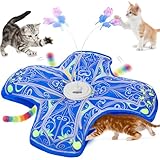
- Top-Tier Dual Interactive Fun: Qraxond's new indoor cat toy has dual motors, controlling random rotation of butterfly and plush tail swing rod accessories, bringing fun, exciting play for kittens and adult cats. Hide-and-Seek: The animal tail-shaped plush hides under the cover cloth, rotating irregularly to appear/disappear, creating a hide-and-seek game. It mimics real prey, bringing unpredictable chases to stimulate the cat's brain and senses. Irregular Rotating Butterfly: The top has an auto-rotating butterfly that rotates, pauses or swings to simulate real flight, keeping the cat engaged. Various interactions ensure the cat gets enough exercise to avoid obesity
- 3 Adjustable Speed Modes: Customize the excitement with separate buttons for the butterfly and tail. Choose from 3 settings: Steady (Blue Light), Active (Purple Light), and Random (Yellow Light). Suitable for high-energy cats to burn off steam or for calm cats to enjoy gentle play. Keep your feline entertained and prevent boredom, especially when they are home alone
- Touch-Sensitive Activation: Your Cat's in Control! With smart touch-sensor technology, just tap the device to fire up the fun mode, it will kick off a 5-minute automatic play session instantly. Right after the play session ends, it switches directly to touch-sensitive standby mode, where the purple indicator light flashes every 20 seconds. Simply tap again to reactivate it for another 5-minute cycle. This smart loop ensures your cat gets sufficient exercise and prevents overstimulation
- Large Rechargeable Battery: Enjoy long-lasting play with the built-in 2500mAh battery. It charges fully in just 2.5 hours via the included USB cable (use a 5V adapter only). The efficient auto on/off cycle extends battery life, making it convenient for busy pet owners while ensuring your cat gets healthy, moderate exercise
- Realistic Bird Chirping: Elevate the hunt with lifelike sound. The built-in speaker emits authentic bird chirps to attract your cat's attention and stimulate their prey drive. Combined with the random motions of the butterfly and tail, it creates an irresistible and engaging play experience that keeps your cat happily chasing even when they're by themselves
Arrange the four items as a system
The items work best when they are not clustered into one crowded “cat corner.” Cats need access to resources without being challenged by another cat or forced past a perceived threat. Separate food, water, toileting, scratching, resting and play areas where the home allows.
| Area | Practical arrangement | Reason to separate it |
|---|---|---|
| Food and puzzle | Place the puzzle in a quiet feeding area with room to approach and leave. | Eating should not require passing a guarding cat or loud appliance. |
| Water | Offer water in a location the cat can reach without crossing a busy route. | Some cats avoid a bowl if the surrounding traffic feels unsafe. |
| Scratching | Keep a scratcher near sleeping areas and established scratch sites. | Scratching often occurs during stretching and territorial routines. |
| Perch or retreat | Provide a quiet, elevated or enclosed option with more than one way out when possible. | The cat needs a refuge, not a dead end where another animal can trap it. |
| Interactive play | Use open floor space or a room where the cat can chase and turn safely. | Removing obstacles reduces collision risk and lets the cat complete the sequence. |
Keep familiar scents on bedding and in resting areas. FelineVMA guidance notes that unfamiliar or strong smells can be stressful. Avoid heavily fragranced cleaning products around a refuge, and do not repeatedly wash away a cat’s familiar scent unless hygiene requires it. Synthetic facial pheromones, including products sold under the Feliway name, may be considered as a calming aid during stressful or unfamiliar situations; they are optional and are not guaranteed to change behavior.
Adapt the setup for one cat or several
For a single cat
Even one cat benefits from choice. Offer a retreat, a scratching option and a play area in different parts of the home rather than requiring the cat to use one location for every activity. Watch which areas the cat chooses and adjust height, cover, texture and distance accordingly.
For a multi-cat household
Cats vary in how social they are. Some rest together; others prefer substantial distance. Do not assume that sharing one food station, litter area, perch or puzzle is friendly. Spread resources and safe places throughout the home so a cat can avoid another cat without losing access to essentials.
Best Value

- Ball Cat Toy: Multi-level cat toy with 3 tiers and 6 spinning balls—keeps indoor cats active, curious, and entertained
- Enrichment: Encourages batting, swatting, and chasing to satisfy hunting instincts and enhance everyday enrichment
- Durable & Safe: Sturdy, non-slip base and a secure safety bar for hours of safe independent play
- Feline Favorite: Designed for older kittens and adult cats alike; great for multi-cat homes or gifting; not recommended for kittens under 12 weeks
- Expandable: Enjoy on its own or pair with Catstages Topper Toys (sold separately) for even more interactive chaos
- Provide more than one retreat, with routes that cannot easily be blocked.
- Separate feeding and puzzle stations when cats rush, stare, guard or leave before finishing.
- Run wand-toy sessions one cat at a time if competition develops.
- Watch for subtle avoidance: waiting until another cat leaves, eating quickly, hiding or abandoning a preferred perch.
Use observation as your selection tool
There is no reliable way to choose the perfect item from a picture alone. A simple observation log can prevent expensive trial and error. Record the cat’s age, mobility, favorite resting places, current scratching surface, reaction to movement, food motivation and whether other animals affect access. Then change one feature at a time—texture, angle, height, location or difficulty—so you can tell what helped.
Signs that an item is working include voluntary approach, relaxed body language, repeated use, normal eating and the ability to leave freely. Signs that it needs adjustment include avoidance, startling, guarding, frustration, slipping, repeated failed attempts or a sudden change from previous behavior.
When an accessory is not the answer
House-soiling, unusual scratching, sudden hiding, aggression, appetite changes or a sharp decline in play can have medical causes. Do not treat a behavior change as evidence that the cat simply needs a new toy or tree. Contact a veterinarian for a new, persistent or concerning change, particularly when it occurs with pain, altered drinking or eating, difficulty urinating, vomiting, diarrhea or reduced movement.
Free tools Windows power users keep installed
One-click scans. No signup required.
Indoor living can reduce some outdoor hazards, but it does not automatically meet every need. In an August 28, 2025 announcement about its indoor-cat position statement, Ilona Rodan, DVM, DABVP (Feline), AdvCertFB, chair of the FelineVMA Feline Welfare Committee, said: “Indoor-only cats are often assumed to be the safest, but it is more challenging to meet their needs, impacting their physical and emotional health and resulting in more caregiver concerns about behavior.” The practical response is environmental choice and observation, not a claim that one product guarantees wellbeing.
Quick Recap
A concise setup checklist
- Choose at least one scratching surface after observing preferred material and orientation.
- Test every post, perch and tree for stability before allowing unsupervised access.
- Give the cat a retreat with sides, suitable space and a route out; provide additional retreats when cats share a home.
- Use a wand toy to imitate prey and allow intermittent captures; supervise the toy.
- Introduce a food puzzle at an easy level using appropriate food, then increase difficulty only when the cat succeeds comfortably.
- Separate key resources so food, water, toileting, rest, scratching and play are not all controlled from one location.
- Keep familiar scents and limit strong, unfamiliar odors around safe areas.
- Reassess after any household change, new pet, illness or behavior shift.
Product prices and availability are accurate as of the date/time indicated and are subject to change. Any price and availability information displayed on Amazon at the time of purchase will apply.





Leave a Reply