What’s actually slowing this PC down?
Pick the symptom - the matching free tool is one click away.
Spider silk is a family of protein fibers, not one uniform material. Its different types serve different jobs, and their properties depend on the spider, silk type, protein structure, and spinning conditions. Here are eight research-grounded facts about what makes spider silk remarkable—and what scientists can and cannot yet reproduce.
Key takeaways
- Spiders produce multiple silk types with distinct biological roles and properties.
- Dragline silk is used for structural lines and as a lifeline, but it is only one kind of spider silk.
- Protein sequence, fiber structure, and spinning conditions influence how a silk performs.
- Strength, extensibility, and toughness describe different properties; no single number captures them all.
- A 2025 review reports a tensile strength of 1.1 GPa for dragline silk, not for every spider silk or specimen.
- Engineered silk and biomedical applications remain active research areas; research potential does not establish consumer availability or clinical adoption.
1. Spider silk is a family of materials
Spider silk refers to protein-based fibers with different functions, rather than one standardized substance. Orb-weaving spiders, for example, use several silk types for tasks such as structural support and prey capture. Their mechanical behavior varies with the silk’s role.


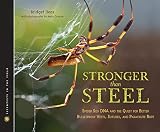

Reviews of spider silk describe its diversity and the relationship between structure and function. The Nature Reviews Materials review on spider-silk structure and function and the review of spider-silk-inspired artificial fibers discuss how different silks and engineered materials should not be treated as interchangeable.
2. Dragline silk does more than form a web
Major ampullate silk, commonly called dragline silk, forms structural lines and is associated with a spider’s lifeline. It is among the most studied spider silks, but its role does not represent the full range of silk types a spider can produce.
Do these 3 things before closing this tab:
1Fix the driver behind crashes, sound loss and screen glitches2Repair Windows errors before they cause bigger problems3Scan for outdated or missing drivers - takes under a minute#1 Best Overall
Other silks serve different biological functions and have different mechanical behavior. Comparing silk types therefore requires considering what each fiber does, not just asking which one is “best.”
3. Spider silk’s structure helps explain its performance
Dragline silk has a hierarchical protein structure. Nanocrystalline beta-sheet regions coexist with less ordered regions, and this organization helps explain how the fiber can combine strength with elasticity.
Spider-silk proteins and fibers are affected by more than one structural feature. Protein sequence, the way the fiber is organized, and the conditions under which it is spun all contribute to its behavior. The 2018 structure–function review describes this connection.
4. Strength and toughness are not the same
Tensile strength describes the stress a material withstands before failure. Toughness concerns how much energy it absorbs before breaking. Extensibility—the degree to which it can stretch—also matters: a fiber’s ability to stretch can contribute to toughness without making it the strongest material by a simple tensile-strength comparison.
| Property | What it describes | Why it matters |
|---|---|---|
| Tensile strength | Stress at failure | Shows resistance to being pulled apart |
| Extensibility | Stretch before failure | Shows how far a fiber can deform before breaking |
| Toughness | Energy absorbed before breaking | Reflects performance across loading and deformation |
These measures are related, but they are not interchangeable. A comparison between spider silk and another material needs to specify the property and test conditions; a blanket claim that spider silk is “stronger than steel” leaves out essential context. Reviews on spider silk structure, function, and properties and spider silk design and performance discuss these distinctions.
5. Published strength values need context
A 2025 review, Structure, production and application of spider silks, reports a tensile strength of 1.1 GPa for dragline silk. This is a value reported by that review, not a universal constant for every spider, silk type, or specimen.
Measured properties can vary with silk type, spider, environment, gland chemistry, and spinning process. The 2025 review of spider silks provides the context for the reported dragline figure. Treat any value as specific to its source and test rather than as the strength of all spider silk.
6. Different spider silks should not be ranked on one number
Silks evolved for different biological jobs, so a single ranking can obscure what makes each one useful. A meaningful comparison should consider biological function, tensile strength, extensibility, toughness, test conditions, and specimen source.
| Comparison question | What to check |
|---|---|
| What is the fiber for? | Its biological function, such as structural support or prey capture |
| How does it perform? | Tensile strength, extensibility, and toughness—not just one measure |
| How was it tested? | Test conditions and specimen source |
| What kind of material is it? | Native spider silk, recombinant silk, or a material merely inspired by spider silk |
These distinctions are important when comparing natural fibers with materials made using engineered proteins or other silk-inspired approaches. The Annual Review of Entomology article on property variation in spider silk explains why variation and production methods matter.
7. Scientists can engineer silk-like materials, but copying native silk is difficult
Researchers are exploring recombinant spider-silk proteins, electrospinning, and other approaches to make engineered fibers. These methods aim to reproduce useful aspects of natural silk, but a lab-made or silk-inspired fiber is not automatically identical to native spider silk.
A 2017 review reported that the production methods it assessed had not achieved properties as impressive as native silk. That is a finding from that review, not a timeless claim about every process developed since. Research on recombinant production and structure–function relationships continues; see the 2024 review of recombinant spider-silk proteins and the review of spider-silk-inspired artificial fibers.
8. Biomedical promise does not mean established products
Reviews discuss spider-silk proteins and materials for possible biomedical uses, including tissue engineering and drug delivery. These are research directions, not proof that broadly available spider-silk medical products have been established or adopted in clinical care.
Windows Errors? Fix Them Before They Spread
Repair common Windows errors and clear accumulated junk for a smoother, more stable PC - no reinstall needed.Free scan · no reinstallCrashes, No Sound, or Screen Glitches?
Random freezes, missing sound and display glitches usually trace back to one bad driver. Find and replace yours safely.Free scan · under a minuteProduction and processing challenges remain relevant to turning promising protein designs into usable materials. The 2024 recombinant-production and biomedical review and the 2025 review of spider-silk applications describe the research landscape. A potential use in a review article should not be mistaken for a finished consumer or medical product.
Independent reader supportYour contribution helps us test, update, and keep practical guides available for everyone.FAQ
What makes spider silk so strong?
Its performance is linked to protein sequence and structure. In dragline silk, nanocrystalline beta-sheet regions coexist with less ordered regions, helping explain a combination of strength and elasticity.
Is spider silk stronger than steel?
There is no useful universal answer without specifying the silk, steel, property, and test conditions. Tensile strength and toughness are different measures, and spider silk’s notable performance can include extensibility as well as strength.
How many kinds of spider silk are there?
Spiders produce multiple silk types with different functions and mechanical behavior. The number and kinds vary; the research summarized here does not establish one count that applies to every spider.
Best Value
Can scientists make spider silk?
Researchers use approaches such as recombinant protein production and electrospinning to develop engineered silk-like materials. These materials are not automatically identical to native spider silk, and production challenges remain.
Are spider-silk medical products available?
The reviewed evidence discusses possible biomedical applications, including tissue engineering and drug delivery, but does not verify broadly available spider-silk medical products or clinical adoption.
The bottom line
Spider silk is a varied family of protein fibers whose properties depend on type, structure, spider, and production conditions. Its strength, stretch, and toughness should be discussed separately, and reported numbers need context. Engineered and biomedical uses are promising research areas, but they should not be presented as equivalent to native silk or established products without supporting evidence.
Quick Recap
Product prices and availability are accurate as of the date/time indicated and are subject to change. Any price and availability information displayed on Amazon at the time of purchase will apply.
Quick wins for a faster PC:
Fix the driver behind crashes, sound loss and screen glitchesFind Drivers →Repair Windows errors before they cause bigger problemsFix Now →Scan for outdated or missing drivers - takes under a minuteDriver Scan →



