
Quick wins for a faster PC:
Scan for outdated or missing drivers - takes under a minuteDriver Scan →Repair Windows errors before they cause bigger problemsFix Now →There is no defensible, current ranking of the eight most mosquito-infested U.S. states in the available evidence. The latest widely cited list, Orkin’s 2026 Mosquito Cities List, ranks cities by the number of new residential mosquito treatments the company performed—not by mosquito population, trap counts, bites, or disease risk. Its eight entries include Washington, D.C., which is not a state.
For pet households, the list is still useful as an indicator of where mosquito-control activity was highest for one company during a defined year. The table below reports that measure accurately, explains what it cannot prove, and shows how to reduce mosquito exposure around people and animals.
As an Amazon Associate I earn from qualifying purchases.
What the 2026 list actually ranks
Orkin published its 2026 Mosquito Cities List on May 5, 2026. The ranking counts new residential mosquito treatments performed from March 18, 2025, through March 18, 2026. That is a measure of Orkin’s treatment activity in selected cities during a one-year window. It is not a census of mosquitoes and does not estimate the number of insects, the number of bites, or the probability of mosquito-borne disease.
PC Slower Than It Used to Be?
A free scan shows the junk files, broken settings and background clutter dragging Windows down - then fixes them in one click.Free scan · Windows 10 & 11Crashes, No Sound, or Screen Glitches?
Random freezes, missing sound and display glitches usually trace back to one bad driver. Find and replace yours safely.Free scan · under a minuteThat distinction matters because “most infested” can mean several different things. A state could have a large potential range for a mosquito species, many mosquitoes detected in traps, many reported bites, high demand for professional treatment, or substantial disease incidence. Those are different measurements. A treatment-job ranking cannot be converted into a scientifically valid state ranking without comparable state-level data.
#1 Best Overall

- BACKYARD MOSQUITO PROTECTION: Use the mosquito killer outdoors on the ground in a level shaded location near bushes, trees, or other secluded areas of your yard for lasting defense that keeps working and reduces the amount of mosquitoes over time
- OUTDOOR MOSQUITO CONTROL: Stops the breeding cycle at its source by using technology backed by scientific research to mimic natural mosquito breeding sites to lure mosquitoes in through a contained and targeted approach (Aedes and Culex spp)
- KILL & PREVENT: Kill adult mosquitoes in 9 days and their larvae in the station and other places they lay eggs, preventing new mosquitoes from developing; provides more comprehensive control than traps, repellents, or repellers (Aedes and Culex spp)
- HASSLE-FREE AND EASY TO USE: Quiet and effective mosquito control without flames, sprays, or batteries - just set-up per directions using a refill band and water, replace the band every 30 days, and check water level periodically to refill as needed
- LARGE PROTECTION ZONE: Ortho Home Defense Mosquito Kill & Prevent protects up to 4,300 sq. ft. against mosquitoes and larvae (Aedes and Culex spp)
Orkin entomologist Shannon Sked described the trend this way: “Over the past decade, we’ve seen mosquito activity expand beyond traditional hotspots and become a nationwide concern.” That is Orkin’s characterization of its experience, not an independent nationwide mosquito-count statistic.
The eight entries—and why they are not eight states
| List position | City listed by Orkin | State or district | What the position represents |
|---|---|---|---|
| 1 | Los Angeles | California | Relative number of new residential mosquito treatments by Orkin during the stated window |
| 2 | Chicago | Illinois | Same Orkin treatment-volume measure |
| 3 | New York | New York | Same Orkin treatment-volume measure |
| 4 | Detroit | Michigan | Same Orkin treatment-volume measure |
| 5 | Atlanta | Georgia | Same Orkin treatment-volume measure |
| 6 | Washington, D.C. | District of Columbia | Same Orkin treatment-volume measure; D.C. is not a state |
| 7 | Houston | Texas | Same Orkin treatment-volume measure |
| 8 | Dallas | Texas | Same Orkin treatment-volume measure |
The list therefore contains seven states plus the District of Columbia, with Texas represented twice. It also reflects one company’s residential-treatment demand. Differences in population, housing, advertising, service availability, customer awareness, and local climate can all affect treatment volume. The ranking should be read as a city-based activity proxy, not as proof that California, Illinois, New York, Michigan, Georgia, or Texas has a particular statewide mosquito abundance.
Why a city treatment ranking cannot answer a state-infestation question
Treatment demand is not mosquito abundance
A treatment is an action taken by a homeowner and a service provider. It does not directly count mosquitoes. A city with many treatment jobs may have substantial mosquito activity, but the total can also reflect the number of eligible homes, local purchasing behavior, and how widely the company operates. The Orkin source does not provide a standardized mosquito count for each city or a population-adjusted rate.
The Tool Desk
Outbyte PC Repair FREERepair Windows errors before they cause bigger problemsFix Now →Outbyte Driver Updater FREEFix the driver behind crashes, sound loss and screen glitchesFind Drivers →Rank #2
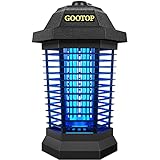
- Effectively eliminate most flying insects: Mosquito, Aedes, gnats, midges, flies, fruit flies, house flies, horse flies, moths, wasps, etc. Please use this exterminator at night and in the dark.
- EPA Registered: The bulb light attracts flying insects, and the high-voltage electric grid zaps them on contact. Efficient physical mosquito control. So you don't have to put up with the smell of sprays, insecticides and attractants. You also don't have to worry about your pets eating insects that have been killed by pesticides.
- Easy to use & Light weight : It’s very light so you can hang it everywhere you like. No warm up, Starts working when plugged in.
- Replaceable bulb & Easy to clean : Dead bugs will fall onto the tray, you just need to clean the tray with brush provided. 15W Bulb is replaceable. If your bulb becomes less effective at attracting flying insects, you can replace it.
- Area Coverage up to 1/2 Acre. Good for home, patio, balcony, courtyard, front porch, garden, pergola, deck, backyard, camping, swimming pool, garage, farm, etc.
City boundaries do not represent entire states
Mosquito conditions can vary sharply between neighborhoods, counties, and ecological settings. A result for Los Angeles does not establish conditions across California; a result for Houston or Dallas does not establish conditions across all of Texas. Treating a city entry as a state measurement would extend the evidence beyond what was measured.
The list’s geography is not a state sample
Because Washington, D.C., appears in the top eight and Texas appears twice, the entries cannot be relabeled as eight states. Removing D.C. would leave seven entries, not a measured eighth state. Adding another state from outside the list would require a new dataset rather than an inference.
What CDC mosquito maps can—and cannot—tell you
The Centers for Disease Control and Prevention’s “Potential Range of Aedes Mosquitoes” maps estimate where Aedes aegypti and Aedes albopictus could occur. The estimates use county-level records, historical records, and climate variables. They are useful for understanding potential geographic range, but the CDC expressly says the maps do not show mosquito numbers or disease-spread risk.
Rank #3

- Controls Mosquito Populations: Prevents larvae from maturing so no biting mosquitoes emerge, keeping your backyard, patio, and garden mosquito free
- Quick and Simple Setup: Just add water to activate and place in a shady area under bushes or trees for safe and hassle free outdoor mosquito prevention
- Breaks Mosquito Life Cycle: Attracts female mosquitoes to lay eggs inside the trap where larvae are eliminated, stopping future generations before they bite
- Family friendly design: Safe around kids and pets with a flat bottom for ground use or a hanging loop for trees, offering flexible placement outdoors
- Effective long term protection: Each mosquito killer trap provides up to 1500 sq ft of coverage, delivering reliable and eco friendly mosquito control for yards, porches, and patios
Actual populations can differ by state and county. A shaded county is not a count of insects, and an unshaded area is not a guarantee that no mosquitoes are present. The maps also concern two Aedes species, while local mosquito communities include other species. Consequently, map shading cannot supply the missing “eight most infested states” ranking.
How public-health programs measure local mosquito conditions
CDC surveillance guidance explains that local programs can measure vector presence and abundance. Their methods vary according to traps, sampling frequency, funding, equipment, available resources, and trained staff. Those differences make it difficult to compare one jurisdiction with another unless the collection method, time period, species, and reporting units are standardized.
A credible future state comparison would need to define its metric before naming winners. The measures below answer different questions:
Rank #4

- MOSQUITO BACKYARD CONTROL: Effectively attract and trap mosquitoes, flies, and more with this indoor bug trap that utilizes a mosquito lamp; it disrupts mosquito breeding cycles
- DURABLE WEATHER-RESISTANT DESIGN: Suitable for both indoor and outdoor fly trap use, this sturdy fly killer can keep running all season long for non-stop outdoor fly trap usage
- EASY MAINTENANCE: This Dynatrap mosquito trap features a simple catch basket that empties with the touch of a button, while also having an easy-to-change LED bulb that lasts 6x longer than regular fluorescent bulbs
- EFFICIENT INSECT LURE: Each lure in our mosquito killer outdoor trap has a whisper-quiet fan that sucks them into the basket
- WIDE COVERAGE AREA: Protects up to ½ acre, great for backyard mosquito control; ensure proper placement 3-6 ft. off the ground and 20-40 ft away from areas of enjoyment to efficiently draw insects away from family relaxation areas
| Possible metric | Question it answers | Why it cannot be substituted for another metric |
|---|---|---|
| Standardized trap counts | How many mosquitoes were collected under a stated surveillance protocol? | Results depend on trap type, placement, sampling dates, and species identification. |
| Positive surveillance locations | Where was a target mosquito detected? | Presence does not reveal abundance or biting intensity. |
| Residential treatment volume | Where did one provider perform more new treatments? | Demand and service coverage influence the total. |
| Reported bites or nuisance complaints | Where did residents report more problems? | Reporting behavior and access to complaint systems vary. |
| Disease cases | Where were human infections reported? | Cases measure illness, not the number of mosquitoes, and depend on testing and reporting. |
Until one comparable, state-level dataset is selected, a “top eight” would create false precision. The honest conclusion from the current sources is that no supported state ranking was identified.
Independent reader supportYour contribution helps us test, update, and keep practical guides available for everyone.What this means for pet owners
The city list can help explain why a household may notice intense mosquito-control activity, but it cannot predict conditions at a particular address. Even within a listed city, exposure depends on the immediate surroundings, recent weather, drainage, vegetation, screens, and standing water. A home outside the eight entries can still have a serious local nuisance problem.
Do these 3 things before closing this tab:
1Clear out junk files and repair common Windows errors2Fix the driver behind crashes, sound loss and screen glitches3Repair Windows errors before they cause bigger problemsFor households with dogs, cats, or other companion animals, the practical response is to reduce mosquito access around the property and follow product directions exactly. The available guidance supports the following measures:
Best Value

- Last Up to 2 Months: Designed for extended use, give off long lasting scent to protect your space, it fits quietly into your routine without ongoing attention. For optimal results, use in enclosed or sheltered areas away from strong airflow. For indoor use, keeping doors and windows closed may help maintain the scent longer. For outdoor use, place the product in sheltered or low-airflow locations.
- Suitable for Areas Up to 120 sq ft:Works for common likely-prone aresa like patio, deck, yard, bedroom, balconies, porches, garages, cars, RV, boats and outdoor seating areas; or while camping, traveling, fishing, etc.
- Easy to Use, No Daily Maintenance: Simply put or hang where needed and let it stay quite in your area. Or put a ball in the bedroom at night to create a natural protective space. No setup or daily attention required.
- Plant‑Based Ingredients: Plant‑derived ingredients with realistic expectations, focusing on practical everyday home and outdoor use.
- Comfortable for People, Pets for Family: Suitable when used as directed. Exclusive-designed to support everyday family spaces, just simple placement for a calmer indoor and outdoor experience.
- Remove standing water. Empty, drain, or cover containers and other items that collect water. Check the yard routinely, because small amounts of stagnant water can remain after rain or irrigation.
- Maintain tight-fitting screens. Inspect window and door screens for holes, loose edges, or gaps. Repair them so mosquitoes are less likely to enter indoor spaces where people and pets spend time.
- Use air conditioning when available. CDC technical guidance lists air conditioning among personal-protection measures. Keep doors and windows closed when the system is operating unless they are screened.
- Trim vegetation around living areas. Orkin’s prevention advice includes trimming vegetation. Keeping dense growth away from doors, windows, and pet-resting areas can make the immediate environment easier to inspect and maintain.
- Use repellents according to their labels. The guidance supports CDC-recommended repellents, but it does not establish a best brand or formula. Never assume a product intended for people is suitable for an animal; apply any animal product only when its label specifically allows that use and follow the stated directions.
- Inspect outdoor pet areas. Water bowls, toys, saucers, tarps, gutters, and low spots can all become collection points. Refresh drinking water as needed while preventing additional containers from remaining stagnant.
These steps address exposure for the whole household. They do not turn a city ranking into a diagnosis of conditions at your property, and they are not a substitute for local public-health instructions.
A practical property check for mosquito reduction
- Walk the property after rain or watering. Look for water in buckets, plant saucers, toys, tarps, clogged drains, gutters, and depressions in the ground.
- Empty or cover containers. Drain items that are not needed outdoors. For necessary containers, use a cover that prevents mosquito access and keep it in good condition.
- Check entry points. Close gaps around screened doors and windows, repair tears, and confirm that screens fit tightly.
- Reduce dense growth near the home. Trim vegetation where it touches structures or blocks inspection of pet areas.
- Review product labels before application. Confirm that a repellent or control product is labeled for the intended person, animal, location, and method of use.
- Repeat the inspection. Conditions change after every storm, irrigation cycle, or landscaping project, so a one-time cleanup may not remain effective.
How to interpret headlines about “the worst mosquito states”
Before accepting a ranking, check five details:
- Unit: Is it ranking states, counties, cities, properties, or service territories?
- Measurement: Does it count mosquitoes, traps, treatments, complaints, bites, or disease cases?
- Time window: Are the figures from a defined year, a season, or multiple years?
- Coverage: Are all states sampled with the same method, or only locations served by one organization?
- Qualification: Does the publisher warn that potential range is not abundance or disease risk?
If those details are missing, the headline may be using “infested” as a broad description rather than a measured scientific category. The 2026 Orkin list supplies a clear time window and metric, but its metric is treatment activity in named cities.
What the current evidence supports
The strongest supported statements are narrow. Orkin’s 2026 list places Los Angeles, Chicago, New York, Detroit, Atlanta, Washington, D.C., Houston, and Dallas in its top eight for new residential mosquito treatments during March 18, 2025–March 18, 2026. The list does not rank states, count mosquitoes, or measure disease risk. CDC potential-range maps describe where two Aedes species may occur, not how many mosquitoes are present. CDC surveillance guidance identifies local monitoring as the way to assess vector presence and abundance, with methods that vary among programs.
For a pet owner, the useful takeaway is not that one of those states is definitively “the most infested.” It is that mosquito conditions are local, the available national proxy has strict limits, and basic measures—screens, reducing standing water, appropriate repellents, air conditioning, and vegetation maintenance—can reduce exposure around the home.
Quick Recap
Product prices and availability are accurate as of the date/time indicated and are subject to change. Any price and availability information displayed on Amazon at the time of purchase will apply.





Leave a Reply