
Humans see only a narrow slice of the light spectrum. Many animals detect wavelengths shorter than visible violet—ultraviolet (UV) light—and use that information to navigate, find food, choose mates, recognize signals, or capture prey.
But “seeing UV” does not mean the same thing for every species. Some animals have dedicated UV-sensitive photoreceptors and demonstrated UV-guided behavior. Others have eyes that transmit UVA to the retina, showing physiological sensitivity without proving that the animal experiences UV as a separate color. Here are nine animals with the clearest evidence.
As an Amazon Associate I earn from qualifying purchases.
Humans see only a narrow slice of the light spectrum. Many animals detect wavelengths shorter than visible violet—ultraviolet (UV) light—and use that information to navigate, find food, choose mates, recognize signals, or capture prey.
Recommended Free Tools
But “seeing UV” does not mean the same thing for every species. Some animals have dedicated UV-sensitive photoreceptors and demonstrated UV-guided behavior. Others have eyes that transmit UVA to the retina, showing physiological sensitivity without proving that the animal experiences UV as a separate color. The nine animals below represent both situations, with the evidence clearly labeled.
#1 Best Overall
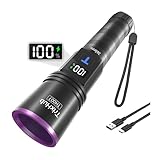
- 【Professional 365 UV Flashlight】Extreme Power 30W 365NM UV black light flashlight for detecting any scenario involving fluorescent substances or invisible stains such as pet-dried urine stains on rugs, carpets, which make it become a professional black light for some professional use! Our uv flashlight rechargeable is very powerful, so please do not shine into your eyes when using 365nm uv light.
- 【USB-C Charging & Digital Display】UV black light flash light connect to the power supply via the USB-C interface and charge at any time. UV light for ac system also equipped with a digital battery level screen to monitor the battery status of the uv curing light in real time, ensuring that the flashlight is always in the best working condition.
- 【Sturdy & Waterproof】Ultraviolet blacklight is made of reliable and impact-resistant aluminum alloy. Black light flashlights waterproof technology and seal design greatly enhanced its heat dissipation performance, will not burning hot even if used uv flashlight 365nm for a long time, uv flash light perfect for portability during outdoor adventures or indoor inspections.
- 【Wide Range of Applications】Outdoor Adventures: Searching for rocks, scorpion hunting, mineral and insect searches;Home Detection: Pet urine inspection, ringworm/bed bug detection, hotel/bathroom/kitchen cleaning, food stains/fluorescent material detection;Professional Uses: UV resin curing, air conditioner leak detection, ID and currency authentication, uranium glass inspection, UV coatings, golf ball searches, etc.
- 【Powerful Ultraviolet Flashlight】Black lights flashlight with its precise wavelength, digital battery level display function, rechargeable design, robust and durable quality, and wide range of application scenarios, it brings you a brand-new usage experience. It is not only a uv flashlight, but also a little assistant in your life, helping you discover those overlooked details and embark on your exploration journey!
What counts as UV vision?
Ultraviolet generally refers to wavelengths shorter than the human-visible range, with the biologically important boundary often placed at approximately 400 nanometers (nm). Researchers can investigate an animal’s capacity to detect UV at several levels:
- Behavioral evidence: the animal responds differently when UV is present, absent, or changed.
- Electrophysiological evidence: a photoreceptor or retina responds to UV wavelengths.
- Molecular evidence: the animal produces an opsin or visual pigment associated with UV sensitivity.
- Optical evidence: the cornea and lens allow UVA to reach the retina.
Behavioral and electrophysiological evidence are the clearest demonstrations that an animal uses UV information. Molecular and optical evidence show visual capacity or sensitivity, but they do not by themselves reveal what the animal’s subjective visual experience is like.
1. Honeybee (Apis mellifera)
Honeybees are among the best-established examples of UV vision. Their compound eyes contain separate ultraviolet-, blue-, and green-sensitive receptor types, forming a trichromatic system that differs from the human red-green-blue system. Specialized UV-sensitive receptors also occur in parts of the eye involved in detecting polarized skylight.
Quick wins for a faster PC:
Fix the driver behind crashes, sound loss and screen glitchesFind Drivers →Repair Windows errors before they cause bigger problemsFix Now →That UV information is not merely a laboratory curiosity. Honeybees can discriminate orientations of polarized UV light, which helps them use the sky as a compass while flying—even when the Sun itself is partly obscured. UV patterns can also contribute to how bees locate and assess flowers.
Some flowers that look uniformly colored or relatively plain to humans contain UV-reflecting and UV-absorbing regions. These patterns may help guide pollinators toward a flower’s reproductive structures or nectar, but they are not universal “bullseyes”: the pattern depends on the plant species and flower.
2. Bumblebee (Bombus terrestris)
Bumblebees also possess UV-sensitive photoreceptors. Comparative studies of bumblebees and honeybees have measured UV receptor responses directly, placing both familiar pollinators within a broader insect visual system built around UV, blue, and green channels.
This matters because UV vision is not a special trick belonging only to honeybees. Across many hymenopterans, it can support flower detection, color discrimination, orientation, and the interpretation of visual signals. A bumblebee therefore does not simply see a flower as a smaller version of the image a human sees; its visual system samples an additional part of the spectrum.
The practical benefit varies with lighting, flower species, and the task the bee is performing. UV is one source of information among several, not a magic overlay applied equally to every object.
Rank #2

- [UPGRADED BRIGHT UV LIGHT BEAD]: Made of upgraded powerful UV LED bead, with high power of 10W and 1300mW radiant intensity. The 365nm Light is a real invisible uv light that is not dazzling. It doesn't look as bright as 395nm because it is invisible to human’s eye. But, when it irradiates items containing fluorescent agents, security code or watermark, it will show obvious blue-violet light.
- [FILTERED UV 365NM LIGHT]: More Obvious Detection Effect. Equipped with hard toughened black filter optical lens that can filter out purple visible light, and release purer invisible ultraviolet light for demanding detection needs. Without disturbing visible violet light, just enjoy your more efficient searching like rocks hounding or antique appraisal.
- [MINI BUT POWERFUL ULTRAVIOLET LIGHT]: Compact enough to fit in your purse or pocket. You will definitely be impressed with this combination of mini size & powerful output is a good pick for daily use. Not afraid of losing, can easily put into pocket, backpack, toolbox, your car or hang on your wrist . High-quality aluminum alloy case, greatly enhance heat dissipation performance and make flashlights more reliable.
- [BUILT-IN RECHARGEABLE BATTERY POWERED]: The UV 365nm Flashlight is powered by built-in rechargeable battery (1h runtime, 1h charging time). The USB - C direct charge design saves you quite a bit of money in future. Conveniently charge this uv light via your adapter, power bank, laptop and other USB devices, the charging voltage of no more than 5V/2A will prevent the item from internal wiring failure.
- [READY FOR YOUR NEED]: It’s a needed multifunctional black light in your life -- Detecting dried urine, stains; Curing UV resin and green oil; Glow uv paints, reactive minerals and uranium glass; Banknote / gem appraisal; Locate hidden cracks, glue, AC leak etc.
3. Japanese yellow swallowtail butterfly (Papilio xuthus)
The Japanese yellow swallowtail has an unusually complex visual system. Its eyes contain photoreceptors sensitive to ultraviolet, violet, blue, green, and red wavelengths, along with broad-band receptors. In other words, UV is one channel in a larger color system—not the whole of the butterfly’s vision.
That distinction is important. Saying that a butterfly “sees UV” does not mean that all its colors would simply look brighter to it, or that humans can reproduce its view by adding a purple filter. The butterfly’s brain combines signals from multiple receptor types, and the resulting color distinctions may not have a direct human equivalent.
For a butterfly searching for flowers or assessing visual signals, UV information can be integrated with ordinary visible-light cues. Its broader receptor set illustrates how evolution can build a more finely divided spectral system than the one found in humans.
PC Slower Than It Used to Be?
A free scan shows the junk files, broken settings and background clutter dragging Windows down - then fixes them in one click.Free scan · Windows 10 & 11Outdated Drivers Are Slowing You Down
One free scan finds every outdated or missing driver and matches the right update for your exact hardware.Free scan · exact hardware match4. Zebrafish (Danio rerio)
Zebrafish have UV-sensitive cones with peak sensitivity near 360 nm. In larvae, these specialized cones are positioned and connected in a way that helps the young fish detect UV-bright prey in the upper frontal part of the visual field.
This is one of the most concrete examples in the list because the evidence connects the receptor to a specific behavior: UV vision makes a substantial contribution to visually guided prey capture. The fish is not merely carrying a UV-related gene or possessing a lens that happens to transmit short wavelengths. Its visual system is arranged to help solve a feeding problem.
For a tiny larval fish hunting near the water’s surface, detecting a small, UV-contrasting organism against the background can be valuable. As with the insects above, the UV channel works alongside other visual information rather than replacing it.
5. Chilean cururo (Spalacopus cyanus)
The Chilean cururo is a subterranean rodent with a UV-sensitive cone whose peak is near 365 nm. Its cornea and lens transmit near-UV wavelengths, and its retina retains a meaningful population of cones despite the animal’s underground lifestyle.
That combination challenges the simple assumption that every burrowing mammal has severely reduced eyes and little useful vision. Underground environments are dim, but they are not necessarily visually irrelevant: cururos may still encounter openings, surface light, tunnel entrances, or visual marks.
Rank #3

- 【PROFESSIONAL TIPS】1. Genuine 365nm UV light does not make blood "glow", but creates high-contrast shadows against the background to effectively aid tracking. 2. Our 365nm uv flashlight can detect dried blood! Fresh blood appears dark brown, dark black or dark purple areas under a 365nm UV flashlight, regular lighting flashlight is recommended for fresh blood for clearer visibility; 3. This UV flashlight 365nm is a professional detection tool, not an illumination device.
- 【30W 4-CORE STRONG UV LIGHT | EXPLORE FARTHER & SAFER】While conducting surveys in the desert at night, are you concerned about scorpions heading to you? Our G1979 UV flashlight uses 4-core 365nm UV LED source, and multi-layer black uv filter lens effectively filters 99% other lights to enhance UV light. up to 30W output, the high power blacklight can providing a long beam up to 30ft in the dark. It enables you to detect threats from a long distance at earlier, ensuring your personal safety.
- 【UPGRADE 365NM UV FLASHLIGHT | PURER BLACK LIGHT THAN 395NM】Trapped in excessive purple glare from standard 395nm lights when detecting the currency/IDs/licenses/jewels ? Our 365nm black light flashlight features a multi-layer filter lens that blocks 99% of visible light, delivering superior UV purity and stronger fluorescence, ensures faster, more reliable results with minimal uncertainty. The uv light flashlight also used for uv resing curing, uranium glass, A/C leak detection.
- 【2-HOUR CHARGE, 10-HOUR RUNTIME | WORRY-FREE POWER 】Do you often frustrating during deep cleaning at home that your usual uv light drains too quickly and charges too slowly, causing long waits when detecting pet urine stains on carpet and sofa or checking for bed bugs on bed? Our black light for pet urine detection features USB-C fast charging (full in 2 hrs) and USB-A output as a portable power. This powerful flashlight offers 10 hours runtime (only 1 high mode, non-focusing).
- 【Precise ±1% LCD DISPLAY | EASE UNEXPECTED POWER OFF ANXIETY】Are you often anxious about unexpected shutdowns due to uncertain remaining power when searching for rocks/minerals/scorpions/insects/blood tracking outdoors? Our 365nm uv flashlight rechargeable equipped with upgraded LCD power percentage display shows remaining power exactly, you can easily and accurately know the remaining power, No need to worry about the blacklight flashlight suddenly running out of power and shutting off.
Researchers also found that cururo urine reflects UV strongly. This raises the possibility that scent marks could have a visual component in addition to their chemical function. That is an ecological interpretation, not a settled demonstration that cururos routinely use UV-reflecting urine as a visual sign. The stronger conclusion is that the animal’s eye has the optical and retinal features needed for UV sensitivity.
6. Seba’s short-tailed bat (Carollia perspicillata)
Seba’s short-tailed bat has S-opsin cones and measurable elevated sensitivity to UV wavelengths. It is one of the phyllostomid bats directly examined in research on bat UV sensitivity.
UV detection could offer several potential advantages for a bat active during twilight or in low-light conditions. Researchers have suggested possible roles in orientation, predator avoidance, and finding UV-reflecting flowers. Those are plausible ecological benefits, not proof that every flight path or feeding decision depends on UV.
The bat example is also a useful reminder that nocturnal animals do not automatically lose all cone-mediated vision. A bat’s main sensory specialty may be echolocation, but its eyes can still retain specialized visual channels that are useful under the right conditions.
7. Pallas’s long-tongued bat (Glossophaga soricina)
Pallas’s long-tongued bat is another phyllostomid bat directly studied for UV sensitivity. This nectar-feeding species has UV-sensitive cones, giving it the physiological prerequisites for detecting UV information during twilight or nectar foraging.
Flowers and nectar-related cues can interact with UV light in ways that are invisible to humans. A bat visiting flowers may therefore receive visual information that is absent from an ordinary human description of the same scene. The most defensible claim is that UV sensitivity may assist flower detection or other low-light tasks—not that every flower is marked with a bat-visible UV signal, or that UV is necessarily the bat’s primary way of finding nectar.
Unlike the common vampire bat, which is sometimes included in casual lists of UV-seeing animals, G. soricina was directly examined in the cited bat research. Keeping the species precise matters: evidence from a related bat cannot automatically be presented as a measurement in every member of the family.
Do these 3 things before closing this tab:
1Repair Windows errors before they cause bigger problems2Fix the driver behind crashes, sound loss and screen glitches3Clear out junk files and repair common Windows errors8. Budgerigar (Melopsittacus undulatus)
Budgerigars belong to the parrot group, whose UV-sensitive vision has strong molecular and optical support. Across a study of 14 parrot, macaw, and cockatoo species, researchers identified a substitution associated with UV-sensitive SWS1 visual pigments, alongside lens transparency compatible with transmitting UV to the retina.
Rank #4
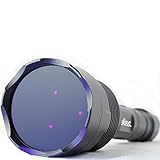
- COUNTERFEIT sold by muchensiliao. Check sold by uvBeast. Ready for operation out of the box
- WHY uvBeast V3 365nm? Our users wanted more intense 365nm UV and more range for better results. Our new design intentionally aims to fill those gaps. (1) The popular and in-demand V3 spec now emits even higher quality UV at 365nm wavelength. (2) More bang for your buck with filtered UV. This isn’t cheaper unfiltered UV. (3) Unbeatable long range (60 feet+) and a high intensity 365nm beam unlike others.
- PROFESSIONAL GRADE FILTERED 365nm. This is High Flux Density 365nm wavelength that professionals use. We know. We supply them. This is NOT to be confused with longer wave 395nm devices. Nor is it to be confused with unfiltered 365nm UV. Most excitation occurs at 365nm which means you’re getting superior results to most users. 395nm cannot compete with 365nm devices. The on-board UV filter blocks unwanted visible light but allows max transmission of pure 365nm UV. This is UV at its purest
- OUR HIGHEST INTENSITY 365nm DEVICE. Higher UV Flux Density than most 365nm devices currently on the market. 365nm is the gold standard for UV flashlights. There's limited market choice in high flux density 365nm UV. So we made one with superior UV. The V3 365nm has TRIPLE LEDs at 1000 mA each emitting 1800 uW/cm2 of UV radiant intensity. That’s a whopping total of 5400 uW/cm2 of UV intensity at 365nm
- UNLIKE OTHERS THIS IS LONG RANGE 365nm UV. A high intensity 365nm device which can emit a beam out to 60 feet plus is hard to find. We know, because our users have told us. We’ve filled this gap with the V3 365nm to change the game for those who want results at long range with UV 365nm purity
In parrots, UV sensitivity may contribute to visual signals used in social communication, mate choice, feather assessment, or foraging. The exact role can differ between species and situations, so it is better to say that the visual system makes UV-based distinctions possible than to assign one universal purpose to all parrots.
A pet budgerigar’s UV sensitivity also does not mean that a household UV lamp recreates its view. The bird’s retina, brain, lighting environment, and other receptor types all shape its perception. A photograph or color filter cannot reliably show a human what a budgerigar experiences.
Independent reader supportYour contribution helps us test, update, and keep practical guides available for everyone.9. Three-spot damselfish (Dascyllus trimaculatus)
The three-spot damselfish has a near-UV visual pigment. In this marine environment, UV sensitivity may help the fish detect zooplankton during foraging, although the ecological role should be described as a proposed advantage rather than an assumption about every individual’s behavior.
It is also useful to distinguish UV vision from “seeing through water.” Water absorbs different wavelengths at different rates, and the available light changes with depth, turbidity, time of day, and habitat. A near-UV channel can be useful in a particular visual niche without giving the fish a universally superior view.
Other damselfishes show how flexible this system can be. Pomacentrus coelestis also has a measured UV pigment, while Chromis punctipinnis has a near-UV pigment in adults but a violet-sensitive pigment in juveniles in the cited research. That developmental difference is a reminder that visual systems can change with age and ecological needs.
What about dogs and cats?
Comparative optical measurements indicate that dog and cat lenses transmit significant amounts of UVA. That means some UVA can reach the retina, making physiological UV sensitivity plausible. It does not establish that dogs or cats have a dedicated UV cone, or that they perceive UV as a vivid, independent color in the way honeybees use a UV receptor channel.
For that reason, dogs and cats are weaker examples than the nine species above if “can actually see in UV” means demonstrated UV-guided perception. They may detect some UVA through the eye, but lens transmission alone is lower on the evidence hierarchy than a measured photoreceptor response combined with behavior.
The Tool Desk
Outbyte Driver Updater FREEFix the driver behind crashes, sound loss and screen glitchesFind Drivers →Outbyte PC Repair FREEClear out junk files and repair common Windows errorsFree Scan →Can you see what these animals see?
Not exactly. Human eyes do not normally detect UV, and an image made with a UV-sensitive camera is a measurement that must be translated into visible colors. There is no single scientifically correct human-visible reconstruction of a bee’s, butterfly’s, fish’s, or bat’s experience.
Best Value

- 【ADVANCED UV IDENTIFICATION TECHNOLOGY】UV blacklight flashlight identification light is outfitted with 365nm UV light and an upgraded lamp bead setup. Boosts the light's intensity and consistency, enabling highly accurate identification. It is far better than ordinary UV lights, which are often lack of the power or precision to reveal subtle details. Whether you're checking for hidden marks or verifying authenticity, this uv flashlight delivers clear and reliable results.
- 【RECHARGEABLE UV FLASHLIGHT & LCD POWER DISPLAY】The black light for pet urine detection fully recharges in 3-3.5 hours and delivers 4 hours of use, uv light supports USB input for charging. Black light flashlight clear LCD digital screen shows real-time battery percentage - no more guessing remaining power!
- 【DURABLE AND USER-FRIENDLY DESIGN】Built to last, the UV light flashlight features a robust construction that can withstand regular use. Blacklight flashlights also come with a convenient lanyard, allowing for easy carrying. Waterproof technology and seal design, whether you’re taking uv light flashlight on a trip to check antiques or using blacklight for pet urine around the house for various inspections, portability and durability make it a practical tool.
- 【WIDE RANGE OF APPLICATIONS】Outdoor Adventures: Searching for rocks, scorpion hunting, mineral and insect searches; Home Detection: Pet urine inspection, ringworm/bed bug detection, hotel/bathroom/kitchen cleaning, food stains/fluorescent material detection; Professional Uses: UV resin curing, air conditioner leak detection, ID and currency authentication, uranium glass inspection, UV coatings, golf ball searches, etc.
- 【WHAT YOU WILL GET】 1*UV Light Flashlight, 1*USB-C Charging Cable, 1*User Manual. You can always contact us through Amazon if you have any questions, our professional team will immediately solve your problem.
UV fluorescence adds another source of confusion. When a material fluoresces, it absorbs UV and emits longer-wavelength visible light. That glowing appearance is not the same as an animal detecting UV light reflected directly from the material. A flower, feather, mineral, or fabric can fluoresce under a lamp without producing the same signal it would produce in natural daylight.
The takeaway
UV vision is best understood as a set of biological solutions rather than one shared superpower. Honeybees and bumblebees use dedicated UV receptors as part of a pollinator visual system. The Japanese yellow swallowtail combines UV with several other spectral channels. Zebrafish connect UV-sensitive cones to prey capture, while the cururo retains near-UV sensitivity despite living underground. Two phyllostomid bats, a parrot, and a damselfish show that UV sensitivity also occurs in nocturnal, avian, and marine visual systems.
What’s actually slowing this PC down?
Pick the symptom - the matching free tool is one click away.
The key question is not simply whether an animal “sees UV.” It is what evidence exists, what wavelengths reach its retina, and what the animal does with that information.
Frequently Asked Questions
What is ultraviolet light?
UV generally means wavelengths shorter than human-visible violet, commonly below about 400 nanometers. UVA is the longest-wave portion of UV and is the part most relevant when discussing whether an animal’s eye transmits UV to the retina.
Do animals see UV as a distinct color?
No. Some animals have dedicated UV-sensitive photoreceptors and demonstrated UV-guided behavior. In others, researchers have shown only that the eye’s optical tissues transmit UVA. That supports sensitivity, but it does not prove the animal experiences UV as a separate color.
Can a UV camera show me what a bee sees?
Not reliably. UV-camera images are translated into colors humans can see, and there is no single correct reconstruction of another species’ subjective vision. Fluorescence under a UV lamp is also different from directly detecting reflected UV in daylight.
Free tools Windows power users keep installed
One-click scans. No signup required.
Can dogs and cats see ultraviolet light?
Dogs and cats have lenses that transmit significant UVA, so some UV sensitivity is physiologically plausible. However, lens transmission alone does not prove that they have dedicated UV cones or perceive UV as an independent color channel.
The Bottom Line
Several animals have directly measured UV-sensitive photoreceptors and UV-dependent behavior, including honeybees, bumblebees, Japanese yellow swallowtails, and zebrafish. Other species have strong physiological evidence of UV sensitivity but less direct evidence about how they use it. None should be assumed to see UV as a human-like extra color.
Quick Recap
Product prices and availability are accurate as of the date/time indicated and are subject to change. Any price and availability information displayed on Amazon at the time of purchase will apply.





Leave a Reply