The Catahoula Leopard Dog is a muscular Louisiana working dog with a short coat, striking eyes, and a serious approach to its job. It was developed to track, bay, herd, bay up feral hogs, guard property, and work independently—not simply to look unusual.
That background still shapes life with the breed. A Catahoula may be affectionate and playful with its family while remaining territorial, reserved with strangers, and selective about other dogs. Its coat is relatively easy to care for; its exercise, training, and socialization needs are not. This breed is generally a better fit for an experienced, structured owner who can provide meaningful daily activity.
Catahoula Leopard Dog at a glance
| Characteristic | What to expect |
|---|---|
| Other names | Louisiana Catahoula Leopard Dog, Catahoula Cur, Catahoula Hog Dog, and Catahoula Hound |
| Pronunciation | Commonly “Cat-a-who-la” |
| Adult size | About 22–24 inches and 50–95 pounds according to the AKC; registry standards vary |
| Life expectancy | Approximately 10–14 years |
| Coat | Short to medium, close-lying, and generally easy to maintain |
| Energy level | High; requires physical exercise and mental work |
| Typical temperament | Loyal, independent, protective, territorial, and often reserved with strangers |
| Grooming needs | Relatively low for the coat, but regular ear, nail, and dental care is still needed |
Height figures differ between registries. The UKC gives ideal mature heights of 24 inches for males and 22 inches for females, with a two-inch allowance in either direction, while NALC lists a wider range: 22–26 inches for males and 20–24 inches for females. These are differences between breed standards rather than evidence that one source is describing a different dog.
History and original purpose
The breed developed in Louisiana as an all-purpose working dog. Catahoulas were used to trail and tree game, guard, hunt, and work cattle and feral hogs. When working livestock, they may use movement, presence, and vocalization to control animals rather than relying on the close, biddable style of a traditional herding breed.
#1 Best Overall
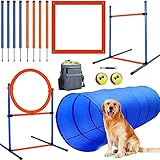
- UNIQUE & HEALTH: Running, jumping, playing, and most of exercising for maximum dog agility. Whether training for competition or just for fun, you should own this dog agility equipment kit to build trust with your pets and keep them healthy!
- PREMIUM & STURDY: This dog agility course is made of ABS material, safe and sturdy that can be used in the park or backyard. Its collapsible tunnel is made of 190T tear-resistant polyester, even if scratched by the paws, there will no large-scale damage!
- LIGHTWEIGHT & EASY INSTALL: The agility training equipment for dogs is easy to set up and take down without tools in just minutes! It is lightweight for carrying to the outdoor or the indoor big stage. The convenient dog treat pouch will easily store training treats and your stuff when training or walking the dog!
- FUN & CREATIVE COMBINATION: Perfect for dogs that sharpen obedience, speed, and dexterity; JMMPOO dog obstacle course has everything supplies you need to get going and is recommended for (small/ Medium/ large) dogs of any age! What a great way to spend time with your pet!
- GREAT GIFT IDEAS: This fantastic doggie agility set is a great gift idea for young and old dog lovers! It included an agility tunnel, 8 weave Poles, adjustable agility hurdle, jump rings, a square pause box, a whistle, 2 pet tennis ball toys,1 dog treat pouch and 2 carrying cases!!
The breed’s ancestry is not established with certainty. Historical accounts propose contributions from Native American dogs, dogs brought by Spanish explorers, and possibly Beaucerons. The UKC describes red-wolf involvement as a belief, not proven fact. The honest summary is that the Catahoula’s origins are partly unknown.
Louisiana named the Catahoula its official state dog on July 9, 1979. The breed is registered with organizations including the United Kennel Club and the National Association of Louisiana Catahoulas. In the United States, it is recorded in the AKC Foundation Stock Service and placed in the Herding Group, but it is not fully AKC-recognized or eligible for standard AKC registration. FSS recording is an optional record-keeping service, not full AKC recognition.
Appearance: more than a leopard coat
Catahoulas are medium to medium-large dogs with a powerful, athletic build. They are muscular and deep-chested without being excessively bulky, with strong legs suited to endurance and agile movement. The body is generally slightly longer than tall. Drop ears, a broad head, and a natural tail are typical features.
The breed’s coat may be leopard, solid, brindle, or patchwork. Despite the name, not every Catahoula has a leopard pattern. Eyes may be brown, blue, amber, green, or combinations of colors, including mismatched eyes. Blue eyes and a patterned coat are eye-catching, but they do not determine whether a dog is healthy, well-bred, or capable of working.
Quick wins for a faster PC:
Clear out junk files and repair common Windows errorsFree Scan →Scan for outdated or missing drivers - takes under a minuteDriver Scan →Repair Windows errors before they cause bigger problemsFix Now →UKC standards permit a natural bobtail but do not prefer it; a completely tailless dog is disqualified under that standard. The same standard does not prefer one acceptable coat color or pattern over another, although excessive white, a solid white head, albinism, and certain other appearances are disqualified.
Color should never be the main reason to choose a Catahoula. Temperament, hearing, eye health, structure, and the dog’s suitability for your household matter much more than whether its coat resembles a patch of marble.
Temperament and behavior
A well-bred Catahoula is loyal and affectionate with its household, but it is not necessarily socially easygoing. The breed standard describes it as independent, protective, and territorial. Many dogs are cautious or aloof with unfamiliar people. Some are intolerant of unfamiliar dogs, especially when introductions are rushed or when the dog is allowed to manage social situations on its own.
Rank #2
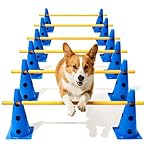
- Build Your Dog's Agility Course: Includes 12 cones & 6 durable rods. Mix and match to create endless training layouts!
- Adjustable Heights for Every Dog: Our agility hurdle cone set stand at 12 inches tall. Easily set jumps at 3 different heights (2", 5.5", 9") using the rods – perfect for puppies to pros!
- Premium Durability & Portability: This dog agility training set is made of lightweight plastic. Cones nest together for compact storage, and the whole set sets up or packs away in seconds – perfect for indoors or backyard fun!
- Versatile Training :This dog agility course backyard set create jumps, weave poles, or zig-zag tunnels! Transform your space into a stimulating agility course that keeps your dog engaged and excited to learn. And the lowest height allows the dog to undergo good rehabilitation training.
- Boost Agility & Bonding Time: Watch your dog gain confidence, speed, and coordination! This dog agility equipment strengthens your connection while providing essential physical & mental exercise.
At home, the same dog that works with intense concentration may be playful, funny, and devoted. This contrast can surprise first-time owners: affection for family does not automatically translate into friendliness toward every visitor.
Recommended Free Tools
Early socialization is important, but it is not a guarantee that an adult Catahoula will want to greet strangers or play with every dog. Socialization should teach the puppy how to remain calm and responsive around different people, animals, surfaces, sounds, and environments. It should not force interactions. The AKC describes the breed’s compatibility with young children and other dogs as variable, not universally easy.
- Use a leash, barrier, or crate when visitors arrive until the dog is settled.
- Introduce unfamiliar dogs in a controlled neutral area rather than at a doorway or over a food bowl.
- Supervise all interactions with children, particularly young children.
- Do not allow children to climb on, corner, hug, or disturb the dog while it eats or rests.
- Get professional help early if the dog shows guarding, lunging, escalating fear, or aggression.
The breed standard rejects both excessive shyness and unwarranted viciousness. A Catahoula that is persistently fearful or dangerously aggressive needs careful behavioral assessment, not punishment.
Exercise and mental stimulation
This is a high-energy working breed. A fenced yard is useful, but opening the back door is not an exercise plan. Without enough activity, interaction, and problem-solving, a Catahoula may dig, chew, bark, or invent its own jobs.
Good outlets include hiking, swimming, retrieving, structured walks, scent work, obedience, rally, agility, and suitable stock or hunting activities. The AKC describes the breed as an excellent swimmer, but water should be introduced safely and supervised. Activities should match the dog’s age, physical condition, training, and temperament.
What’s actually slowing this PC down?
Pick the symptom - the matching free tool is one click away.
There is no single verified daily exercise duration that suits every Catahoula. A young, healthy working-bred dog may need substantially more activity than an older companion. The useful test is whether the dog can settle after a satisfying combination of movement, training, and rest—not whether you have completed a particular number of minutes.
Apartment living and a sedentary household are generally poor matches, according to the AKC. This is guidance, not an absolute prohibition: an individual dog’s needs and behavior depend on age, health, training, and daily management. Limited space does not remove the need for substantial daily activity or make territorial behavior easier to manage.
Rank #3

- RUGGED & STURDY:Our product is durability, the training pole is made of ABS material,which is safe and sturdy,that can be used in the park or backyard. In addition, our u-shaped ground nail ensure that each agile pole remains stable on the ground, providing the best stability even during intense running and jumping processes!
- LIGHTWEIGHT & EASY INSTALL: It can be assembled and removed in just a few minutes without any tools, and there are 2 free storage bags for you to take outdoor or indoor. When you train or walk your dog,and our little toys are all great fun for you and your pet.
- HEALTH & FUN:Running, jumping, playing and crossing obstacles can improve your dog's agility and flexibility, make your dog more active and health, and getting closer between you and your pet. What a great way to spend time with your pet!
- SUITABLE For EVERYONE:This adjustable dog agility training set is suitable for dogs of any age (large/medium/small). The perfect 11-piece obstacle training set allows beginners and experts to freely choose their training mode, to complete their dog's agility training course.
- INDOOR & OUTDOOR USE:Our dog agility kit allows you to use it in any indoor or outdoor setting, such as the living room, hallway,backyard, garden, etc. It is easy and portable, and will not affect the fun of your pet's training and play, regardless of the weather!
Training a Catahoula
Start training and socialization early. Use rewards, repetition, clear boundaries, and routines that the dog can understand. Catahoulas are intelligent, but intelligence is not the same as automatic obedience. Their independent working history means they may assess a situation for themselves rather than immediately doing what a handler asks.
- Teach practical basics first. Prioritize name response, recall, loose-leash walking, leave it, place, wait, and a reliable way to return to you around distractions.
- Reward calm behavior. Reinforce quiet settling, looking at a visitor without rushing forward, and disengaging from dogs or wildlife.
- Use controlled challenges. Increase distance, duration, and distractions gradually instead of testing the dog in situations it cannot yet handle.
- Give the dog a job. Short scent searches, retrieving exercises, obedience patterns, and problem-solving games can make training more satisfying.
- Keep development in mind. A Catahoula may look and work like an adult at around 10 months, but the AKC notes that full maturity may not arrive until about 2 years.
Do not use harsh physical corrections. The AKC warns that a Catahoula may assert itself in self-defense if mistreated. Firm guidance means consistent rules and follow-through, not intimidation. Keep exercise and training age-appropriate and enjoyable to avoid burnout during adolescence.
Free tools Windows power users keep installed
One-click scans. No signup required.
Grooming and routine care
The short to medium coat is relatively simple compared with that of a long-haired or heavily coated breed. Brush about once a week to remove loose hair and dirt. Bathe when the dog is dirty or has been active outdoors rather than following a rigid calendar.
The maintenance routine should also include:
- Nails: Trim regularly. Catahoulas have strong, fast-growing nails that can overgrow, split, or crack.
- Ears: Check the drop ears for wax, debris, odor, redness, or discharge. Ask a veterinarian how to clean them safely rather than inserting cotton swabs deeply.
- Teeth: Brush regularly with dog-safe toothpaste and arrange veterinary dental care when recommended.
- Skin and feet: After hikes, hunting, swimming, or rough outdoor work, check for cuts, thorns, ticks, and irritated areas.
“Low-maintenance coat” does not mean “low-maintenance dog.” The time saved on brushing is easily replaced by training, exercise, supervision, and behavioral management.
Health concerns
Most Catahoulas are healthy, but the AKC identifies hip dysplasia, deafness, and eye problems as concerns that have occurred in the breed. These are risks to investigate, not conditions that every Catahoula will develop.
Deafness
Congenital deafness is a recognized concern, particularly in dogs with certain white-pigmentation and merle patterns. It may affect one ear or both. A puppy with unilateral deafness can respond normally to household activity because its good ear compensates, so casual observation is not a dependable hearing test.
BAER—brainstem auditory evoked response—testing is the commonly used definitive evaluation. Ask for documented hearing results rather than accepting a statement that a puppy “hears fine.” A deaf dog can live well with appropriate visual cues and management, but the household needs to know the dog’s hearing status before making plans.
Rank #4

- 【Unique 2-In-1 Design】Space & Value Saver ! 6 weave poles【with base】 can be easily switched to 6 ground-nails weave poles【adjustable spacing and stays in wind】.Suitable for indoor and outdoor and various training modes
- 【Complete Agility Training Kit】It includes : 2 adjustable jump hurdles,jump ring, dual modes weave poles(used on grass and hard surface),1 tunnel and 1pause box,a dog treat pouch and 2 toy balls.Suitable for (small/ Medium/ large) dogs of any age
- 【Portable & Easy Storage】Hit the park, yard,with it! This kit comes with 2 heavy-duty carry bags,which is easy for you to store and transport.And the agility training equipment for dogs is easy to set up and take down without tools in just minutes
- 【Safe & Sturdy Construction】Train with confidence!This agility course are made from safe,sturdy and lightweight materials(ABS and PE) . the tunnel use 190T tear-resistant polyester. Built to hold up to energetic training sessions.
- 【Great Backyard Training Partner】Ideal for yards, parks, or indoor spaces! A good choice for beginner dogs and pet owners to build confidence, boost agility, and enjoy bonding time. Help your dog exercise, stay health, burn energy, and have fun
Eye disease
OFA lists the Louisiana Catahoula Leopard Dog among breeds for which eye certification is relevant and recommends a preliminary eye examination before pharmacological dilation to help identify certain disorders. Conditions associated with the breed include iris coloboma and persistent pupillary membrane. Eye color alone cannot diagnose either condition.
A routine eye certification examination does not identify every possible eye disorder. If a veterinarian suspects glaucoma, retinal disease, or another problem, additional examination or testing may be needed. Ask for records from an appropriate veterinary ophthalmology program when evaluating a breeding dog.
Hips and breeder screening
Before buying a puppy, search OFA records for the sire, dam, and relatives where possible. Ask specifically about hip evaluations, eye examinations, hearing testing when appropriate, and other testing recommended for the line. The AKC describes health screening as potentially including radiographic evaluations, eye examinations, cardiac testing, and other breed-relevant assessments; ask the breeder which tests apply to the parents.
A CHIC number is not a disease-free certificate. It indicates that required tests were completed and made public; it does not mean every result was normal. Request the actual results and ask the breeder to explain abnormalities rather than relying on a badge, registration claim, or verbal assurance.
Independent reader supportYour contribution helps us test, update, and keep practical guides available for everyone.Feeding and weight management
Feed a complete diet appropriate for the dog’s life stage, size, activity, and health. Puppies, adults, seniors, highly active working dogs, and neutered dogs may not need the same calorie intake. Keep fresh water available at all times.
There is no universal Catahoula feeding amount. Begin with the food label as a starting point, then adjust according to body condition, weight trend, activity, and veterinary advice. Some Catahoulas may become overweight, particularly when treats and exercise are not balanced.
If you want to feed a home-prepared diet, have it formulated and monitored by a veterinarian or veterinary nutrition professional. Avoid changing foods repeatedly or adding supplements without a specific reason.
Best Value
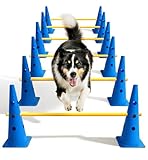
- Build Your Dog's Agility Course: Includes 12 cones & 6 durable rods. Mix and match to create endless training layouts!
- Adjustable Heights for Every Dog: Our agility hurdle cone set stand at 18 inches tall. Easily set jumps at 3 different heights (5.9", 9.8", 13.7") using the rods – perfect for for most larger dogs!
- Premium Durability & Portability: This dog agility training set is made of lightweight plastic. Cones nest together for compact storage, and the whole set sets up or packs away in seconds – perfect for indoors or backyard fun!
- Versatile Training :This dog agility course backyard set create jumps, weave poles, or zig-zag tunnels! Transform your space into a stimulating agility course that keeps your dog engaged and excited to learn. And the lowest height allows the dog to undergo good rehabilitation training.
- Boost Agility & Bonding Time: Watch your dog gain confidence, speed, and coordination! This dog agility equipment strengthens your connection while providing essential physical & mental exercise.
How to choose a Catahoula puppy or adult
Evaluate the individual dog, not just its coat color or registry paperwork. A rescue or breeder should be able to discuss behavior in ordinary situations and provide health information without dismissing reasonable questions.
- Ask whether the dog or litter has had documented BAER hearing testing.
- Request eye-examination records and ask who performed the examination.
- Review hip evaluations and other health tests for both parents.
- Ask how the dog behaves around strangers, children, other dogs, livestock, handling, food, and veterinary care.
- Find out what exercise, training, and working experience the dog actually has.
- Confirm which registry is involved—such as UKC, NALC, or AKC Foundation Stock Service—and do not confuse any of these systems with full AKC registration.
Be especially cautious of a seller who markets rare colors as more valuable, guarantees a particular adult temperament, cannot produce test documentation, or says that a CHIC number proves the parents are disease-free.
Common Catahoula misconceptions
| Claim | More accurate version |
|---|---|
| Every Catahoula has a leopard coat and blue eyes. | Coats may be solid, brindle, leopard, or patchwork, and eye colors vary. |
| The breed is fully AKC-recognized. | It is recorded in the AKC Foundation Stock Service, not fully recognized for standard AKC registration. |
| A blue-eyed or merle Catahoula is automatically deaf. | These traits can raise concern, but hearing must be evaluated; unilateral deafness may be missed without BAER testing. |
| The breed definitely descends from red wolves. | Its ancestry is uncertain; red-wolf involvement is a historical belief, not settled proof. |
| A short coat makes it easy for any owner. | Grooming is relatively simple, but exercise, training, socialization, and supervision are demanding. |
FAQ
Are Catahoula Leopard Dogs good family dogs?
They can be loyal and affectionate family companions in a structured, active household. Their territorial and protective tendencies mean they need early socialization, careful visitor management, and supervision around children. They are not universally easy with strangers or other dogs.
Do all Catahoula Leopard Dogs have blue eyes?
No. Catahoulas may have brown, amber, green, blue, or mismatched eyes. Their coats may be leopard, solid, brindle, or patchwork, so neither a leopard pattern nor blue eyes is required.
Windows Errors? Fix Them Before They Spread
Repair common Windows errors and clear accumulated junk for a smoother, more stable PC - no reinstall needed.Free scan · no reinstallOutdated Drivers Are Slowing You Down
One free scan finds every outdated or missing driver and matches the right update for your exact hardware.Free scan · exact hardware matchAre Catahoula Leopard Dogs easy to train?
They are intelligent and capable of learning quickly, but their independence can make them less automatically obedient than highly biddable breeds. Reward-based training, consistent boundaries, early socialization, and useful jobs are important.
What health tests should a Catahoula breeder provide?
Ask for verifiable hip evaluations, eye examinations, and hearing results where appropriate, particularly BAER testing for puppies or dogs at risk of congenital deafness. Review actual records for both parents; a CHIC number alone does not guarantee normal results.
The Bottom Line
The Catahoula Leopard Dog is best understood as a working dog with unusual coloring—not as a decorative, low-effort pet. Its short coat is manageable, but its independence, energy, territorial instincts, and need for purposeful training require an involved owner. Before choosing one, assess your ability to provide secure containment, daily activity, controlled social exposure, and lifelong behavioral guidance. Health records—especially hearing, eye, and hip information—should matter more than coat pattern.




