
The Tool Desk
Outbyte PC Repair FREEClear out junk files and repair common Windows errorsFree Scan →Outbyte Driver Updater FREEFix the driver behind crashes, sound loss and screen glitchesFind Drivers →A gorilla is an ape. “Ape” is the larger animal group, while a gorilla is one particular kind of great ape. The useful comparison is therefore not ape versus gorilla as two separate categories, but gorillas versus other apes—or apes versus monkeys.
This guide explains the classification, body features, movement, size, tails and genetics that help you identify each group without relying on misleading shortcuts.
As an Amazon Associate I earn from qualifying purchases.
What is the difference between an ape and a gorilla?
The words describe different levels of classification. Ape is a broad group of primates. Gorilla is the name of one genus within that group. In other words, every gorilla is an ape, but not every ape is a gorilla.
What’s actually slowing this PC down?
Pick the symptom - the matching free tool is one click away.
Gorillas belong to the great apes, alongside chimpanzees, bonobos, orangutans and humans. Gibbons are apes as well, usually described as small apes. “Great” and “small” refer to the major ape groupings; they do not mean that every individual in one group is larger than every individual in the other.
#1 Best Overall
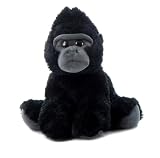
- Watch the excitement in your child’s eyes when they see this gorilla stuffed animal, muscle-bound and fearless with a cunning look on his face.
- Great for beating their chest and sharing adventures, these gorilla plush toys for kids are full of exhilarating excitement.
- Massive and mighty, yet soft and cuddly these plush gorillas are sure to be a hit and make great birthday or anytime gifts for girls and boys of all ages.
- Made with high quality fabric and durable stitching, this gorilla animal plush is designed to last through years of excursions and hugs.
- What better way to learn about the great outdoors than to fall in love with someone who lives there? What an awesome gorilla friend to have and learn about.
A monkey is a different branch of the primate family tree. A gorilla is not a type of monkey, and “ape” is not simply another word for a large monkey. The terms identify related but distinct groups.
Where gorillas fit among primates
Classification works like a set of nested boxes. “Primate” is the broadest box used here. Inside it are monkeys and apes. Inside the apes are the great apes and small apes. Inside the great apes are gorillas, along with the other great-ape groups.
This hierarchy matters because a size-based definition fails. Gorillas are famously large, but body mass is not what makes an animal an ape. A small ape is still an ape, and a comparatively large monkey is still a monkey. The shared traits, anatomy and evolutionary relationships are more informative than a single measurement.
PC Slower Than It Used to Be?
A free scan shows the junk files, broken settings and background clutter dragging Windows down - then fixes them in one click.Free scan · Windows 10 & 11Crashes, No Sound, or Screen Glitches?
Random freezes, missing sound and display glitches usually trace back to one bad driver. Find and replace yours safely.Free scan · under a minuteGreat apes
The great apes are:
- Gorillas
- Chimpanzees
- Bonobos
- Orangutans
- Humans
Gorillas are one branch of this group, not the definition of the group itself. Their closest visual resemblance to other apes is easiest to see in their body plan, lack of an externally visible tail and flexible shoulder and arm anatomy.
Small apes
Gibbons are the apes most often called “small apes.” Their lighter build and highly mobile arms can make them look unlike a gorilla, but appearance does not move them into the monkey category. If someone asks, “Are gibbons monkeys?” the answer is no: gibbons are apes.
Rank #2

- Adorable Companion: The MaoGoLan Giant Gorilla Stuffed Animal is a soft and cuddly companion that brings joy to children, making it the perfect gift for boys and girls of all ages. With its comforting presence, it's ideal for snuggling and provides emotional support during playtime
- Realistic Muscle Detailing: This 19.6" large gorilla plush features realistic muscle detailing that captivates young imaginations. Kids will love the fun and engaging environment created by this cute stuffed gorilla, inspiring creative play and storytelling
- Perfect Gift for Any Occasion: Whether you're celebrating a baby shower or searching for a delightful party favor, this gorilla stuffed animal is an excellent choice. It makes a heartwarming present that can truly heal your heart and brighten anyone's day
- Skin-Friendly Materials: Crafted with skin-friendly materials, our gorilla plushie ensures safety and comfort for your little ones, allowing them to enjoy countless hours of play without any worries
- Charming Decorations: Not only is this stuffed gorilla a great toy, but it also serves as an adorable decoration for any child's room. Elevate your decor while creating unforgettable memories with the MaoGoLan Giant Gorilla Stuffed Animal
How gorillas differ from other apes
Gorillas share the defining ape features with their relatives, but their proportions, size and typical movement give them a distinctive appearance.
Gorillas are the largest great apes
The Smithsonian National Zoo and Conservation Biology Institute describes gorillas as the largest of the great apes. Its western lowland gorilla profile gives a more specific picture: adult males average 300 pounds (136.1 kilograms), can reach 500 pounds (226.8 kilograms), and stand up to 6 feet (1.8 meters) tall. Those figures apply to the profile’s adult male western lowland gorillas; they are not measurements for every gorilla, every sex or every subspecies.
Quick wins for a faster PC:
Fix the driver behind crashes, sound loss and screen glitchesFind Drivers →Clear out junk files and repair common Windows errorsFree Scan →The same official profile states: “Gorillas are the largest of the great apes, but the western lowland gorilla is the smallest of the subspecies.” That qualification is important. “Largest great ape” is a group-level comparison, while “smallest of the subspecies” refers specifically to western lowland gorillas within the gorilla group.
Arms, legs and posture
Gorillas have arms longer than their legs. Their long forelimbs support movement on the ground and help them negotiate vegetation. A gorilla’s torso is broad and powerful, and its shoulders and arms are especially prominent compared with a human’s upright proportions.
Other apes do not all share the same silhouette. Orangutans have very long arms suited to life in trees. Chimpanzees and bonobos are generally more lightly built than gorillas. Gibbons have extremely long arms and are adapted for swinging between branches. These differences show why “ape” is a classification, not a single body shape.
Rank #3

- Gorillas, the largest of the great apes, roam Central Africa's rainforests. Known for their profound intelligence, strong family bonds, and sheer physical strength, they're a testament to the wonders of evolution. With our plush, you’re holding a gentle representation of this magnificent creature.
- Our Pocketkins eco Gorilla stands as a testament to sustainable luxury. meticulously designed, It promises a plush experience that’s not only gentle to your skin but also to the planet. Dive into a world of eco-friendly comfort and adventure.
- This stuffed animal makes a great gift: perfect for baby showers, birthday gifts, holiday gifts, room decoration, and themed parties. This is also perfect for teaching children about wildlife.
- Toy Safety: Exceed the requirements set by CPSIA (USA) and EN71 (EU) for safety standards and specifications.
- Wild Republic is the global leader in designing and manufacturing realistic and whimsical plush and toy for kids of all ages since 1979. The company was founded on the principle of fostering the curiosity of wildlife and the wonders of nature.
Knuckle-walking
Gorillas commonly move on all fours by knuckle-walking, placing weight through the bent fingers of their forelimbs while their palms remain off the ground. This is one of the quickest ways to distinguish a walking gorilla from a human, although it is not a complete definition of all apes. Chimpanzees and bonobos can also use knuckle-walking, while other apes rely on different combinations of climbing, walking, swinging or upright movement.
Free tools Windows power users keep installed
One-click scans. No signup required.
Skull crest and jaw muscles
Male gorillas can have prominent skull crests. The Smithsonian profile explains that these crests provide attachment points for the large muscles used to operate the jaws. The raised shape is therefore connected to feeding anatomy and powerful chewing, not a separate “gorilla-only” category.
Apes versus monkeys: the fastest clues
When the real question is whether an animal is an ape or a monkey, a few visible clues are useful. They should be treated as identification aids rather than absolute rules.
| Feature | Apes, including gorillas | Most monkeys | Important qualification |
|---|---|---|---|
| Externally visible tail | No externally visible tail | Usually a visible tail | Not every monkey has an obvious tail. The Smithsonian notes exceptions, including a macaque with a hidden vestigial tail. |
| Shoulder and arm movement | Flexible shoulders; many species climb, swing or support weight with the arms | Movement varies widely among species | Locomotion alone cannot identify every primate. |
| Body size | Ranges from small apes such as gibbons to very large gorillas | Ranges from small to large species | Size by itself does not establish whether an animal is an ape. |
| Classification | Great apes and small apes | Separate monkey groups | They are related primates, but one group is not a subtype of the other. |
A visible tail is a useful first question: “Does this animal have an externally visible tail?” If yes, it is usually a monkey. If no, it may be an ape—or one of the monkey exceptions. Check the animal’s overall anatomy and, when possible, its species identification before reaching a conclusion.
Are gorillas apes or monkeys?
They are apes. More precisely, gorillas are great apes. Calling a gorilla a monkey confuses two different branches of primate classification.
Rank #4
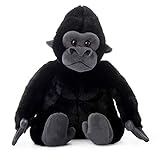
- Watch the excitement in your child’s eyes when they see this gorilla stuffed animal, muscle-bound and fearless with a cunning look on his face.
- Great for beating their chest and sharing adventures, these gorilla plush toys for kids are full of exhilarating excitement.
- Massive and mighty, yet soft and cuddly these plush gorillas are sure to be a hit and make great birthday or anytime gifts for girls and boys of all ages.
- Made with high quality fabric and durable stitching, this gorilla animal plush is designed to last through years of excursions and hugs.
- What better way to learn about the great outdoors than to fall in love with someone who lives there? What an awesome friend to have and learn about.
The confusion often comes from everyday language. People may use “monkey” to mean any nonhuman primate, especially when looking at an unfamiliar animal. Scientific classification is narrower: apes and monkeys are separate groups, even though both are primates and share a distant evolutionary history.
It is also inaccurate to say that apes evolved from monkeys that are alive today. Modern monkeys and modern apes are separate lineages. They share older ancestors, but a living monkey is not an ape’s direct modern ancestor.
How similar are gorillas and humans?
The Smithsonian Institution’s Human Origins Program discusses an approximately 1.6% DNA difference between humans and gorillas for the comparison described on its page. That number needs careful handling. Geneticists can calculate similarity and difference in more than one way, and the Smithsonian explicitly notes that different methods of comparing genomes produce different impressions.
The percentage should not be turned into the claim that humans and gorillas are “almost identical.” A small percentage difference can represent many biologically important changes, and the calculation depends on which parts of the genome and which comparison method are used. The useful conclusion is that humans and gorillas are closely related great apes, not that they are interchangeable or genetically the same.
Recommended Free Tools
A practical way to identify an ape in the field or on screen
Use this sequence when you are looking at a photograph, documentary image or zoo animal. It is a guide, not a substitute for a verified species label.
Best Value

- Get ready to monkey around with this adorable stuffed animal Gorilla
- On the go play and adventure is not a problem This plush is approx 7" so it can be brought anywhere with ease
- A stuffed toy This cute is the perfect unique gift for kids as well as anyone who wants some a cuddly companion
- Lifelike stuffed animals are a great way to ignite that creativity through imaginative play
- Hug’ems are made of high-quality material which allows them to be surface washable and durable to handle numerous hours of fun
- Look for a tail. A clearly visible tail points toward a monkey. No external tail keeps an ape in consideration, but remember that some monkeys have hidden or reduced tails.
- Check the body proportions. Long arms, a broad torso and flexible shoulders are common ape clues. Do not decide from size alone.
- Observe movement. A ground-moving animal supporting its weight on its knuckles may be a gorilla, chimpanzee or bonobo. An ape in the canopy may climb, hang or swing instead.
- Separate gorillas from other apes. Very large body mass, a heavy chest and shoulders, arms longer than the legs and, in males, a pronounced skull crest all support a gorilla identification.
- Confirm the species when accuracy matters. Lighting, posture, age and camera angle can make an animal look misleadingly large or small. Use the enclosure label, a field guide or an authoritative zoological source.
Why a gorilla’s size does not define all apes
Gorillas are often the first animal people picture when they hear “ape,” but they represent only one body design within the group. A gibbon’s lightweight frame, an orangutan’s long arms and a human’s upright stride are all compatible with ape classification. The category is broad enough to include major differences in habitat, diet, movement and social behavior.
Likewise, a monkey can be robust, agile or relatively large without becoming an ape. The absence or presence of a tail is more useful than a guess based on bulk, but even that clue has exceptions. Classification works best when several features are considered together.
Gorilla social life and conservation context
Classification is the main answer, but gorillas are also socially distinctive animals. A 2025 article from the Smithsonian’s National Zoo describes gorillas as commonly living in family groups or troops. The zoo also participates in an Association of Zoos and Aquariums-managed Species Survival Plan for western lowland gorillas. Such programs coordinate captive populations so that breeding decisions support genetic diversity and long-term conservation goals.
This background does not change what a gorilla is: a great ape. It does explain why species labels matter. “Gorilla” covers more than a cartoon image of a large, solitary animal; real gorillas have varied social lives, and conservation programs focus on particular species and populations.
A concise comparison
| Question | Gorilla | Other ape | Monkey |
|---|---|---|---|
| Is it an ape? | Yes; a great ape | Yes, if it is a gibbon, chimpanzee, bonobo, orangutan or human | No; it is a different primate group |
| Does it have an externally visible tail? | No | Apes have no externally visible tail | Usually, but exceptions exist |
| Typical identifying movement | Ground movement that commonly includes knuckle-walking | Varies: climbing, swinging, knuckle-walking or upright walking | Varies widely by species |
| Relative size | Largest of the great apes; western lowland adult males average 300 pounds in the cited zoo profile | Not stated as one group-wide value | Not stated as one group-wide value |
| Examples | Western lowland gorilla and other gorilla populations | Chimpanzee, bonobo, orangutan, human and gibbon | Many separate monkey species |
Common mistakes to avoid
- “Ape and gorilla are opposites.” A gorilla is included within the ape category.
- “Every tailless primate is automatically an ape.” Some monkeys have a hidden vestigial tail, so inspect more than one trait.
- “All apes are huge.” Gibbons are small apes, and ape body plans vary greatly.
- “Knuckle-walking proves an animal is a gorilla.” Other great apes can use this form of movement.
- “A DNA percentage tells the whole story.” Similarity figures depend on the comparison method and do not erase meaningful biological differences.
- “Monkeys alive today turned into apes.” Living monkeys and living apes are separate modern lineages with shared older ancestry.
The answer in one sentence
A gorilla is a great ape—the largest great-ape group by body size—while “ape” is the broader category that also includes chimpanzees, bonobos, orangutans, humans and gibbons; monkeys are a separate primate group, usually recognizable by a visible tail but with documented exceptions.
Quick Recap
Product prices and availability are accurate as of the date/time indicated and are subject to change. Any price and availability information displayed on Amazon at the time of purchase will apply.





Leave a Reply