Recommended Free Tools
Holiday travel with a pet is easier to manage when you settle the rules for your exact route before you pack. The holiday itself does not change animal-health or airline requirements. Your dates, your route and your destination do. Preparation cannot guarantee a stress-free trip, but it removes many avoidable problems: a health certificate that arrives too late, a carrier an airline will not accept, or a long car day with no plan for breaks.
The guidance below draws on U.S. federal sources (CDC, USDA APHIS and FDA) and the American Veterinary Medical Association (AVMA). It describes U.S. departure and entry practice and general safety habits. Your destination, your airline and your veterinarian set the final details, so confirm them directly and again close to departure.
Start with the itinerary, then the packing list
Pet rules vary by destination, and some require veterinary steps on a fixed timeline. For international travel from the United States, USDA APHIS recommends contacting a USDA-accredited veterinarian as soon as travel is planned. That veterinarian can identify the vaccines, tests, treatments and certificates your destination requires and help you map out when each one needs to happen.
Check every leg of the trip separately
- Destination entry rules: these are set by the destination country or authority and depend on the species.
- Airline rules: these apply to any flight, including a connecting one, and are set by each airline.
- Layovers and transit: a stop that is not your final destination can still trigger requirements (see the international section below).
- Return trip: the same checks apply on the way back, so build the return route into your planning.
A practical planning sequence
- As soon as your dates are set, confirm your destination and any transit points. For international travel, contact a USDA-accredited veterinarian. For a domestic trip, ask your regular veterinarian whether your pet is fit to travel.
- Check that the microchip is registered with a current contact record and that vaccinations are up to date.
- Before buying tickets, confirm the airline’s current pet policy. If a direct flight is available, CDC recommends choosing it, because layovers and extreme weather add separation risk.
- Order any health certificate with enough lead time. For air travel, APHIS’s air-travel lesson states that the health and acclimation certificate must be signed by a licensed veterinarian within 10 days of the animal’s travel date.
- Start car acclimation or carrier training well before departure, not the night before.
- Pack using the lists below, and save the emergency contacts on your phone and on paper.
Identification and records to carry
- An up-to-date microchip with a current contact record (CDC).
- Current vaccination records, including proof of rabies vaccination where it applies (CDC).
- The health and acclimation certificate for air travel, signed within the 10-day window above (APHIS).
- Destination entry documents for your pet’s species, and any airline forms the carrier requires.
Traveling by car
Restraint: harness or secured crate
CDC recommends keeping a pet in the back seat, either in a harness attached to the seat buckle or in a crate that is secured so it cannot shift when the vehicle stops. Check size, attachment style and vehicle fit before you buy. The guidance does not establish crash-test performance for any product, so a harness should not be treated as a safety rating.
#1 Best Overall
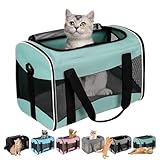
- [PRODUCT DIMENSIONS] Pet travel carrier size : 17x11x11 inches, recommended up to 15 lb pets, it is suitable for large, medium cats and small dogs. Please don't choose your airline cat carrying case based on weight, please refer to your pet's length and height when choosing a pet carrier size.
- [AIRLINE APPROVED] This cat carrier is designed with airline approved, it can fit comfortably under most flight seats, we can take our pets wherever we want. Dog travel carrier offers two attachment loop handles that can be used as a dual harness or as a luggage strap for balanced carry and secure transport.
- [EXCELLENT MATERIAL] Collapsible cat carrier is made of polyester fabric, supported by a steel ring, washable, wear-resistant and durable. The three sides and the top of this pet carrier are nylon mesh, scratch-resistant and not easy to damage, it can not only check your pet in real time, but also ensure enough air circulation.
- [SAFE AND COMFORTABLE] Dog travel bag has metal zippers on the top and side entrances, durable and not easy to deform, it allows your pets to enter and exit easily. The cat carrying case is equipped with an anti-escape safety buckle, which can effectively prevent pets from accidentally falling. It is suitable for car rides and vet rides.
- [PORTABLE AND FOLDABLE] Pet travel carrier comes with a detachable and hand washable wool pet bed, it can provide a comfortable sleeping space for your traveling pet. The cat travel case comes with an adjustable shoulder strap and handle for easy portability. When not in use, you can fold it up for storage.
A crate should be ventilated and large enough for the animal to stand, sit, lie down and turn around.
Acclimate before the trip
Begin with short drives and lengthen them gradually, so the pet learns the car before the long day arrives. Plan regular stops so dogs can relieve themselves and move around. CDC advises feeding a pet 3 to 4 hours before a car departure to reduce car sickness or vomiting. This is general CDC guidance, not an individual feeding plan, so ask your veterinarian if your pet has a health condition that affects eating.
Rank #2

- AIRLINE APPROVED CARRIER - With airline-approved design, you can take your pet to go to everywhere. This pet carrier provides two connecting loop handles for balanced carrying as a dual seat belt or luggage strap to secure transport
- SAFETY DESIGN - The adjustable shoulder strap help you hands-free carrying and makes it more safe and convenient pet carrier bag for your travel
- DURABLE - This cat carrier is made of durable and lightweight polyester fabric. The four-side mesh will not only give a safe and comfortable travel for your pet, but also easy for you to check on your pet
- PORTABLE & FOLDABLE - This dog carrier is easy to carry and store, which has a padded shoulder strap and handles
- BOTH SIZES AND WEIGHTS - The mediun cat carrier is designed for small and medium pets within 15" x 9" x 9"(smaller than product) and 15 lbs. Please do not choose your carrier only based on weight. Reference your pets' length and height in selecting a carrier size.If carried on board, the maximum dimensions should not exceed 18IN*11IN*11IN.
Keep the cabin under control
- Do not let animals roam loose in the vehicle.
- Do not let a pet put its head out of a window.
- Never leave a pet alone in a parked vehicle, even briefly.
Heat, cold and parked cars
CDC warns that temperatures inside a parked vehicle can rise quickly in hot weather, and that animals can die from heat or freeze in cold weather. FDA’s travel page relays an AVMA estimate that hundreds of pets die each year from heat exhaustion after being left in parked vehicles. It gives an example: on an 80°F day, the inside of a car can reach 114°F in 30 minutes. The FDA page does not state the year of the underlying AVMA estimate, so the figure is cited here without a publication year.
Traveling by air
Book direct and confirm the airline’s policy first
Before you buy tickets, confirm the airline’s current pet rules. Ask whether your pet can travel in the cabin or only as cargo, what carrier dimensions apply, whether reservations are limited, and how the airline handles animals. These rules are airline-specific and change over time. No single carrier size applies across airlines.
The Tool Desk
Outbyte PC Repair FREEClear out junk files and repair common Windows errorsFree Scan →Outbyte Driver Updater FREEFix the driver behind crashes, sound loss and screen glitchesFind Drivers →Rank #3

- Pet Carrier: 17.5” L x 11” W x 11” H, Recommended max load of 16 lbs cats small dogs. Please do not choose your carrier based on weight--please reference your pet's length and height in selecting a pet carrier size.
- Fits for under-seat dimensions of most airlines. Every airline has a specific set of rules and regulations, please contact with airline before flying with your cats small dogs.
- Mesh windows for ventilation, top and side entry with locking zippers for safety. Carrying handles, adjustable shoulder strap which can also be used as seatbelt, and back strap can fasten the pet carrier to your luggage.
- Pet carrier comes with a removable base insert, which creates a solid surface for your pet to stand on, along with a removable & hand washable cozy fleece pet bed, which offers a cozy sleeping space for your traveling cats small dogs.
- "Toys for pets, of textile materials". Mostly used as a Toy of Fabric Pet Home for pets playing and relaxing.
Cabin or cargo: what differs
| Factor | In-cabin travel | Cargo travel |
|---|---|---|
| Where the pet rides | In its carrier under the seat, never in an overhead bin (CDC) | As cargo in a USDA-approved shipping crate (CDC) |
| Container standard | A carrier that meets the airline’s approved dimensions; not stated as one universal size | Room to stand, sit and turn comfortably (CDC) |
| Who decides eligibility | The airline; confirm before booking | The airline and APHIS requirements; confirm both before booking, since not every pet or route is eligible |
| Animal readiness | Health assessment for air travel, including with a veterinarian (APHIS) | Same health assessment; APHIS also discusses kennel suitability (APHIS) |
| Security screening | AVMA’s 2023 brochure advises removing the pet from the carrier before the carrier goes through the X-ray tunnel | Not stated in the sources reviewed |
Assess readiness before you fly
Talk with your veterinarian before booking if your pet has a health condition, is elderly or very young, or has never traveled. The sources establish that a pet’s fitness for air travel should be assessed, but they do not offer individual medical advice, so the veterinarian is the right person to make that call.
Airport screening
AVMA’s 2023 brochure advises taking the pet out of its carrier before the carrier passes through the X-ray tunnel. Screening procedures at checkpoints can change, so check current TSA and airport guidance before you travel.
Rank #4

- High Quality Design:Sturdy steel cage structure and wooden support board maintain good spatial stability and shape. Breathable mesh windows on four sides,which can ensure good air circulation and views,make pets have a comfortable and safe travel.It can also be easy for you to check on your pets.There is a front pocket to store pet toys,treats,etc.
- Dimension and Weight:Made of durable tear-resistant fabric.Four easy entrances for pets. Dimensions: 17 inch x 11 inch x 11 inch (L*W*H), suitable for pets up to 16 lbs.Please don't choose your carrier based on weight only,consider your pet's length and height when choosing a carrier.
- Airline Approved & Safty:Can be placed under the seats of most airplanes(Four non-slip feet on the bottom to prevent movement), and comfortably on the seat next to you in a car or bus.It has a adjustable shoulder strap.Can also be fastened to the car seat with a safety belt or shoulder strap to keep your pet safe.
- Easy to Clean :You can clean the stains and dirt on the surface with a soft cloth.Soft mat inside the pet carrier is removable and washable.You can take it out and wash it easily to solve all stains.
- Easy to Collapsible & Lightweight:When not in use,fold it into a flat,space saving and easy to store.Only 2.2lbs,it's easier to carry around.It can also used as a toy of pet house,allowing pets to play in a safe space to relax and rest.
International travel, layovers and returns to the United States
Dog entry into the United States
The CDC Yellow Book sets out the baseline for dogs entering the United States. Each dog must be at least 6 months old, microchipped, appear healthy on arrival, and have a CDC Dog Import Form receipt. Additional requirements depend on the dog’s travel history. Because these requirements are updated, check the current CDC dog import page before you travel.
Layovers can carry requirements
CDC’s layover guidance, updated April 29, 2026, explains that requirements depend on where the dog has been, whether it clears customs, how it travels, and whether it visits a high-risk rabies country, even if that stop is not the final destination. A dog that does not meet the applicable requirements can be returned at the owner’s expense. Build any connection into your route check, not just the final destination.
Best Value
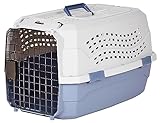
- Hard sided pet carrier with 2 doors for front and top entry; suitable for cat or medium size dog weighing 12 - 20 pounds
- Durable plastic construction with steel wire doors; screws keep the top and bottom sections securely connected
- Spring load latches ensure easy one-handed door opening and closing; top door swings open to the left or right and includes a top carry handle
- Plenty of air ventilation on the sides, top, and back of the carrier
- Note: Be sure to measure the size of the pet when choosing carrier size
Cats and other pets
Do not apply dog rules to cats or other animals. Contact the destination authority for the species you are traveling with.
What to pack
Tailor quantities to your pet and trip length. The core items below follow CDC’s travel guidance.
Quick Recap
Daily care
- Food, with extra if the trip may run longer than planned
- Plenty of water and a bowl
- Leash
- Waste bags
- Grooming supplies
- Prescribed medication
Emergencies and contacts
- Basic pet first-aid supplies
- Identification with current contact details
- Phone numbers for your regular veterinarian, a poison-control service, and a 24-hour veterinary hospital near your destination
- The records listed earlier in this guide
Product prices and availability are accurate as of the date/time indicated and are subject to change. Any price and availability information displayed on Amazon at the time of purchase will apply.




