The most effective way to ease a move for your pet is to change its environment in small, controlled steps: get the carrier or crate familiar before moving day, keep the animal shut away from the chaos of loading, travel in a secured and ventilated space, and open the new home one room at a time. The guidance behind this plan comes mainly from the ASPCA and the American Veterinary Medical Association (AVMA), and it is written chiefly for cats and dogs. If your pet is a bird, rabbit, reptile, or another species, use these principles as a starting point and check species-specific advice with a veterinarian.
Start preparing well before packing
Pets do best when the move arrives gradually rather than all at once. Begin with the environment your pet already knows, then add the new elements slowly.
Let boxes become ordinary furniture
Bring boxes into the home early, so they are not a sudden unfamiliar feature on moving day. Keep your pet’s familiar room available until late in packing, and preserve normal feeding, walking, and sleep routines wherever the move allows. The ASPCA’s moving guidance, published at Moving With Your Pet, makes these points directly.
Train your pet to accept the carrier or crate
If the pet will travel by car, get it used to its carrier or crate weeks in advance rather than on the day you leave. The ASPCA suggests this sequence:
#1 Best Overall

- Multiple Cats: Two large cat carriers that connect in a snap—plus, the side windows can be rolled up or down whenever you need! Ideal for traveling with multiple fur babies.
- Spacious 2-in-1 Design: The carrier transforms into a secure playpen or travel crate, suitable for pets up to 35 lbs. Ideal for cats, dogs, and other small to medium pets, it offers comfort and flexibility.
- Enhanced Travel Convenience: Comes with a collapsible travel bowl and a litter box. Perfect for car rides, vacations, or camping trips, ensuring your pet's basic needs are met.
- Secure and Safe: Features locking zippers to prevent escapes, reinforced stitching, and a stable base to keep your pet secure during travel.
- Easy Setup and Storage: Simple assembly with pipe connectors, designed to be safe and user-friendly. The foldable design allows for convenient storage when not in use, saving space.
- Place food inside an open crate so the pet learns that it is a good place to be.
- Progress to meals with the door closed.
- Carry the pet around the home inside the crate.
- Take short drives, then gradually longer ones.
Keep every session positive. A pet that associates the crate with treats, rest, and calm rooms will travel with less resistance than one that meets it for the first time on the road.
Ask your veterinarian early
Talk with your veterinarian if your pet has a health condition, a history of distress during travel, or any other need that could affect the trip. The AVMA’s client brochure, Planning and preparation are important when traveling with family pets (2023), states: “Some pets may be uncomfortable with travel due to illness, injury, temperament, or other concerns.” It adds that when a move makes travel necessary, owners should ask their veterinarian how to make the trip safe and comfortable. Asking early gives you time to act on that advice.
Rank #2

- High Quality Design:Sturdy steel cage structure and wooden support board maintain good spatial stability and shape. Breathable mesh windows on four sides,which can ensure good air circulation and views,make pets have a comfortable and safe travel.It can also be easy for you to check on your pets.There is a front pocket to store pet toys,treats,etc.
- Dimension and Weight:Made of durable tear-resistant fabric.Four easy entrances for pets. Dimensions: 17 inch x 11 inch x 11 inch (L*W*H), suitable for pets up to 16 lbs.Please don't choose your carrier based on weight only,consider your pet's length and height when choosing a carrier.
- Airline Approved & Safty:Can be placed under the seats of most airplanes(Four non-slip feet on the bottom to prevent movement), and comfortably on the seat next to you in a car or bus.It has a adjustable shoulder strap.Can also be fastened to the car seat with a safety belt or shoulder strap to keep your pet safe.
- Easy to Clean :You can clean the stains and dirt on the surface with a soft cloth.Soft mat inside the pet carrier is removable and washable.You can take it out and wash it easily to solve all stains.
- Easy to Collapsible & Lightweight:When not in use,fold it into a flat,space saving and easy to store.Only 2.2lbs,it's easier to carry around.It can also used as a toy of pet house,allowing pets to play in a safe space to relax and rest.
Keep your pet safe on moving day
Loading and unloading is when most pets are most likely to escape or be hurt by a moving door, a propped-open gate, or an unfamiliar person carrying boxes. The ASPCA recommends keeping your pet out of the way entirely.
- Choose a quiet room away from the front door and the moving path, and close the door.
- Post a clear sign for movers and household members stating that the room must not be opened and the pet must not be let out during loading or unloading.
- Or arrange trusted care. If no suitable room is available, have a trusted person keep the pet with them away from the activity.
- Keep essentials within reach: food, water, bedding, and any medication the pet needs.
Plan the journey around your pet
Travel is the part of a move most likely to upset an animal, so the vehicle setup and the packing list deserve as much attention as the moving truck.
Rank #3

- AIRLINE APPROVED CARRIER - With airline-approved design, you can take your pet to go to everywhere. This pet carrier provides two connecting loop handles for balanced carrying as a dual seat belt or luggage strap to secure transport
- SAFETY DESIGN - The adjustable shoulder strap help you hands-free carrying and makes it more safe and convenient pet carrier bag for your travel
- DURABLE - This cat carrier is made of durable and lightweight polyester fabric. The four-side mesh will not only give a safe and comfortable travel for your pet, but also easy for you to check on your pet
- PORTABLE & FOLDABLE - This dog carrier is easy to carry and store, which has a padded shoulder strap and handles
- BOTH SIZES AND WEIGHTS - The mediun cat carrier is designed for small and medium pets within 15" x 9" x 9"(smaller than product) and 15 lbs. Please do not choose your carrier only based on weight. Reference your pets' length and height in selecting a carrier size.
Choose a restraint system
For car travel, the ASPCA’s Travel Safety Tips identifies a crate as the safest option in a car and gives a secured harness as an alternative. The right choice depends on your pet’s size, how well it tolerates confinement, your vehicle setup, and your veterinarian’s advice.
| Option | How it should be set up | Ask yourself |
|---|---|---|
| Crate or carrier (ASPCA’s identified safest option in a car) | Well-ventilated and large enough for the pet to stand, sit or lie down, and turn around. Secured so it cannot shift. | Does my pet accept confinement? Will the crate fit in my vehicle and stay put during braking? |
| Secured back-seat harness (ASPCA alternative) | Pet kept in the back seat, harness attached to a secured seat belt. | Does my pet tolerate a harness? Is the back seat available and fitted with a usable belt anchor? |
Rules that apply to every car trip
- Never let a pet ride with its head out of the window.
- Never leave a pet alone in a parked car.
Pack the travel kit
Assemble the following before departure and keep it in the passenger area, not buried in the moving truck:
Rank #4
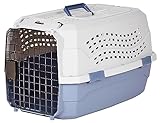
- Hard sided pet carrier with 2 doors for front and top entry; suitable for cat or medium size dog weighing 12 - 20 pounds
- Durable plastic construction with steel wire doors; screws keep the top and bottom sections securely connected
- Spring load latches ensure easy one-handed door opening and closing; top door swings open to the left or right and includes a top carry handle
- Plenty of air ventilation on the sides, top, and back of the carrier
- Note: Be sure to measure the size of the pet when choosing carrier size
- Food, water, and bowls
- Leash and waste bags
- Medications, with enough for the journey and the first days after arrival
- Travel documents and veterinary contact details
- A familiar toy or blanket
- A collar ID tag with current contact information
- An optional pet first-aid kit, which ASPCA guidance lists among travel items
Manage feeding in transit
The ASPCA advises against feeding in a moving vehicle. It describes offering a light meal three to four hours before departure. If your pet has special feeding or medical needs, follow the individual instructions your veterinarian gives you.
Check documents for interstate or air travel
Document requirements for interstate travel and air transport vary, so a general guide cannot tell you what you need. Check with your veterinarian, the destination authorities, and your carrier well in advance. The ASPCA specifically advises asking your veterinarian whether a health certificate is required for interstate car travel.
Free tools Windows power users keep installed
One-click scans. No signup required.
Best Value

- MULTIPLE CATS- Two large cat carriers which can be connected, and the side windows that can be lowered or rolled up. Prepared for multiple cats travel, with litter box and two foldable bowls. If someone is missing, please contact customer service and we will arrange for reshipment.
- EXTRA LARGE CAT CARRIER- Perfect for large cats or multi-cat household. Measure is 24x16.5x16 inches. Hold pets up to 55 pounds. Fit medium dogs soft-sided carriers.
- STURDY & COLLAPSIBLE STRUCTURE- The inner part is iron support structure. And the metal support is foldable, can easily storage when do not need be used.
- SUPERIOR QUALITY- This cat carrier is made from Oxford fabric that is wear resistant and easy to clean. And nylon mesh is resistant to tearing and ventilated.
- SAFETY DESIGN- Each access has a zipper lock to prevent cats from escaping. On the side have seatbelt loops, can fix the carrier in the car. The internal metal support structure may also provide good protection for pets.
Decide whether your pet should travel at all
For some animals, the safest option is not to take them on the road. The AVMA names two alternatives to bringing the pet along: a trusted pet sitter, or a veterinarian-recommended boarding arrangement. Whether either suits your pet depends on its health, temperament, and the quality of the care available, so make the decision with your veterinarian rather than by default. If the pet is unlikely to tolerate travel, arranging care at the origin until the household is settled at the new home is a reasonable path to discuss.
Settle your pet into the new home
A new home is full of unknown hazards and unfamiliar smells. The goal is to let your pet explore only when it is ready, and to remove risks before that happens.
- Inspect at pet level. Crouch down and look at the rooms as your pet would. Secure electrical cords, remove access to poisons and pest-control products, check windows and hiding spaces, and remove any plants that are unsafe for your animal.
- Check for entrapment. Look for spaces where a pet could get stuck, such as gaps behind appliances, under furniture, or inside cabinets.
- Check for dropped medication. Look under beds and on the floor during unpacking, since a dropped pill is easy to miss.
- Start with one home-base room. Give your pet a quiet room with familiar items, food, water, and a litter box or bed.
- Open the rest of the home gradually. Expand access as your pet appears comfortable. For cats, ASPCA suggests moving the litter box toward its permanent location in small increments rather than in one step.
Cats also benefit from vertical space in the new home, and puppies, older dogs, and dogs with house-training challenges may need frequent outdoor access. Consider these needs when you choose a home and a neighborhood.
Know the ASPCA’s latest travel advice
The ASPCA published Traveling With Pets? Follow These Expert Dos and Don’ts to Keep Them Safe on 30 December 2025. It reinforces the core steps in this guide: acclimating the pet to its carrier in advance, keeping the pet secured in the vehicle, and checking the destination for hazards before letting the pet roam.
What’s actually slowing this PC down?
Pick the symptom - the matching free tool is one click away.
Quick Recap
The Bottom Line
“”
Product prices and availability are accurate as of the date/time indicated and are subject to change. Any price and availability information displayed on Amazon at the time of purchase will apply.




