Free tools Windows power users keep installed
One-click scans. No signup required.
Dunkleosteus terrelli was a heavily armored fish that lived in the Late Devonian sea covering what is now Ohio. Its jaws were edged with sharpened bone rather than true teeth, giving it an imposing way to cut prey. “Cleveland” points to where its fossils are found today—not a city the animal ever inhabited.
Why is a prehistoric predator associated with Cleveland?
In the Late Devonian, roughly 375–359 million years ago, an inland sea covered the region that is now Ohio and connected to the open ocean. Rocks in the Cleveland Member of the Ohio Shale—where Dunkleosteus terrelli fossils occur—date to about 360–359 million years ago, according to the Ohio Department of Natural Resources’ Division of Geological Survey.
The modern geography can be misleading: Cleveland did not exist, and the animal did not swim through a city. The name reflects the fossils’ geological and museum context. The black shale formed as fine sediment and organic matter accumulated in the Appalachian Foreland Basin. Later movement of Earth’s plates helped bring those ancient deposits to their present location.
Did Dunkleosteus really have teeth?
No—not true teeth like those found in many other armored fishes of its time. Dunkleosteus had exposed, sharpened bony edges along its jaws, as well as fang-like bony projections called odontoids. The Ohio Geological Survey compares the upper and lower jaw edges to self-sharpening scissors. So “toothless” does not mean smooth-mouthed: its cutting surfaces were part of the jaw bones themselves.
Recommended Free Tools
#1 Best Overall

- DINO-MITE REPLICAS: Master Replicas Groups presents prehistoric fossil replicas, realistic sculptures created by MRG paleo artists, using artistic interpretation based on current scientific data.
- MADE IN THE USA: Made by artisans in the U.S.A. Cast in super-durable resin, NOT polystone.
- DIMENSIONS: Measures 5 x 2.5 x 0.25 inches.
- GREAT GIFT IDEA: Purchase this replica for yourself or gift it to the prehistoric lover in your life!
This arrangement was unusual among arthrodires, the group of armored fishes to which Dunkleosteus belonged. Many relatives had actual teeth. Bone-blade specializations also evolved independently in some other arthrodire groups, so one dramatic reconstruction should not stand in for every placoderm.
What did it eat, and how did it hunt?
The blade-like jaws are interpreted as adaptations for taking large prey, including other fishes. That is an inference from anatomy, not a preserved record of every meal or hunt. Claims about the precise mechanics of its feeding have also changed as researchers revisit its anatomy.
Rank #2

- - Authentic natural Lycoptera fish fossil from Western Liaoning, China, slab features two fish with distinctive curved body posture. - Skeleton, fin and tail details are well‑preserved. Real natural fossil, not replica or cast. - Natural irregular slab edge, minor natural cracks and mineral discoloration are original geological formation features, not product defects.
A peer-reviewed study first published on November 20, 2025, reexamined specimens chiefly from the Cleveland Museum of Natural History. The authors infer that the skull contained substantially more cartilage than older reconstructions assumed and revise interpretations of jaw-muscle attachments. They argue that earlier claims for suction feeding are questionable and that older bite-force estimates need reassessment in light of the revised muscle reconstruction. A dramatic bite-force figure should therefore not be treated as settled fact.
How large was Dunkleosteus?
Published estimates differ. The Ohio Department of Natural Resources’ 2019 geological survey article gives an estimated maximum length of 6–8.8 meters (20–29 feet). Case Western Reserve University’s 2025 research announcement uses 14 feet. Those are attributed estimates, not a single agreed measurement; the available sources do not establish why the figures differ. Any length should be read with its source attached.
The Tool Desk
Outbyte Driver Updater FREEFix the driver behind crashes, sound loss and screen glitchesFind Drivers →Outbyte PC Repair FREERepair Windows errors before they cause bigger problemsFix Now →Rank #3

- NEW! FOSSIL COLLECTION SORTING ACTIVITY KIT with over 100 authentic fossils (20 different types), full-color educational identification sheet, geological time card and ID cards!
- FIND, SORT & IDENTIFY--spread fossil mixture out on a table or floor and identify specimens with the Identification sheet. Match fossils to the ID cards and store in the zip-lock bags -- discover and identify like a real fossil hound!
- BONUS: Ammonite fossil, Otodus shark tooth in matrix, Coprolite (dinosaur poo ), and dinosaur bones!
What fossils have been found?
The species is known mainly from head and thoracic shields, along with some vertebrae and a pectoral fin. Black shale and low-oxygen conditions on the ancient sea floor favored preservation, but the fossil record remains incomplete. Armor and jaw elements are better represented than soft anatomy, so a full-body image necessarily includes reconstruction rather than direct fossil evidence.
That limitation matters when interpreting body shape, swimming, and feeding. The 2025 anatomical study updates ideas about cartilage and jaw muscles, but it does not turn incomplete remains into a complete record of the animal’s soft tissues or behavior.
Rank #4
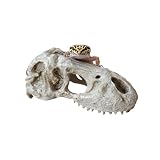
- AUTHENTIC DESIGN: Highly detailed T-Rex skull fossil replica measuring 5.7 inches, perfect for creating a prehistoric atmosphere in your aquatic or reptile habitat
- VERSATILE USE: Suitable for fish tanks, terrariums, vivariums, and various pet enclosures - ideal for aquascapes and reptile habitats
- DURABLE MATERIAL: Constructed from sturdy resin material that's safe for aquarium use and maintains its appearance underwater
- DECORATIVE FEATURE: Creates natural hiding spots and swimming spaces for fish while adding a striking Jurassic-themed focal point to your tank
- PERFECT SIZE: At 5.7 inches, this skull ornament provides an impressive display while being appropriately sized for most aquariums and terrariums
How were the Cleveland fossils discovered?
Ohio geological survey accounts credit Jay Terrell with finding fossils in 1867 in black shale along the Lake Erie shore at Sheffield Lake. Ohio geologist John Strong Newberry described them in 1873. The species name terrelli honors Terrell; the genus name Dunkleosteus honors Cleveland Museum of Natural History paleontologist David Dunkle.
The shale could be difficult to search. In a 1926 passage quoted by the Ohio Geological Survey, Professor Jesse Earle Hyde wrote: “It is almost useless for a man, untrained in the ways of the black shale, to come into the region hoping to find much.”
Quick wins for a faster PC:
Clear out junk files and repair common Windows errorsFree Scan →Scan for outdated or missing drivers - takes under a minuteDriver Scan →Repair Windows errors before they cause bigger problemsFix Now →Quick Recap
Best Value

- Replica Chirostenotes dinosaur claw – approx. 4.5 inches (11.43cm)
- Species: Chirostenotes pergracilis, Late Cretaceous (~76.5 million years ago), Alberta, Canada
- Realistic texture and anatomical accuracy – great for collectors, educators, and fossil enthusiasts
- Useful in paleontology education, museum displays, or as a unique prehistoric gift
- Display-ready fossil replica (stand not included)
Product prices and availability are accurate as of the date/time indicated and are subject to change. Any price and availability information displayed on Amazon at the time of purchase will apply.




