A hog oiler was a self-service farm device that let a pig oil its own skin. The animal rubbed against a wheel, roller, ball, bar, or post, and that movement transferred oil—sometimes mixed historically with insecticide—to areas of the hide. The idea was ingenious, but the device offered limited coverage and was never a complete cure for lice or mange.
A hog oiler was a self-service parasite-control device that let a pig oil its own skin. When an itchy hog rubbed against a wheel, roller, ball, bar, or other roughened surface, that movement helped carry oil from a trough or reservoir onto the animal. Some models even used the hog’s pressure to open a valve or dispensing passage.
As an Amazon Associate I earn from qualifying purchases.
The name sounds like a farm joke, but the machine addressed a real problem. Lice and mange could irritate hogs, weaken them, and reduce production. The hog oiler saved labor by turning a pig’s natural urge to rub into the operating force for a small piece of farm machinery.
Do these 3 things before closing this tab:
1Scan for outdated or missing drivers - takes under a minute2Repair Windows errors before they cause bigger problems3Fix the driver behind crashes, sound loss and screen glitchesWhat was a hog oiler?
A hog oiler—also called a greaser—was a livestock implement designed to transfer oil to a hog’s exterior. It normally combined two basic elements:
#1 Best Overall

- 【Quality Material】: The car oil squirt can is meticulously crafted from rugged alloys and metals. Its surface is treated with spray painting, featuring excellent wear resistance, rust prevention, corrosion resistance, and impact resistance. It is easy to clean and ensures stability and reliability even after long-term use.
- 【Humanized Design】: The car oil can pump oiler is equipped with an arc-shaped ergonomic handle, which conforms to the curve of the palm to provide a comfortable grip experience. At the same time, it is highly efficient and labor-saving, effectively reducing wrist fatigue. Its wide bottom design ensures a stable placement during oiling and prevents it from toppling over.
- 【Sealing】: The high-pressure pump of the automotive metal oil can is made of alloy die-casting and features a double-threaded structure design, offering outstanding sealing performance. When the pump is under pressure, it can deliver a sufficient amount of oil, and the nozzle head closes tightly, effectively eliminating the risk of oil leakage.
- 【Easy to Use】: The car oil squirt can is simple and convenient. When operating, simply apply a slight pressure to the trigger with your thumb to achieve smooth oil output. Its compact design enables flexible oiling in narrow areas. It adopts a detachable design and can be quickly rinsed after use to regain its cleanliness.
- 【Versatile Application】: The car oil pump oiler has a wide range of applications in lubrication-related fields such as mechanical maintenance and automotive repair, covering the vast majority of bicycles, motorcycles, automobiles, as well as home appliances and mechanical industries. It is an ideal tool for handling precision liquids and lubrication scenarios.
- An oil supply: a shallow trough, tank, pan, or elevated reservoir.
- A rubbing surface: a wheel, ball, roller, drum, cylinder, bar, rope-wrapped post, or similar component.
The animal supplied the energy. A hog rubbed against the surface because it was itchy or simply sought pressure against its skin. The movement rotated a component, depressed a mechanism, or otherwise caused oil to reach the rubbing surface. The pig then spread some of that oil over its own hide.
There was no single standard hog-oiler shape. “Hog oiler” describes a function, not one particular machine. Two examples might look completely different—one like a cast-iron wheel in a pan and another like a tank above a pair of movable rubbing members—while operating on the same basic principle.
Why did farmers use hog oilers?
External parasites were a persistent concern in late-nineteenth- and early-twentieth-century hog production. Lice and sarcoptic mange caused irritation, and contemporary agricultural guidance connected infestations with weakened animals and production losses.
The Tool Desk
Outbyte Driver Updater FREEFix the driver behind crashes, sound loss and screen glitchesFind Drivers →Outbyte PC Repair FREEClear out junk files and repair common Windows errorsFree Scan →Before a self-service oiler, applying oil or another treatment could mean catching and handling hogs individually. Farmers sometimes had to “mop” or swab the animals by hand—a dirty, time-consuming job, especially in a large herd. A hog oiler offered a labor-saving alternative: the animal approached the device and applied at least some of the material to itself.
The oil could help soothe irritated skin and was sometimes combined with an insecticide. The important qualification is that the oiler was a delivery aid and parasite-control measure, not a complete veterinary treatment. Its usefulness depended on regular access, adequate oil, and the hog actually rubbing against it.
How did a hog oiler work?
Although manufacturers experimented with many forms, most designs fit into a few mechanical categories.
1. Rotary trough oilers
In the simplest mechanical arrangement, a wheel, ball, drum, or perforated cylinder sat above or partly within a trough of oil. When a hog pressed and rubbed against it, the component turned. Its surface picked up oil from the trough and transferred it to the animal.
Rank #2

- 【Fuel and Bar Oil in One Portable Can】Keep fuel and bar oil together in one dual-chamber container for a cleaner, more organized refueling setup. Designed for chainsaw work, yard maintenance, forestry tasks, farm use and other outdoor power equipment needs.
- 【Adjustable Shoulder Strap for Easier Carrying】The upgraded carrying design includes an adjustable shoulder strap to help reduce hand fatigue during outdoor work. Carry the can more comfortably across the yard, farm, workshop or jobsite when compared with hand-carry-only containers.
- 【Visible Level Window with Measurement Marks】A built-in visible level window with clear measurement marks makes it easier to check remaining liquid at a glance. Quickly monitor fuel or bar oil levels before heading out or during refueling tasks.
- 【Covered Tool Storage Box for Better Organization】The upgraded storage box comes with a secure lid to help keep small tools and accessories neatly stored during transport. It helps reduce the risk of tools falling out while moving between the garage, truck, yard or work area.
- 【Designed for Cleaner Outdoor Refueling】Dedicated pour spouts help provide better control when transferring liquids, while the dual-chamber layout supports a more efficient workflow for chainsaw refueling, tree maintenance, firewood cutting, forestry jobs and general outdoor equipment maintenance.
A 1916 Niccum patent illustrates this approach with a removable perforated cylinder mounted over a trough. The cylinder’s rotation helped keep its exterior coated. Making the cylinder removable also addressed two practical farm-equipment concerns: cleaning and transport.
Other rotary versions used large wheels, rounded balls, or distinctive “watermelon” rollers. Their silhouettes differed, but the operating logic was similar: rubbing produced rotation, and rotation brought oil into contact with the hog.
2. Pressure-actuated dispensers
More elaborate oilers used the hog’s pressure to control the flow of oil. In the 1918 Nasser patent, roughened rubbing members moved inward when an animal pressed against them. That movement opened a passage from an oil-retaining tank to the rubbing surface. Springs returned the members to their original position when the pressure stopped, closing or restricting the flow.
This design attempted to meter the oil rather than leave a continuously exposed, oil-covered surface. In theory, oil was released when the machine was being used and conserved when it was not.
3. Vertical rollers and rubbing bars
Some oilers fed oil downward onto upright rollers or bars. A metering arrangement could be intended to release fluid when the rubbing member moved, vibrated, or was depressed. These models were often designed to let the hog reach several parts of its body by rubbing vertically or at different heights.
4. Homemade rubbing posts
Not every hog oiler was a patented cast-iron machine. A much simpler version could be made by setting a post firmly in the ground and wrapping it with rope or a piece of sack kept saturated with oil. Government and pesticide-label records describe this type of improvised rubbing station.
The homemade post lacked the metering and moving parts of a commercial oiler, but it preserved the central idea: provide a durable rubbing surface and let the hog distribute the material.
Rank #3
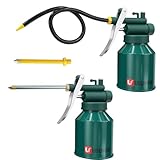
- A great addition to any workshop
- Durable epoxy finish to resist rust
- 2 Sets oil can with 3 spouts 1 Yellow spout ,1 Metal Spout ,1 9"Flex Spout
- Zinc plated rigid spouts for maximum protection against corrosion
A short history of hog-oiler patents
Hog-oiler innovation was especially active during the 1910s and 1920s. The first known patent for a hog-oiling device dates to 1902, and collector research cited in historical coverage has identified more than 160 patents.
Windows Errors? Fix Them Before They Spread
Repair common Windows errors and clear accumulated junk for a smoother, more stable PC - no reinstall needed.Free scan · no reinstallCrashes, No Sound, or Screen Glitches?
Random freezes, missing sound and display glitches usually trace back to one bad driver. Find and replace yours safely.Free scan · under a minuteThat unusually large number reflects the practical difficulties of the problem. A successful device had to:
- survive repeated pushing and rubbing by heavy animals;
- deliver enough oil to be useful without wasting the supply;
- remain stable in a pen or lot;
- avoid becoming unusable when covered with mud, manure, or dust;
- provide a rubbing surface comfortable and attractive enough for hogs to use; and
- be accessible for filling, cleaning, repair, and seasonal storage.
Patent drawings and surviving examples show the range of solutions: balls, wheels, drums, cylinders, watermelon-shaped rollers, vertical spinning columns, rubbing bars, rope-wick arrangements, and machines with reservoirs and spring-controlled valves.
The Nasser and Niccum patents represent two contrasting approaches. Nasser’s design focused on pressure-controlled dispensing and spring return. Niccum’s design emphasized a removable, rotating cylinder near a trough. Neither should be treated as the definitive hog oiler; each is evidence of the period’s experimentation.
Did hog oilers cure lice or mange?
No. A hog oiler should not be described as a device that eradicated lice or mange.
Recommended Free Tools
A U.S. Department of Agriculture bulletin cautioned that an oiler deposited material on only a limited portion of the skin. When kept filled and free of mud, it could help reduce the spread of parasites, but it was not sufficient to eliminate a serious infestation.
Several limitations explain why:
- Limited coverage: rubbing usually treated only the areas that contacted the device.
- Optional use: the hog had to choose to use the oiler.
- Maintenance problems: mud and debris could clog or coat the rubbing and dispensing parts.
- Uneven dosing: some animals could use the machine more often than others.
- Serious infestations required more: an oiler could not substitute for appropriate herd-level treatment and veterinary guidance.
Historical records also document oil products containing insecticides, including a 1967 label for a lindane-containing hog oil intended for use with hog oilers. That record shows how the equipment was used historically; it is not current veterinary advice. Lindane and other older pesticide practices should not be copied from archival labels. Modern animal-parasite treatment must follow current veterinary guidance and the rules for the specific animal, product, and location.
Rank #4

- READY TO USE: 16 oz oil can with 5" flexible braided hose
- TIME SAVING: Pump with two ball valves for larger delivery volume, letting you apply oil faster
- EASY TO USE: Convenient thumb lever for easy application
- UP TO STANDARDS: Meets or exceeds ANSI standards
- POWERBUILT 16 OZ OIL CAN: Durable, convenient, and precise oil application with a comfortable thumb lever
Why did hog oilers disappear?
The hog oiler’s widespread use lasted for less than about thirty years. Its decline was not necessarily proof that every machine was ineffective. Rather, newer control methods and changing farm environments reduced the device’s advantages.
Sprayed insecticide solutions
By the 1930s, sprayed insecticide solutions became more available. Spraying could treat animals more directly and cover areas that a rubbing device reached poorly. That reduced the appeal of relying on voluntary self-application.
Quick wins for a faster PC:
Clear out junk files and repair common Windows errorsFree Scan →Scan for outdated or missing drivers - takes under a minuteDriver Scan →Repair Windows errors before they cause bigger problemsFix Now →Cleaner buildings and lots
Changes in hog housing also mattered. Paved buildings and lots were easier to clean than some earlier dirt environments, making it more difficult for lice populations to persist. Better sanitation reduced one of the conditions that had made parasite-control devices especially valuable.
Maintenance and coverage limitations
A hog oiler needed to remain filled, functional, and reasonably clean. A device clogged with mud could not meter or distribute oil properly. Even a well-maintained machine treated only the skin the hog brought against its rubbing surface. Those constraints made it less attractive as farms adopted more direct treatment methods.
What do hog oilers look like today?
Today, hog oilers are primarily historical artifacts and farm-implement collectibles rather than ordinary livestock-treatment equipment. Surviving examples can be recognized by their unusual combinations of heavy construction, oil reservoirs, rotating or roughened rubbing parts, and manufacturer-specific mechanisms.
Collectors may encounter several recognizable families:
| Design family | Typical identifying feature | Historical operating idea |
|---|---|---|
| Ball oiler | Rounded ball or spherical rubbing component | Rubbing moved or coated the ball so it could transfer oil |
| Watermelon-shaped roller | Large elongated, rounded roller | Animal pressure rotated the roller near an oil supply |
| Wheel or drum machine | Cast-iron wheel, drum, or cylindrical member | Rotation carried oil from a trough to the hog |
| Vertical roller or bar | Upright rubbing surface, sometimes with a reservoir above | Oil fed downward as the animal rubbed or moved the surface |
| Rope-wrapped post | Simple fixed post covered with saturated rope or sack | Hog rubbing spread oil without a complex mechanism |
Buying a hog oiler as a collectible
Antique hog oilers still appear through secondary-market listings, farm auctions, classified advertisements, and collectible-equipment channels. The market is fragmented: some listings are complete machines, while others are parts, advertising pieces, reproductions, or damaged fragments.
Best Value

- 【20 Gallon Capacity】 This oil drain tank has a capacity of 20 gallons and can collect waste oil from 8-10 cars. It features air operated working principle, and this waste oil drain can empty the waste oil from the fuel tank in a short time. Great for draining, transferring, and evacuating oils and fluids.
- 【Adjustable Height】 The oil drain container has a wide range of adjustable heights, 38" to 65" for draining fluids from vehicles on lifts. It can correctly complete the work of collecting car waste oil. Suitable for factory, auto repair shop, and home use.
- 【Stable Mobility】 Our oil drain pan is constructed with two 4.5" rigid wheels and two 2.76" swivel casters for maximum mobility and maneuverability. It would be more flexible in the working space and can be moved from place to place easily.
- 【Large Diameter Funnel】 The oil drain pan is designed with a funnel shape, which diameter is 15". The big pan is perfect for transferring oil and effectively prevents waste oil from spilling. The 5.7' oil drain tube can withstand high temperature and is great for convenient draining.
- 【Well-designed Details: As this type of waste oil drain tank, the pressure can be adjusted through the pressure regulating valve. And the intake air volume can be controlled. The pressure adjustment range is 1-3 MPa, and can be accurately read on the pressure gauge. With the ergonomic handle, our oil drain tank is comfortable to use. Built of premium steel with powder coated surface, the oil drain pan is sturdy and rustproof.
Before buying one, check the following:
- Identify the design. Compare the wheel, roller, tank, frame, and rubbing members with documented examples or patent drawings.
- Inspect for cracks. Cast iron can fracture, particularly around mounting points, thin housings, and stressed supports.
- Check completeness. Determine whether the reservoir, trough, wheel, roller, axles, springs, caps, and brackets are present.
- Test movement carefully. A stuck wheel or roller may be dirty, rusted, incomplete, or permanently damaged. Do not force an old mechanism before checking it.
- Look for repairs and alterations. Welds, replacement hardware, fabricated parts, and modern paint may affect historical and monetary value.
- Ask about provenance. A documented farm, manufacturer, region, or prior collection can make an otherwise obscure implement easier to identify.
- Confirm dimensions and weight. Heavy cast-iron equipment can be expensive or impractical to ship, and some listings are local-pickup only.
- Separate a complete example from a fragment. A decorative wheel or partial frame may be interesting, but it should not be valued or represented as a complete working oiler.
Prices vary according to rarity, condition, completeness, manufacturer, provenance, and transport costs. An online listing is evidence that an item is being offered, not proof that it is authentic, available, complete, fairly priced, or shippable. Those details must be verified with the individual seller or auction house.
Why the hog oiler still matters
The hog oiler is a compact example of practical agricultural engineering. It did not require the pig to be trained or the farmer to operate a handle. Instead, it used an existing behavior—rubbing when itchy—and converted that behavior into rotation, pressure, and fluid delivery.
Its history also shows why farm technology cannot be judged by mechanical cleverness alone. Coverage, hygiene, animal behavior, labor requirements, available chemicals, housing design, and maintenance all determined whether the device made sense. Once sprayed treatments and cleaner facilities became more practical, a machine that depended on voluntary rubbing and constant upkeep lost its place.
Free tools Windows power users keep installed
One-click scans. No signup required.
So “All Hail the Hog Oiler” is a fitting tribute to a strange-looking but inventive tool: a device operated by the animal it was meant to help, important in its own era, and now most useful as a window into the engineering and working routines of historic hog farming.
Frequently Asked Questions
Did hog oilers get rid of lice and mange?
No. Historical USDA guidance warned that a hog oiler covered only limited areas and should not be relied on to eradicate lice or mange. It could help reduce parasite spread when properly maintained, but serious infestations required appropriate treatment.
How did a hog oiler work?
Most hog oilers used a trough or reservoir plus a wheel, roller, ball, drum, cylinder, bar, or rope-wrapped post. A hog’s rubbing either rotated the surface through oil or activated a mechanism that released oil onto it.
Why are hog oilers no longer used on most farms?
They declined as sprayed insecticide solutions became more available in the 1930s and as paved buildings and lots made sanitation easier and reduced lice populations. Their limited coverage and maintenance needs also reduced their usefulness.
What’s actually slowing this PC down?
Pick the symptom - the matching free tool is one click away.
Are old hog oilers worth anything?
Surviving examples can be collectible farm Americana. Value depends on design, rarity, condition, completeness, provenance, manufacturer, and shipping or local-pickup requirements.
The Bottom Line
Bottom line: The hog oiler was an early-twentieth-century self-service oiling device that used a pig’s rubbing behavior to distribute oil for limited parasite control. It could reduce labor and help manage exposure to lice and mange, but it did not eradicate infestations. Improved sprays, sanitation, and housing pushed it out of everyday use; surviving examples are now chiefly agricultural antiques and collectibles.
Quick Recap
Product prices and availability are accurate as of the date/time indicated and are subject to change. Any price and availability information displayed on Amazon at the time of purchase will apply.




