
Yes, many animals lay eggs—but egg-laying is not limited to birds. Many fish, most reptiles, many amphibians and insects reproduce this way, and two extraordinary mammals—the platypus and echidnas—also lay eggs. Those mammals are called monotremes: their eggs are soft or leathery, and their hatchlings later drink milk.
What does it mean when an animal lays eggs?
An egg is a reproductive package containing an embryo and stored nutrients. In an egg-laying, or oviparous, animal, the egg is released before the young is born. Development then continues outside the parent’s body, with the embryo using the egg’s nutrients until it hatches or emerges.
As an Amazon Associate I earn from qualifying purchases.
The phrase “lays eggs” describes a reproductive strategy, not an animal’s taxonomic class. Birds are egg-laying animals, but an egg does not automatically make an animal a bird. The same is true for reptiles, fish, amphibians and insects: egg laying occurs widely within these groups, yet reproductive strategies vary among species. A scientifically careful statement is “many fish lay eggs” or “most reptiles lay eggs,” not “all fish” or “all reptiles.” The Egginfo primary lesson on animals that lay eggs uses this broad group-level approach.
Free tools Windows power users keep installed
One-click scans. No signup required.
Which animal groups lay eggs?
| Animal group | What can be said accurately | Important qualification |
|---|---|---|
| Birds | Birds reproduce by laying eggs. | Eggs differ in size, color, shell texture and incubation behavior among species. |
| Fish | Many fish release eggs, often in water. | “Many” is the safe wording; not every fish species uses the same reproductive method. |
| Reptiles | Most reptiles lay eggs. | Some reptiles have other reproductive strategies, so “all reptiles” is too broad. |
| Amphibians | Many amphibians lay eggs, commonly in or near water. | Reproductive patterns vary across amphibian species. |
| Insects | Egg laying is common among insects. | Egg placement and development differ greatly between insect species. |
This diversity explains why an egg can look and function very differently from one animal to another. A bird egg familiar from a nest is not the only model. Some fish eggs are released into open water; amphibian eggs may occur in gelatinous masses; and insects place eggs on or near the food their larvae will use. The shared feature is that the embryo develops in an egg rather than being born directly as a fully formed young animal.
#1 Best Overall

- 【STABLE TEMPERATURE】: The circulating airflow system driven by a strong fan provides a stable temperature condition for the eggs.
- 【EXTERNAL WATER REFILLING】: Refilling water without opening the incubator lid, avoid causing the interior temperature & humidty suddenly drop a lot.
- 【BUILT-IN EGG CANDLER】: A convenient way for you to observe the development of embryos, no need to buy additional egg candler.
- 【AUTOMATIC EGG TURNER】: Side-to-side turning the eggs automatically at 60 minutes interval, and also can auto-stop turning 3 days before hatching to avoid excess turning.
What lays eggs but isn’t a bird?
The best-known answer is a monotreme. Monotremes are mammals that lay eggs, and the living examples are the platypus and echidnas. The National Oceanic and Atmospheric Administration’s platypus overview identifies both as monotremes. The Australian Museum’s explanation of monotremes likewise describes this group as egg-laying mammals.
Monotremes remain mammals even though they lay eggs. Their young hatch and are then nourished with milk, which is the key feature highlighted in the mammal sources. Egg laying therefore does not override the animal’s broader biological classification.
The platypus
The platypus is a semi-aquatic Australian mammal with a flattened bill, a broad tail and webbed feet. Its reproductive biology combines an egg-laying stage with mammalian nursing. According to NOAA, a platypus egg hatches after about 10 days, and the young nurse for up to four months. The result is a life cycle that begins in an egg but continues with milk feeding, rather than with a hatchling that immediately lives independently.
What’s actually slowing this PC down?
Pick the symptom - the matching free tool is one click away.
Rank #2

- 360° Air Circulation Design: The air circulation allows airflow inside the egg incubator, ensuring even distribution of temperature and humidity. This promotes uniform embryo growth and increases hatching rate and quality. It reduces the risk of poor development and shortens the incubation period.
- Integrated Temperature & Humidity Sensor: Real-time monitoring of temperature and humidity inside the chicken egg incubator ensures the healthy growth of each embryo. No more tedious adjustments are needed. The intelligent system displays humidity fluctuations in real time to prevent eggshell breakage.
- Automatic Egg Turning: The 360° egg-turning design ensures that every egg incubates at an even temperature. You can simply await the magical moment of hatching. No need for frequent adjustments, preventing eggshell cracking and creating an ideal hatching environment.
- The egg hatching incubator with transparent material allows you to observe changes inside the eggs without lifting the lid. The PP shell also provides stability and ensures the incubator. Built-in lighting illuminates the embryo's development, enabling you to closely monitor their growth.
- Whether you're hatching small birds, poultry, or mysterious reptiles, our automatic egg incubator provides the perfect environment to accommodate various species' needs. It supports a 110V power supply, and in case of a power outage, it can be manually switched to a 12V battery power source. Temperature fluctuations of 0.9°F are normal and do not affect incubation.(If used in a cold environment don't throw away the styrofoam packing, it can be used for further insulation)
That timing matters when comparing the platypus with a typical bird. In a bird, the egg is usually the visible beginning and end of the parent’s direct reproductive investment before the chick hatches. In a platypus, hatching is only an early milestone: the newborn still depends on milk for an extended period.
Echidnas
Echidnas are the other living monotreme lineage. The Australian Museum’s mammal information identifies platypus and short-beaked echidna eggs as soft-shelled. OpenStax Biology 2e describes monotreme eggs as leathery and discusses the platypus together with echidnas in its mammal chapter. These descriptions point to the same distinction: monotreme eggs are flexible and soft or leathery, unlike the hard-shelled bird eggs most people picture.
Echidnas and platypuses are related through their monotreme classification, but they are not the same kind of animal. One is adapted to an aquatic lifestyle and the other to a land-based, spiny body plan. The important point for this topic is their shared reproductive combination: an egg-laying mammal whose young later receive milk.
Rank #3
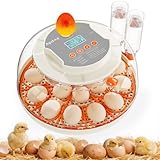
- 【Automatic Egg Turning with Adjustable Intervals】Gentle horizontal egg turning helps improve hatch rates. Customize turning intervals for different species—choose from 1h / 2h / 3h, with a real-time countdown to the next rotation. Automatically stops turning during Lockdown (last 3 days) to ensure safe hatching.
- 【Two Egg Trays for Different Egg Sizes】The standard tray (18-slot) holds 18 chicken or up to 50 quail or other small bird eggs, while the large tray (8-slot) fits 8 duck, goose, or turkey eggs. Designed to accommodate a wide range of egg sizes for versatile incubation.
- 【Fully Adjustable Incubation Day & Cycle (2026 Upgrade)】Manually set incubation day and cycle for any species. Automatically enters Lockdown based on your settings. Eggs transferred mid-incubation can be set to the correct incubation day, enabling real-time tracking and Lockdown at the correct time.
- 【Temperature & Humidity Alerts (Alarm Optional – 2026 Upgrade)】Instantly notifies you of temperature or humidity issues. Alerts can be turned off, a feature most other incubators lack—perfect for dry incubation users without constant annoying alarms.
- 【Automatic Water Refill & Precise Humidity Control】The external water bottle refills automatically, with only 2–3 water bottle refills needed throughout incubation. No lid opening or daily refills required. Adjustable air vent and multi-level water channels provide precise and flexible humidity control.
How does a platypus egg-to-milk life cycle work?
- Egg production: The female platypus produces eggs, placing the species among the monotremes rather than among mammals that give birth to live young.
- Incubation: The egg develops outside the mother’s body. NOAA reports that a platypus egg hatches after about 10 days.
- Hatching: The young platypus emerges from the egg in a very dependent state. Hatching does not mark the end of parental care.
- Nursing: The young receives milk for up to four months, according to NOAA. This extended milk-feeding stage is why the animal is still classified as a mammal.
- Growing into a juvenile: As development proceeds, the young transitions away from nursing and toward the body form and behavior of an independent platypus.
The exact schedule is species-specific, but the sequence illustrates why “lays eggs” and “is a mammal” are not contradictory statements. Reproduction can begin with an external egg and continue with mammalian lactation.
Recommended Free Tools
Are monotreme eggs hard like bird eggs?
No. Sources from the Australian Museum describe platypus and short-beaked echidna eggs as soft-shelled, while OpenStax calls monotreme eggs leathery. Their flexible covering is a major visual and structural difference from the familiar rigid shells of many bird eggs.
A soft or leathery shell still performs the egg’s essential job: it encloses the developing embryo and helps retain the nutrients and moisture needed for development. The shell material reflects the lineage and reproductive environment, not a lower level of protection or a halfway status between a bird and a mammal.
Rank #4

- 🔔[Precision Temperature Control] - Our digital incubator maintains professional-grade temperature accuracy within optimal hatching ranges. An advanced airflow system with silent fan technology ensures even heat distribution, while real-time monitoring provides instant visual and audible alerts for any abnormal change—increasing the hatching rate.
- 🚿[Auto-Regulated Humidity System] - The water system automatically sustains ideal humidity levels. Its sealed construction prevents outside interference, and smart replenishment adjusts to your eggs' needs across all development stages—avoid the need for frequent manual refills.
- ⏰[Customizable Smart Turning] - Adjust turning to suit your eggs with 60/120/180 minute options. The smart system pauses automatically 96 hours before hatching, so if the machine stops auto turning, please check if the "STOP" indicator on the display screen lights up. The machine auto-turn fuction will stop 4 days before the hatching day you set, safeguarding embryos during the critical final phase and helping maximize hatch rates.
- 🔦[Witness Life Gently] - A high-intensity LED candling light paired with a 360° crystal-clear dome enables you to check the growth status of the eggs conveniently at any time.
- 🐥[Versatile Professional Performance] - Designed to hold: 18 standard eggs such as chicken or duck; 40 smaller eggs like quail or parrot eggs. For best performance and product lifespan, please refer and follow the manual to reset and set up the machine.
Why are platypuses and echidnas still mammals?
Classification is based on a collection of biological traits, not on one feature such as whether an animal lays an egg. Monotremes belong to Mammalia because their young are nourished with milk. NOAA specifically notes nursing in the platypus, and OpenStax places monotremes in its mammal treatment while describing their leathery eggs.
This is why the question “What lays eggs but isn’t a bird?” has a precise answer: several broad animal groups lay eggs, and monotremes show that even a mammal can do so. Their egg-laying is an unusual reproductive trait within mammals, not evidence that they should be reclassified as reptiles or birds.
The Tool Desk
Outbyte Driver Updater FREEFix the driver behind crashes, sound loss and screen glitchesFind Drivers →Outbyte PC Repair FREERepair Windows errors before they cause bigger problemsFix Now →Common mistakes about egg-laying animals
- “Every animal that lays eggs is a bird.” False. Fish, reptiles, amphibians and insects include many egg-laying species, and monotremes are egg-laying mammals.
- “All fish lay eggs.” Too broad. Use “many fish” unless you are discussing a particular species with verified reproductive information.
- “All reptiles lay eggs.” Too broad for the same reason. “Most reptiles” is the supported general description.
- “A mammal must give birth to live young.” Monotremes disprove that rule. They lay eggs, then nurse their young.
- “A monotreme egg has a hard bird-style shell.” Monotreme eggs are described as soft-shelled or leathery by the Australian Museum and OpenStax.
- “Hatching means the young no longer needs its parent.” In platypuses, hatching is followed by up to four months of nursing.
How to explain this to children
Start with the familiar idea that birds hatch from eggs, then widen the category: “Many animals hatch from eggs, including fish, reptiles, amphibians and insects.” Next ask, “What lays eggs but isn’t a bird?” Introduce the platypus and echidna as mammals that lay eggs and feed their young milk.
Best Value

- [SMART TEMP & HUMIDITY CONTROL FOR HIGH HATCH RATE] Achieve professional-grade results with our integrated digital sensor system that monitors and adjusts environment parameters in real-time. By providing a stable, optimized climate, this incubator minimizes developmental risks, ensuring a significantly higher hatching success rate for beginners and experts alike.
- [360° VISIBILITY FOR EDUCATIONAL MIRACLES] Designed with high-transparency materials, our incubator offers a panoramic 360° view to witness the entire incubation process without opening the lid. It’s the perfect STEM educational tool for families and schools, allowing kids to safely observe the fascinating moment a chick breaks its shell for the first time.
- [AUTOMATIC EGG TURNER & NATURE SIMULATION] Mimicking the natural behavior of a mother hen, this machine features an automated turning function that gently rotates eggs every 2 hours. This ensures even heat distribution and prevents the embryo from sticking to the shell, promoting vigorous development and a more synchronized hatching cycle.
- [EXTERNAL WATER SUPPLY & STABLE ENVIRONMENT] Maintain perfect humidity levels without ever disturbing your eggs. The external water inlet allows you to refill the reservoir from the outside, preventing the drastic temperature and humidity fluctuations caused by opening the cover. This "no-interference" design creates a safer, stress-free environment for delicate embryos.
- [ALL-IN-ONE KIT WITH BUILT-IN EGG CANDLER] Start your journey out of the box with this comprehensive set, including a built-in LED egg candler to track embryo growth and identify fertile eggs easily. Made from durable, easy-to-clean ABS material, it also includes a bonus chicken waterer, providing a seamless transition from incubation to brooding.
A sorting activity can make the distinction concrete. The Egginfo lesson suggests using animal-sorting cards. Have learners sort pictures into “lays eggs,” “does not lay eggs,” and “need more information,” then discuss why “need more information” is useful when a whole group, such as fish or reptiles, contains different reproductive strategies. Add a second label—“young drink milk”—to show that egg laying and mammal classification answer different questions.
A reliable way to describe an egg-laying animal
- Name the animal or group precisely. Say “platypus,” “echidna,” “many fish” or “most reptiles,” rather than using an unsupported universal.
- Separate reproduction from classification. Explain whether the animal lays eggs, then state which larger group it belongs to.
- Describe the egg itself. If the source establishes shell texture, include it: monotreme eggs are soft or leathery.
- Include what happens after hatching. For platypuses, mention the approximately 10-day hatching period and nursing for up to four months, both reported by NOAA.
- State uncertainty honestly. If a source does not establish a species count, incubation time or reproductive detail, do not fill the gap with a guess.
The headline surprise is real, but the accurate lesson is broader than a single oddity. Egg laying appears across several major animal groups, while the platypus and echidnas demonstrate that it can also occur in mammals. Looking at both parts together gives a clearer picture of animal diversity than treating “lays eggs” as a synonym for “bird.”
Quick Recap
Product prices and availability are accurate as of the date/time indicated and are subject to change. Any price and availability information displayed on Amazon at the time of purchase will apply.





Leave a Reply