
Crashes, No Sound, or Screen Glitches?
Random freezes, missing sound and display glitches usually trace back to one bad driver. Find and replace yours safely.Free scan · under a minutePC Slower Than It Used to Be?
A free scan shows the junk files, broken settings and background clutter dragging Windows down - then fixes them in one click.Free scan · Windows 10 & 11Some links on this page are affiliate links: if you buy through them we may earn a commission, at no extra cost to you.
For a cat that wakes you at 4 or 5 a.m. for breakfast, start with a timed automatic feeder. It moves the food reward from you to a predictable machine. Add a puzzle feeder when you also need slower eating, foraging, or mental engagement. You can combine both by having the timed feeder release a measured portion into a puzzle feeder, provided your cat can use it safely.
Why cats wake people before breakfast
Early-morning waking is not always a simple feeding problem. Hunger is a common reason, according to Stephanie Borns-Weil, D.V.M., a behavior clinician at Tufts Cummings School of Veterinary Medicine (2025). Play and social contact can also motivate a cat to wake its caregiver.
As an Amazon Associate I earn from qualifying purchases.
What’s actually slowing this PC down?
Pick the symptom - the matching free tool is one click away.
Cats are naturally more active around dawn and dusk, so a pre-breakfast period can coincide with a normal activity peak. The Feline Veterinary Medical Association’s toolkit explains the learning loop clearly: “However, this human behavior of feeding the cat teaches the cat to continue to wake them early for food since the cat is inadvertently rewarded for this behavior by getting the food when they want it.”
That distinction determines which feeder is useful:
Popular on Amazon

- Interactive Level 2 Cat Puzzle Toy: 13" x 9.5" cat puzzle feeder that triggers hunting and foraging instincts. Level 2 adjustable difficulty for beginner to advanced cats.
- Indoor Cat Enrichment: Keeps indoor cats engaged, minimizes boredom, and delivers rewarding treat-finding play that supports daily stimulation.
- Level 2 Slow Feeder Puzzle: Holds 1/4 cup food or treats across 16 compartments. Promotes slower eating and positive feeding habits with adjustable challenge.
- Multiple Ways to Play (Level 2 Adjustable): Easy mode: treats in base compartments only. Hard mode: add treats into sliding cups via top holes so cats must push and move pieces to release rewards.
- Safe, Durable & Easy Clean: No removable parts. Made without BPA, PVC, lead, or phthalates. Wipes clean quickly for everyday use.
- If the cat is waking you because you are the route to breakfast, a timed feeder directly changes the reinforcement pattern.
- If food is available but the cat is bored, eats too quickly, or seeks hunting-style activity, a puzzle feeder addresses the way the cat obtains food rather than the clock time.
- If appetite has changed suddenly, weight is changing, or the cat is vomiting or refusing food, a feeder is not a substitute for veterinary assessment.
Automatic feeder and puzzle feeder: the practical difference
| Decision axis | Timed automatic feeder | Puzzle feeder |
|---|---|---|
| Main job | Delivers food at a chosen time without waking the caregiver | Makes the cat work to obtain food |
| Best match | Breakfast-demand behavior tied to the person | Need for foraging, slower eating, and enrichment |
| Effect on dawn waking | Directly addresses meal timing and the reinforcement loop | May occupy the cat after food is available, but does not independently set breakfast time |
| Food format | Depends on the device; verify dry- versus wet-food compatibility | Usually dry food or treats unless the design supports wet food |
| Cat’s skill requirement | Low after setup | Must be introduced gradually and matched to the cat’s ability |
| Main limitation | Provides little or no foraging component | Does not guarantee the cat will stop waking the caregiver before the puzzle is available |
Neither device is universally “better.” They solve different parts of the problem: one controls when food appears, while the other changes how the cat gets it.
When a timed automatic feeder is the better first move
It removes the person from the breakfast transaction
A timed feeder can release a measured meal just before the cat normally wakes you. The cat learns that the machine, not the bedroom door or your response, predicts food. The Feline Veterinary Medical Association specifically recommends a timed, automated feeder or treat dispenser that can toss one dry kibble at a time in different directions and opens just before the cat would normally wake the caregiver.
Recommended Free Tools
AAFP/ISFM guidelines also list store-bought timed feeders as a way to promote small, frequent meals. That can be useful for cats whose daily allowance is easier to divide than to serve in two large meals.
It is most direct when the schedule is the trigger
Use this option first when the pattern is consistent: the cat wakes you, you get up or speak to it, and breakfast follows. The feeder should be programmed for the time you want the cat to associate with breakfast, not for the time you usually surrender and feed it.
It has important limits
Automatic feeders mainly solve timing and portion delivery. A feline feeding-program review notes that they “do not typically provide foraging and predation.” A cat whose dawn activity is driven partly by boredom, hunting-style behavior, or a desire to manipulate food may still seek you out after the feeder dispenses the meal.
Also popular on Amazon

- Interactive Level 3 Cat Puzzle Toy: Cat puzzle feeder that triggers hunting and foraging instincts. Adjustable difficulty lets beginner cats start with an easier setup while advanced cats take on the full Level 3 challenge.
- Indoor Cat Enrichment: Keeps indoor cats engaged, minimizes boredom, and delivers rewarding treat-finding play that supports daily stimulation.
- Level 3 Slow Feeder Puzzle: Holds 1/4 cup food or treats across 14 base treat compartments plus 5 treat-filled pegs. Promotes slower eating and positive feeding habits with adjustable challenge.
- Adjustable Difficulty: Easier mode: place treats in base compartments and under spinning wheel, leave raindrops uncovered. Harder mode: also place treats inside pegs through top holes, cats must swivel the raindrops and slide the pegs to release rewards.
- Safe, Durable & Easy Clean: No removable parts. Made from a durable wood-and-plastic composite material; no BPA, PVC, or phthalates. Hand wash with warm soapy water and dry before refilling.
Check the device’s food requirements before relying on it. The evidence and guidance do not establish one universal design for every diet: some feeders handle dry food only, while others are designed for refrigerated or wet portions. Confirm compatibility, portion consistency, battery or power reliability, and whether the outlet is accessible to the cat.
Quick wins for a faster PC:
Scan for outdated or missing drivers - takes under a minuteDriver Scan →Repair Windows errors before they cause bigger problemsFix Now →Fix the driver behind crashes, sound loss and screen glitchesFind Drivers →How to set up an automatic feeder for a 4 or 5 a.m. wake-up
- Work out the complete daily allowance. Calculate the cat’s total daily food with veterinary guidance. Every feeder portion, training treat, and puzzle portion must come from that allowance rather than being added on top.
- Program the first release before the usual waking time. If the cat normally wakes you at 5 a.m., set the feeder to open shortly before that pattern begins. The goal is to make the machine the first predictable source of food.
- Keep your response boring and separate from feeding. When possible, do not get up, talk, or hand out extra food immediately after the cat wakes you. Any direct reward can preserve the old association between waking you and eating.
- Move the schedule in small increments if you need a later breakfast. Once the cat is using the feeder reliably, shift the release gradually rather than making a large sudden change. Wait for the cat to adjust before moving it again.
- Observe the actual portion and the cat’s access. Confirm that the hopper delivers the intended amount and that the cat can reach it without another pet blocking the route. In a multi-cat home, watch for guarding or one cat eating another’s ration.
- Use a dispenser that fits the behavior you are trying to change. A simple timed bowl may be adequate for schedule control. A model that releases individual pieces or scatters them can add a small amount of activity, but it still does not replace a true puzzle task.
Consistency matters more than a complicated schedule. If breakfast sometimes comes from the feeder and sometimes from a half-awake caregiver, the cat has a reason to continue trying both routes.
When a puzzle feeder is the better choice
It turns eating into a foraging task
Puzzle feeders require the cat to manipulate, move, bat, or otherwise work for food. A food-puzzle review describes this as using cats’ natural inclination to work for food and suggests potential physical and emotional benefits. The same review cautions that the evidence base is still developing and that more study is needed.
This approach is especially relevant when the cat finishes a meal immediately and then continues prowling, vocalizing, or seeking interaction. Slower access can extend the eating period and provide a behaviorally meaningful task, even though it does not set the breakfast clock by itself.
What the available findings do—and do not—show
In a shelter result reported by the food-puzzle review, 85% of group-housed cats—23 of 27—engaged with a food puzzle without increased aggression. That is a specific shelter population and outcome, not proof that every household cat will accept every puzzle.
Also popular on Amazon

- FUN FIVE WAYS: This cat puzzle toy features five different modules to challenge their minds and senses - perfect for beginners and advanced cats keeping mealtime playful and engaging
- SLOW & STEADY: As an interactive treat puzzle and slow feeder, the Fun Board mimics hunting behavior, supports digestion, and helps prevent overeating
- MENTAL STIMULATION: Designed to manage your cat's weight through instinct-driven tasks and balanced cognitive challenges to keep indoor cats mentally active, reduce boredom and encouraging daily enrichment and focus
- STABLE PLAYTIME: No more chasing puzzle toys across the floor with non-slip rubber pads keeping this food puzzle securely in place while your clever cat explores and searches for treats
- EASY CARE: After your cat's adventure with this treat dispenser, cleanup is quick and easy with handwashing or top rack dishwasher placement
A small household pilot summarized by the American Veterinary Society of Animal Behavior in 2019 included 19 cats. Eleven used an Indoor Hunting Feeder, and eight used PetSafe puzzles including SlimCat and Egg-Cersizer. The study found no difference in overall activity between bowl and puzzle feeding and no effect of puzzle type. Its small sample and short acclimation period limit conclusions about long-term behavior or sleep disruption.
It requires a teachable starting point
A puzzle that is too difficult can frustrate a cat, cause it to abandon the food, or leave a meal uneaten. Begin with an easy design and familiar food. Increase difficulty only after the cat succeeds consistently. A cat that is elderly, has impaired vision or mobility, or is highly anxious may need a simpler option or a different feeding plan.
How to introduce a puzzle feeder without creating food frustration
- Choose a low-effort puzzle. Start with large, obvious openings and a stable base. The cat should be able to see and smell the food without extensive trial and error.
- Use familiar food. Put part of the cat’s normal measured ration in the puzzle instead of introducing a new treat at the same time.
- Demonstrate, then step back. Let the cat investigate. You can place a few pieces near openings at first, but avoid repeatedly solving the puzzle for the cat.
- Watch for successful eating. The cat should obtain food reliably before you make the task harder. If it walks away hungry, return to an easier setting.
- Increase challenge gradually. Add manipulation or reduce the visibility of food only after the current level is routine.
- Inspect the feeding area. Remove spilled pieces, keep the puzzle clean, and make sure another pet cannot take over the station.
For a cat that eats too fast, placing the measured meal in a suitable puzzle can slow access. The puzzle still has to match the cat’s diet and ability; a device that cannot safely hold the food or that causes the cat to skip eating is not an improvement.
Can you combine an automatic feeder with a puzzle feeder?
Yes. A combined setup addresses timing and enrichment separately: the automatic feeder controls when the measured portion appears, and the puzzle controls how the cat obtains it.
- Program the automatic feeder for the chosen breakfast time.
- Place the released portion in a puzzle only if the feeder and puzzle can work together safely and the cat already understands the puzzle.
- Start with part of the meal in the puzzle and leave the rest easy to access if you are still teaching the behavior.
- Check that the entire portion is eaten within the cat’s normal feeding window and that no pieces are left where they can spoil or attract another animal.
- Keep the caregiver out of the immediate exchange. The machine should remain the predictable source of the food, while the puzzle supplies the activity.
Do not combine them merely to make breakfast harder. The point is to meet two separate needs without reducing intake, increasing conflict, or adding calories.
Also popular on Amazon
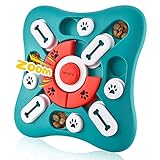
- 【PRODUCT SIZE】10 inch*10 inch*1.3 inch.
- 【3 WAYS TO PLAY, UPGRADE SLOW FEEDER】Our dog mental stimulation toys have a unique squeak button in the middle, which make it easier to attract the attention of dogs and cats. Three different difficulty designs and the 16-hole dog treat dispenser design maximize slow feeding time, even beyond 20 minutes.
- 【FUNNY STIMULATING TOYS】All kinds of dogs and cats love the puzzle game of Spin & Slide and the Seek & Hide with their smell sense and paw skills to find food. Combining circular orbit sliding game and linear orbit sliding game, smart dog and cat must move the slider correctly to get the food reward hidden in the maze.
- 【NON-REMOVABLE PARTS DOG PUZZLE】Our dog treat puzzle is made of non-toxic materials, very durable and suitable for pets to play for a long time. This dog toy has no removable parts because the design has built-in play parts that fold tightly and won't fall off easily.
- 【ANTI-SLIP & EASY TO CLEAN】: The four corners of the bottom are equipped with four anti-skid pads, which can be well fixed during the dog's slow food process; It is easy to clean, also dishwasher safe.
Choosing between the two in common situations
| Situation | Start with | Reason |
|---|---|---|
| The cat scratches or vocalizes until you get up and feed it | Timed automatic feeder | Breaks the link between waking the caregiver and receiving breakfast |
| The cat eats a measured meal rapidly and immediately seeks more activity | Puzzle feeder, if safe and accepted | Extends food access and adds manipulation |
| The cat wakes you and also seems bored at dawn | Combined setup | Automatic timing handles the schedule; the puzzle adds a task |
| The cat refuses to use a difficult puzzle | Easier puzzle or automatic feeder | Food access must remain reliable while skills are built |
| Several cats share a home | Feeder plan with monitored stations | Access, guarding, and unequal portions need observation |
| The diet is wet food | Only equipment confirmed for wet food | Many devices and puzzles are designed for dry food or treats |
Troubleshooting early-morning waking
The cat still wakes you after the feeder dispenses food
That suggests food timing is not the only reinforcer. Check whether the cat is seeking play or social contact, whether the feeder is empty or inaccurate, and whether you respond after the alarm. A feeder cannot independently resolve a dawn activity need that has nothing to do with access to food.
The cat ignores the puzzle
Lower the difficulty, use familiar food, and provide a clear path to the first pieces. Do not withhold the entire meal until the cat solves a puzzle it has not learned. If the cat continues to refuse it, use another feeding method and treat the puzzle as optional enrichment.
One cat controls the puzzle or feeder
Observe every cat during meals. The 23-of-27 shelter finding indicates that many group-housed cats can engage without increased aggression, but individual compatibility still matters. Separate stations or supervised feeding may be necessary when one cat blocks access, steals food, or causes another to retreat.
The cat’s appetite or weight changes
Seek veterinary advice for abrupt appetite changes, weight change, vomiting, or refusal to eat. A new early-morning demand can reflect a medical issue rather than a habit, and feeding schedules should be individualized.
Portion control, diet, and equipment checks
- Count feeder portions and puzzle food as part of the daily allowance.
- Confirm whether the device is intended for dry food, treats, wet food, or refrigerated portions.
- Measure what the feeder actually dispenses rather than assuming the programmed setting is exact.
- Keep food clean and accessible, especially when a puzzle leaves pieces hidden in compartments.
- Check batteries, power, lids, and dispensing openings so a mechanical failure does not leave the cat without a scheduled meal.
- In multi-cat homes, verify which cat consumed the portion instead of assuming every animal received an equal share.
What results to expect
A timed feeder is the most direct first intervention when the cat wakes the person to trigger breakfast, but it is not a guarantee of uninterrupted sleep. The cat may continue waking you for attention, play, or access to another resource. A puzzle can make the available food last longer and add a foraging task, but it does not independently establish when breakfast appears.
There is no large, long-term trial directly comparing automatic feeders and puzzle feeders for reducing human sleep disruption. The available material consists of guidelines, clinical behavior advice, reviews, a small household pilot, and a shelter result. Use the devices as behavior-management tools, monitor intake and household dynamics, and adjust the plan to the individual cat rather than treating either feeder as a universal cure.
Quick Recap
A simple decision rule
- Waking you is the main problem: begin with a timed automatic feeder.
- Fast eating or lack of engagement is the main problem: add an appropriately easy puzzle feeder.
- Both problems occur: schedule the meal automatically and place some or all of the measured portion in a puzzle once the cat can use it reliably.
- Health signs or food refusal appear: pause behavior experiments and consult a veterinarian.





Leave a Reply