
A baby chimpanzee begins life almost completely dependent on its mother. It clings to her underside, later rides on her back, nurses for roughly three years and spends several more years learning how to move, feed and survive. Those milestones make a young chimpanzee irresistibly cute, but they also show why this is a wild animal with demanding social and developmental needs—not a pet.
This guide follows five memorable facts and five picture moments families can use for learning. Biological details come from the San Diego Zoo Wildlife Alliance chimpanzee profile and the Los Angeles Zoo and Botanical Gardens chimpanzee profile.
As an Amazon Associate I earn from qualifying purchases.
At a glance: how a baby chimpanzee grows
| Life stage | What the infant is doing | Timing reported by the San Diego Zoo |
|---|---|---|
| Newborn | Clings to its mother’s underside; pink skin is visible beneath sparse dark hair. | Immediately after birth |
| Young infant | Transfers from underside carrying to riding on the mother’s back. | Back riding lasts about seven months |
| Nursing youngster | Continues receiving milk from its mother while learning through close contact. | Milk may continue until about age three |
| Growing juvenile | Practices movement and survival skills but remains dependent on maternal teaching. | Independent walking can begin around age four |
| Older juvenile | Builds the skills needed to forage, travel and function socially. | Maternal care may be needed until about age seven |
The same profile lists a gestation of about 7.5 months, usually one young per birth and a birth weight of approximately 1.9 kilograms. The zoo does not state a publication year for those figures, so they should be read as undated species-profile measurements rather than dated population statistics.
Fact 1: A newborn chimpanzee clings to its mother
A newborn chimpanzee is extraordinarily helpless. Soon after birth, it learns to hold onto the mother’s underside while she carries it. This close position keeps the infant in contact with the adult’s body as she moves through the forest and provides the support the baby cannot yet create for itself.
#1 Best Overall

- Chimpanzee Koba: This chimpanzee is called Koba. It has round and shiny eyes, realistic and friendly expressions, and a super soft touch. There are some black lines on the hands and feet, which are added finger boundaries.
- Perfect Size: Koba Chimpanzee 11.8 * 9.4 * 13.7 inches, with soft limbs that can swing freely. It can pick up the arm of the chimpanzee to imitate the gesture of greeting and interact with children. Children can also easily pick up the doll. The light and soft chimpanzee makes children love it.
- A good companion for playing and sleeping: When children play during the day, they will keep this chimpanzee stuffed animal toy by their side to accompany them. At night, they can put Koba by their bed or hug Koba to sleep together. With the companionship of this chimpanzee, children will sleep more soundly.
- Party Decoration: When holding a jungle themed party, chimpanzees shining as jungle animals are a great choice. Of course, on Christmas or commemorative days worth celebrating, chimpanzees can be brought out to play together or used as decorations at home.
- The best gift: If you give a gift for kids on any day or their birthday gift, Christmas, Easter, Halloween, there are multiple options for parents to choose from. This is the best stuffed animal toy for children, which will make them feel very happy.
Newborn skin is pink beneath the dark hair that develops over the body. The contrast can be surprising in photographs: a tiny face and hands may look dark-haired while the skin around the torso is still visibly pink. The color is a normal newborn feature, not a sign that the infant is a different species or ill.
The underside-clinging stage also gives children a useful way to understand mammal development. A baby chimpanzee cannot simply be placed in a nest and left alone. It must be carried, fed and protected by a particular mother within a stable social group. The San Diego Zoo describes this early mother–infant dependence in its species account: San Diego Zoo Wildlife Alliance, “Chimpanzee”.
Picture moment 1: tiny hands, secure grip
Fact 2: The infant graduates to a piggyback ride
As the baby becomes stronger, its carrying position changes. The San Diego Zoo says the infant transfers from underside carrying to riding on its mother’s back for about seven months. A back-riding infant can hold on while the mother climbs, travels and interacts with other chimpanzees, yet it is still relying on her judgment and strength.
Free tools Windows power users keep installed
One-click scans. No signup required.
Rank #2

- Adorable Chimpanzee Baby: This plush captures the playful and curious nature of a young chimpanzee, inviting a connection with this remarkable species.
- Exceptional Realism and Comfort: Meticulously crafted for detailed realism and long-lasting comfort, this Chimpanzee Baby plush stands out in both design and quality.
- This stuffed animal makes a great gift: perfect for baby showers, birthday gifts, holiday gifts, room decoration, and themed parties. This is also perfect for teaching children about wildlife.
- Toy Safety: Exceed the requirements set by CPSIA (USA) and EN71 (EU) for safety standards and specifications. Our packaging is free of single use plastic, made of post-consumer materials and printed in soy ink
- Wild Republic is the global leader in designing and manufacturing realistic and whimsical plush and toy for kids of all ages since 1979. The company was founded on the principle of fostering the curiosity of wildlife and the wonders of nature.
This change is not a sudden sign of independence. It is a new way to remain close while the youngster’s muscles, balance and awareness develop. The mother continues to decide where the pair goes and when it is safe to pause, climb or move on. In a troop, the infant may also encounter other adults and youngsters, but the mother remains the central source of transport and protection during this stage.
Picture moment 2: the classic piggyback
Fact 3: Nursing continues for years, not weeks
A chimpanzee’s early nourishment lasts much longer than many readers expect. The San Diego Zoo reports that a young chimpanzee may nurse until about age three. Milk is only one part of the relationship: feeding takes place alongside carrying, resting, grooming, play and constant opportunities to observe an experienced adult.
Because nursing continues into the juvenile period, a three-year-old chimpanzee is not equivalent to a human toddler who is expected to manage independently. The youngster is still developing its body, coordination and social knowledge. A mother may allow more exploration while remaining close enough to intervene or provide comfort.
Rank #3
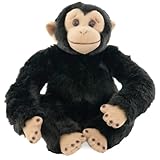
- MEET BING THE CHIMPANZEE: At 10.5 inches, Bing The Chimpanzee offers a delightful bundle of fluffiness and cuddliness. This adorable stuffed plush toy monkey brings warmth to any space, charming everyone with its irresistible cuteness and comfortable embrace.
- CUDDLY: The plush stuffed monkey is an adorable delight, expertly crafted from premium plush materials. Its excellent craftsmanship is evident in its soft fur and intricate details, making it a treasured companion excellent for cuddling.
- SPECIAL GIFT: Bearington presents an enchanting array of stuffed monkey plush toys, ideal for celebrations like graduations, Christmas, birthdays and more! These cuddly monkeys epitomize cuteness and offer heartfelt presents, treasured for years. Crafted with top-notch materials and precision, Bearington's monkeys symbolize everlasting love. Embrace the delight of gifting a stuffed animal monkey from Bearington to a special someone!
- BEARINGTON QUALITY: Bearington is synonymous with global excellence in plush toys. Our renowned brand is celebrated for opulent fabrics, unparalleled craftsmanship, and uniquely designed stuffed puppy and dog plushies. Elevate festivities with Bearington's holiday stuffed animals, embodying custom luxury and utmost quality.
- AWARD-WINNING TOYS: Bearington's legacy spans 25 years of crafting award-winning stuffed toys. Our collection ranges from timeless teddy bears to lifelike dog plushies, feline companions, and holiday stuffed animals. For every age, our creations bring joy and comfort.
For children, this is a useful reminder that “baby” does not mean a fixed number of months across species. Different primates have different schedules, and a chimpanzee’s long childhood is closely connected to the complexity of its social life and foraging skills.
Picture moment 3: quiet mother–infant contact
Fact 4: Growing up takes many years
Chimpanzee development is gradual. The San Diego Zoo says chimpanzees can begin walking independently at about age four. Walking, however, is not the same as being ready to live without a mother. The same source says maternal care may be needed until about age seven for a young chimpanzee to survive on its own.
During those years, the youngster has to learn where food can be found, how to travel safely, how to respond to threats and how to behave around members of its social group. It can watch adults, practice movements and play with peers while still returning to its mother for guidance and security. That extended apprenticeship is one reason a chimpanzee cannot be responsibly treated as a household companion.
Rank #4

- Realistic chimp, eco friendly fill and fabric made of recycled water bottles.
- Educational. This realistic plush primate offers the opportunity to teach kids about some of the many species of primates found on the planet.
- This stuffed animal makes a great gift: perfect for baby showers, birthday gifts, holiday gifts, room decoration and themed parties.
- Toy Safety: Exceed the requirements set by CPSIA (USA) and EN71 (EU) for safety standards and specifications. Safe for the little one.
- Wild Republic is the global leader in designing and manufacturing realistic plush and toy. The company was founded on the principle of fostering the curiosity of wildlife and the wonders of nature.
The timeline is approximate, not a schedule that every individual follows to the day. Age, health, social conditions and the particular skills available in a group can affect behavior. The useful point is the length of dependence: a young chimpanzee remains a learner long after it can take independent steps.
Picture moment 4: play as practice
Fact 5: Chimpanzees use tools and learn techniques socially
Tool use is not limited to adult chimpanzees, but it is an important part of what youngsters eventually learn. The San Diego Zoo describes chimpanzees stripping branches to gather insects and chewing leaves so they can act as sponges for water. These actions require selecting a suitable object, modifying it and applying it to a goal.
Recommended Free Tools
Chimpanzees can learn tool techniques by watching others. A youngster may observe an experienced individual, try a similar action and improve through repetition. That combination of dexterity, memory and social learning helps explain why a long childhood matters: the infant has years to watch, experiment and receive feedback before it must solve every foraging problem alone.
Best Value

- You will go bananas to be able to bring this heart-warming Hug’Ems Chimp stuffed animal into your cozy home.
- This plush toy will bring endless smiles into your life and it makes an excellent present for any child, teen, adult, or animal love
- The approximate size of this plushie is 7 inches, which will allow you to bring along your stuffed toy while you swing in some trees
- These cute plushies are made of soft high-quality material and are surface washable if you get the zoo animal plush dirty after taking it on an adventure
- Zoo stuffed animals will provide you with an ever-lasting friend that will stay attached to you after it swings its arms around your side
Tool traditions can differ among chimpanzee communities because skills are passed through social groups rather than appearing as a single identical routine everywhere. The Los Angeles Zoo also describes chimpanzee tool use and social behavior: Los Angeles Zoo and Botanical Gardens, “Chimpanzee”.
Picture moment 5: investigating a leaf or twig
Why the cute photos need a conservation context
Chimpanzee infancy is appealing, but the species faces serious human-caused pressures. The San Diego Zoo identifies illegal pet keeping, hunting and habitat loss as threats. The Los Angeles Zoo also lists poaching, habitat loss and degradation, and disease. These pressures can remove family members, reduce safe forest and disrupt the social learning on which young chimpanzees depend.
A photograph should therefore invite respect rather than ownership. Chimpanzees are strong, intelligent wild animals with specialized diets, social relationships and years-long care requirements. A private home cannot provide a mother, a chimpanzee community or a natural environment. Do not buy, handle or promote a chimpanzee as a pet, and do not support attractions that encourage direct contact with infant apes.
Do these 3 things before closing this tab:
1Repair Windows errors before they cause bigger problems2Fix the driver behind crashes, sound loss and screen glitches3Clear out junk files and repair common Windows errorsHow to use the five pictures responsibly
- Confirm the source. Ask the photographer, zoo or rights holder whether the specific image may be republished, where it may appear and for how long.
- Use an accurate caption. State what is visible—such as underside clinging or back riding—without guessing an animal’s exact age, feelings or future action.
- Protect the animals’ dignity. Avoid images showing forced handling, unsafe proximity, feeding by visitors or distress.
- Give context beside the image. Place the relevant developmental fact and a conservation note near the picture so cuteness is not separated from the animal’s needs.
- Choose education over novelty. A clear view of a natural behavior is more valuable than a staged “selfie” or costume-style image.
What children should remember
- A newborn chimpanzee’s first secure place is against its mother’s body.
- Carrying changes from underside clinging to a piggyback position as the infant grows.
- Nursing can continue until about age three, and learning continues for years afterward.
- Walking independently around age four does not mean the youngster is ready to live alone.
- Chimpanzees use modified branches and leaves to obtain food and water, and they can learn these techniques by watching others.
- Protecting forests and rejecting illegal pet keeping are more helpful than trying to own or touch a chimpanzee.
Sources for further learning
For species biology, infant development, tool use and threats, see the San Diego Zoo Wildlife Alliance chimpanzee profile. For additional information on social behavior, habitat, threats and infant imagery, see the Los Angeles Zoo and Botanical Gardens chimpanzee profile. Image availability, licensing and captions must be confirmed with the relevant rights holder.
Quick Recap
Product prices and availability are accurate as of the date/time indicated and are subject to change. Any price and availability information displayed on Amazon at the time of purchase will apply.





Leave a Reply