
The Tool Desk
Outbyte Driver Updater FREEScan for outdated or missing drivers - takes under a minuteDriver Scan →Outbyte PC Repair FREEClear out junk files and repair common Windows errorsFree Scan →Some links on this page are affiliate links: if you buy through them we may earn a commission, at no extra cost to you.
Beginner coral success depends less on finding a supposedly indestructible species than on starting with a fully cycled aquarium, measuring salinity and water quality, and matching light, circulation, feeding and spacing to each coral. Soft corals such as mushrooms, leather corals, button polyps and zoanthids are sensible first choices, but no coral is maintenance-free. Establish stable conditions first, add one or a few colonies, and use their behavior as an early warning that something in the system needs attention.
What corals are and why that matters for beginners
Corals are colonial marine animals, not rocks or plants. A colony is made of many tiny animals called polyps connected by living tissue. Many shallow-water, reef-building hard corals host microscopic algae in their tissues. The algae use light to photosynthesize and provide much of the coral’s nutrition. NOAA’s National Ocean Service summarizes the relationship this way: “Most importantly, zooxanthellae supply the coral with food.”
As an Amazon Associate I earn from qualifying purchases.
Do these 3 things before closing this tab:
1Repair Windows errors before they cause bigger problems2Scan for outdated or missing drivers - takes under a minute3Clear out junk files and repair common Windows errorsPhotosynthesis does not make every coral’s needs identical. Corals can also capture small animals and plant material suspended in the water, and some species rely more heavily on this feeding than others. Light, flow, feeding time, growth form and aggression vary by coral. Treat a species label as the beginning of your research, not as a complete care plan.
When a coral stays withdrawn for a prolonged period or loses color, consider it a husbandry signal. Check measured water conditions, equipment and placement rather than moving it repeatedly or adding supplements at random.
Popular on Amazon
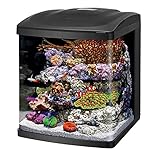
- EVERYTHING YOU NEED - Feature a compact and customizable filtration chamber that is already built-in to the back of the aquarium – easy to setup and maintain.
- GREAT FEATURES – Includes quiet submersible pump, dual intakes and adjustable return nozzle. Compatible with all existing BioCube accessories. Fish, corals, substrate and décor are sold separately.
- SLEEK and MODERN – Biocubes feature a rounded edge design and is the perfect innovative all-inclusive aquarium for all needs..
- VIBRANT LED LIGHTING - Low-profile hood contains vibrant LED lighting that is capable of sustaining and growing healthy, vibrant corals and live plants.
- MAXIMIZE BEAUTY - 24-hour timer which makes it easy to control the three independent light channels for maximum beauty: bright white, sparkling blue and color enhancing LEDs.
Get the aquarium ready before buying coral
Complete the nitrogen cycle
A new marine aquarium must complete its nitrogen cycle before fish, invertebrates or coral are added. During cycling, beneficial microbes process toxic ammonia into nitrite and then nitrate. The University of Florida Institute of Food and Agricultural Sciences (UF/IFAS) uses three to four weeks as an example estimate in its marine-aquarium project material. That is not a guaranteed timetable: temperature, filtration, the starting material and the cycling method all affect the result.
Use test results and an established maintenance routine as the readiness test. Do not add coral simply because a calendar says the tank is old enough. If ammonia or nitrite is detectable, postpone livestock and continue cycling. Once the cycle is complete, add animals gradually so the biological filter can adjust to the new waste load.
Quick wins for a faster PC:
Scan for outdated or missing drivers - takes under a minuteDriver Scan →Clear out junk files and repair common Windows errorsFree Scan →Fix the driver behind crashes, sound loss and screen glitchesFind Drivers →Stabilize the environment
Corals tolerate less rapid change than a new keeper may expect. Set up the heater, circulation, filtration and light, then observe the aquarium before adding a colony. Verify that temperature and salinity remain steady over several days, including after top-off water is added.
Use the right source water
UF/IFAS lists reverse-osmosis water among marine-aquarium materials. Purified water makes salinity and dissolved-mineral management more predictable than an untested source. Evaporation removes water but leaves salt behind, so replace evaporated water with fresh purified water rather than saltwater unless you are deliberately performing a water change.
Also popular on Amazon

- Contains one (1) API REEF MASTER TEST KIT Reef Aquarium Water Test Kit 1-Count, including 7 bottle of testing solution, 2 color cards and 4 test tubes with cap
- Helps prevent invisible water problems that can be harmful to fish and cause fish loss
- Accurately monitors 4 most vital water parameters levels in reef aquariums: Calcium, carbonate water hardness, phosphate and nitrate
- Designed for use in reef aquariums only
- Use for weekly monitoring and when water or fish problems appear
Water parameters: useful ranges, not automatic recipes
Natural reef conditions provide context, but a tank should follow the requirements of its inhabitants and the instructions for its equipment. The following figures come from two different sources and should not be treated as a single universal target.
| Factor | Published figure | How to use it |
|---|---|---|
| Temperature | 73–84°F (23–29°C) for many reef-building corals, according to NOAA’s National Ocean Service (page last updated 2024) | Use as a broad natural-history range. UF/IFAS gives 76–83°F as an example reef-tank range. Choose a stable setting appropriate to your livestock and avoid abrupt swings. |
| Salinity | 32–42 parts per thousand for reef-building corals, according to NOAA | UF/IFAS gives 34 ppt or specific gravity 1.026 as an example reef-tank value. Measure with a calibrated refractometer rather than estimating. |
| Ammonia and nitrite | No single beginner set point is supplied in the cited material | Do not add livestock while either is detectable in a tank that is still cycling. Test to verify the cycle and investigate any later rise. |
| Nitrate | No universal number is supplied in the cited material | Test regularly, record the trend and follow the tolerance of the animals you keep instead of chasing an arbitrary value. |
| Calcium | UF/IFAS does not provide a target in the cited setup material | Tropical Marine Centre specifically advises hard-coral keepers to monitor calcium. Test when your coral choices and maintenance plan make it relevant. |
| Light and flow | No universal PAR or flow value is established for all corals | Match intensity and circulation to the selected coral, then adjust gradually while observing expansion, tissue condition and detritus accumulation. |
Specific gravity is a hydrometer or refractometer reading related to salinity, not a separate form of salt. Because readings vary with temperature and instrument calibration, use one reliable method consistently and calibrate it as directed by the manufacturer.
Free tools Windows power users keep installed
One-click scans. No signup required.
Equipment a first reef tank actually needs
UF/IFAS’s simplified marine-aquarium materials include a thermometer, heater, test kit, refractometer, reverse-osmosis water, filtration, protein skimmer and glass scraper. Your aquarium’s volume, livestock and husbandry style determine which capacity and design are appropriate.
- Thermometer: confirms the water is in the intended range and reveals heater failure.
- Heater: keeps temperature from falling; use a dependable controller or a backup plan where practical.
- Refractometer: measures salinity or specific gravity more precisely than judging by eye.
- Marine water test kit: checks the nitrogen-cycle compounds and any additional parameters your coral plan requires.
- Filtration: removes or processes waste. Select it for the aquarium’s bioload rather than the display volume alone.
- Protein skimmer: exports dissolved organic material in systems where its size and operating conditions make it effective.
- Circulation pump: distributes oxygen, nutrients and heat and prevents stagnant areas.
- Reef-appropriate light: supplies the spectrum and intensity required by the corals you choose. A light marketed for freshwater plants is not automatically suitable.
- Glass scraper: removes algae so you can inspect animals and equipment.
- Prepared saltwater and top-off water: keep replacement water’s salinity consistent and compensate for evaporation correctly.
Buy testing capability before coral. A visually clear aquarium can still have unstable salinity or nitrogen compounds, while a cloudy or algae-marked tank may simply need routine maintenance rather than a new additive.
Also popular on Amazon
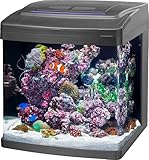
- ALL-IN-ONE SYSTEM: Everything you need for quick and easy setup. Includes a sleek and modern hood, white and blue LED lights, filter, quiet pump, dual intakes, adjustable nozzle and more.
- SMART LIGHTING: Control your aquarium from anywhere with the Aqueon BlueIQ app to toggle between white and blue LED, a programmable 24/7 schedule, feeding reminders and more.
- PERFECT FOR ALL LEVELS: Designed for both newcomers and seasoned aquarium keepers. Perfect for freshwater or saltwater environments.
- OPTIMAL GROWTH ZONES: Produces light and current within three distinct BioZones, providing the perfect light spectrum and intensity to sustain and grow different types of corals.
- PAIRS WITH BIOCUBE ACCESSORIES: Explore a range of BioCube accessories like the BioCube Protein Skimmer for advanced filtration or the Algae Cleaning Magnet and Pad for simple maintenance. Discover more options to enhance and tailor your ecosystem.
Beginner-friendly coral options
UF/IFAS identifies button polyps, cauliflower colt coral, colony polyps, leather coral, mushrooms, tree coral and zoanthids as soft corals suited to beginning hobbyists. Its guide states that these listed examples do not require additional lighting and are not aggressive; interpret that statement within the guide’s specific list. Every coral still needs suitable aquarium lighting, circulation and placement, and neighboring colonies may compete or sting one another.
| Coral group | Why beginners consider it | Questions to answer before purchase |
|---|---|---|
| Mushrooms | Soft, fleshy colonies included in UF/IFAS’s beginner list; often useful for a first observation of polyp expansion and contraction. | How quickly can the colony spread in your available space? What light and flow does the exact variety prefer? |
| Leather coral | A soft coral named by UF/IFAS as beginner-oriented and generally forgiving when conditions are stable. | Will its mature shape shade or contact other colonies? Does it periodically retract while renewing its surface? |
| Button polyps | Included in UF/IFAS’s beginner examples and available as small colonies or frags. | How will you leave room around the colony as it expands, and how will you observe its response without crowding it? |
| Zoanthids | Listed by UF/IFAS among soft corals suitable for beginning aquarists. | What light and current does the seller specify for the particular colony, and where can it grow without contacting neighbors? |
| Cauliflower colt coral | A soft coral included in the UF/IFAS list. | Does the aquarium provide the circulation and open space needed by its branching form? |
| Colony polyps | Named in UF/IFAS’s beginner group and useful for learning how a colony occupies rockwork. | Can you contain its spread and keep it from overrunning slower-growing corals? |
| Tree coral | Included in UF/IFAS’s beginner examples. | What support and flow does the exact species need, and how much vertical room will it require? |
“Beginner-friendly” describes a relative starting point, not a guarantee. A healthy specimen from a reliable source, transported carefully and placed in a stable aquarium, is a better choice than a stressed colony selected only because its common name sounds easy.
Choose coral by the aquarium you can maintain
Match light without guessing a PAR number
The available evidence does not support one PAR target for every beginner coral. Ask for the species or variety, the light type, and the position where the coral was previously kept. Place a new colony in a conservative location, then acclimate it gradually to stronger light if its response and care guidance support that move. Sudden exposure can stress a coral just as much as insufficient light.
Use flow to deliver clean, oxygenated water
Circulation should move water through the display without continuously blasting a soft coral against rock. Look for gentle, varied movement: tissue should not remain pinned in one direction, and detritus should not settle permanently around the colony. Redirect the pump or reduce intensity when a coral cannot expand, is being abraded, or accumulates debris.
Also popular on Amazon

- 🐠 EVERYTHING YOU NEED - Feature a compact and customizable filtration chamber that is already built-in to the back of the aquarium – easy to setup and maintain
- 🐠 GREAT FEATURES – Includes quiet submersible pump, dual intakes and adjustable return nozzle. Compatible with all existing BioCube accessories. Fish, corals, substrate and décor are sold separately.
- 🐠 SLEEK & MODERN – Biocubes feature a rounded edge design and is the perfect innovative all-inclusive aquarium for all needs!
- 🐠 VIBRANT LED LIGHTING - Low-profile hood contains vibrant LED lighting that is capable of sustaining and growing healthy, vibrant corals and live plants.
- 🐠 MAXIMIZE BEAUTY - 24-hour timer which makes it easy to control the three independent light channels for maximum beauty: bright white, sparkling blue and color enhancing LEDs.
Plan mature size and chemical space
Leave room between colonies from the day you place them. Tropical Marine Centre warns that corals can sting neighboring corals while competing for space. A gap that looks excessive around a small frag may be necessary once the colony grows. Place faster-spreading colonies where they can be isolated or trimmed without touching slower neighbors.
Check fish compatibility
Fish may nip, overturn or otherwise disturb coral. Tropical Marine Centre specifically advises considering fish compatibility as part of coral care. Confirm that existing and planned fish will not repeatedly pick at the colony or dislodge it from its attachment point.
Recommended Free Tools
How to add and place a new coral
- Verify the tank first. Check temperature, salinity and the nitrogen-cycle tests before opening the coral’s container. Delay introduction if the aquarium is unstable.
- Prepare a low-stress acclimation area. Match temperature and follow the seller’s acclimation instructions. Avoid mixing transport water into the display unless the supplier explicitly directs it.
- Inspect the colony. Look for tissue damage, unusual films, pests or a foul odor. Isolate a questionable specimen rather than exposing an established display.
- Choose a temporary location. Start with the light and flow level recommended for that coral, leaving clear space from every neighbor.
- Secure it. Prevent pumps, snails or fish from rolling the coral. A loose colony can be injured repeatedly before it attaches.
- Observe before adjusting. Give the coral time to settle. Record its position, polyp expansion, color and any interaction with nearby animals.
- Change one variable at a time. If the response is poor, test water and inspect equipment before moving the coral. When a move is warranted, alter light or flow gradually so you know what helped.
Do not interpret a short period of contraction as proof that the coral is dying. Transport, handling and a new light pattern can cause temporary withdrawal. Prolonged withdrawal, progressive paling or tissue loss requires a systematic check rather than repeated disturbance.
Independent reader supportYour contribution helps us test, update, and keep practical guides available for everyone.Feeding: why one schedule cannot fit every coral
Photosynthetic algae provide substantial nutrition for many reef-building hard corals, but corals can also capture suspended food. Tropical Marine Centre notes that some corals feed at different times and require different feeding patterns. Research the exact coral’s feeding behavior before selecting a food or schedule.
Also popular on Amazon

- [DIGITAL AQUARIUM WATER TEST KIT – APP-ENABLED 10-IN-1 FRESHWATER & SALTWATER FISH TANK TEST KIT]: Test aquarium water with this all-in-one digital aquarium water test kit, fish tank test kit, and freshwater aquarium test kit. Measure ammonia, nitrate, nitrite, pH, GH, KH, chlorine, and more for freshwater aquariums, saltwater aquariums, reef tanks, shrimp tanks, and fish tanks. Scan each aquarium test strip with the DROPLYTIX app for fast digital results without comparing colors to printed charts.
- [FOR ALL AQUARIUM TYPES – FRESHWATER, SALTWATER, REEF, BETTA, SHRIMP, TURTLE & AXOLOTL]: This fish tank water testing kit works with freshwater fish tanks, saltwater aquariums, reef aquariums, planted aquariums, shrimp tanks, betta tanks, turtle aquariums, axolotl tanks, nano aquariums, and aquarium starter kits. Compatible with 5-gallon, 10-gallon, 20-gallon, and 30-gallon fish tanks. Ideal for aquarium maintenance kits, aquarium cleaning routines, and routine water testing.
- [FAST RESULTS – DIGITAL AQUARIUM TEST STRIPS WITH NO COLOR GUESSING]: Replace traditional ammonia test kits, pH drops, and manual color charts with digital aquarium test strips and fish tank test strips. Simply dip, scan, and receive detailed results for ammonia, nitrite, nitrate test strips, pH balance, GH, KH, chlorine, and aquarium water quality. Ideal for fish tank water quality testing, planted aquariums, aquarium cycling, and accurate aquarium water test results.
- [COMPLETE AQUARIUM WATER TESTING FOR HEALTHIER FISH & STABLE WATER]: Monitor the most important aquarium water parameters to help maintain balanced conditions for tropical fish, freshwater fish, saltwater fish, shrimp, snails, corals, and reef aquariums. This master aquarium test kit provides detailed monitoring of pH, ammonia, nitrate, nitrite, hardness, GH, KH, and chlorine for beginner and advanced aquarium hobbyists using digital aquarium testers and water quality test kits.
- [COMPLETE AQUARIUM TEST STRIP KIT – DIGITAL WATER TESTING AT HOME]: Everything needed to monitor aquarium water quality in one app-powered aquarium water test kit. Use as a betta fish test kit, freshwater test kit, freshwater aquarium test kit, reef aquarium water tester, fish tank test kit, or fish tank water testing kit. Ideal for aquarium cycling, water changes, routine aquarium maintenance, GH/KH test kits, saltwater master test kits, nitrate/nitrite test kits, aquarium test strips, and digital aquarium testers.
- Observe when the polyps extend and offer food only when the coral can capture it.
- Use circulation to distribute fine food without allowing uneaten material to rot in dead spots.
- Feed sparingly at first and watch the aquarium’s nutrient trend.
- Do not assume a coral labeled “photosynthetic” never benefits from suspended food, or that every coral needs target feeding.
Feeding cannot compensate for unsuitable salinity, temperature, light or flow. Correct the environmental problem first.
A practical monitoring routine
Weekly checks
The Tropical Marine Centre care sheet advises testing ammonia, nitrite and nitrate weekly, especially after initial setup or after adding fish. It also says hard-coral keepers should monitor calcium. Treat that as the care sheet’s recommendation and adapt the exact schedule to your stocking plan and test results.
- Measure salinity and top off evaporated water with fresh purified water.
- Check temperature and confirm that the heater and circulation pump are operating.
- Test the nitrogen-cycle compounds and record the numbers, not just “good” or “bad.”
- Inspect each coral for extension, color, tissue condition and contact with neighbors.
- Remove algae from viewing panels so you can see the colony and equipment.
After adding livestock
New fish and invertebrates increase waste production. Test more attentively after additions, look for an ammonia or nitrite rise and avoid adding another animal until the system has settled. A stable test record is more useful than a single reassuring result.
When a coral looks wrong
- Confirm the instrument reading with a clean, calibrated test method.
- Check for salinity change caused by evaporation or an incorrectly mixed water change.
- Inspect heater, pump and light operation and look for a blocked intake or stagnant area.
- Check whether a neighboring coral is touching or stinging the colony.
- Review recent additions, maintenance and feeding for a likely trigger.
- Make one measured correction and observe before making another.
Common beginner mistakes and better choices
| Mistake | Why it causes trouble | Better approach |
|---|---|---|
| Adding coral before cycling is verified | Ammonia and nitrite can harm animals while the biological filter is immature. | Use tests to confirm the cycle; regard three to four weeks as an example estimate, not a deadline. |
| Relying on a fixed internet parameter list | Different sources and corals have different requirements, and stability matters as much as a point value. | Use the cited natural-history ranges as context, then follow species-specific aquarium guidance. |
| Replacing evaporation with saltwater | Salt remains when water evaporates, so adding more saltwater raises salinity. | Top off with fresh purified water and verify the reading with a refractometer. |
| Placing colonies edge to edge | Corals can sting or shade one another as they grow. | Leave a deliberate buffer and plan for mature size. |
| Changing light, flow and chemistry simultaneously | You cannot identify the cause of improvement or decline. | Test first and adjust one variable at a time. |
| Assuming all corals eat the same way | Some feed at different times or rely more on suspended food. | Follow the exact coral’s feeding pattern and observe its response. |
| Ignoring fish behavior | Nipping or digging can injure or dislodge an otherwise healthy colony. | Plan coral and fish as one compatibility decision. |
A simple decision framework for your first coral
- Confirm readiness: the aquarium is cycled, temperature and salinity are stable, and you can test the water consistently.
- Describe your system: note aquarium size, light type, pump pattern, existing fish and the rockwork available.
- Choose a soft-coral candidate: start with a UF/IFAS-listed option whose mature growth and placement suit your aquascape.
- Obtain care details: ask for the coral’s scientific identity when possible, previous light and flow, feeding behavior and expected size.
- Reserve space: mark a location with adequate clearance from other colonies and a secure attachment point.
- Add only a small number: observe the system’s response before increasing its biological load.
- Keep records: write down test values, maintenance, feeding and visual changes so trends are visible.
When to wait instead of buying coral
Wait if ammonia or nitrite is detectable, salinity is drifting, temperature is unstable, equipment is unreliable, or you cannot identify a suitable location away from neighboring colonies. Also wait when a planned fish may eat or dislodge coral, or when you do not yet have a way to measure the conditions the coral requires. A delayed purchase protects both the animal and the stability you have worked to establish.





Leave a Reply