
Recommended Free Tools
Some links on this page are affiliate links: if you buy through them we may earn a commission, at no extra cost to you.
The best anti-pull dog harness is the one that fits your dog securely, leaves the shoulders free, and gives you useful steering while you teach loose-leash walking. A front chest attachment can turn a forward surge toward you; a dual-clip design can provide that steering during training and a back connection for ordinary walks later. No harness teaches leash manners by itself, and no model is proven to stop every dog from pulling.
Use the comparison below to match attachment style and construction to your dog, then measure and adjust carefully. Pair the harness with reward-based practice: reinforce a slack leash and check-ins, and pause or change direction when the leash tightens.
As an Amazon Associate I earn from qualifying purchases.
What an anti-pull harness can—and cannot—do
A harness changes where leash force is applied and where you can guide the dog. With a front chest ring, a pulling dog’s forward motion is redirected toward the handler instead of being aimed straight ahead. That redirection can make it easier to regain attention and keep a strong dog from towing you in a straight line. NOCO Humane describes front-clip designs as generally more effective for managing pulling than back-clip styles, while emphasizing that a harness is not a quick fix. NOCO Humane’s guidance recommends pairing the equipment with loose-leash training.
A back clip is positioned over the shoulder blades and is often comfortable for a dog that already walks politely. It offers less mechanical redirection for a dog that is still learning. A dual-clip harness gives you both connection points, but it still depends on correct adjustment and on teaching the dog what a loose leash means.
Popular on Amazon
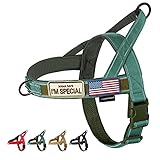
- [Premium No Pull Dog Harness] The wider soft padded inner is comfortable and friendly for dog's neck without dog's fur hurting. The back strap and chest strap inner is made of soft and breathable material that is comfortable for the dogs. And the front strap is better to prevent the dog from rushing forward. This design is maintain a long-time comfortable for walking,jogging,running,training,etc.
- [Reflective Strip] Reflective stitching along polyester webbing is not only add a sense of design to the safe for walking dog harness,but also increase a better visibility at dark under the light that it can keep the dog safe while walking.
- [Two Rings Design] The O-ring and D-ring is convenient and flexible to hang,they not only can connect well with dog leash,but also can hang ID tags,key,poop bag,etc.
- [Choose the Suitable Dog Harness] The no pull dog harness have FIVE sizes,XS is design 1 inch wide / S M L XL are design 1.5 inches wide for the small & medium and large dogs. PLEASE measure the size of the dog and refer the dimension chart to select the right one before buying.
- [Come with TWO Patches] There has a velcro area on the dog walking harness,and come with 2 patches, you can put the patches "MAMA SAY I'M SPECIAL" or the flag on the dog harness velcro area to make your dog unique.
Think of the harness as management while learning happens. It can improve steering and reduce the handler’s leverage problem, but it does not reward the dog, make a decision about where to walk, or replace behavior work. The evidence available for the products below consists of consumer guidance and manufacturer specifications, not independent head-to-head testing, so there is no defensible “best for every dog” ranking.
Choose the attachment style first
| Style | Where the leash connects | Best use | What to watch |
|---|---|---|---|
| Front clip | Chest, in front of the shoulders | Dogs that surge ahead and need gentle redirection while learning | The leash may rotate the harness if the fit is loose; check shoulder movement and strap position |
| Back clip | Upper back | Dogs with reliable loose-leash skills, routine walks, or handlers who prefer a simple connection | Provides less redirection when a dog pulls; a determined dog can still tow |
| Dual clip | Front chest ring and back ring | Training with two-point control or transitioning from front guidance to back-clip walks | Requires compatible equipment and careful leash handling; two points are not automatically better |
These categories reflect the distinctions described by the American Kennel Club (AKC): front clips can help dogs that pull, back clips suit well-trained walkers, and dual clips allow a front-to-back transition as skills improve. Read the AKC overview of harness types for that framework.
Two illustrative harnesses and what their specifications mean
The following are examples supported by the manufacturers’ published descriptions. They are not independent test winners, and a front ring alone does not prove that a particular harness will fit or work for your dog.
| Harness | Attachment and steering description | Sizing and adjustment information supplied | Potential fit and use questions |
|---|---|---|---|
| PetSafe Easy Walk Harness | PetSafe describes a front martingale loop intended to steer the dog to the side and redirect attention when pulling. | Use the maker’s current size chart and adjustment instructions; the cited product guidance does not establish one universal measurement range. | Confirm that the loop lies at the chest, the straps do not rub behind the elbows, and the dog cannot back out. A martingale-style front section must never be treated as a substitute for checking fit. |
| 2 Hounds Design Freedom No-Pull Harness | The manufacturer describes front and back attachment use and a two-point leash option. | Its cited listing specifies chest-measurement sizing, including an XXSmall example for a 13–16-inch chest, and describes a two-finger fit check. Verify the current chart before ordering. | Measure the dog rather than choosing by breed or weight. Check whether the construction suits the dog’s shoulder shape and whether a two-point setup is useful for your handling style. |
Details for the Easy Walk’s front loop come from PetSafe’s product guidance. The Freedom harness’s attachment, sizing, and two-point descriptions come from the 2 Hounds Design product page. Manufacturer statements describe intended design and use; they do not establish comparative effectiveness or guarantee comfort for every body shape.
How to match a harness to your dog
Start with the dog’s measurements, not the label
Measure the chest where the maker’s chart instructs, normally around the rib cage behind the front legs, while the dog stands naturally. Record the result and compare it with the exact model’s chart. Two dogs of the same breed or weight can have different chest depth, neck shape, and shoulder width, so “medium” is not a measurement.
Protect shoulder movement
A strap should stay behind the rib cage and away from the elbows. The harness must not cut across the front of the shoulder in a way that limits extension (the leg reaching forward) or abduction (the leg moving outward). Ask someone to watch the dog walk and trot: the stride should remain natural, with no shortened step, hitch, or repeated rubbing.
Quick wins for a faster PC:
Repair Windows errors before they cause bigger problemsFix Now →Fix the driver behind crashes, sound loss and screen glitchesFind Drivers →Clear out junk files and repair common Windows errorsFree Scan →Also popular on Amazon

- Helps Stop Pulling: Patented Martingale loop design puts gradual pressure on your dog’s shoulders to safely and effectively stop pulling; a front leash attachment helps you guide your dog
- Legacy Of Trust: Created by a veterinary behaviorist in 2004, the Easy Walk harness is loved and trusted by a million pet parents and trainers
- Comfortable Fit: Easy Walk harness has less coverage than other harnesses making it lightweight and very breathable
- No Gagging Or Choking: Rests across your dog’s chest instead of his throat to stop gagging and choking if he pulls
- Easy to Fit: Quick-snap shoulder straps and a different color belly strap make it simple to put the harness on your dog
Balance steering with security
A front ring helps redirect, but a loose harness can rotate or allow an escape. Look for adjustment points that let you set the chest and girth sections independently. After fitting, test whether the dog can reverse out by applying gentle, steady backward pressure while you stand beside the dog; do not jerk the leash. If the harness can slide over the head or shoulders, change the adjustment or choose another design.
Consider body shape and coat
Deep-chested, narrow-waisted, short-coated, and heavily coated dogs can each expose different problems. A narrow dog may need more adjustment range to prevent backing out. A thick coat can hide a loose girth strap, while a short coat makes rubbing obvious quickly. Check the skin under every strap after the first few walks and after any adjustment.
Decide whether two-point walking is practical
A double-ended leash can connect a compatible front and back ring. The arrangement can distribute your guiding input and give you a second point of control during training, but it is an accessory, not a requirement. Use it only when the harness is designed for two points and you can manage both clips without tangling. The AKC discusses two-point attachment in its fit guidance; the Freedom manufacturer describes the configuration for its own harness.
Fit the harness safely: a seven-step check
- Measure first. Follow the product maker’s chest-measurement method and chart. Keep the measurement and the selected size with the packaging in case an exchange is needed.
- Let the dog stand naturally. Fit on a level surface when the dog is calm, not while it is sitting, twisting, or pulling away.
- Identify each strap and ring. The chest piece should sit on the front of the body; the girth strap belongs behind the rib cage and away from the elbows. If the design has a front martingale loop, make sure it lies centered rather than off to one side.
- Adjust for two-finger clearance. You should be able to slide two fingers under each properly positioned strap without forcing them. Less space can pinch; much more can permit slipping. The AKC uses this two-finger check in its well-fitting harness guidance.
- Check the shoulders in motion. Walk the dog several steps and watch for a restricted reach, rubbing behind the elbows, or a strap drifting onto the shoulder joint. Reposition and readjust before attaching a leash for a full walk.
- Perform an escape check. With the dog standing, gently test backward and sideways movement. The harness should stay on the rib cage and chest and should not pull over the head. Never rely on a collar as a backup if the harness can slip off; use a properly fitted safety connection only if your equipment instructions support it.
- Recheck after movement. Front attachments can rotate when the leash changes angle. Inspect the position again after a short indoor walk, after a vigorous sniffing session, and whenever the dog’s weight or coat changes.
If the dog is uneasy about putting its head through a loop, do not force it. The AKC recommends voluntary introduction and rewards; its harness-putting-on guide describes that approach.
Introduce the harness without creating a struggle
- Place the harness on the floor and reward the dog for looking at or sniffing it.
- Touch the harness briefly to the shoulder or chest, feed a treat, and remove it. Repeat until the dog stays relaxed.
- Invite the dog to put its nose or head through the opening voluntarily. Feed several small treats through the opening rather than pulling the harness over the dog.
- Fasten one buckle, reward, and unfasten. Build duration gradually before adding the leash.
- Walk indoors for a few steps, rewarding a loose leash and calm body language. Increase distance and distractions only while the dog remains comfortable.
Signs that the pace is too fast include freezing, repeated pawing at the harness, tucked posture, escape attempts, or refusal of food. Back up to the previous easy step rather than holding the dog in the equipment.
Train loose-leash walking while the harness manages pulling
Use the least amount of physical guidance that keeps the situation safe. AVSAB’s current public position says its 2021 Humane Dog Training statement remains authoritative and recommends reward-based methods for all dog training and behavior modification. In its words: “Based on current scientific evidence, AVSAB recommends that only reward-based training methods are used for all dog training, including the treatment of behavior problems.” Read the AVSAB position statement.
Also popular on Amazon

- 【No Pull & No Choke Design】: This harness simply goes through the dog's head, snaps on the belly and that's the end of it. Besides, the D-ring on the chest strap is used for no pull dog training and guiding direction, and the O-ring on the back is used for daily dog walking. The triangular design on both sides of this no pull harness helps to distribute the pulling force, so you don't have to worry about the dog choking when suddenly pulling.
- 【Soft Velvet Padded & Durable】: With soft thicken and wider fleece pads used beneath the strap of neck, back and handle atop, this dog harness could reduce friction from movement and protect the health of the dog's skin. It also uses superior nylon material to ensure long-lasting use.
- 【Leash Double Handle & Elastic Band】: You can use the top handle for casual dog walking, and the center handle for controlling the direction of the dog, easily guiding it through crowded areas and preventing storming in case of accidents. And the springy design of the leash really absorbs the pull from large strong dogs without tugging on your wrist and shoulder.
- 【Neck & Chest Adjustable】: SlowTon dog harness is equipped with adjustable loop for both neck and chest girth, and the quick-release buckle allows for quick donning. No matter what kind of breed and shape, it provides proper length after adjusting to fit your dog's neck and chest, which is perfectly designed for walking, jogging, running, hiking and training.
- 【Tangle-free Leash & Reflective】: The heavy-duty 360°swivel metal hook ensures no tangle. Plus, it has an elastic bungee and 2 padded handles, which is great for walking training of city dogs, or wandering off in country. Furthermore, its super bright reflective strips ensure a safe walk both day and night. And it comes with 2 hook and loop straps, a regular one Support Dog and the reflective one DO NOT PET.
Reward the behavior you want
Carry small, high-value treats. Mark and reward slack in the leash, a glance back at you, or a voluntary change from pulling to walking beside you. Begin in a quiet area where the dog can succeed, then add distance, smells, people, and other dogs one at a time.
Respond consistently to leash tension
When the leash tightens, stop or calmly change direction. Wait for slack or a check-in, then continue and reward. Avoid dragging the dog toward you, leash jerks, or equipment intended to cause pain. The front clip is there to make your redirection easier, not to deliver a correction.
PC Slower Than It Used to Be?
A free scan shows the junk files, broken settings and background clutter dragging Windows down - then fixes them in one click.Free scan · Windows 10 & 11Outdated Drivers Are Slowing You Down
One free scan finds every outdated or missing driver and matches the right update for your exact hardware.Free scan · exact hardware matchKeep sessions short enough to succeed
Several brief practices can be more productive than one exhausting walk. End while the dog is still able to eat, respond, and move naturally. If the environment is too difficult, increase distance from the trigger, choose a quieter route, or return to an easier skill.
Get help for serious behavior
Intense lunging, fear, redirected biting, or repeated escape attempts require more than a product choice. Ask your veterinarian about a qualified, reward-based behavior professional. A harness should not be used to force a dog closer to a feared person, animal, or situation.
Common problems and practical fixes
- The harness rides to one side. Recheck chest and girth adjustment, center the front attachment, and test whether the leash angle is pulling the harness around. If rotation persists, the model may not match the dog’s proportions.
- Skin is red or hair is broken. Stop the walk, inspect the strap path, and loosen or reposition it while preserving two-finger clearance. Persistent rubbing means the design or size is unsuitable; do not cover a pressure point and continue using it.
- The dog’s stride looks short. Observe the shoulder and elbow area in motion. Move the girth strap behind the rib cage and reassess. If extension or abduction remains restricted, discontinue that harness.
- The dog backs out. Tighten within the two-finger guideline, verify that the girth strap is behind the ribs, and test again. If the dog can still reverse out, use a different design rather than relying on a tighter setting.
- Pulling gets worse at exciting places. Lower the difficulty: practice farther from the trigger, reward earlier, and use shorter sessions. A front clip cannot override a dog that is already over threshold.
- The dog freezes when the harness appears. Return to voluntary introduction with treats and shorter wearing periods. Forcing the harness can make future handling harder.
- The leash connection keeps flipping. Check fit and ring placement after movement. A rotating attachment may indicate excess looseness, an incompatible two-point setup, or a body-shape mismatch.
Which setup fits common walking situations?
A puppy still learning manners
Choose a secure, adjustable front or dual-clip design that can accommodate growth without leaving excess strap. Measure frequently as the puppy’s chest changes. Keep sessions short and reward every check-in; do not expect the harness to prevent pulling without practice.
A strong adult dog who surges forward
Prioritize a centered front attachment, stable girth adjustment, and shoulder freedom. A dual-clip configuration may give an experienced handler more control during training, provided the harness is designed for it and the leash does not tangle. Start in low-distraction locations and seek professional help if surging becomes lunging or reactivity.
The Tool Desk
Outbyte Driver Updater FREEScan for outdated or missing drivers - takes under a minuteDriver Scan →Outbyte PC Repair FREEClear out junk files and repair common Windows errorsFree Scan →Also popular on Amazon

- No Pull, 2 Clips - With 2 sturdy metal hook loops for leash attachment. Use the front clip to create gentle redirection force, to reduce tugging during walks and training. While back clip is great for casual walks, jogging for well-behaved dogs
- Comfort, No Choke - Made from durable fabric with breathable mesh, this vest keeps them comfortable and cool during extended walks or active play. The pulling pressure is distributed evenly with soft padded —no rubbing, no irritation, just happy tails
- Easy to Wear & Adjust - Simply slip the harness over dog's head, snap the two quick-release buckles, and ready to go. 4 fully adjustable straps to create a perfect fit for your dog with room of growth. No worries about slipping out
- Built for Safety - Bright reflective strips ensure a safe walk both early morning walks or late night runs. The top handle helps to hold dog pulling immediatly, also can be used for car riding with safety
- Large Dog Harness - Chest: 17-33.4in. Recommended to Large Dogs, such as Labrador, German Shepherd, Siberian Husky, Schnauzer Giant, etc. Please measure your dog's neck and check girth carefully before purchasing
A dog that already walks politely
A back clip may be sufficient and simpler to put on. Keep checking fit and shoulder movement; good walking behavior does not make an ill-fitting harness comfortable.
An escape artist or narrow-bodied dog
Security is the first filter. Look for enough adjustment to keep the girth behind the ribs and confirm the dog cannot back out. Test the harness indoors before visiting an open area, and recheck after the dog moves, sniffs, and changes direction.
A dog sensitive to handling
Favor a design that can be introduced without forcing the head through a loop, or plan a gradual voluntary-acclimation process. Let the dog’s comfort determine the pace, and stop if distress appears.
Independent reader supportYour contribution helps us test, update, and keep practical guides available for everyone.Recheck the harness throughout its life
Fit is not permanent. Re-measure after weight change, muscle development, grooming, seasonal coat changes, or a growth spurt. Examine stitching, buckles, rings, and webbing for wear before every walk. Replace equipment that is frayed, cracked, or no longer locks securely. A harness that fit last month can become loose, restrictive, or unstable after the dog’s body changes.
Do these 3 things before closing this tab:
1Repair Windows errors before they cause bigger problems2Fix the driver behind crashes, sound loss and screen glitches3Clear out junk files and repair common Windows errorsKeep a simple record of the size, adjustment settings, and the walking behaviors you are rewarding. If the dog’s stride, skin, breathing, or willingness to move changes, stop and reassess rather than assuming the behavior is stubbornness.
Frequently asked questions
Is a front-clip harness safe for every dog?
No design is automatically right for every body. A front clip must be positioned so it does not restrict shoulder movement, rub, or rotate the harness. Fit and the dog’s response determine whether it is appropriate; discontinue use if you see pain, distress, slipping, or a changed gait.
Also popular on Amazon
](https://m.media-amazon.com/images/I/41ji4lsxEIL._SL160_.jpg)
- [UPDATED VESION, EASY TO PUT ON & TAKE OFF] This dog harness has 3 buckles( One is on the neck with Lockable, two are on the chest), NO NEED go through dog’s head. This will let your dog loves to wear harness!
- [NO PULL WITH 2 HOOK LOOPS] There are 2 sturdy metal hook loops for leash attachment. If you use the front hook on the chest, it will reduce the pulling a lot and make going for a walk more enjoyable. As usual, most people like to use the back hook.
- [REFLECTIVE MATERIAL] The reflective material will be really nice when it gets dark. Also, your dog will be saw easily. This reflective material can make drivers have long time to react, which ensure your dog’s safety!
- [USEFUL & SOFT HANDLES] You will like this handle on the back,it is helpful in controlling dogs a bit closer to you when they are trying to lunge at something. Also, it is convenient to assist dogs into the car.
- [100% BEST CUSTOMER SERVICE] If any products quality really exits, a refund or replacement will be available.
When should I switch from a front clip to a back clip?
Switch when the dog can regularly maintain a slack leash and respond to your cues in the environments you visit. A dual-clip harness can allow a gradual transition, but keep the front connection available if pulling returns and continue reinforcing loose-leash behavior.
Do I need a double-ended leash?
No. It is useful only with a compatible dual-point harness and a handler who can manage both connections. A single leash on the appropriate ring is sufficient for many dogs; the equipment does not replace training.
Free tools Windows power users keep installed
One-click scans. No signup required.
What if my dog still pulls after I buy a no-pull harness?
That result is normal: the harness is a management aid, not a self-training device. Check fit and shoulder freedom, move to an easier environment, reward slack and check-ins, and pause or change direction when tension appears. For fear, intense lunging, or safety concerns, involve a qualified reward-based professional.
Frequently Asked Questions
Can a front-clip harness injure a dog’s shoulders?
A poorly fitted harness can rub or restrict movement. Check two-finger clearance, keep the girth strap behind the ribs and away from the elbows, watch shoulder extension and abduction, and stop using the harness if the dog’s stride changes or skin becomes irritated.
Is a dual-clip harness better than a front-clip harness?
Neither is universally better. Dual clips add flexibility for two-point handling or a later back-clip transition, while a front clip may be simpler for redirecting a dog that pulls. Choose based on fit, security, and your ability to use the setup correctly.
How often should I check the fit?
Check before walks and again after the dog moves, changes direction, or wears the harness for a longer period. Re-measure after growth, weight or coat changes, and grooming.
What’s actually slowing this PC down?
Pick the symptom - the matching free tool is one click away.





Leave a Reply