
There is no universally best running breed. The right partner is an individual dog whose age, joints, conditioning, temperament, recall, coat and local weather match the way you run. The American Kennel Club (AKC) identifies Weimaraners, Dalmatians, Vizslas, German Shorthaired Pointers, Rhodesian Ridgebacks and English Springer Spaniels as possible running companions, and discusses Siberian Huskies as active athletes that need special care in warm weather. The ten-entry list below is an editorial guide, not a scientifically validated ranking. Breed labels never guarantee that a particular dog can safely tolerate your distance or pace.
Before starting a strenuous routine, have your veterinarian assess your dog. Build distance slowly, use suitable surfaces, carry water, and stop when the dog shows fatigue or heat stress. A dog may keep running to please you even when it needs a break.
As an Amazon Associate I earn from qualifying purchases.
How to judge a running partner
“Best” is a practical fit rather than an objective score. Evaluate a dog on all of these factors before choosing a training partner:
Recommended Free Tools
- Endurance and energy: Can the dog sustain the type of effort you enjoy, or does it prefer short bursts and play?
- Age and maturity: Growing bones and joints cannot safely absorb distance running. Large and giant breeds may still be maturing at two years.
- Health and structure: A sound individual with a healthy weight is more important than a breed reputation. Previous injuries, joint disease, heart problems and breathing difficulties change the plan.
- Climate and coat: Dogs generally cope with heat and humidity less effectively than people. Thick coats require extra caution in warm weather.
- Surface and distance: Pavement, packed dirt and rocky trails place different loads on paws and joints. Long outings may be better on forgiving surfaces.
- Trainability and prey drive: A dog that chases wildlife or ignores recall can be unsafe on open trails, even when it has excellent stamina.
- Mental exercise: Active working and hunting dogs often need training, scent work or problem-solving in addition to miles.
The AKC’s running guidance supplies examples of athletic breeds, but it does not establish a data-based ranking of ten breeds. Treat the list as a starting point for individual assessment, not proof that one breed outperforms every other breed.
#1 Best Overall

- Removable Zipper Pouch: Easily store and access your smartphone, keys, poop bags, dog treats in the removable zipper pouch. It’s a good add-on for the leash for training, walking, jogging, hiking training and running
- Double shock absorbers: Feature 2 shock-absorbers to help provide a bit of “give” in the leash. This can help reduce the amount of tugging both you and your dog will experience as you cruise down the road
- Durable clip - Enjoy a 2” heavy duty clip for added safety and handy D-ring to attach your favorite dog training clicker or dog poop bag holder.
- 2 Extra handles for extra control: Easily guide your pup on your runs through the park with the built in waist handle. Then switch to the amazing traffic handle when you need tighter control of your pet.
- Hand free waist wearing: Enjoy a waist dog running leash belt that lets you freely use your phone or read a newspaper without feeling restrained by your Dog's movements
Ten practical breed candidates
The first seven entries are mentioned in the AKC guidance summarized for this article. The final three are included only as additional possibilities for readers to investigate; the cited guidance does not establish a running profile for them. None should be selected without evaluating the individual dog.
| Breed | What the guidance supports | Checks before running |
|---|---|---|
| Weimaraner | Described by the AKC as suited to long, steady runs. | Confirm mature joints, gradual conditioning and the ability to settle when not exercising. |
| Dalmatian | Strong and active; softer trails may be preferable for long distances. | Inspect paws and gait, and reduce exposure to hard or hot surfaces. |
| Vizsla | Energetic, athletic hunting dog needing physical and mental exercise. | Do not begin long-distance work before maturity; train focus and recall. |
| German Shorthaired Pointer | High-energy, athletic dog needing vigorous exercise and stimulation; strong prey drive. | Proof recall around wildlife and provide mental work as well as running. |
| Rhodesian Ridgeback | Named by the AKC as a possible running partner. | Assess the individual dog’s heat tolerance, conditioning and willingness to maintain your pace. |
| English Springer Spaniel | Named by the AKC as a possible running partner. | Check fitness, coat comfort, recall and tolerance for your chosen surface. |
| Siberian Husky | Discussed by the AKC among active athlete breeds; its thick coat calls for care in warm weather. | Run in cool conditions, watch closely for overheating and never assume cold-weather ability equals heat tolerance. |
| Labrador Retriever | The cited guidance does not establish a running profile for this breed. | Use veterinary clearance and the individual dog’s structure, weight, age and conditioning—not the label—to decide. |
| Border Collie | The cited guidance does not establish a running profile for this breed. | Evaluate joints, arousal, recall and whether the dog can relax after exercise. |
| Standard Poodle | The cited guidance does not establish a running profile for this breed. | Assess the individual dog’s health, coat management, training and climate tolerance. |
1. Weimaraner
The AKC specifically describes the Weimaraner as suited to long, steady runs. That description fits runners who prefer continuous efforts rather than repeated sprints. It is still not a promise of unlimited mileage: start with short, easy sessions, check the dog’s gait afterward and increase only when recovery is comfortable. A high-energy dog also needs boundaries and calm training so every outing does not become an uncontrolled pull.
2. Dalmatian
Dalmatians are described as strong and active. For long distances, the AKC discussion favors softer trails over unforgiving hard surfaces. Choose a route that is cool, stable and free of sharp debris, and inspect the paw pads after each outing. Heat, humidity and accumulated fatigue matter more than a breed’s reputation for athleticism.
3. Vizsla
The Vizsla is an energetic, athletic hunting dog. The AKC says it needs both physical and mental exercise and cautions against long-distance running before maturity. A run should therefore be one part of a broader routine that includes training and enrichment. Build recall around distractions before allowing freedom in any open area.
Rank #2

- Removable Zipper Pouch: Easily store and access your smartphone, keys, poop bags, dog treats in the removable zipper pouch. It’s a good add-on for the leash for training, walking, jogging, hiking training and running
- Double shock absorbers: Feature 2 shock-absorbers to help provide a bit of “give” in the leash. This can help reduce the amount of tugging both you and your dog will experience as you cruise down the road
- Durable clip - Enjoy a 2” heavy duty clip for added safety and handy D-ring to attach your favorite dog training clicker or dog poop bag holder.
- 2 Extra handles for extra control: Easily guide your pup on your runs through the park with the built in waist handle. Then switch to the amazing traffic handle when you need tighter control of your pet.
- Hand free waist wearing: Enjoy a waist dog running leash belt that lets you freely use your phone or read a newspaper without feeling restrained by your Dog's movements
4. German Shorthaired Pointer
German Shorthaired Pointers are high-energy dogs that need vigorous exercise and stimulation. The AKC also highlights their strong prey drive. That combination can make them enthusiastic partners but creates a safety obligation: practice an emergency stop and reliable recall around birds, squirrels, deer and other triggers. A fenced area or leash may remain necessary even after the dog is fit.
5. Rhodesian Ridgeback
The AKC lists Rhodesian Ridgebacks among possible running partners. The listing alone does not determine how far a particular dog should go. Judge readiness by veterinary examination, mature development, body condition, breathing, recovery and behavior during progressive training. Plan around the weather rather than assuming a robust-looking dog is heat-proof.
6. English Springer Spaniel
English Springer Spaniels also appear in the AKC’s possible-partner list. Before choosing one for regular runs, assess the individual dog’s conditioning, recall and tolerance for your route. Keep sessions easy enough that you can notice changes in stride, enthusiasm and recovery, and provide mental activities when a run does not meet the dog’s entire exercise need.
Crashes, No Sound, or Screen Glitches?
Random freezes, missing sound and display glitches usually trace back to one bad driver. Find and replace yours safely.Free scan · under a minutePC Slower Than It Used to Be?
A free scan shows the junk files, broken settings and background clutter dragging Windows down - then fixes them in one click.Free scan · Windows 10 & 117. Siberian Husky
AKC athlete guidance includes Siberian Huskies among active breeds while warning that their thick coats require care in warm weather. A Husky that is comfortable in cold conditions may overheat quickly on a humid summer outing. Favor cool times of day, carry water and end the session at the first sign of distress. Temperature, humidity and sun exposure can make a normally athletic dog unsuitable for a particular run.
Rank #3

- Removable Zipper Pouch: Easily store and access your smartphone, keys, poop bags, dog treats in the removable zipper pouch. It’s a good add-on for the leash for training, walking, jogging, hiking training and running
- Double shock absorbers: Feature 2 shock-absorbers to help provide a bit of “give” in the leash. This can help reduce the amount of tugging both you and your dog will experience as you cruise down the road
- Durable clip - Enjoy a 2” heavy duty clip for added safety and handy D-ring to attach your favorite dog training clicker or dog poop bag holder.
- 2 Extra handles for extra control: Easily guide your pup on your runs through the park with the built in waist handle. Then switch to the amazing traffic handle when you need tighter control of your pet.
- Hand free waist wearing: Enjoy a waist dog running leash belt that lets you freely use your phone or read a newspaper without feeling restrained by your Dog's movements
8–10. Additional candidates require individual evidence
Labrador Retrievers, Border Collies and Standard Poodles are included here as possibilities a runner may encounter, not as proven top-ten performers. The cited AKC running material does not establish comparative endurance, safe distance or surface recommendations for these three breeds. If you are considering one, obtain breed-appropriate veterinary advice and evaluate the actual dog’s joints, weight, age, temperament, coat and response to gradual conditioning. Do not infer a safe mileage from this list.
When a dog is old enough to run
Do not start distance running with a puppy. Developing bones and joints are vulnerable to repetitive impact. AKC general running guidance says many dogs may begin once fully developed, often around 12 to 18 months, while medium-to-large dogs should not run on hard surfaces until at least 18 months. Those are broad guidelines, not automatic clearance. Large and giant breeds may continue physical development until about two years, and individuals mature at different rates.
Ask your veterinarian for a timeline based on the dog’s expected adult size, orthopedic history and current condition. The same advice applies when restarting an adult dog after illness, surgery, a long layoff or substantial weight change. A senior dog may still enjoy movement, but distance, duration, surface and temperature often need adjustment.
The Tool Desk
Outbyte PC Repair FREEClear out junk files and repair common Windows errorsFree Scan →Outbyte Driver Updater FREEScan for outdated or missing drivers - takes under a minuteDriver Scan →Veterinary and fitness checks before the first run
- Schedule an examination. Ask the veterinarian to evaluate heart and respiratory function, joints, gait, body condition and any breed- or individual-specific risks.
- Describe your target activity. Explain whether you plan pavement, trails, hills, heat, cold, short jogs or prolonged runs. “Exercise” is too vague for a useful plan.
- Set a baseline. Note how the dog handles ordinary walks, stairs and play, including recovery time and any stiffness later that day or the next morning.
- Resolve equipment and control issues. Use a secure leash and properly fitted harness or collar. Off-leash running is appropriate only where it is legal and safe and when recall remains reliable amid distractions.
- Plan hydration and emergency care. Carry water for the dog, identify shade and exits, and know where veterinary help is available along unfamiliar routes.
How to build running fitness safely
Begin with walking, then introduce brief jog intervals on a forgiving, familiar surface. Keep the first sessions easy enough that the dog can maintain a relaxed gait and respond to you. Add only one variable at a time—duration, speed, hills or technical terrain—so you can identify what causes trouble.
Rank #4

- PERFECT LEASH FOR ONE MEDIUM OR LARGE DOG - If you have an active, large or strong dog, you need a heavy duty bungee leash guaranteed to never rip or break. With two separate bungee sections, each absorbing your dog's pulling and sudden movements, our bungee walking leash enables you to walk safely hands free while your dog explores. Our hands free bungee leash is so strong its rated for up to 500 pounds tensile strength!
- COMFORTABLE THICK PADDED WAIST BELT WITH DUAL ATTACHMENTS - Walking a strong medium or large dog attached to your waist might seem stressful on your body, but our waist belt has thick foam padded lumbar support for long comfortable walks even with strong pulling dogs. Plus, with dual stainless steel leash attachments, you have twice the safety and security - your dog will never break the connection!
- DUAL HANDLES FOR EXTRA EXPERT CONTROL – Our 2 handle dog leash includes padded handles near the dog to hold them closer and quickly gain control of your dog’s movement when waiting for traffic, in a crowded space, or to secure your dog through anxious situations. You can also detach the bungee and use as a traditional dog walking leash.
- DESIGNED FOR NIGHTTIME SAFETY – Our dog bungee leash includes dual 3M reflective stitching across all of the entire width and length of the bungee leash to provide maximum visibility so both you and your dog can be safely seen on evening walks. The waterproof waist belt also includes reflective piping for greater nighttime visibility when walking near roads. For better safety while walking at night, you need as much reflective strips as possible - we have you covered!
- WORLD CLASS CUSTOMER SERVICE & 100% SATISFACTION SUPPORT — Because we’re animal lovers, Tuff Pupper has been voted time and time again as being #1 in customer satisfaction. If you have ANY issues with any of our pet accessories in the first 30 days, we will replace it at no cost to you. All of our products include a hassle free Lifetime Warranty against manufacturer defects.
- Warm up by walking. Start slowly and allow the dog to loosen up before any sustained pace.
- Use short run-and-walk intervals. End while the dog is still moving comfortably rather than waiting for exhaustion.
- Provide regular breaks and water. Do not make the dog wait until it is desperate to drink or panting heavily.
- Cool down by walking. Gradually reduce effort instead of stopping abruptly.
- Check later, not just during the run. Look for stiffness, soreness, reluctance to rise, licking at paws or unusual fatigue that appears hours afterward.
- Progress conservatively. If recovery worsens, return to the last comfortable level or stop and consult the veterinarian.
Dogs can continue running to please an owner, so enthusiasm is not a reliable safety signal. Your responsibility is to notice subtle lagging, altered stride or repeated attempts to slow down.
Independent reader supportYour contribution helps us test, update, and keep practical guides available for everyone.Heat, humidity and coat management
Dogs do not handle heat and humidity as well as humans. Schedule runs during the coolest practical part of the day, choose shade and avoid hot pavement. Thick-coated dogs, including Siberian Huskies, need particular caution in warm weather, but any dog can overheat.
- Carry water and offer it at regular breaks.
- Shorten or cancel the run when humidity, sun or surface temperature is high.
- Watch for excessive or worsening panting, weakness, confusion, vomiting, stumbling or collapse.
- Stop immediately for concerning signs and seek urgent veterinary care; do not force the dog to continue.
Never use a previous successful run as proof that today’s conditions are safe. Weather, fitness and health change.
Choosing surfaces and distance
There is no universal safe mileage for a breed. AKC guidance states that distance depends on breed, fitness and environmental conditions. A distance that is comfortable for one mature, conditioned dog may be excessive for another of the same breed.
Best Value
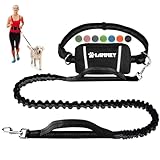
- Waist Pouch Has Been Upgraded, And Some Of The Inventory Is Printed With The Brand Logo:LANNEY
- 【PREMIUM MATERIAL, EXCELLENT WORKMANSHIP】 LANNEY hands free dog leash is made of anti-tear nylon that can withstand pulling from energetic dogs, medium and large breeds. The cross-stitching lines are wear-resistant to ensure the hands free leash will last for years. Heavy duty metal clasps with 360° rotation increase durability and makes the dog waist leash tangle free. Durable belt buckle locks tightly and securely
- 【SHOCK ABSORBING BUNGEE LEASH】The Hands free dog leash can absorb shock and pull force from dogs up to 25-130lb. With the handsfree leash being pulled, elastic bungee tension goes higher. It is “stop pulling” warning, thus your dog will be gradually trained. The dog running leash will reduce stress and muscle strain on you and dog. Your waist won’t get injured. Our waist leash for dog walking is 51” and extends up to 76” that is long enough to provide adequate room
- 【DUAL PADDED HANDLES FOR BETTER CONTROL】LANNEY waist leash for dog walking has 2 handles with soft neoprene padding for easy and comfortable grip. Quickly grip the handle by your waist to guide dog back on track. The hands-free dog leash allows you to control your dog without breaking stride. When crossing the street or walking in the crowd, you can hold the handle near collar to achieve direct traffic control, to keep your pet dog nearby you, walking slowly or stopping immediately
- 【ADJUSTABLE WAIST BELT WITH 2 RINGS】The waist dog leash for running suits both men and women. 1.1” wide waist belt fits a large range of waist sizes. The movable D ring allows dog running freely around you without stepping on your heels. Another ring allows you to attach extra leash or accessories. You can control the dog with body weight instead of having your hands strained. With hands free dog leash on waist, you can swing arms, answer phone call, hold umbrella and so on
Hard surfaces can be especially tough on young dogs. For long outings, the Dalmatian discussion favors softer trails, but trails introduce roots, rocks, mud, wildlife and uneven footing. Inspect the route first, increase technical difficulty gradually and check paws afterward. Rotate surfaces when practical rather than accumulating every mile on abrasive pavement.
Leash, recall and trail manners
Off-leash running should occur only where it is legal and genuinely safe. Reliable recall means the dog returns promptly despite wildlife, other dogs, cyclists, food and unfamiliar sounds—not merely in a quiet yard. Until that standard is met, use a leash and select routes with room to move without tangling.
A hands-free dog running leash can be convenient for some teams, but it is not automatically suitable. A dog that lunges, crosses in front of you or reacts to triggers can pull you off balance. First teach loose-leash movement, emergency stops and direction changes. Keep enough control to protect the dog, other trail users and your own joints.
When a different dog is the better choice
Do not force a running program because a breed appears on a list. A dog may be better suited to walking, swimming, scent games or short play sessions if it is immature, overweight, recovering from injury, uncomfortable in your climate, fearful outdoors or unable to disengage from prey. Adapting the activity protects the relationship and may prevent a preventable injury.
Likewise, an athletic adult may need rest days and mental work. Conditioning is not a contest for maximum distance. A balanced week can combine easy walks, controlled running, training, enrichment and recovery.
A practical decision checklist
- Has a veterinarian cleared this individual dog for strenuous exercise?
- Is the dog fully mature for its expected adult size?
- Can it walk and jog without lameness, coughing, distress or prolonged recovery?
- Can you run at a safe temperature on an appropriate surface?
- Can the dog drink, rest and cool down during the outing?
- Is recall dependable, or will a leash remain necessary?
- Have you planned for wildlife, traffic, other dogs and emergency exits?
- Will the dog receive mental stimulation and rest in addition to miles?
One warning deserves special emphasis. Russell Hartstein, identified by the AKC as a certified behaviorist and dog trainer in Los Angeles, says: “Dogs age quickly, and just because your dog ran fine last year doesn’t mean he is up for the task this year.” Reassess the plan whenever the dog’s age, health, weight, behavior or environment changes.
Quick Recap
Product prices and availability are accurate as of the date/time indicated and are subject to change. Any price and availability information displayed on Amazon at the time of purchase will apply.
Quick wins for a faster PC:
Repair Windows errors before they cause bigger problemsFix Now →Fix the driver behind crashes, sound loss and screen glitchesFind Drivers →Clear out junk files and repair common Windows errorsFree Scan →




Leave a Reply