
The best gate for a home with toddlers and pets depends first on where it will be installed. For the top or bottom of stairs, choose a child-safety gate that is hardware- or hard-wall-mounted exactly as its manufacturer directs. For a suitable doorway or hallway, a pressure-mounted child-safety gate can be easier to remove or relocate. In every location, verify the opening width, gate height, latch, opening design, and whether the product is intended and certified for children as well as capable of containing your particular dog.
Do not substitute a pet-only barrier for a toddler gate. Health Canada states that gates designed and marketed solely for pets should not be used as child-safety gates because they are not subject to the same requirements or intended to protect children.
As an Amazon Associate I earn from qualifying purchases.
Start with the location, not the dog
A gate that works well across a kitchen doorway may be the wrong product for a stair landing. The installation point determines how much the gate can move, how a child might load it, and what happens if the latch is left open.
Free tools Windows power users keep installed
One-click scans. No signup required.
Stairs: use a hard-mounted child-safety gate
Stairs are a high-risk location because a failed barrier can expose a child to a fall. Government safety guidance favors hardware-mounted or otherwise hard-wall-mounted gates in high-risk areas. Follow the exact screw locations, hardware, wall preparation, and top-of-stair orientation in the model’s instructions. Some pressure-mounted gates are expressly not designed for stair use, even when their width range fits.
#1 Best Overall
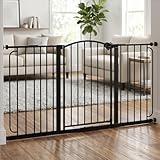
- ✅TESTED & TRUSTED BABY SAFETY GATE FOR OVER 30 YEARS: Parent-trusted baby safety product certified by the Baby Safety Alliance. Designed to support everyday baby proofing and safer spaces at home.
- ❤️AMERICAN DESIGNED & FAMILY OWNED BABY GATE BRAND: Designed in the USA by parents, for parents. Regalo is a family-owned, US-based brand delivering trusted baby safety gates and child safety products for over 30 years.
- 🔒EXTRA WIDE BABY GATE: Expands to fit openings 30.5–58" wide. Ideal for bottom of stairs, hallways, and doorways. FITS: 30.5–31" no extension, 36.5–39" with 6", 38–39" with 8", 42.5–44.5" with 12", 44-45" with 6"+8", 48-51" with 6"+12", 50-53" with 8"+12", and 56–58" with 6"+8"+12". DOES NOT FIT: 31-36.5", 39-42.5", 45-48, or 53-56"
- EASY SETUP WITH PRESSURE MOUNT DESIGN: Install according to manufacturer’s instructions. Wall cups must be used to keep the gate securely in place. ⚠️ To prevent falls, never use at the top of stairs.
- 🐾CHILD & PET SAFE | PUERTA DE SEGURIDAD PARA BEBÉS Y MASCOTAS: Walk-through safety gate designed for babies ⚠️6–24 months and small to medium pets. Features a secure safety locking system for parent convenience.
At the top of stairs, position the gate so a child cannot use the stair edge, a nearby post, or the gate itself as a launch point. At the bottom, account for the landing and the direction in which the gate swings. A gate that opens over a stair run, or whose release can be reached from the wrong side, creates a different risk from a doorway installation.
Doorways and hallways: pressure or hardware mounting may fit
A level doorway or hallway can accommodate either mounting style when the manufacturer permits it. Pressure mounting uses force against the side walls and usually avoids drilling, which is useful in a rental or where adults frequently move the barrier. It can also be easier to relocate between approved openings.
Pressure mounting is not automatically safer or less safe in every doorway. Inspect the contact points, tighten the adjustment system as directed, and confirm that the indicator or lock shows a fully secured installation. Never assume that a pressure gate approved for one opening is approved for a stairway, an uneven surface, a banister, or a location with a gap underneath.
Do these 3 things before closing this tab:
1Scan for outdated or missing drivers - takes under a minute2Repair Windows errors before they cause bigger problems3Fix the driver behind crashes, sound loss and screen glitchesOpen-plan rooms and temporary separation
For a wide, level opening or a temporary room division, use a model whose instructions specifically cover that span. Extra panels, extensions, or an angled configuration can change the load on the hinges and wall cups. A barrier that is stable in a straight line may become less secure when it is folded or set at an angle.
Child safety and pet containment are separate tests
A toddler gate and a dog gate solve related but different problems. Child-safety rules address issues such as structural strength, locking, openings, entrapment, and foreseeable use by young children. Pet containment depends on the individual animal’s height, jumping ability, climbing behavior, chewing, pushing, and ability to squeeze through a gap.
Health Canada’s guidance is explicit: “Gates that are designed and marketed solely for pets should not be used as a safety gate for children.” A pet-only product may have a convenient cat door or a spacing pattern that is acceptable for an animal but unsafe for a child’s head, neck, or limbs. Choose a product identified as a child-safety gate when a toddler will be on either side, then evaluate whether its construction also contains your dog.
Which U.S. rules matter?
The U.S. Consumer Product Safety Commission (CPSC) describes gates and enclosures intended for children aged 6 to 24 months. For products manufactured after January 21, 2023, CPSC identifies ASTM F1004-22 requirements under 16 CFR part 1239. These are U.S. requirements; another country may apply different rules, labels, or conformity processes. Check the package, instructions, and manufacturer documentation for the market in which you will use the gate.
Rank #2

- Baby Gate with Door for Wider Openings: Secure openings from 29.4" to 78" wide and 28" tall with this adjustable baby gate, designed to provide a reliable safety barrier for your pets and little ones in extra-wide spaces. Child gate mounts firmly to straight or awkward angled walls, and features a generous 16.5" walk-through door that allows parent to pass through comfortably without bending or climbing
- Dual-Lock Safety You Can Trust: Built with a dual-lock system that keeps little ones safely contained while allowing people to open the toddler gate easily with one hand. Unlike auto-closing gates, this gates for dogs indoor with door lets you control when the door opens and close. It avoids wear on parts and eliminates slamming noises, ensuring long-lasting, silent performance
- Stable and Secure Long Baby Gate with Pedal Protection: Anchored to the wall with hardware-mounted installation and reinforced at the bottom with a strong adhesion suction cups, this configurable baby gates stays firmly in place against bumps from pets or active kids. The anti-trip pedal is designed to protect both parents and children, allowing everyone to step safely with no trips and no worries
- Detachable Panels for Custom Setup: Transform your extra long baby gate in seconds by using 1, 2, or all 3 panels to fit your space perfectly. Ideal for doorways, hallways, kitchens, playrooms, and stairways. When folding or moving, simply release all the knobs first for safe, easy adjustment. Panels fold flat for simple storage
- Installation Safety Notice: To maintain stability and protective strength, ensure all knob and screws are securely tightened. Do not adjust the panel angles once all knobs are fully tightened. For optimal safety, we recommend not installing this large baby gate at the top of stairs. Please measure your openings before purchase
A certification mark is not a substitute for correct installation. It does not tell you that a gate will contain a 40-kilogram jumper, fit an unlisted opening, or remain secure when mounted to a weak surface. Treat certification as one screening criterion, then assess the actual location and dog.
How to choose the right gate
1. Measure the opening at the mounting surfaces
Measure the clear distance where the gate will attach, not the baseboard-to-baseboard distance several inches away. Measure at the top, middle, and bottom if the walls are not parallel. Record the smallest usable width and note baseboards, trim, banisters, radiator covers, or other obstructions.
Compare that measurement with the model’s stated adjustment range, including any extension panels. Do not rely on a retailer’s generic “extra wide” label. A gate that is technically within range may leave a large adjustment gap, require a particular extension, or be incompatible with your wall hardware.
2. Select height for the dog and the child
The American Kennel Club quotes veterinarian Dr. Kelly Hood: “The gate should be tall enough so that your dog can’t jump over it.” Height alone is not a guarantee. A dog may climb a vertical pattern, use a nearby sofa as a step, or clear a gate after a running start.
Recommended Free Tools
Choose the height and placement together. Move furniture, storage bins, toys, and plant stands away from the barrier. Check whether the dog can put its front paws on a horizontal rail and whether a child can climb the same feature. If the dog is a persistent jumper or climber, a standard low gate may not be a reliable containment solution; ask the manufacturer whether the model is intended for that use rather than assuming a “large dog” claim applies to every animal.
3. Inspect openings and entrapment risks
Look at every opening: the bars, the space below the gate, the hinge side, the latch side, and the gap created by an extension. Health Canada advises against diamond-shaped or V-shaped openings larger than 38 mm (1½ inches) along the top or sides. Australian Competition and Consumer Commission guidance says spaces between safety-gate bars should be between 5 cm and 9.5 cm to avoid trapping a child’s head. These figures come from different jurisdictions and guidance documents; use the rules that apply where you live and follow the product’s instructions.
Do not judge safety from bar spacing alone. A child’s hand can reach a latch, a foot can enter the lower gap, and a dog can push its muzzle through a space that appears narrow. Check the gate in its installed position, including any wall cups or threshold strip.
Rank #3

- ✅ TESTED & TRUSTED BABY SAFETY GATE FOR OVER 30 YEARS: Parent-trusted safety gate certified by the Baby Safety Alliance.
- ❤️AMERICAN DESIGNED & FAMILY OWNED BABY GATE BRAND: Designed in the USA by parents, for parents. Regalo is a family-owned, US-based brand delivering trusted baby safety gates and child safety products for over 30 years.
- 🔒2-IN-1 SUPER WIDE BABY GATE & PLAY YARD: Converts in seconds from a hardware-mounted baby gate for stairs (bottom only) or large openings into a freestanding play yard. Flexible panel system lets you shape it to your space—square, rectangle, circular, or custom layouts—making it ideal for baby proofing large rooms and open floor plans.
- HARDWARE-MOUNTED FOR MAXIMUM SECURITY: Includes mounting brackets for a secure installation on walls, banisters, or angled spaces. ⚠️ Install according to manufacturer’s instructions.
- 🐾 CHILD & PET SAFE | PUERTA DE SEGURIDAD PARA BEBÉS Y MASCOTAS: Walk-through safety gate designed for babies 6–24 months and small to medium pets. Features a secure safety locking system for parent convenience.
4. Test the latch with one hand
Adults often carry a child, laundry, or a pet supply when passing through. A walk-through gate with a release that an adult can operate one-handed may reduce the temptation to leave it open. The release should still be deliberately difficult for a toddler to operate. Check whether the gate can be opened from both sides, whether it swings in the permitted direction, and whether it automatically returns to a locked state if the instructions promise that function.
What’s actually slowing this PC down?
Pick the symptom - the matching free tool is one click away.
Practice the complete sequence: approach, release, open, pass through, and confirm closure. Listen for the lock or inspect the visual indicator specified by the manufacturer. A latch that works only when the frame is perfectly square may become unreliable after a small shift in a pressure-mounted installation.
5. Match construction to the dog’s behavior
Dr. Hood, in advice quoted by the American Kennel Club, says metal gates are usually the most durable and chew-resistant and can suit persistent chewers. That is expert guidance, not an independent test ranking. Wood, plastic, and composite designs may be appropriate where chewing and pushing are not concerns, but inspect the finish, joints, and exposed edges for your particular dog.
Consider four behaviors separately:
- Jumping: select sufficient height and remove launch points.
- Climbing: avoid designs that provide footholds or horizontal rails your dog can use.
- Pushing: prefer a mounting system and wall surface that can withstand repeated force.
- Chewing: favor a construction that leaves no accessible edge the dog can damage or ingest.
6. Verify the wall and hardware
A “hardware-mounted” label does not make every wall suitable. Locate studs when required, use the supplied anchors or an approved equivalent for the wall material, and do not substitute shorter screws because they are convenient. Banister installations may require a manufacturer-approved adapter rather than direct drilling into a rounded or unstable post.
After installation, push and pull the gate at several points, including the latch side and the lower corner. Recheck fasteners after the first day of use and periodically thereafter, especially if the dog leans or jumps against it. Stop using the gate if the frame bends, the wall cups loosen, the latch fails to engage, or a new gap appears.
PC Slower Than It Used to Be?
A free scan shows the junk files, broken settings and background clutter dragging Windows down - then fixes them in one click.Free scan · Windows 10 & 11Crashes, No Sound, or Screen Glitches?
Random freezes, missing sound and display glitches usually trace back to one bad driver. Find and replace yours safely.Free scan · under a minuteMounting styles compared
| Mounting style | Best fit | Advantages | Limitations to verify |
|---|---|---|---|
| Hardware- or wall-mounted | Top or bottom of stairs; permanent doorway installations | Anchors the barrier to the structure and is the style favored by government guidance for high-risk areas | Requires drilling and a suitable wall or post; installation direction and hardware are model-specific |
| Pressure-mounted | Approved, level doorways and hallways | Usually faster to install, remove, and relocate; avoids drilling in many installations | Not suitable for every stair use or surface; depends on correct tension, wall contact, and continued adjustment |
| Freestanding or configurable panels | Temporary room division or wide, level openings when explicitly approved | Can cover unusual spans and be repositioned | May be easier for a determined dog or child to shift; angled layouts and added panels change stability |
Use the style permitted by the manufacturer for the exact location. “No-drill” convenience should never override a stair-safety requirement.
A practical installation and safety check
- Identify the risk. Mark whether the opening is at stairs, a doorway, a hallway, or a temporary room boundary. If it is near stairs, plan for hardware mounting unless the manufacturer and local guidance clearly allow another method.
- Measure three times. Record the narrowest width at the actual attachment points, plus the height of baseboards and any obstruction that could prevent a flush fit.
- Screen the model. Confirm that the stated width range covers your measurement, that the product is a child-safety gate when a toddler is involved, and that the intended mounting method matches your location.
- Review the opening design. Check bar spacing, lower clearance, V- or diamond-shaped openings, hinge gaps, and any pet door. Apply the child-safety guidance relevant to your jurisdiction.
- Plan the dog side. Measure the dog’s shoulder and overall height, observe jumping and climbing, and remove furniture or objects that could act as steps.
- Install exactly as directed. Use the supplied hardware, required wall cups, extension arrangement, and orientation. Do not improvise a stair installation or omit a locking component.
- Load-test gently. Apply controlled pressure at the latch and corners; do not allow the dog or child to be the first stress test. Confirm that the latch fully engages after opening and closing.
- Supervise the first sessions. Watch how the dog approaches, paws, bites, or jumps at the barrier. Reposition the gate or choose another model if the behavior creates a foreseeable failure.
- Maintain it. Inspect screws, pressure indicators, hinges, latch operation, and gaps on a regular schedule and after moving the gate.
Product example: Cardinal Gates Stairway Special Safety Gate SS-30
Cardinal Gates describes its Stairway Special Safety Gate, Model SS-30, as a wall-mounted gate for children and pets and lists JPMA certification. The manufacturer publishes different width ranges for its aluminum and wood versions:
Rank #4

- Reinforced Support Design: Our reinforced retractable baby gates feature reinforced rods to: 1. Prevent pets or children from escaping under the toddler gate, 2. Prevent top mesh sagging or deformation, 3. Ensure smooth, jam-free retraction, 4. See-through visibility.
- Perfect for Babies and Pets: With a span of up to 96" wide and 33" high, this reinforced retractable dog gate fits most household openings. It's ideal for parents and pet owners who want to create a safe space for their babies and pets.
- Space-Saving Retractable Design: This retractable dog fence retracts completely when not in use, maximizing space and keeping your home neat. No bottom bar - no tripping hazards, ensuring smooth passage.
- Flexible Fit for Indoor/Outdoor Use: Our 96-inch extra wide baby gate adjusts to fit your opening perfectly, ideal for indoor spaces like doorways, staircases, hallways, and outdoor areas such as porches, decks, and garages.
- Easy Operation: Featuring a secure locking mechanism designed for adult operation, our extra wide dog gate can be operated smoothly with 1 hand, easily retracting and extending.
| SS-30 version | Listed opening width | Listed height | Listed bar spacing |
|---|---|---|---|
| Aluminum | 27–42.5 inches | 29.5 inches | 2.5 inches |
| Wood | 29–49.5 inches | 29.5 inches | 2.5 inches |
Those dimensions and the JPMA statement are manufacturer specifications, not independent comparative test findings. Before purchase, match the exact version to your measured opening, confirm what hardware and accessories are included, and read the current installation instructions for your stair or doorway. A 29.5-inch gate may be unsuitable for a dog that can jump it, and a 2.5-inch bar spacing does not by itself establish compliance in every country or installation.
Independent reader supportYour contribution helps us test, update, and keep practical guides available for everyone.Are baby gates safe for dogs?
A child-safety gate can be safe for a dog when its construction, height, openings, and mounting withstand that dog’s behavior. “Baby gate” is not a guarantee of pet containment: a small dog may slip beneath it, a powerful dog may push it out of alignment, and a jumper may clear it. Conversely, a pet gate is not automatically safe for a toddler.
The Tool Desk
Outbyte PC Repair FREERepair Windows errors before they cause bigger problemsFix Now →Outbyte Driver Updater FREEScan for outdated or missing drivers - takes under a minuteDriver Scan →Watch the interaction during supervised use. If the dog repeatedly rams the gate, bites bars, climbs, or wedges its head into an opening, block access and reassess the design. Never leave a child or dog unsupervised solely because a latch appears closed.
Common mistakes and how to correct them
Buying by the advertised width alone
Symptom: The gate technically spans the opening but touches trim, leaves a side gap, or cannot sit level.
Correction: Measure at the mounting surfaces and use the model’s exact adjustment range and extension requirements.
Using a pressure gate at stairs
Symptom: The gate shifts when pushed, or the product instructions exclude stair use.
Correction: Replace it with a manufacturer-approved hardware-mounted child-safety gate installed as directed.
Best Value

- SIMPLE & STURDY: This Convertible Wooden Dog Gate is a Pet Fence, Room Divider, and Pet Pen All In One. Constructed of sturdy wood and strong steel wire . Non-Slip Rubber Feet to protect your floor.
- FOLDING AND EXPANDABLE DESIGN: This Dog Gate Indoor is Free Standing and Can be Folded Out into the Wide Z-Shape Allows You to Use It in Full Hallways, Double Doors, or Standard Doorways, Bedrooms, Kitchen, Living Room, Staircases or Any Place in Your House.
- EASY TO SET UP & STORE: The Dog Gate Quickly Unfolds Like an Accordion, Making It Simple to Set Up and Store. You can easily Move it Around and Fold it up to Tuck it Away when Needed. Heavy Enough that Doggy won't Knock it over but Light Enough that you can Move the Foldable Dog Gate Easily.
- NO ASSEMBLE REQUIRED: This Pet Gate Comes Completely Assembled Already. Included set of Steadying Support Feet. This Freestanding Dog Gate Works Great as an Indoor Garden Fence Preventing Puppy from Getting into the Plants, such as Christmas Tree.
- EXTRA WIDE AND TALL: OPEN DEMS: UP to 96" Width x0.75" Depth x 31.2" Height; COLLAPSED DEMS: 24" Width x 3" Depth x 31.2" Height; WEIGHT: 31 lbs. Our Standing Gate Suitable for Small to Large Dogs, Such As Labradors, Bulldogs, Dachshunds, and More.
Choosing a pet-only barrier for a toddler
Symptom: The product has a pet door, large decorative openings, or no child-safety information.
Correction: Select a gate intended for children and verify the applicable certification and local requirements; then evaluate pet containment separately.
Ignoring launch points
Symptom: The dog clears the gate despite its nominal height.
Correction: Remove nearby furniture and objects, change the gate location if possible, and choose a taller or differently constructed model only if the manufacturer supports that use.
Assuming the latch is maintenance-free
Symptom: The latch catches intermittently or requires lifting the gate.
Correction: Check alignment, fasteners, pressure indicators, and the frame for damage. Follow the adjustment procedure; discontinue use if the lock cannot reliably engage.
How to make the final choice
For a stairway, the decision is straightforward: prioritize a child-safety gate designed for that location and hard-mount it according to the instructions. For a level doorway or hallway, choose between pressure and hardware mounting based on whether the location is approved, how often the gate moves, and how much force your dog applies. In both cases, reject any model that fails the opening, height, latch, spacing, or wall-suitability checks.
No source cited here establishes one universal “best” gate through head-to-head testing. The safest choice is the model whose documented child-safety suitability, mounting method, dimensions, and construction match your exact opening and your child’s and dog’s observed behavior.
Quick Recap
Product prices and availability are accurate as of the date/time indicated and are subject to change. Any price and availability information displayed on Amazon at the time of purchase will apply.





Leave a Reply