
What’s actually slowing this PC down?
Pick the symptom - the matching free tool is one click away.
Some links on this page are affiliate links: if you buy through them we may earn a commission, at no extra cost to you.
There is no evidence-based “best” electronic, prong, or choke collar for training. The American Veterinary Society of Animal Behavior (AVSAB) says reward-based methods should be used for all canine training and behavior modification, and that aversive methods—including electronic collars, prong collars, and choke chains—should not be used. For leash pulling, AVSAB discusses a head halter as a possible management aid, while emphasizing that equipment does not replace training. The safest, simplest plan is to teach the behavior you want with rewards, then choose equipment that helps you manage a walk without causing pain or fear.
What “training collar” should mean in 2026
The phrase dog training collar covers several very different products. Treating them as one category can lead owners to buy a device designed to correct behavior rather than teach it.
As an Amazon Associate I earn from qualifying purchases.
| Reader’s goal | Approach supported by current guidance | What it can and cannot do |
|---|---|---|
| Teach cues, recall, manners, or behavior changes | Reward-based training using clear cues, a clicker or verbal marker, and rewards such as food or toys | Builds a behavior through reinforcement; no single tool is established as the best model |
| Reduce pulling while you work on loose-leash skills | A head halter may provide walking management | Can reduce pulling, but does not independently teach a dog to walk on a loose leash |
| Deliver an electric correction or physical punishment | Not recommended by AVSAB | Electronic collars, prong collars, and choke chains are identified as aversive methods |
AVSAB’s 2025 Board Statement says its 2021 Humane Dog Training Position Statement remains its current and authoritative view. That statement says, “Evidence supports the use of reward based methods for all canine training.” It also says aversive methods should not be used. These are professional-welfare recommendations, not a ranking of commercial products.
Are electronic, prong, and choke collars safe?
Under AVSAB’s current position, they are not appropriate recommendations for routine training. The organization explicitly lists electronic collars, prong collars, and choke chains among aversive methods. An article that labels one of these devices a safe or easy solution would conflict with that guidance.
Popular on Amazon

- [4 Effective Training Mode - Recall & Correct Unwanted Dog Behavior] Featuring advanced Safe-Tech with 4 modes: Beep(1-8), Vibration(1-16), Shock(1-99 levels), and Emergency Shock Mode (stimulation for emergency behavior correction), our dog shock collar with remote control lets you customize the intensity and mode for efficient training, whether you're teaching basic commands at home or stopping excessive barking during outdoor walks.
- [Extended 4500FT Range - Ultimate Outdoor Freedom] The e collar for dogs training gives you exceptional long-range control - up to 4,500 feet - perfect for parks, beaches, and hiking trails. Train off-leash with total confidence. This dog training collar also supports 2 dogs with 1 remote, making it ideal for multi-dog homes. Plus, the smart remote remembers each dog’s settings, so switching between pets is seamless and hassle-free!
- [IPX8 Waterproof Collar - Ready for Any Adventure] With industry-leading IPX8 waterproof rating, the dog training collar is built to handle it all: rain, mud, lake swims, or even accidental dunks. No more worrying about water damage. Whether it’s a sudden downpour or a day at the beach, this shock collar for dogs stays fully functional. Let your dog splash, play, and train freely!
- [Adjustable & Comfortable Collar - Perfect for Most Dogs] Designed to fit dogs’ neck sizes from 7.8" to 24.4", this training collar suits small(10+lbs), medium, and large breeds up to 120 lbs - from energetic Terriers and smart Shepherds to playful Labradors, Huskies, and Golden Retrievers. The secure yet gentle fit ensures effective training without discomfort. For your dog’s well-being, we recommend using the collar for no more than 12 hours per day.
- [Long Lasting Battery & Safe-Lock] Enjoy up to 35 days of standby for the ecollar and 45 days for the remote. When it's time to recharge, a 2-hour fast charge gets you back quickly. Plus, the remote’s one-touch Safe-Lock can instantly lock the controls to prevent accidental pushes, so you can carry the remote worry-free in your pocket or bag. Train longer, train safer!
“Aversive” means the dog is exposed to something unpleasant to reduce a behavior. Depending on the device and the person using it, that may involve an electric stimulus, pressure from metal points, tightening around the neck, intimidation, or physical force. Even when an owner intends to use a low setting or a quick correction, the dog still has to experience the unpleasant event and associate it with the situation.
AVSAB summarizes studies in which dogs trained with aversive methods displayed stress-related behaviors such as a tense or lowered posture, lip licking, tail lowering, lifting a front leg, panting, yawning, and yelping. The statement also discusses survey findings associating aversive methods with behavior concerns. Those survey studies cannot distinguish causation from correlation, so the accurate wording is that these behaviors were observed or these concerns were associated with aversive training—not that every collar inevitably causes a specific problem in every dog.
Windows Errors? Fix Them Before They Spread
Repair common Windows errors and clear accumulated junk for a smoother, more stable PC - no reinstall needed.Free scan · no reinstallOutdated Drivers Are Slowing You Down
One free scan finds every outdated or missing driver and matches the right update for your exact hardware.Free scan · exact hardware matchAVSAB reports no evidence that aversive training is more effective than reward-based training in any context. Its discussion of recall training found no advantage for remote electronic collars over reward-based methods, even when experienced trainers used them. That removes the main practical reason owners are often given for buying an electronic collar: the claim that it is necessary for reliable results.
Why reward-based training is the safer default
Reward-based training changes behavior by making the desired action worth repeating. You identify the behavior, give the dog a clear cue or capture the action when it occurs, mark the moment, and deliver something the dog values. The reward may be food, a toy, praise, or access to an activity. AVSAB gives cues, clickers or verbal markers, toys, and treats as examples of this approach.
This method is not permissive or unstructured. The owner still controls access to rewards, sets up the environment, prevents rehearsal of unwanted behavior where possible, and practices in small steps. The difference is that the dog learns what earns reinforcement instead of trying to avoid pain, pressure, or fear.
- Define one observable behavior. “Be good” is too vague; “four paws on the floor when greeting” is teachable.
- Start below the dog’s reaction threshold. Work at a distance, distraction level, or duration where the dog can still eat and respond.
- Mark the correct moment. A click or consistent word tells the dog exactly which action earned the reward.
- Reward promptly. Deliver the treat or toy immediately after the marker so the connection is clear.
- Raise difficulty gradually. Add only one challenge—distance, duration, distraction, or location—at a time.
- Reinforce maintenance. Continue rewarding intermittently after a behavior is reliable, while still paying generously when the environment becomes harder.
Step-by-step: a simple reward-based training session
- Choose the target behavior. For a walk, this might be standing near you with a loose leash. For recall, it is turning toward you and coming when called.
- Prepare rewards before presenting the challenge. Use food, a toy, or another reward your dog already values. A clicker or verbal marker is optional; consistency matters more than the brand or format.
- Begin in an easy setting. A quiet room or familiar yard gives you more chances to reinforce success than a crowded park.
- Mark small successes. At first, reward a glance toward you, a step in your direction, or a moment of slack in the leash. Do not wait for a perfect finished behavior.
- Repeat briefly. Several short sessions are generally easier for a dog to process than one exhausting session. Stop while the dog is still engaged.
- Generalize deliberately. Practice the same skill in new rooms, outside, near mild distractions, and eventually in more difficult locations.
- Record what happened. Note the distance, distraction, number of successful repetitions, and the reward used. If performance falls apart, reduce difficulty rather than adding a correction.
A collar cannot perform these steps for you. Equipment can change how safely you manage a situation, but the learning comes from the timing and consistency of the interaction.
Also popular on Amazon
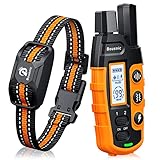
- Humane and Safe, Eliminate Bad Behavior Effectively: Bousnic Dog shock collar features 3 humane training modes with adjustable beep(1-8 levels), vibration(1-16 levels), safe shock(1-99 levels). It helps your unruly and hard-headed dogs learn to be a better part of your household.
- Extended 3300FT Range: Bousnic Dog Training Collar covers up to 3300Ft allowing your pet to roam farther. With dual-channel, It is perfect to train 2 dogs simultaneously outdoor at distances up to 3/4 mile.
- Fits for All Sizes of Dogs 5-120lbs: Bousnic training collar for dogs is ideal to control dogs as small as 5 pounds and as big as 120 pounds. Instant response security on/off switch button allows you to carry it without any fear of accidental touch.
- IP67 Waterproof Receiver: Bousnic electric dog collar can be used in any weather and any condition thanks to the IP67 waterproof design of the receiver (You’ll have to keep the remote control away from water).
- Incredible Battery Life: Bousnic e collar for dogs training has a decent battery life. The receiver’s battery can last for up to 15 days in working modes while the remote for over 1 month. the long battery runtime is a true lifesaver on those camping or tailgating weekends.
When a head halter may help with leash pulling
For owners whose immediate problem is pulling, AVSAB discusses a head halter as a possible management option. Its leash-pulling article reports that head halters reduce pulling while risking less damage to the neck and spine than chain collars. That makes the category relevant when you need more control during walks while teaching loose-leash skills.
A head halter is not a correction collar and is not a substitute for reinforcement. It changes the mechanical advantage of the leash so the dog’s head can be guided more easily; the dog still needs to learn where to walk and what behavior earns rewards.
The available guidance does not identify a best model, establish sizing rules, explain an acclimation schedule for every dog, or confirm suitability for every breed, muzzle shape, medical condition, or temperament. Individual tolerance also varies. Some dogs accept a head halter readily; others rub at it, freeze, paw at it, or show distress. Follow the manufacturer’s instructions and ask a veterinarian or reward-based trainer for help if your dog resists, has neck or facial problems, or shows signs of stress. Do not assume that a head halter is appropriate simply because pulling is difficult.
Use the halter as part of a plan: reinforce slack in the leash, reward check-ins, pause or change direction before pulling becomes intense, and select routes that keep the dog under threshold. If the equipment itself becomes the focus of conflict, stop and obtain professional guidance rather than escalating pressure.
Quick wins for a faster PC:
Repair Windows errors before they cause bigger problemsFix Now →Fix the driver behind crashes, sound loss and screen glitchesFind Drivers →Clear out junk files and repair common Windows errorsFree Scan →Tools that support reward-based training
Clicker or verbal marker
A clicker produces a brief, consistent sound that marks the instant the dog performs the desired action. A short word can serve the same purpose if everyone uses it consistently. The marker is not the reward; it predicts the reward and improves timing.
Treats
Food is one possible reinforcer, not a requirement. Use pieces your dog values and account for training food in the daily diet. If food is ineffective in a highly distracting setting, lower the difficulty or try a different reward rather than adding an aversive correction.
Also popular on Amazon

- 7 Effective Training Modes:SLOPEHILL dog shock collar with Beep, Vibration, Flash Light, Low shock level, High shock level, No shock ,and Keypad lock modes. You can use it to teach a dog basic commands and correct unwanted behaviors such as barking, chasing, and biting during outdoor activities
- 4200ft Remote Range & 3 Channels : Shock collar for dogs covers up to 4200ft remote range for more performance training.You can immediately get your dog's attention and recall them the moment they run too far.Train up to 3 dogs simultaneously from a single remote .You could train your dog in both the parks ,beaches, and hikes without any burden
- Built-in Anti-Lost Light on Both Collar and Remote: The flashing light on the collar helps you instantly locate your dog at night. Plus, the solid white LED light on the remote ensures you never fumble in the dark during nighttime walks. Keep your little one visible and safe in low-light situations
- No Shock Mode & Safe Static Adjustment :No shock mode is convenient for you to use only vibration and beep mode.Low shock (0-50) and high shock (51-99) allow you to adjust the accurate and comfortable static level for your dog, and keypad lock mode helps you prevent any accidental operation.When shock is not needed, you can also remove the metal prongs for a comfortable fit and it won’t harm your pet's skin
- IP68 Waterproof and Adjustable Shock Collar:The training collar receiver is waterproof which offers your dogs maximum flexibility during outdoor activities.(Note: Remote is Not waterproof).Size adjustable collar strap, length from 8 to 26 inches, fits dogs from 8 to 140 lbs.Dog training collar is the excellent solution to all your dog training needs
Toys and play
Some dogs work harder for a toy, a brief game, praise, or access to sniffing. Rotate rewards so the dog remains interested, and keep play short enough that you can regain calm before the next repetition.
Treat pouch and other convenience items
A pouch can make rewards easier to reach during a walk, but it is an accessory, not a training method. The evidence cited here does not establish that any particular pouch, clicker, leash, or collar model is superior.
Recommended Free Tools
How to choose equipment without falling for “easy” claims
Use these questions before buying any training collar or walking aid:
- What problem am I solving? Teaching a behavior and physically managing a walk are different jobs.
- Does the device rely on reward or aversive correction? If it delivers an electric stimulus, painful pressure, or tightening intended to punish, it is not consistent with AVSAB’s recommendation.
- Can my dog perform the desired behavior without the device? A tool that suppresses behavior only while worn has not necessarily taught a reliable skill.
- Does my dog accept the equipment? Avoid treating freezing, frantic pawing, lowered posture, lip licking, or repeated attempts to escape as evidence that the device is working.
- Is there independent professional help available? A veterinarian or qualified reward-based trainer can account for pain, fear, arousal, and environmental triggers that equipment alone cannot resolve.
- Are the product details actually verified? Model availability, prices, fit, wear time, and medical suitability change. No specific model has been comparatively tested for this article.
Training loose-leash walking without a shock collar
- Pick a low-distraction route. Start where your dog can notice you and still take a reward.
- Reward orientation. Mark and reward voluntary glances or steps toward you before the leash becomes tight.
- Reinforce slack. The instant the leash loosens, mark and reward. Keep moving while the leash remains slack.
- Respond early to tension. Pause, turn, or move away from the distraction before pulling becomes a sustained contest. Reward the dog for reconnecting with you.
- Increase challenge gradually. Add busier locations, longer stretches, or closer distractions one at a time.
- Use management when necessary. A head halter may help reduce pulling during this process, but continue rewarding the walking behavior itself.
If pulling is sudden, severe, or accompanied by lunging, barking, fear, or aggression, treat it as a behavior case rather than a collar-shopping problem. A veterinarian should rule out pain or illness, and a reward-based professional can design a controlled plan.
Independent reader supportYour contribution helps us test, update, and keep practical guides available for everyone.Training recall without an electronic collar
Recall is a safety behavior, so build it in layers. Begin indoors or in a secure area, say the cue once, and reward the dog for turning and coming. Make returning to you consistently worthwhile. Gradually add distance and distractions, and use a safe physical management setup appropriate to the environment while reliability is developing. Do not test an unfinished recall near traffic, open water, wildlife, or other hazards.
AVSAB’s review of recall training found no advantage for remote electronic collars over reward-based methods, including with experienced trainers. That does not mean every dog learns at the same speed; it means an electronic correction is not established as necessary for the outcome.
Also popular on Amazon

- Humane and Safe, Eliminate Bad Behavior Effectively: Bousnic Dog shock collar features 3 humane training modes with adjustable beep(1-8 levels), vibration(1-16 levels), safe shock(1-99 levels). It helps your unruly and hard-headed dogs learn to be a better part of your household.
- Extended 3300FT Range: Bousnic Dog Training Collar covers up to 3300Ft allowing your pet to roam farther. With dual-channel, It is perfect to train 2 dogs simultaneously outdoor at distances up to 3/4 mile.
- Fits for All Sizes of Dogs 5-120lbs: Bousnic training collar for dogs is ideal to control dogs as small as 5 pounds and as big as 120 pounds. Instant response security on/off switch button allows you to carry it without any fear of accidental touch.
- IP67 Waterproof Receiver: Bousnic electric dog collar can be used in any weather and any condition thanks to the IP67 waterproof design of the receiver (You’ll have to keep the remote control away from water).
- Incredible Battery Life: Bousnic e collar for dogs training has a decent battery life. The receiver’s battery can last for up to 15 days in working modes while the remote for over 1 month. the long battery runtime is a true lifesaver on those camping or tailgating weekends.
Signs the plan is too difficult
- Your dog stops taking familiar rewards.
- The dog repeatedly scans, freezes, hides, pants heavily, yawns, licks the lips, lowers the tail, lifts a front leg, or adopts a tense or lowered posture.
- You are repeating the cue, pulling on the leash, or increasing pressure because the dog is not responding.
- The dog performs only while the collar is active and immediately returns to the unwanted behavior when it is removed.
- Progress worsens across sessions or new defensive behavior appears.
These signs call for a lower-distraction setup, more distance, shorter sessions, or professional help. They are not a reason to increase correction intensity.
Finding qualified professional help
Look for a trainer or behavior consultant who explains exactly how rewards, management, and gradual exposure will be used. Ask what happens when the dog makes a mistake. A transparent answer should not depend on pain, intimidation, physical force, or punishment-based tools.
- Request a written description of methods before booking.
- Ask how the professional handles fear, aggression, reactivity, and safety risks.
- Observe whether the trainer explains timing and reinforcement rather than promising instant obedience.
- Involve your veterinarian when behavior changes are sudden, severe, or potentially linked to pain or illness.
- Be cautious of guarantees, “dominance” explanations used to justify force, or claims that one collar works for every dog.
AVSAB’s 2025 clarification states that it does not endorse or oppose trainers from any specific organization. Therefore, do not treat membership in a named directory or organization as an AVSAB endorsement; evaluate the person’s methods, qualifications, communication, and ability to coordinate with veterinary care.
What this evidence does—and does not—establish
The guidance supports a clear decision: use reward-based training for teaching and behavior modification, avoid aversive correction collars, and consider a head halter only as a possible leash-management aid. It does not establish a winning brand, a best model, current pricing, universal fit instructions, a guaranteed timeline, or a collar that makes training effortless.
Availability and product specifications change by country and retailer. If you are considering a particular device, verify its current instructions independently and discuss medical or behavioral concerns with a veterinarian or reward-based professional. The absence of a product ranking is intentional: the cited sources are welfare guidance and explanatory material, not comparative product tests.
Frequently Asked Questions
Is a shock collar necessary for reliable recall?
No. AVSAB’s discussion of recall reports no advantage for remote electronic collars over reward-based training, even with experienced trainers. Build recall gradually with high-value reinforcement and safe management while reliability develops.
Can a head halter stop leash pulling by itself?
It may reduce pulling as a management aid, and AVSAB reports less neck and spine risk than chain collars. It does not teach loose-leash walking on its own; reinforce the walking behavior and obtain help with fit or acclimation concerns.
What should I do if my dog reacts badly to a training device?
Stop increasing pressure, move to a calmer setting, and watch for stress signs such as freezing, lowered posture, lip licking, panting, yawning, or escape attempts. Ask your veterinarian or a reward-based trainer to assess the equipment, the environment, and possible pain or fear.
The Tool Desk
Outbyte PC Repair FREEClear out junk files and repair common Windows errorsFree Scan →Outbyte Driver Updater FREEScan for outdated or missing drivers - takes under a minuteDriver Scan →




Leave a Reply