
Some links on this page are affiliate links: if you buy through them we may earn a commission, at no extra cost to you.
For a strong rescue dog, the safest choice is not the product marketed as “indestructible.” It is equipment that fits correctly, has sound hardware, and matches the dog’s behavior. Measure the dog before buying, use a front harness attachment when you need to redirect pulling, choose a crate that allows natural movement and cannot be forced open, and offer a large chew while you supervise. Introduce every item gradually with food and calm reinforcement, because an unknown history can make sudden restraint or confinement frightening.
What matters most when equipment must handle a powerful rescue dog
Strength is only one part of safety. A heavy-duty harness can still fail if the dog can back out of it; a rigid crate can still overheat in a parked vehicle; and a durable chew can still become dangerous after a chunk breaks off. Evaluate each item against five questions:
As an Amazon Associate I earn from qualifying purchases.
What’s actually slowing this PC down?
Pick the symptom - the matching free tool is one click away.
- Does it fit? The dog should move naturally without rubbing, pinching, or escape gaps.
- Does the hardware match the force? Inspect buckles, stitching, webbing, doors, latches, and tie-down points rather than judging by appearance.
- Can you supervise and maintain it? Equipment needs regular checks, cleaning, and replacement when damaged.
- Does it suit the dog’s behavior? Pulling, backing out, chewing, guarding, panic, and heat sensitivity require different solutions.
- Can it be introduced positively? Rescue dogs may have unknown associations with restraints, crates, or handling.
No product has been independently established as universally escape-proof, crash-proof, or indestructible. The examples below are useful starting points, but the individual dog, fit, supervision, and environment determine whether a setup is safe.
Harnesses for a strong dog that pulls
A harness spreads pressure across the chest and torso instead of concentrating it on the neck. For a dog that surges toward triggers, a front attachment can help turn the shoulders back toward you; a back attachment is usually more practical for ordinary walking once the dog is under control. A handle can help with brief, close control, but it is not a substitute for a secure fit or a training plan.
Popular on Amazon

- Instinctual Needs: The KONG Extreme black rubber toy helps satisfy dogs' instinctual needs and provides mental stimulation; toy helps solve chewing, teething, boredom, crate training, digging, barking, and more
- Enticing Chew Toy for Dogs: This unique toy has an erratic and unpredictable bounce, keeping all breeds of dogs engaged and entertained during interactive play sessions
- Treat-Filling Capabilities: The hollow interior allows for stuffing with kibble, peanut butter, or KONG Snacks or Easy Treat, offering an added challenge and extended play time for your pet; dishwasher safe for easy clean up
- KONG's Most Durable Natural Rubber Dog Toy: The KONG Extreme black rubber formula is created for power chewing dogs, and is recommended by veterinarians and trainers worldwide
- Made in the USA. Globally sourced materials. KONG has been innovating since 1976 to enrich the lives of pets with the highest quality pet toys and treats. Covered by KONG's Satisfaction Guarantee
Ruffwear Front Range Harness: features to verify
The Front Range Harness is described by its manufacturer as a padded harness with four adjustment points, an aluminum V-ring on the back, reinforced webbing at the chest, reflective trim, and both front and back leash points. Listed girth ranges are 13–17, 17–22, 22–27, 27–32, and 32–42 inches. These are manufacturer specifications, not independent strength-testing results.
Measure around the widest part of the rib cage, immediately behind the front legs. If the measurement falls between sizes, the manufacturer advises choosing the larger size and adjusting it down. Check the finished fit with the dog standing and walking: you should be able to slide two fingers under the straps without the harness rotating, cutting into the armpits, or leaving a shoulder-sized escape gap.
The Tool Desk
Outbyte Driver Updater FREEFix the driver behind crashes, sound loss and screen glitchesFind Drivers →Outbyte PC Repair FREERepair Windows errors before they cause bigger problemsFix Now →Harness comparison checklist
| Feature | Why it matters | What to check at home |
|---|---|---|
| Girth range | Determines whether the harness can sit on the rib cage rather than the throat. | Measure the widest rib-cage point; size up when between listed ranges. |
| Front attachment | Can redirect a pulling dog by turning the chest. | Clip the leash and test for rubbing or twisting during slow turns. |
| Back attachment | Useful for routine walking and dogs that already walk politely. | Confirm the back ring is centered and the leash does not pull the harness sideways. |
| Adjustment points | More adjustment allows a closer fit across different body shapes. | Set each strap evenly; recheck after the dog moves. |
| Padding and webbing | Can reduce rubbing while distributing force. | Look for frayed edges, flattened padding, or stitching that is separating. |
| Visibility | Reflective trim helps drivers and handlers see the dog in low light. | Use a light or reflective leash as well; trim does not replace lighting. |
| Handle | Provides a short hold for transitions or emergencies. | Lift only when the manufacturer allows it and the dog’s body is supported. |
| Escape resistance | A frightened dog may reverse out of a loose harness. | With the leash attached, walk backward gently and check that the shoulders cannot slip through. |
Fitting and inspection procedure
- Measure the rib cage and select the appropriate listed range.
- Loosen the straps before putting the harness on, then identify the chest, shoulder, and back panels.
- Adjust each point symmetrically while the dog stands naturally.
- Check that the neck opening is clear of the throat and that the lower straps do not chafe behind the elbows.
- Attach the leash indoors and walk a few steps. Watch for twisting, rubbing, or a strap sliding toward the neck.
- Practice turns, stops, and a gentle backward step. If the dog can reverse out, stop using the harness outdoors until the fit is corrected.
- Before every walk, run your fingers over buckles, rings, webbing, and seams. Replace the harness at the first sign of structural damage.
A front clip can reduce leverage, but it does not teach loose-leash walking by itself. Pair it with distance from triggers, reward-based training, and gradual exposure. If the dog lunges hard enough to injure you or repeatedly escapes, involve a qualified force-free behavior professional and use a second safety connection only when it can be arranged without tangling.
Also popular on Amazon

- Durable Toy for Dogs: The KONG Tires is an entertaining dog toy constructed with KONG Extreme Natural Rubber for reliable durability; 4.5" x 4.5"
- Provides an Active Chewing Experience: The sidewalls are designed to double up and rebound when compressed
- Versatile Toy for Dog Treats: This tire-shaped dog toy features an inner wall that can be stuffed with snacks or treats for engaging play
- Made in the USA: Globally sourced materials. KONG has been innovating since 1976 to enrich the lives of pets with the highest quality pet toys and treats. Covered by KONG's Satisfaction Guarantee
- KONG: Since not all toys are created equal, it’s always best to supervise your dog during play. Supervised play will help toys last longer and keep your dog safe. No dog toy is truly indestructible, so always remove the toy from playtime if damaged
Crates that can contain a powerful rescue dog
Choose a crate by interior fit, escape resistance, ventilation, and how it will be secured. Cornell veterinary guidance identifies size, material, and durability as the primary selection factors. The dog must be able to stand without ducking, turn around, and lie down comfortably. A crate that is too small creates welfare problems; one that is excessively large can make secure transport and house-training harder.
Material choices
- Wire crates: Often include dividers, allowing the usable area to grow as a young dog matures. They provide broad airflow, but a determined chewer may bend bars or damage feet and teeth.
- Fabric or mesh crates: Light and portable, but less durable for puppies, escape artists, or dogs that chew when stressed.
- Rigid molded kennels: Offer solid walls and can be easier to clean. Check that the door, hinges, and ventilation openings cannot be pried apart.
- Heavy-duty vehicle kennels: May use reinforced shells and metal hardware. Their claims about impact performance must be treated as manufacturer claims unless independent test evidence is available.
GUNNER G1 Kennel: documented features and limits
The G1 Kennel is described by its manufacturer as a double-walled kennel with a metal latch, ventilation, carry handles, and a lifetime warranty. Its size guidance lists the Intermediate model for Boxers, Pit Bulls, and Standard Poodles, and the Large model for Labs, Shepherds, and other large working breeds. Breed labels are only a starting point: measure the actual dog and compare those measurements with the kennel’s interior dimensions.
The manufacturer also uses claims such as “2x impact protection,” “10% cooler,” and “proven to save.” Those statements are marketing claims, not independent test findings established here. Ask what test, conditions, vehicle, and restraint system each claim refers to before treating it as a safety guarantee.
Also popular on Amazon

- Instinctual Needs: The KONG Extreme black rubber toy helps satisfy dogs' instinctual needs and provides mental stimulation; toy helps solve chewing, teething, boredom, crate training, digging, barking, and more
- Enticing Chew Toy for Dogs: This unique toy has an erratic and unpredictable bounce, keeping all breeds of dogs engaged and entertained during interactive play sessions
- Treat-Filling Capabilities: The hollow interior allows for stuffing with kibble, peanut butter, or KONG Snacks or Easy Treat, offering an added challenge and extended play time for your pet; dishwasher safe for easy clean up
- KONG's Most Durable Natural Rubber Dog Toy: The KONG Extreme black rubber formula is created for power chewing dogs, and is recommended by veterinarians and trainers worldwide
- Made in the USA. Globally sourced materials. KONG has been innovating since 1976 to enrich the lives of pets with the highest quality pet toys and treats. Covered by KONG's Satisfaction Guarantee
Crate comparison table
| Decision point | Questions to answer | Red flags |
|---|---|---|
| Interior fit | Can the dog stand erect, turn, sit, and lie naturally? | Head forced down, shoulders compressed, or no room to reposition. |
| Escape resistance | Can the dog bend, chew, or paw the door and corners apart? | Light mesh for a known chewer, exposed wire ends, or a latch that can be manipulated. |
| Ventilation | Are openings unobstructed on multiple sides? | Blankets or covers blocking airflow, especially in warm weather. |
| Door and latch | Does the latch close fully and resist pressure from inside? | Partial engagement, loose hinges, or a door that flexes against the frame. |
| Vehicle securing | Can the kennel be firmly tied to the vehicle’s approved anchor points? | Relying on its weight alone or attaching to a non-rated interior feature. |
| Cleaning | Can urine, drool, and vomit be removed quickly? | Absorbent surfaces that retain odor or seams that cannot be reached. |
| Heat management | Can you monitor temperature and provide airflow during the entire trip? | Leaving the dog unattended in a parked vehicle or covering ventilation openings. |
| Evidence and warranty | What testing and warranty terms are actually documented? | Turning a marketing phrase into a guarantee of survival. |
Vehicle transport requirements
U.S. Animal Welfare Regulations require transport enclosures to be strong enough to contain dogs securely and comfortably, free of sharp points or edges, ventilated, and large enough for the animal to turn, stand, sit erect, and lie naturally. In the 2026 CFR language, covered transport ventilation openings must total at least 90% of the front-wall area. During surface transport, auxiliary ventilation is required when the animal cargo space reaches 85°F (29.5°C), and that temperature may not be exceeded for more than four hours.
Those are regulatory requirements for covered transport situations, not permission to leave a dog in a hot vehicle. Temperature inside a vehicle can rise rapidly even when the outdoor air feels moderate. Plan a route with climate control, monitor the dog, avoid direct sun, and stop the trip if the dog shows heavy panting, weakness, confusion, vomiting, or collapse. GOV.UK kennel guidance likewise calls for enough room to stand, lie down, and turn freely, good ventilation, and firm securing.
How to secure and test a crate
- Place the kennel so vents are not pressed against luggage, seats, or walls.
- Use the vehicle manufacturer’s approved cargo anchors or a restraint system rated for the kennel; do not improvise with a loose rope around a door or handle.
- Close and operate every latch before loading the dog. Pull firmly on the door from inside and outside to confirm full engagement.
- Drive a short route first. Check whether the kennel shifts, rattles, or develops a latch gap.
- Inspect after each trip for cracked panels, bent hardware, sharp edges, and damaged tie-downs.
Chew toys for an aggressive or frenzied chewer
The safest chew is large enough that the dog cannot swallow it whole, durable enough for the dog’s actual chewing style, and used under active observation. The ASPCA recommends larger, durable products for large breeds and aggressive or frenzied chewers. It also advises matching the chew to the dog’s size and habits, watching the dog while chewing, and contacting a veterinarian if a piece is swallowed: obstruction or intestinal perforation can require emergency treatment.
Also popular on Amazon
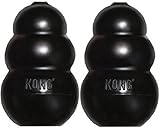
- Ultra-strong, ultra-durable, Black rubber compound is recommended for the most powerful chewers
- Used worldwide by police, drug enforcement and military K-9 TEAMS; also used by schutzhund and akc competition trainers
- Perfect for stuffing with KONG treats; helps reduce boredom and separation anxiety for powerful chewers
- Unpredictable bounce for games of fetch
- Made in USA
KONG Extreme: sizing and realistic expectations
The manufacturer describes KONG Extreme as its most durable rubber strength and as designed for the toughest chewers. Listed sizes are Small, Medium, Large, X-Large, and XX-Large; the XX-Large size is listed for dogs weighing 85 pounds or more. Select by the dog’s mouth size, jaw strength, and chewing pattern rather than weight alone. A dog that can fit the toy behind the back teeth may need a larger size.
The product’s durability language is a manufacturer claim. Even a heavy rubber toy can be punctured, split, or reduced to a swallowable piece by an individual dog. Stuffable designs can make quiet enrichment last longer, but food residue must be removed during cleaning and the toy discarded when damage appears.
Chew-toy decision table
| Criterion | Safer choice | What requires caution |
|---|---|---|
| Size | Too large to swallow and proportionate to the dog’s jaw. | Small items that can pass behind the molars or fit entirely in the mouth. |
| Material | Dense, purpose-made chew material that does not splinter readily. | Materials that fracture into sharp shards or shed long strips. |
| Shape | Rounded or broad enough to reduce impaction risk. | Pieces with sharp corners, narrow necks, or openings that can trap the jaw. |
| Stuffability | Allows measured food enrichment and can be frozen for longer use. | Deep cavities that stay dirty or encourage excessive calorie intake. |
| Breakage risk | Replaceable when worn, with no detachable parts. | Cracks, missing chunks, loose squeakers, or strings. |
| Cleanability | Can be washed and dried completely. | Porous surfaces retaining food, odor, or moisture. |
| Individual destruction speed | Outlasts the dog’s normal session while remaining intact. | A toy that changes shape or loses pieces within minutes. |
Supervision and replacement rules
- Offer the chew in a quiet area and watch continuously during the first sessions.
- Interrupt calmly if the dog starts tearing, grinding, or trying to swallow pieces.
- Remove the toy when the dog finishes, unless you have confirmed it remains intact and appropriate for unsupervised access.
- Wash and dry it according to the material’s instructions.
- Replace it immediately when a crack, puncture, detached part, sharp edge, or swallowable fragment appears.
- Seek veterinary advice promptly if the dog consumes a chunk or develops repeated vomiting, abdominal pain, lethargy, difficulty defecating, or loss of appetite.
Introducing equipment to a rescue dog without creating fear
Assume the dog may have an unknown history with confinement, collars, handling, or vehicle travel. Short, voluntary sessions are safer than forcing the dog into a harness or crate and hoping it adapts.
Also popular on Amazon

- Designed for Chew Sessions: Our dog toys are made to delight even the toughest of chewers, extending playtime and keeping them engaged
- Durable Natural Rubber Dog Toy: The KONG Extreme black rubber formula is created for power chewing dogs, and is recommended by veterinarians and trainers worldwide
- Appropriate Chewing Outlet: Satisfy you dog's natural instincts with a durable natural rubber with patented Goodie Gripper, ideal for stuffing challenges
- Extend Dog's Playtime: The toy is designed for stuffing with KONG Easy Treat or KONG Ziggies, providing a fun, interactive fillable dog toy for your pup
- Made in the USA. Globally sourced materials. KONG has been innovating since 1976 to enrich the lives of pets with the highest quality pet toys and treats. Covered by KONG's Satisfaction Guarantee
Crate introduction
- Set the open crate in a quiet area and feed treats near the entrance.
- Toss treats just inside, then wait. Do not shut the door while the dog is still hesitant.
- Reward the dog for choosing to enter, and feed meals near or inside the crate.
- When the dog rests comfortably inside, briefly touch the door, reward, and open it again.
- Build up to closing the door for a few seconds, then minutes, while you remain nearby.
- Add bedding only if the dog does not shred or ingest it. A bare, washable floor is safer for a dog that destroys fabric.
VCA recommends making crate time positive with treats, chew toys, and bedding. If the dog pants, drools, claws, vocalizes continuously, or tries to break out, reduce the duration and consult a veterinarian or qualified behavior professional rather than escalating confinement.
Harness introduction
- Let the dog sniff the harness while you deliver treats.
- Touch the shoulder and chest with the harness, reward, and remove it.
- Put it on indoors for a few seconds, then lengthen the period while the dog remains relaxed.
- Check for rubbing behind the elbows, pressure at the throat, and gaps at the shoulders.
- Attach a leash and walk a few steps inside before attempting a higher-distraction route.
- Practice clipping and unclipping calmly so the sound of the hardware does not become a warning signal.
Chew and multi-dog management
Offer a new chew in a quiet location while you observe the dog’s body language. Stiff posture, hovering, freezing, growling, air snapping, or rapid gulping can indicate guarding. Do not reach into the dog’s mouth or punish the warning. Separate dogs for food and chews, use doors or pens, and obtain behavior guidance if guarding or conflict appears. GOV.UK guidance emphasizes supervised enrichment, daily safety checks, and separation when food-related adverse behavior occurs.
A practical setup for walking, home, and travel
| Situation | Recommended setup | Daily check |
|---|---|---|
| Routine walk | Correctly fitted harness using the back attachment when the dog walks calmly; front attachment when redirection is useful. | Inspect clips, rings, webbing, and rubbing points. |
| High-distraction area | Front-clip control, short training sessions, and distance from triggers. | Confirm the dog cannot reverse out or reach damaged hardware. |
| Home rest | Correct-size crate, washable surface, and a chew only when supervision and toy integrity are appropriate. | Check door, latch, bedding, and ventilation. |
| Vehicle trip | Firmly secured kennel, unobstructed vents, climate monitoring, and a preplanned route. | Check tie-downs, latch engagement, temperature, and signs of stress. |
| Multi-dog household | Separate crates and separate chew sessions when guarding is possible. | Look for tension, resource guarding, and damaged toys. |
When to replace equipment or seek professional help
- Replace a harness if stitching separates, webbing frays, a buckle cracks, or the dog can back out after adjustment.
- Stop using a crate if the door, hinge, shell, bars, or tie-down point bends or develops a sharp edge.
- Discard a chew at the first crack, missing chunk, detached component, or change that makes it swallowable.
- Contact a veterinarian for swallowed toy material, breathing difficulty, heat illness signs, repeated vomiting, or severe distress.
- Arrange qualified behavior help for panic in the crate, dangerous pulling, repeated escape attempts, or guarding that puts people or animals at risk.
The best equipment package is therefore a correctly fitted harness, a crate sized for natural movement and secured to the vehicle, and a chew large and durable enough for the individual dog, all introduced with short positive sessions and checked every day.





Leave a Reply